
Lecture
The Renaissance, spanning the period from the 14th to the beginning of the 17th century, is associated with a powerful manifestation of individuality, the growth of a new self-awareness in the human being and a new social position for him: pride and self-affirmation, and a consciousness of one's own strength and talent, become distinguishing qualities of the human being.
Philosophy of the Renaissance:
The philosophy of the Renaissance was influenced by:
Characteristic features of the Renaissance:
Humanism (human being, the human) – the recognition of the value of the human being as a person, where the good of the human being is the highest and ultimate criterion. The founder of humanism is considered to be Francesco Petrarch (1304–1374), author of «On His Own Ignorance and That of Many Others», «Canzoniere», «On the Contempt of the World»;
Anthropocentrism — a philosophical worldview principle, the content of which is the understanding of the world in connection with the inclusion within it of the human being as a conscious, active being. Anthropocentrism – a philosophical worldview principle, the content of which is the understanding of the world in connection with the inclusion within it of the human being as a conscious, active being.
Pantheism (pan – all, theism – divine) – the identity of nature and God, who is dissolved. Pantheism (pan – all, theism – divine) – the identity of nature and God, who is dissolved in the world, in all things. Here there are elements of materialism, a partial departure from orthodox theism.
The figures of the Renaissance itself contrasted the new era with the Middle Ages as a period of darkness and ignorance. But the distinctiveness of this time consists not in the movement of culture against barbarism, of knowledge against ignorance, but in the manifestation of another civilization, another culture, another form of knowledge.
The Renaissance is above all a revolution in the system of values, in the evaluation of everything that exists and in the attitude toward it. A conviction arises that the human being is the highest value. This view of the human being conditioned the most important feature of Renaissance culture – the development of individualism in the sphere of worldview and the comprehensive manifestation of individuality in social life.
One of the characteristic features of the spiritual atmosphere of this time was the predominance of secular elements. A secular character is inherent to such a vivid phenomenon of Renaissance culture as humanism.
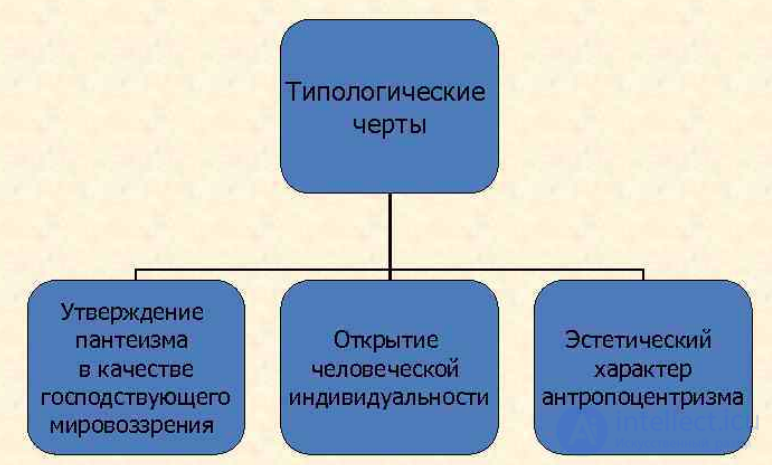
Humanism. Humanism in the broad sense of the word represents a mode of thought that proclaims the idea of the good of the human being as the main goal of social and cultural development and upholds the value of the human being as a person.
In the formation of Renaissance humanistic thought the ancient cultural heritage played an enormous role. A consequence of the increased interest in classical culture was the study of ancient texts and the use of pagan prototypes for the embodiment of Christian images, the collecting of cameos, sculptures and the search for antiquities, as well as the restoration of the Roman tradition of portrait busts. The revival of antiquity, in fact, gave the whole era its name (for Renaissance is indeed translated as rebirth).
The term «humanism» derives from the Latin «humanitas» (humaneness), already used in the 1st century BC by the famous Roman orator Cicero (106–43 BC). For him humanitas was the upbringing and education of a person, contributing to his elevation. In the perfection of a person's spiritual nature the main role was assigned to a complex of disciplines consisting of grammar, rhetoric, poetry, history and ethics. It was precisely these disciplines that became the theoretical basis of Renaissance culture and received the name «studia humanitatis» – the humanities.
The founder of humanism is unanimously considered to be the poet and philosopher Francesco Petrarch (1304–1374). In his work lie the beginnings of many of the paths along which the development of Renaissance culture in Italy proceeded. In the treatise «On His Own Ignorance and That of Many Others» he resolutely rejects the scholastic erudition characteristic of the Middle Ages, in relation to which he demonstratively proclaims his own supposed ignorance, for he considers such erudition completely useless for a person of his time.
In the aforementioned treatise a fundamentally new approach to the evaluation of the ancient heritage is manifested. In Petrarch's conviction, a new flourishing of literature, art and science will be achieved not by blind imitation of the thoughts of remarkable predecessors, but by a striving to rise to the heights of ancient culture and at the same time to rethink and in some respects surpass it. This line, laid out by Petrarch, became the leading one in the attitude of humanism toward the ancient heritage.
The first humanist believed that the content of true philosophy ought to become the sciences of the human being, and throughout his work there sounds a call to reorient philosophy toward this worthy object of knowledge.
Through his reasoning Petrarch laid the foundation for the formation of the personal self-awareness of the Renaissance era. In different eras a person becomes aware of himself differently. Medieval man was valued as a person the more his behavior corresponded to the norms accepted within a corporation. He affirmed himself through the most active possible inclusion in a social group, in a corporation, in a divinely established order – such was the social virtue required of the individual. The person of the Renaissance gradually abandons the universal medieval concepts, turning to the concrete individual.
Humanists work out a new approach to understanding the human being, in which the concept of activity plays an enormous role. The value of the human personality for them is determined not by origin or social affiliation, but by personal merit and the fruitfulness of one's activity.
A vivid embodiment of this approach may be found, for example, in the many-sided activity of the well-known humanist Leon Battista Alberti (1404–1472). In Alberti's opinion, a person is able to prevail over the vicissitudes of fate only through his own activity.
It would, however, be wrong to idealize humanism, failing to notice its individualistic tendencies. A true hymn to individualism may be found in the work of Lorenzo Valla (1407–1457). In his principal philosophical work «On Pleasure», Valla proclaims the striving for pleasure to be an inalienable property of the human being. The measure of morality for him is personal good. «I cannot sufficiently understand why someone wants to die for his fatherland. You die because you do not wish the fatherland to perish, as if it would not perish along with your own perishing». Such a worldview position looks asocial. The humanist thought of the second half of the 15th century was enriched with new ideas, the most important of which was the idea of the dignity of the person, pointing to the special properties of the human being in comparison with other creatures and his special position in the world. Giovanni Pico della Mirandola (1463–1494), in his celebrated «Oration on the Dignity of Man», places the human being at the center of the world. It is asserted that God (contrary to church dogma) did not create man in his own image and likeness, but granted him the possibility of creating himself. The culmination of humanistic anthropocentrism becomes Pico's thought that the dignity of the human being lies in his freedom: he can become whatever he wishes.
Glorifying the might of the human being and his greatness, marveling at his astonishing creations, the thinkers of the Renaissance inevitably arrived at a drawing together of the human being with God. «Man tames the winds and conquers the seas, and knows the reckoning of time. Moreover, with the help of a lamp he turns night into day. Finally, the divinity of man is revealed to us by magic. It works wonders with human hands – both those which nature can create, and those which only God can create.».
In similar reasoning by Giannozzo Manetti (1396–1472), Marsilio Ficino (1433–1499), Tommaso Campanella (1568–1639), Pico (1463–1494) and others, the most important characteristic of humanistic anthropocentrism manifested itself – a tendency toward the deification of the human being. However the humanists were neither heretics nor atheists. On the contrary, the overwhelming majority of them remained believers. But whereas the Christian worldview affirmed that God must stand in the first place, and the human being second, the humanists put the human being in the foreground, and spoke of God afterward. Thus Erasmus of Rotterdam (1469–1536), the pan-European leader of humanism from the 1510s right up to his death, author of the famous satirical anti-scholastic pamphlet «In Praise of Folly», most often called his teaching as a whole «the philosophy of Christ», but in practice equated the pagan culture of the ancient Greeks and Romans with Christian culture, and as a result Socrates, for example, was effectively equated by him with Christ. The essence of Erasmus's ethics is freedom and clarity of spirit, peacefulness, restraint, common sense, learning, simplicity. Opposed to Erasmus's principles are above all fanaticism, then ignorance, violence, hypocrisy, and deliberate intellectualism (hence Erasmus of Rotterdam's aversion to late scholasticism, above all to John Duns Scotus).
The presence of God in the philosophy of even the most radically minded thinkers of the Renaissance presupposed at the same time a critical attitude toward the church as a social institution. Humanistic worldview, therefore, includes anticlerical, anti-church views as well, that is, views directed against the claims of the church and the clergy to dominance in society.
In the writings of Lorenzo Valla, Leonardo Bruni (1374–1444), Poggio Bracciolini (1380–1459), Erasmus of Rotterdam and others, one finds statements against the secular power of the Roman popes, exposures of the vices of churchmen and the moral corruption of monasticism.
It must be said that until the middle of the 16th century, persecution of humanists by the Catholic church was an extremely rare phenomenon. The champions of the new secular culture did not fear the fires of the Inquisition and were reputed to be good Christians. It was only the Reformation that forced the church to go on the offensive.
Natural philosophy. The growth of interest in nature in the philosophy of the Renaissance found expression in a new flourishing of natural philosophy, that is, in the speculative study of nature on the basis of the principle of integrity, harmonizing the problems of the cosmos, nature, the human being, religion and society. A central place among the problems considered is given to the problem of the infinite. The transition from conceptions of a closed world to the conception of an infinite Universe meant a radical revision of the entire system of ontological views. This was the concern of N. Cusanus, B. Telesio and G. Bruno. The natural philosophy of this era developed on the basis of pantheism, a philosophical doctrine that identified God and the world.
The main features of natural philosophy:
Thus, the teaching of Nicholas of Cusa (1401–1464) on the boundlessness of the cosmos cast doubt on the theological-scholastic conceptions of the Universe and was a direct consequence of the resolution of the question of the relationship between God and the world.
God in the philosophy of Cusanus receives the designation of the absolute maximum, or the absolute, which is not something located outside the world, but abides in unity with it. The Good, encompassing all that exists, contains the world within itself. Such an interpretation of the relationship between God and the world characterizes the philosophical teaching of Cusanus as pantheism (from the Greek pan – all, theos – god), the most important feature of which is the impersonality of the single divine principle and its maximal closeness to nature.
According to the pantheistic teaching of Cusanus, the world, absorbed by God, cannot have an independent existence. A consequence of this dependence of the world on God is its boundlessness: the world has «its center everywhere and its circumference nowhere. For its circumference and center is God, who is everywhere and nowhere». The world is not infinite, otherwise it would be equal to God, but «neither can it be thought of as finite, since it has no limits within which it would be enclosed».
In the cosmology of Cusanus the doctrine of the Earth as the center of the Universe was rejected, and the absence of a fixed center led him to accept the motion of the Earth. In the treatise «On Learned Ignorance» he says directly that our Earth in reality moves, although we do not notice this.
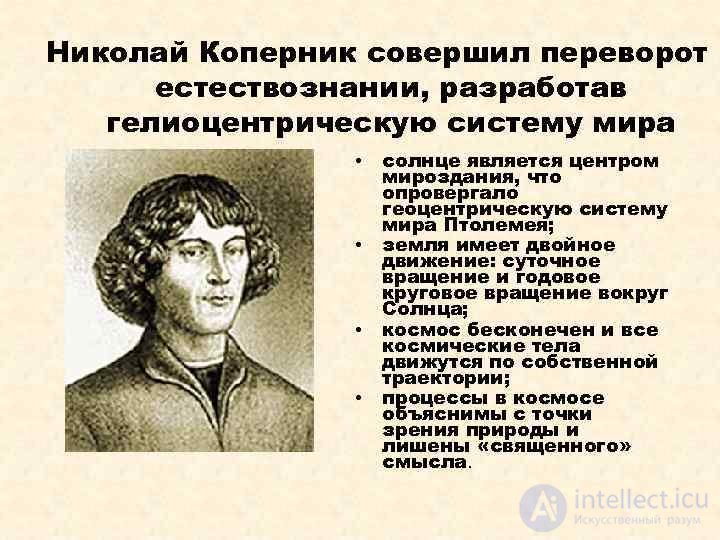
It would, however, be wrong to see in the cosmological constructions of Cusanus a direct anticipation of the heliocentrism of Copernicus. In rejecting the central proposition of the immobility of the Earth, he did not give preference to any particular definite scheme of the motion of the heavenly bodies. But by shaking traditional conceptions of the world, he opened the path to the desacralization of cosmology, that is, to its liberation from religious interpretation..
Leonardo da Vinci (1452–1519), a brilliant artist, a great scientist, a talented inventor (among his projects, the idea of the tank, the parachute, the sluice), asserted that all knowledge is generated by experience and finds its completion in experience. But only theory is able to lend true reliability to the results of experimentation. He considered mathematics to be the most reliable science, necessary above all for the comprehension and generalization of experience.
New views were developed in their writings by Paracelsus (1493–1541), Bernardino Telesio (1509–1588), Francesco Patrizi (1529–1597), and Tommaso Campanella. Thus Telesio founded an academy for the purpose of the experimental study of nature on the basis of its laws. The natural philosophy of Telesio drew on the traditions of ancient hylozoism. The opposing elements of heat and cold, according to Telesio, are the chief moving principles of everything, acting upon passive matter. Heat is the source of all organic life, as well as of the subtle-material vital «spirit» inherent in animals and human beings, who in addition possess an immortal soul instilled in them by God. Through his orientation toward experimental knowledge, Telesio exerted a great influence on Campanella, as well as on G. Bruno, R. Descartes and F. Bacon.
Natural philosophy achieved its most profound results in the work of Giordano Bruno (1548–1600), whose name is associated with a decisive turn in the establishment of a new cosmology.
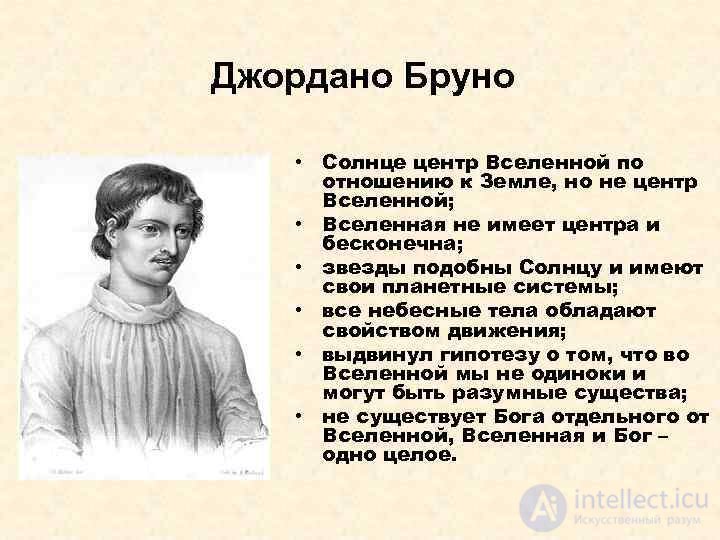
The central idea of Bruno's cosmological doctrine is the thesis of the infinity of the Universe. This Universe is not created; it exists eternally and cannot disappear. It is immovable, for it has nothing outside itself to which it could move, given that it is everything. Within the Universe itself, however, continuous change and motion take place.
Turning to a characterization of this motion, Bruno points to its natural character. He rejects the idea of an external prime mover, i.e. God, and relies on the principle of the self-motion of matter.
The proposition of the infinity of the Universe allowed G. Bruno to pose the question of the center of the world in a new way, rejecting in doing so not only the geocentric but also the heliocentric systems. Neither the Earth nor the Sun can be the center of the Universe, because there exists a countless multitude of worlds. And each world-system has its own center – its own star.
Having torn down the boundaries of the world and affirmed the infinity of the universe, Bruno finds himself faced with the necessity of working out a new conception of God and of his relation to the world. The resolution of this problem attests to the pantheistic position of the thinker. Bruno maintains that nature is God in things: God does not stand opposed to the world as its creator, but is present within nature itself as an inner active principle.
If, in Nicholas of Cusa's reasoning, nature is, as it were, submerged in God, who preserves his separateness from the world, then for Bruno God is identified with nature, and is unthinkable apart from the material world. Herein lies the cardinal difference between Bruno's naturalistic pantheism and Cusa's mystical pantheism.
Seeing in nature not only a perfect divine creation but, above all, a totality of laws proper to it, free from direct intervention, the natural philosophy of the Renaissance opened the way to the further development of experimental natural science, to the rise of Newton's classical mechanics, and to the creation of the philosophical conceptions of the seventeenth and eighteenth centuries.
Experimental-Mathematical Natural Science. The first serious incursion of science into speculative natural philosophy, which had given rise to a fascination with magic and the mysticism of numbers, was the publication of Copernicus's theory in 1513; however, this theory acquired real influence only from the time it was taken up and developed further by Kepler and Galileo in the seventeenth century. The fact is that, in temper, Copernicus's work is not modern, and it may be characterized as Pythagorean. He takes it as axiomatic that all heavenly motions must be circular and uniform. What was important in his work was the refutation of the notion of the Earth as a special geometric center.
The achievement of J. Kepler (1571 – 1630) was the discovery of the three laws of planetary motion. His first law states that the planets move in ellipses, with the Sun at one of the foci. According to the second law, the line joining a planet to the Sun sweeps out equal areas in equal times. The third states that the squares of the periods of revolution of the planets are proportional to the cubes of their mean distances from the Sun.
Galileo Galilei (1564 – 1642) is, with the exception of Newton, the greatest of the founders of modern science. Galileo left a detailed exposition of scientific method and formulated the most important principles of the mechanistic interpretation of the world.
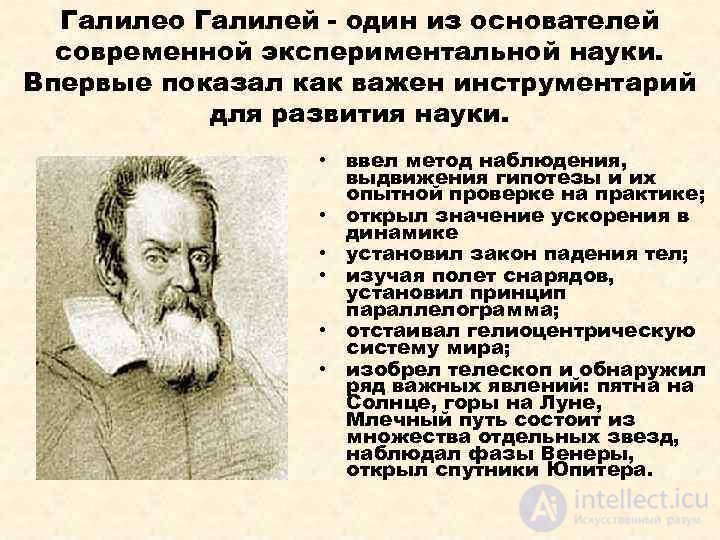
For the confirmation and empirical grounding of Copernicus's theory and of the ideas expressed by Giordano Bruno, the astronomical discoveries made by Galileo with the telescope he constructed were of enormous significance. He discovered craters and ridges on the Moon (in his view, «mountains» and «seas»), made out countless clusters of stars forming the Milky Way, saw the moons of Jupiter, made out spots on the Sun, and so on. Galileo's astronomical discoveries, above all the moons of Jupiter, became visible proof of the truth of Copernicus's heliocentric theory, while the phenomena observed on the Moon, which appeared to be a planet quite analogous to the Earth, and the spots on the Sun, confirmed Bruno's idea of the physical homogeneity of Earth and heaven. The discovery of the stellar composition of the Milky Way was, in turn, indirect proof of the countlessness of worlds in the universe.
Furthermore, in perfecting the proofs of the truth of Copernicus's theory, Galileo's work in the field of mechanics played an enormous role. Galileo was the first to discover the significance of acceleration in dynamics. «Acceleration» means a change of speed either in magnitude or in direction. Thus a body moving uniformly in a circle has, at every moment, an acceleration directed toward the center of the circle. He held that any body, if left to itself, will continue to move in a straight line at constant speed, and that any change either in speed or in direction of motion is explained by the action of some «force». This principle was proclaimed by Newton as the «first law of motion».
Galileo was the first to establish the law of falling bodies: when a body falls freely, its acceleration is constant, disregarding the resistance that the air may offer. Furthermore, the acceleration is the same for all bodies, heavy or light, large or small.
The starting point of knowledge, according to Galileo, is sensory experience, which, however, does not in itself yield reliable knowledge. This is achieved through systematic real or mental experimentation, relying on a strictly quantitative-mathematical description. Galileo distinguished two basic methods of experimental investigation of nature. By the analytical method of «resolution», using the resources of mathematics, abstraction, idealization, and passage to the limit, the elements of reality are singled out – that is, phenomena that are «difficult to imagine», not accessible to direct perception (for example, instantaneous speed, motion by inertia). Then, on the basis of the synthetic-deductive method of «composition», a theoretical scheme is constructed that explains the phenomena and confirms the assumptions previously advanced. Reliable knowledge is ultimately realized in an explanatory theoretical scheme as a unity of the synthetic and the analytical, the sensible and the abstract.
Thus, Galileo's activity confirms that the thinkers of the Renaissance strove to explain the existence of a single infinite material world from itself, independently of an external, otherworldly force – a deity – understanding it as a world subject to the single law of cause and effect.
Social Philosophy A special place in the philosophy of the Renaissance is occupied by conceptions addressed to the problems of the state: the political theories of Niccolò Machiavelli (1469 – 1527) and Francesco Guicciardini (1482 – 1540), founded on realistic principles, and the social utopias of Thomas More (1479 – 1555) and Tommaso Campanella (1568 – 1639).
The largest and most original of them was the Italian thinker, historian, and statesman Niccolò Machiavelli, author of the well-known treatises The Prince and Discourses on the First Ten Books of Titus Livius.
Machiavelli replaces the medieval conception of divine predestination with the idea of fortune, recognizing the force of circumstances that compel a person to reckon with necessity. But fate governs man only by half; he can and must struggle with circumstances. Therefore, alongside fortune, Machiavelli considers virtù – the embodiment of human energy, skill, and talent – to be a moving force of history. Fortune «shows its power where valor has not been marshaled to resist it, and directs its onslaught where it knows that no dikes or embankments have been raised to contain it».
For Machiavelli, the true embodiment of the freedom of the human will is politics, in which there exist «natural causes» and «useful rules» that allow one to reckon with one's own capabilities, foresee the course of events, and take the necessary measures. Machiavelli sees the task of political science as investigating the real qualities of human nature and the balance of forces, interests, and passions struggling within society, in order to explain the actual state of affairs, rather than indulging in utopian dreams, illusions, and dogmas. It was Machiavelli who resolutely broke the bonds that for centuries had linked questions of politics with morality: the theoretical consideration of politics was freed from abstract moralizing.
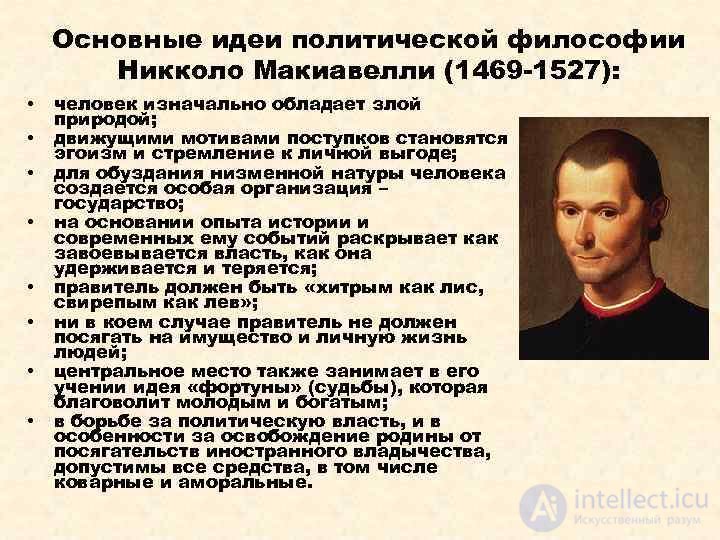
Machiavelli's political realism also shows itself in his analysis of forms of government. Though a supporter of the republic, he nevertheless considered the unification of Italy on republican principles impossible. Studying the actions of the Medici, Sforza, and Cesare Borgia, Machiavelli arrives at the idea of the «new prince» – an absolute ruler. Such a ruler must combine the traits of the lion and the fox: the fox – to avoid the snares set for him, the lion – to crush his adversary in open battle. He must adhere to the principle of firm power, displaying cruelty when necessary: «a prince, if he wishes to maintain power, must learn how to depart from goodness and to make use of this ability as necessity requires».
Such reasoning earned Machiavelli the unhappy reputation of a teacher of tyrants and the author of the thesis «the end justifies the means», and his name became a synonym for the preaching of political treachery and violence – «Machiavellianism».
Having simplistically interpreted the thinker's position as a demand for unlimited license for the ruler, his opponents failed to take into account an important circumstance: Machiavelli was not a propagandist of cruelty and hypocrisy, but a ruthless investigator of the real political practice of his age.
The persistent myth of Machiavelli as the author of the thesis «the end justifies the means» was, in fact, created through the efforts of the Jesuits. By freeing politics from moralizing, Machiavelli struck a blow against religion and the church, which provoked a negative reaction from the black guard of the Roman popes. In reality this saying belongs to the Jesuit Escobar and is the motto of his order.
If Machiavelli does free the political actor from strict adherence to the moral law, this occurs out of necessity and is explained by the contradictions of social reality.
«It should be understood», writes Machiavelli, «that when the salvation of one's country is at stake, no consideration of justice or injustice, mercy or cruelty, praiseworthiness or shame, should be allowed to outweigh it; rather, setting aside every scruple, that course of action should be followed which will save the life of the state and preserve its freedom».
Machiavelli's creative legacy is not free from contradictions, but the thinker's undeniable merit consists in the fact that he brought politics down from the heights of lofty hypocrisy to solid ground, turning it into an object of impartial analysis, thereby elevating it, on the one hand, to the level of a science, and, on the other, to the level of an art.
On the whole, two directions can be distinguished in the political philosophy and political theory of the Renaissance: the first – monarchomach (tyrannicidal, republican), combining the traditions of upholding urban liberties with the ideas of popular sovereignty (La Boétie, Althusius). The second direction justified the necessity of strong monarchical power, of absolutism, as, for example, was characteristic of Machiavelli, who, although he considered the republic to be the ideal order as an expression of popular sovereignty, understood that, under the conditions of his time, only a strong power, unconstrained by any moral traditions or ecclesiastical teachings, exercised by a secular ruler, could bring about national unification and the creation of a new state.
In the Renaissance era, social utopias appeared, reflecting the protest of the popular masses, which at times grew into peasant wars, as happened in Germany. Thomas Müntzer was the most vivid spokesman of these utopian demands for the «kingdom of God on earth», by which was meant a social order without private property, without the power of emperor, pope, kings, or princes. Müntzer regarded an armed uprising of the people as the means of achieving such an order.
The English humanist, statesman, and writer Thomas More (1478 – 1535) achieved worldwide fame for his treatise Utopia, which contains a description of the ideal order of the fantastical island of Utopia (Greek, literally «No-place», a place that does not exist; this word, coined by More, later became a common noun). Here More was the first to depict a society in which private (and even personal) property has been abolished and not only equality of consumption (as in the early Christian communities) but also collectivized production and daily life have been introduced. Labor in Utopia is the obligation of all citizens, distribution proceeds according to need, the working day is reduced to six hours, and the most arduous work is performed by criminals. The political order of Utopia is based on the principles of election and seniority. The family is represented as a cell of communal life, organized not so much on kinship as on productive grounds. More did not conceive of a revolutionary path to the realization of this ideal – he was an opponent of popular movements, seeing in them only a destructive principle and anarchy.
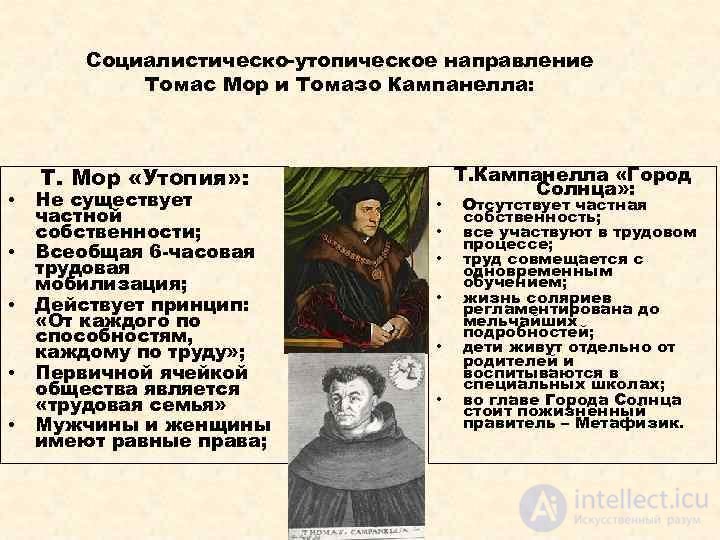
The Italian philosopher, poet, and political figure Tommaso Campanella (1568 – 1639) defended, in his philosophy, the necessity of empirical knowledge and developed a doctrine of a «twofold» revelation (of nature and of Holy Scripture). Coming out in defense of Galileo, Campanella did not accept the doctrine of the infinity of the universe, while nevertheless allowing for the existence of a multitude of worlds. Campanella's social utopia represents a program of universal social transformation on the basis of communal property (he is the author of the book The City of the Sun, a work constructed in the form of a sailor's tale, supplemented by the utopia of a universal theocratic monarchy, «The Monarchy of the Messiah»). In Campanella's ideal community, property and the family are abolished, children are raised by the state, labor is obligatory for all, the working day is reduced to four hours, and enormous attention is devoted to the development of science («magical knowledge»). The leadership of the community is in the hands of a learned-priestly caste. Campanella placed the realization of his program in the hands of European sovereigns (the Spanish, and later the French, king) and the Roman pope, striving to achieve the spiritual unity of humanity within a Catholicism reformed in accordance with his ideals.
The Reformation. In the sixteenth and seventeenth centuries most of the countries of Western and Central Europe were swept by a heterogeneous sociopolitical and ideological movement directed against the medieval Catholic church as the most general synthesis and the most general sanction of feudal society.
The necessity of a broad church reform had been discussed long before the Reformation. The deification of the pope, indulgences, abuses of the clergy, and the excessive development of ritual at the expense of inner content revealed, in the eyes of contemporaries, the spiritual bankruptcy of the Roman Catholic church. The ecumenical councils of the fourteenth and fifteenth centuries (especially those of Constance and Basel) sought to reform the church «in head and members», but attempts at its internal reform failed. The Protestant Reformation, which began in the sixteenth century, came forward not under the banner of correcting Catholicism, but of fighting against it.
It received its ideological formulation in the teachings of M. Luther and his followers – the Swiss priest Ulrich Zwingli (1484 – 1531) and the French theologian Jean Calvin (1509 – 1564).
The relations between the Reformation and the Renaissance are contradictory. On the one hand, the humanists of the Renaissance and the representatives of the Reformation were united by a deep aversion to scholasticism, a thirst for religious renewal, an idea of return to the sources (in one case, to antiquity, in the other, to the Gospels). On the other hand, the Reformation is a protest against the Renaissance's exaltation of the human being.
This contradictoriness fully manifests itself in a comparison of the views of the founder of the Reformation, Martin Luther, and the Dutch humanist Erasmus of Rotterdam. Erasmus's thoughts often echo Luther's reasoning: this includes the sarcastic view of the privileges of Catholic hierarchs and the biting remarks about the mode of thought of Roman theologians. But they diverged in their attitude toward free will. Luther maintained the view that before God man has neither will nor dignity. Only if a person realizes that he cannot be the creator of his own fate can he be saved. And the sole and sufficient condition of salvation is faith.
For Erasmus, by contrast, human freedom meant no less than God. Holy Scripture, for him, is a call addressed by God to man, and the latter is free to respond to it or not.
The cultural and sociohistorical results of the process of reformation are not exhausted by the birth of Protestantism and the modernization of the Catholic church. They are more considerable than that. Traditional doctrine relied on the practice of atoning for sins by performing «holy works» prescribed by the church (strict fasting, the acquisition of indulgences, donations to the church). The main idea of Luther's theses, however, was that the whole life of the believer must be repentance, and that there is no need for special acts, isolated from ordinary life and specifically pursuing the goals of salvation. A person should not flee the world as monks do; on the contrary, he should conscientiously fulfill his earthly calling. Any occupation, if its usefulness is beyond doubt, may be regarded as a holy work.
The Reformation led to religious wars for freedom of conscience, as a result of which religious and political freedoms were established in a number of European states. But the age of the Reformation understood freedom of conscience first of all as freedom from the authority of the church, and its immediate result was the replacement of the authority of the church by the authority of the state. The Reformation rejected the principles of Catholic theocratism and centralism; states were freed from ecclesiastical tutelage, and religion itself became an instrument of state power.
The German Reformation found its continuation in the Dutch (16th century) and English (17th century) revolutions, in the course of which the ideas of toleration, the separation of church and state, and the secular calling of the Christian were developed. The Reformation had a serious influence on the development of socially critical thought, philosophical theories of self-consciousness, the ideal of the "rule-of-law state," and new entrepreneurial orientations in economic practice, contributing to the formation of a new entrepreneurial ethic (the making of profit is recognized as pleasing to God if it is done without usurious tricks, on condition of consumer restraint, honesty in business dealings, and the obligatory investment of the wealth acquired).
But the thought of the Reformation was not the sole outcome of the Renaissance. Natural philosophy develops in the works of Bruno, who turned it into a radical pantheism, and Telesio, who brought it considerably closer to the future new natural science by introducing into the customary pantheistic hylozoism a new method of studying nature "from its own principles." The thought of the Counter-Reformation develops as well, within which the social, psychological, and pedagogical innovations of Loyola take place, who proposed his own, anti-Lutheran conception of personality. "The second scholasticism" experiences an unexpected flourishing, revealing new resources within Thomism. The results achieved in ontology by F. Cajetan and F. Suárez were properly appreciated only in the 20th century. More and Campanella create vivid utopian myths of the perfect society. At the same time Machiavelli formulates his harsh recommendations for governing real society, laying the foundations of modern sociology, while Jean Bodin creates a theory of the rule-of-law state, religious tolerance, and sovereignty, beginning the era of modern legal thought. All this points to a hidden search for a philosophical methodology, which the next generation of thinkers would find. The historical drama of this century, and its disillusionment with the humanist program, to a certain extent stimulated a return to properly philosophical concerns. Thus the 16th century may paradoxically be called a period of the fruitful dissolution of Renaissance philosophy and the release from it of modes of thought that were viable and adequate to the times.
On the whole, the Renaissance was not especially favorable to philosophy and did not produce great results, with the exception of the doctrine of Nicholas of Cusa. Renaissance philosophy developed in indirect forms of aesthetic, ethical, political, and natural-philosophical thought. But for the cultural turn of Europe toward the modern age, the intuitions and patterns of thought tested in the course of the Renaissance were of colossal importance.
The central place that logic and the philosophy of Aristotle had occupied in the system of medieval scholastic education now began to be occupied by rhetoric and Cicero. The study of rhetoric was meant, in the humanists' view, to provide the key to the spiritual treasury of antiquity; mastery of the language and style of the ancients was regarded as mastery of their thought and worldview, and as an essential stage in the liberation of the individual.
Latin, which had earlier been the language of science and literature, was purified in the Renaissance of medieval corruption and restored to its classical purity; Greek, knowledge of which had been lost in medieval Europe, became the subject of zealous study. The writings of the ancients were sought out, copied, and published. By the 15th century, almost the entire surviving corpus of monuments of ancient literature had been assembled. A new view of man and his needs, together with new demands of society, created a new pedagogy as well (Leonardo Bruni, Barbaro, and others). Humanism penetrated the universities, displaced scholasticism from them, and instilled a classical education. With the study of the ancient historians, treatments of native history appeared (Bruni, Poggio, Aeneas Silvius Piccolomini), and new methods of source criticism began to be applied (Lorenzo Valla). Acquaintance with the political doctrines of the ancient thinkers, against the background of the complex political life of Italy, gave a strong impetus to political thought (Coluccio Salutati). Renaissance philosophy is characterized by attempts to reconcile Christianity with Platonic philosophy, which became highly authoritative (Pico della Mirandola, Marsilio Ficino, the Platonic Academy in Florence of Cosimo and Lorenzo de' Medici). Among the numerous centers of humanist culture in Italy, an important role was played by Naples, Pavia, Venice, and above all Rome under Popes Nicholas V and Pius II, and Florence in the time of the Medici. At the end of the 15th century, circles of humanists arose in Northern Europe — in the Netherlands and Germany (Erasmus of Rotterdam, Reuchlin, Ulrich von Hutten).
Since literal restorations are impossible in history, the figures of the Renaissance, looking back at the brilliant achievements of antiquity, in fact created a new culture. The "myth of the Renaissance" is the belief in the boundless possibilities of man, who challenges fate, overcomes his customary timidity before divine authority, and enters into open creative competition with God himself. If ancient philosophy explored the problem of the cosmos, and medieval philosophy was entirely devoted to the problem of God, then Renaissance philosophy was entirely focused on the problem of man. The Renaissance, for the first time in history, discovers the unique individuality of the free human being. The cosmologism of ancient culture and the theologism of medieval culture give way to the anthropocentrism of the Renaissance era.
Thus, at the foundation of Renaissance culture lies individualism, which discovers the intrinsically valuable, free, and unique creative personality; subjectivism — which sets itself the task of revealing the world not in its objective givenness, but through the prism of man's inner world; and finally anthropocentrism, which posits man as the center and meaning of the universe.
In concluding this examination of the philosophical searchings of the Renaissance era, it is necessary to note the ambiguity of assessments of its legacy. Despite the general recognition of the uniqueness of Renaissance culture as a whole, this period was long not considered original in the development of philosophy and, consequently, worthy of being singled out as an independent stage of philosophical thought. However, the ambivalence and contradictoriness of the philosophical thinking of this time should not diminish its significance for the subsequent development of philosophy, nor cast doubt on the merits of Renaissance thinkers in overcoming medieval scholasticism and creating the foundations of the philosophy of the modern age.
The cultural ideal of the Renaissance lies in the highest synthesis of spirit and matter, in the infinite creative power of the spiritual human being, who follows the law of natural harmony and measure.
1. The principle of Renaissance philosophy according to which God is dissolved in nature is called:
2. The foremost representative of Italian humanism is:
3. Name one of the key values of humanism in Renaissance philosophy:
4. After which ancient thinker is the period of Renaissance philosophy named?
5. One of the most important utopias of the Renaissance era bore this poetic title:

Comments