
Lecture
Philosophy of mind — a philosophical discipline whose subject of study is the nature of consciousness, as well as the relation between consciousness and physical reality (the body).
In the 19th century, Arthur Schopenhauer called consciousness the «world knot» , hinting that the mystery of consciousness remains the darkest spot in the entire body (collection) of human knowledge. In the 20th century, the philosophy of mind became one of the most popular areas of research, and every year an enormous amount of literature is published on this topic. The contemporary American philosopher Richard Rorty even declared that, in his opinion, the philosophy of mind is today the only truly useful philosophical discipline.
The problems of the philosophy of mind go back to antiquity. Plato and Aristotle are forerunners of contemporary dualists, since they held that mind exists as an ontological reality separate from matter. At the origins of the tradition of monism stands another Greek philosopher, Parmenides, who asserted that being and thought are one. Consciousness becomes the most important object of study for philosophers in the modern era, in the conceptions of Descartes, Spinoza, Locke, and Hume. Today the philosophy of mind develops mainly within analytic philosophy.
The philosophy of mind has more than merely theoretical significance.
The question of the relation between consciousness and the body, also known as the mind-body problem, is often considered the central theoretical problem of the philosophy of mind.
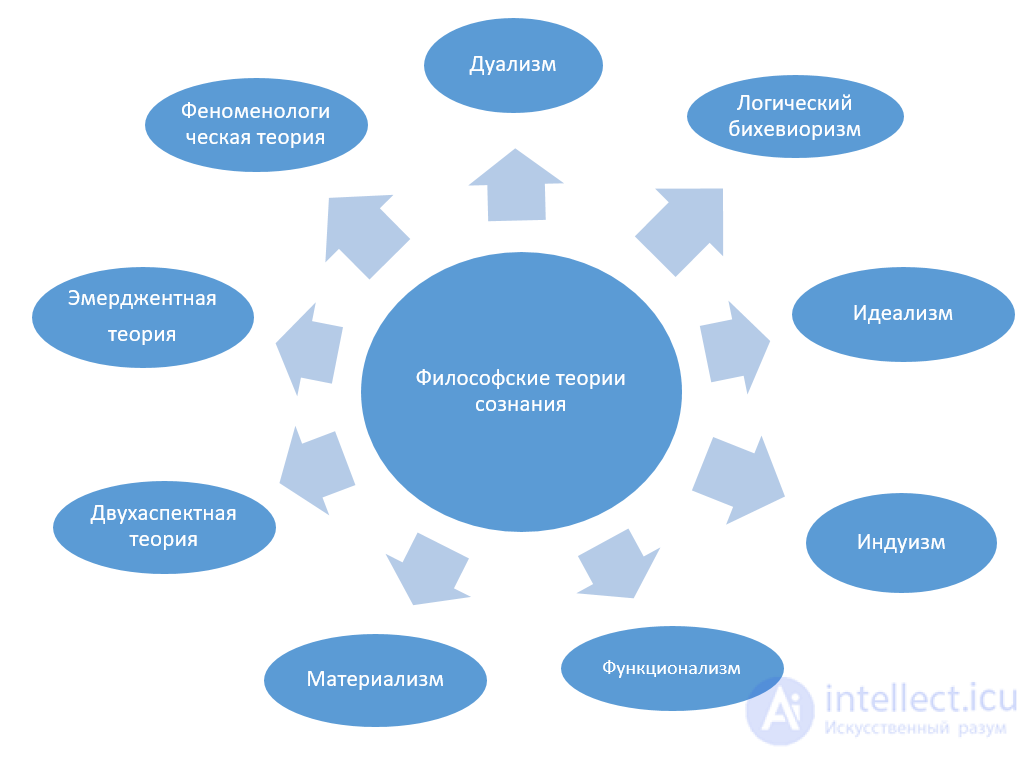
fig. Philosophical theories of consciousness


In its classical form, the mind-body problem was formulated by the 17th-century French thinker René Descartes. Descartes held that the world consists of two kinds of substances: material and spiritual. Here the fundamental attribute of matter is extension, while the fundamental attribute of spirit is thought. From this point of view, a human being represents a combination of an extended body and a thinking spirit. This position became known as psychophysical dualism. The mind-body problem, as Descartes formulated it, is stated as follows:
How are a person's body and spirit related, in what way do they correlate with one another?
In contemporary philosophy, the mind-body problem is defined as the question of the relation between mental states (our thoughts, desires, feelings, etc.) and the physical states of the brain.
There are two main approaches to solving the mind-body problem — dualism and monism. The first proceeds from the assumption that consciousness has a special nature, one that is in principle irreducible to physical material reality. There are several variants of dualism.
Monism historically has three varieties:
In contemporary philosophy, the idealist variety of monism, which asserts that material reality is generated by the activity of certain ideal forms (human consciousness or God), is weakly represented. It is mainly held by some representatives of religious philosophy.
Neutral monism is also not widely held; its proponents believe that some third, neutral reality underlies both matter and consciousness.
The materialist version of monism, in turn, asserts that consciousness is an element of material reality. In other words, only the brain exists, and consciousness is its product. In contemporary philosophy there are several variants of materialist monism.
The main argument in favor of dualism simply appeals to the common sense of most people. If asked what consciousness is, many would say that it is something identical to their «self», or their soul, or some similar entity, but at the same time would certainly reject the idea that consciousness is simply the brain or a part of it. Some contemporary philosophers compare such common-sense intuitions to the belief that the Earth is flat. Intuitively this seems obvious, but science has long proven such a view to be mistaken.
A more contemporary argument in support of dualism is that the mental and the physical have very different, and possibly incompatible, properties. Mental events have a certain subjective quality (see qualia), whereas physical events have no such quality. We can feel a certain pain, see a certain familiar shade of blue, and so on. The dualist thesis is that such things cannot be reduced to anything physical.
In contemporary analytic philosophy two main kinds of dualism are distinguished. Classical substance dualism, following Descartes, asserts that consciousness and matter exist completely independently of one another. A more recent theory, property dualism, holds that although there exists only one substance or one reality (the material one), consciousness is nevertheless associated with a set of properties irreducible to material reality, which are emergently generated on the basis of material systems (the brain).
Interactionist dualism, or simply interactionism, — is a variety of dualism that goes back to Descartes' conception. In the 20th century this theory was defended by Karl Popper and John Eccles. Interactionism holds that mental states, such as thoughts and desires, causally interact with physical states.
Descartes' classical argument in support of interactionism can be formulated as follows: we have a clear and distinct idea of consciousness as a thinking thing that is not extended in space, and we also have a clear and distinct idea of an extended body. Therefore consciousness and body cannot be identical, since they have radically different properties. At the same time, it is obvious that our mental states (thoughts, desires, etc.) causally influence our bodies and vice versa. When a child touches a hot kettle (a physical event), which causes him pain (a mental event), he learns to be careful with such things (yet another mental event), and so on.
The main premise of Descartes' arguments is that «clear and distinct ideas» in our consciousness are necessarily true. Moreover, our mind is fully accessible to us (we have what is called privileged access to our own consciousness). However, most contemporary philosophers do not consider such views self-evident, especially after the works of Freud (who showed that an external observer-psychologist can understand a person's unconscious motivation better than the person himself), P. Duhem (a philosopher of science can understand the methods of scientific discovery better than the scientist himself), Malinowski (an anthropologist can know a person's habits and skills better than the person himself), and also specialists in the theory of perception. All of them showed that the idea of privileged and ideal access to our own consciousness is fairly questionable.
There are several other forms of dualism that arose as a further development of Descartes' ideas.
Property dualism holds that when matter is organized in a certain way (that is, in the way the human body is organized), mental properties arise in it. Property dualism is thus a branch of emergent materialism. Emergent properties have an independent ontological status and cannot be reduced to or explained in terms of the physical basis from which they arise. In contemporary philosophy such a theory is developed by David Chalmers.
Unlike dualism, monism asserts that there exists only one fundamental substance. Most contemporary monistic theories are materialist, or naturalistic. Naturalistic monism (or simply scientific naturalism) holds that the only existing reality is the one described by contemporary natural science. In other words, contemporary science describes the world in a full and exhaustive manner. There are several different approaches to solving the problem of consciousness within this general framework.
Idealist monism (idealism), which holds consciousness or spirit to be primary in relation to matter, is not very popular among contemporary philosophers. However, at the beginning of the 20th century it was, for a short time, widespread among positivists in the form of phenomenalism. The latter is a theory according to which there exist only representations (or sense data) of external objects in our minds, but not the objects themselves. Such a view was characteristic, in particular, of the early philosophy of Bertrand Russell.
Another possible position amounts to the claim that there exists some primary substance that is neither physical nor mental. From this point of view, both the mental and the physical are properties of such a neutral substance. This point of view was first formulated in the history of philosophy by Benedict Spinoza, and in the 20th century it was also developed by Bertrand Russell, thanks to whom it became known as neutral monism.
Below only the main varieties of naturalistic monism will be discussed.
Epiphenomenalism asserts that mental phenomena cannot be a source of causal influence. Physical events can influence other physical events, as well as mental events, but mental events cannot causally influence anything, since they are merely inert byproducts (epiphenomena) of physical reality.
Psychological behaviorism was the dominant direction in analytic philosophy of mind for most of the 20th century. In psychology, behaviorism arose as a reaction to the inadequacy of introspectionism. Introspective reports about someone's mental life cannot be the subject of experimental study, and correct generalizations cannot be made on their basis. Therefore introspection is incompatible with the standard scientific method. The way out for psychology, as it appeared to the behaviorists, was to abandon the idea of an inner mental life (and, consequently, of an ontologically independent consciousness), focusing instead on the description of observable behavior.
In parallel with this development in psychology, the ideas of philosophical or logical behaviorism developed. Its ideas were characterized by consistent verificationism and treated unverifiable statements about inner mental life as meaningless. From the point of view of behaviorist philosophers, mental statements are in fact one way of describing behavior, as well as dispositions to behavior. They are formulated by external observers in order to explain and predict the behavior of other agents.
Psychological behaviorism, whose chief representative was B.F. Skinner, began to go out of fashion in the 1950s—1960s with the emergence of cognitivism.
The physicalism of identity theory, first postulated by John Smart and Ullin Place, became a direct reaction to the failure of behaviorism. This theory held that a given mental state is literally identical to a specific state of the brain.
Identity theory encountered several critical arguments, one of the most famous of which is Hilary Putnam's argument from multiple realizability. It is obvious that, for example, not only humans but also amphibians can feel pain. On the other hand, it is highly unlikely that all the various organisms that feel pain are capable of being in an identical physical state of the brain. Therefore pain cannot be identical to some particular state of the brain, and identity theory finds no empirical confirmation.
Eliminative materialism is the most radical form of physicalism. Proponents of this theory hold that all mental states are objects postulated by a false empirical theory, so-called folk psychology. And just as contemporary science has abandoned other false theories, such as, for example, the concept of phlogiston, it must also abandon folk psychology. Abandoning the latter will also mean abandoning all mental entities. The question of the relation between consciousness and the body will thus turn out to be a pseudo-problem: only those objects recognized by working scientific theories exist.
Early ideas of eliminativism were expressed by Richard Rorty, Wilfrid Sellars, Willard Quine, and Paul Feyerabend . The contemporary proponents of eliminativism are Paul and Patricia Churchland.
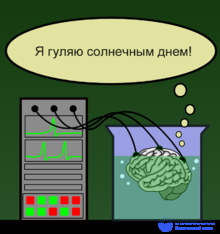
Functionalism — is a theory according to which to have a mental state is to be in a certain functional state. A functional state is fixed by a set of causal relations, so that if a system is in a certain functional state, this means that it is defined by a set of causes «on the input» and effects «on the output». Accordingly, if we are speaking of consciousness, then its functional state is determined by sensory data and the resulting behavior.
The main thesis of functionalism is that the same functional states can be realized by fundamentally different physical systems. Just as, for example, a clock can be analog or digital while performing the same function, so the function of consciousness can be performed not only by organic systems (the brain) but also, for example, by computers.
Functionalists include David Lewis, Hilary Putnam, Daniel Dennett, and D.I. Dubrovsky.
Anomalous monism was developed by the American philosopher Donald Davidson in the 1970s. This theory holds that although there exists only one kind of reality — material — and, accordingly, only one kind of events — physical (including events in the brain) — there are many ways of describing and interpreting these facts. One of these interpretations is the mentalistic vocabulary that describes human behavior in psychological terms.
To date, there is no generally accepted solution to the psychophysical problem. Some philosophers believe that this is not accidental, since the very question of the relation between mind and body contains an error. Such philosophers say that the psychophysical problem is a pseudo-problem. Within analytic philosophy, this position is held mainly by the followers of Ludwig Wittgenstein, who believed that all philosophical problems are in fact merely linguistic puzzles.
Critics of the psychophysical problem point out that it is wrong to ask how mental and biological states relate to one another. One must simply recognize that people can be described in different ways — for example, within the mental (psychological) or the biological vocabulary. Pseudo-problems arise when we try to describe one vocabulary in terms of another, or when the mental vocabulary is used in the wrong context. Something similar happens, for example, when someone tries to look for mental states in the brain. The brain is simply the wrong context for using mentalistic vocabulary, so looking for mental states in the brain is a category mistake.
A similar view of the psychophysical problem is held by many representatives of logical behaviorism (for example, Gilbert Ryle), as well as of functionalism (Hilary Putnam).
Other thinkers believe that although the problem of the relation between body and mind is correctly formulated, we are fundamentally incapable of giving a satisfactory answer to it. For example, Colin McGinn believes that the question of the nature of consciousness lies altogether beyond our cognitive capacities. Every biological species has certain limitations. For example, dogs are not capable of proving the Pythagorean theorem. In the same way, humans are not capable of constructing a satisfactory theory of consciousness.
Another philosopher, Thomas Nagel, believes that McGinn's skepticism of this kind is too radical. The issue is not the limitations of our biological nature, but the fact that consciousness cannot be investigated by standard scientific methods. Science attempts to construct a fully objective picture of reality by eliminating all particular subjective «points of view» on the world. Consciousness therefore fundamentally escapes the field of vision of scientists. Moreover, when we study consciousness, the researcher is himself part of the subject of his own study. Consciousness, thus, is a condition of the possibility of science and cannot be its object. In support of this view, Nagel proposed asking what it is like to be a bat: what is the subjective experience like of a creature that orients itself in space by means of radar? Science cannot answer this question, and it is likewise unable to understand the nature of «ordinary» human consciousness. Nagel's article «What Is It Like to Be a Bat?» became the subject of extensive debate in contemporary philosophy.
Idealism — is a theory according to which only minds exist. Idealists maintain that objects of the physical world do not exist apart from their perception. This thesis was developed most consistently by George Berkeley, who argued that «to be is to be perceived».
In Hinduism, consciousness is correlated with Purusha (the «silent supreme witness»), who observes the actions of Prakriti («material nature»). The consciousness of the soul tends to mistakenly identify itself with the material body, being drawn in and bound by the gunas («qualities of nature»).
Materialism is the theory that if something exists, it has a physical character. Consciousness is therefore described by materialists as a property of the brain. Materialists criticize dualists and idealists as well as behaviorists, arguing that behavior is not consciousness but rather an internal physical cause of consciousness. Among materialists one can mention Friedrich Engels, David Armstrong, Donald Davidson and others.
Functionalism — is a theory according to which to be in a mental state is to be in a functional state, that is, to perform some particular function. From the functionalist point of view, consciousness relates to the brain in the same way that, for example, the function of telling time relates to a particular physical timepiece. Functionalism takes a critical stance toward materialism, since it denies any necessary connection between consciousness and the brain: consciousness could potentially be a function of a great variety of physical objects, for example a computer. Functionalism is the methodological basis of the theory of artificial intelligence. Among functionalists one can include David Lewis, Hilary Putnam and Daniel Dennett.
The dual-aspect theory is the theory that the mental and the physical are two properties of some underlying reality that is in itself neither mental nor physical. The dual-aspect theory therefore rejects dualism, idealism, and materialism alike as views holding that a mental or physical substance exists. Such views are characteristic, for example, of Benedict Spinoza, Bertrand Russell and Peter Strawson.
Phenomenology represents an attempt at a presuppositionless description of the content of experience without any claims regarding the reality of that content. Phenomenology attempts to uncover the ideal features of human thought and perception, free of any empirical and individual admixtures, and thereby to ground all other sciences as founded on thought. The basic property of human consciousness according to phenomenology is intentionality (being directed toward some object). Among the proponents of this theory we may name Edmund Husserl and Maurice Merleau-Ponty.
Emergentism — is the theory that although consciousness is a property of some physical object (usually the brain), it is nevertheless irreducible to the physical states of that object. Consciousness, however, is an ordinary real object, which must be studied by science on a par with all others. Among the proponents of this conception — John Searle.
Physicalism — an extremely materialist approach to the problem of consciousness, according to which consciousness does not exist as an independent substance; it is a product of matter and is explicable in terms of physics and the other natural sciences. The human brain is the most complex "mechanism" of nature, the highest level of organization of matter; the consciousness of a particular person cannot exist without the brain, and the brain is a biological organ; humanity has created artificial intelligence, the bearer of which is a material object – the computer; medications can affect the human psyche and consciousness and against which their logical arguments are undermined – the IDEALITY of consciousness: images in consciousness have no material characteristics (mass, smell, definite dimensions). Consciousness «dominates» over images (enlarges, diminishes, erases them). Consciousness cannot be «seen» (a neurosurgeon operating on the brain does not see thoughts)
Solipsism (subjective idealism)— another extreme view of the nature of consciousness, according to which the consciousness of the individual is the only reliable reality, and the material world is its product. Between physicalism and solipsism (the extreme directions) lie:
OBJECTIVE IDEALISM - recognizes the existence of both consciousness and matter, but assigns consciousness the primary (creative) role and considers it apart from the individual as part of a "world consciousness»

Moderate materialism- MATTER-CONSCIOUSNESS considers consciousness a special manifestation of matter, the capacity of highly organized matter to reflect itself (though it also recognizes in it the quality of ideality) — the point of view most widespread in Russian philosophy

THE THEORY OF REFLECTION. REFLECTION –is a property of matter. It is the mutual influence and interaction of objects with one another, the result of which is a change in certain properties of these interacting things.
Psychic reflection- the systematization and comprehension of sensations, the capacity of living organisms (animals, especially the higher ones) to model behavior for the purposes of adaptation to the environment, to respond to emerging standard and non-standard situations in multiple ways, and to find the correct way out of them
the unconscious, deep, hidden, inner – THE ID (Ego). These are human feelings; a person's unconscious experience; self-awareness, the person's Ego; THE SUPER-EGO, which implies the existence in society of certain accepted norms, rules, and stereotypes of human behavior and morality.
Scientific naturalism in the philosophy of mind faces a fundamental problem: consciousness has certain properties that, at least at first glance, cannot be explained in physical terms. Naturalism, therefore, must explain how these properties are possible. This project is often called the «naturalization of consciousness». Two main problems stand in its way — intentionality and so-called qualia.
Intentionality is defined as the directedness of mental states (our thoughts, desires, etc.) toward some object, including in the external world. The fact that mental states possess this property means that they have some content and semantic referents, and that this content can therefore be assigned truth or falsity. When we try to reduce these states to physical reality, the following problem arises: physical reality cannot be true or false, it simply is. The possibility of assigning truth values to the contents of mental states means that they are directed at certain facts. For example, the thought that Herodotus was a historian points to Herodotus and to the fact that he was a historian. But how is such a relation between thought and fact accomplished? After all, only electrochemical processes exist in the brain, which bear no resemblance whatsoever to Herodotus.
Qualia — is a certain qualitative subjective experience that we undergo. Different mental states are experienced subjectively in different ways by different people. For example, some people like the taste of mint ice cream, while others do not. How can this difference be explained in terms of the natural sciences? How can one even capture what the taste of ice cream seems like to us?
Since people have bodies, they are part of physical and biological reality. In this status, they are an object of study for the natural sciences. And since mental processes are not independent of the body, descriptions of human beings in the natural sciences directly influence the philosophy of mind. In the same way, the philosophy of mind creates conceptual frameworks for some of the younger sciences. There are several scientific disciplines that are relevant to the philosophy of mind. They include biology, computer science, cognitive science, cybernetics, linguistics and psychology.
Biology, like all modern natural sciences, relies on a materialist picture of the world. The object of study of neurobiology, as a branch of biology, is the physical processes that are regarded as the foundations of mental activity and behavior. The progress of biology in studying and explaining mental phenomena is reflected, in particular, in the absence of empirical refutations of its fundamental premise: «changes in the mental states of a subject are impossible without changes in the states of his brain».
Within neurobiology there are a great many branches that study the relations between mental and physical states and processes.
The methodological findings of neuroscience, in particular the introduction of high-tech procedures for creating neural maps, are pushing scientists toward developing ever more ambitious research programs. One of these is the most complete possible description of the neural processes that would correlate with mental functions. However, some neurobiologists, including Karl Popper's co-author John Eccles, deny the possibility of «reducing» mental phenomena to processes in the central nervous system. Moreover, even if this reduction is ever achieved, the problem of the givenness of a person's private, subjective world to an outside researcher still has no solution, even in theory.
Computer science studies the automated processing of information by means of computers. Since computers have existed, programmers have been able to create programs that allow computers to carry out tasks for which biological beings would need rational consciousness. The simplest example is performing arithmetical operations. However, it is obvious that in multiplying numbers, computers do not use consciousness. Could they one day acquire something we might call consciousness? This question is today the headline of numerous philosophical debates connected with research in the field of artificial intelligence.
John Searle proposed distinguishing between «weak» and «strong» artificial intelligence. The main goal of «weak» AI is to construct a successful simulation of mental states, which does not imply endowing computers with genuine consciousness. The goal of «strong» artificial intelligence, by contrast, is to construct a computer system that would be as conscious as a human being. The latter program goes back to the ideas of the British mathematician Alan Turing. In answering the question of whether machines can think, he formulated the famous Turing test. Turing believed that we can say a computer «thinks» if we cannot distinguish the computer's answers, obtained during an anonymous dialogue through a computer terminal, from those of people. What is essential here is that Turing's views on the nature of the mind were behaviorist: a system is intelligent if it behaves as an intelligent one would. Criticism of the Turing test is quite extensive. One of the best-known arguments against it is the thought experiment of the «Chinese Room», proposed by John Searle.
The question of whether computers can feel (have qualia) also remains open. Some scientists believe that research in the field of artificial intelligence may bring us substantially closer to solving the psychophysical problem. They are convinced that the relations between mind and brain can be described on the model of the relations between software and the hardware of a computer.
There are many problems that arise in connection with our answers to the question of what consciousness is. Typical examples are the nature of death and the possibility of immortality, the nature of emotions, perception and memory. What is personhood and in what does its identity and uniqueness consist — that is yet another such problem. But it is the themes of free will and the concept of the «self» that enjoy particular popularity in contemporary philosophy.
In the context of the philosophy of mind, the question of the existence of free will acquires a new significance. This concerns above all deterministic monists and materialists, who believe that consciousness is part of physical reality. According to this position, the world (and consciousness as part of it) is fully subject to the laws established by the natural sciences. Mental states and, consequently, the will, are ultimately certain physical states organized in accordance with these laws. In that case, human behavior is entirely determined by the laws of physics. It follows that man cannot be free.
This argument is rejected by some determinists. They are convinced that the question of whether we are free can be answered only after we have precisely defined the meaning of the concept of «freedom». The opposite of «freedom» is not «causality» but «coercion». Therefore freedom should not be identified with indeterminism. An action is free if the agent could have acted otherwise, had they made a different decision. In this sense a person can be free even if the thesis of determinism is true. David Hume held a similar position in the history of philosophy. Today such a view is defended, for example, by Daniel Dennett.
On the other hand, many philosophers believe that the thesis of the compatibility of determinism and freedom is false, since human beings are free in some stronger sense. Such philosophers are convinced that the world cannot be entirely subject to physical laws (or at least our consciousness cannot be), and thus we can potentially be free. The most famous thinker who held such a view was Immanuel Kant. His critics pointed out that he uses an incorrect concept of freedom. They reasoned as follows. If our will is not determined by anything, then we want what we want by pure chance. And if our desires are random, we are not free. So if our will is determined by nothing, we are not free. Kant's supporters objected to this that such criticism is based on a mistaken interpretation of Kantian ethics, in which genuine freedom is the result of fulfilling the duty prescribed by practical reason.
The main contribution to contemporary philosophy of mind was made by the tradition of analytic philosophy, widespread mainly in English-speaking countries. However, philosophy of mind was also developed within other philosophical trends.
A characteristic feature of these trends was the rejection of the psychophysical problem as the main line of research. Most of these traditions, such as phenomenology or existentialism, presupposed a direct analysis of consciousness as it is given to us in experience. Unlike analytic philosophy of mind, these traditions generally did not pay much attention to scientific methods of research and to the logical analysis of language.
In the 20th century two major schools took shape, which represent, in their own way, a response to Hegel. These are phenomenology and existentialism. The founder of phenomenology, Edmund Husserl, believed that philosophy as a science must begin with the study of the structure of human conscious experience. Existentialism, one of whose main representatives was the French philosopher Jean-Paul Sartre, focused attention on the unique experiences in which the human person is immersed, and on how consciousness operates on these experiences.
In recent decades theories have appeared that postulate the necessity of a convergence of all the main traditions of studying the philosophy of mind.
Unlike analytic philosophy, and also unlike phenomenology and existentialism, Soviet philosophy of mind was concentrated mainly not on solving the psychophysical problem or the problem of describing the structures of consciousness, but on the analysis of the process of cognition and the creative transformation of reality. The theory of consciousness was thus integrated into the methodology of science and social philosophy.
The development of philosophy of mind in the USSR was characterized by two contradictory tendencies. On the one hand, there was the official Marxist orthodoxy, which offered, as the sole correct theoretical model of consciousness, the reflection theory formulated by Lenin. On the other hand, the postwar development of science and the traditions of Russian psychology made it possible to create a fairly original national tradition of studying consciousness at the intersection of science and philosophy.
Social consciousness possesses considerable independence relative to social being. People's consciousness may lag behind social being and fail to correspond to it. People's ideas and views may also outpace actual conditions. Such ideas express social dreams, forecasts, and anticipations.
Social consciousness possesses continuity with regard to everything that is best, useful, and necessary. This continuity manifests itself in science, morality, and the traditions of peoples.
Social consciousness actively affects the whole life of society.
Mass consciousness (in terms of its content) – is the totality of ideas, judgments, representations, illusions, feelings, and moods that reflect, in one way or another, various aspects of life.
The characteristics of the mass as a subject of consciousness:
1) the mass is not an independent formation, but is represented by a multitude of separate «units»;
2) the presence of individuals within the mass is disorderly and random in character, i.e. the mass is distinguished by an indeterminate quantitative and qualitative composition;
3) the situational nature of its existence;
4) instability, changing from one concrete situation to another;
5) heterogeneity, admixture, the breakdown of boundaries between social groups.
Forms of expression and functioning of mass consciousness:
1) public opinion; 2) public mood.
Natural-scientific research proves the connection between language and consciousness. It shows that 100% of a person's waking time is spent «speaking». Here account is taken of so-called inner speech, which accompanies thought. If, in the literal sense, speech means thoughts spoken aloud, then «inner speech» is thoughts to oneself. At the same time, a person spends approximately 30% of their waking time speaking aloud, 45% reading, and 9% writing.


Comments