
Lecture
The Modern age - the 17th century - became a turning point in European history. The most important factor becomes the development of SCIENCE.
Beginning with the 17th century, the classical form of rationality takes shape in European philosophy. Faith in the omnipotence of knowledge, in the rational order of the world and, consequently, the necessity of the cultivation and dissemination of a rational worldview (enlightenment) for the improvement of life, both materially and spiritually, becomes the main dominant mood of the entire epoch.
This change in worldview values is largely connected with the gradual process of secularization, the vigorous growth of cities, the increasing role of trade and entrepreneurship, the Great Geographical Discoveries, in particular the discovery of the New World, as well as with the scientific-technical revolution, which led to the emergence of a new type of science – experimental-mathematical natural science.
The period of the modern European «scientific revolution» is customarily called the span of time from roughly the date of publication of Nicolaus Copernicus's work «On the Revolutions of the Heavenly Spheres», that is, from 1543, to the activity of Isaac Newton, whose work «Mathematical Principles of Natural Philosophy» was first published in 1687. The scientific-technical revolution – is a qualitative leap in the development of the cognition of nature and humanity's use of its laws, characterized by the transformation of science into a direct productive force of society. The recognition of the practical possibilities of science was facilitated by the fact that, during this time, science achieved particular success in mechanics and in those areas of scientific knowledge that readily found their applied interpretation. As a result, science ceases to be perceived as purely speculative knowledge, and prospects for its practical application open up («Knowledge is power» F. Bacon).
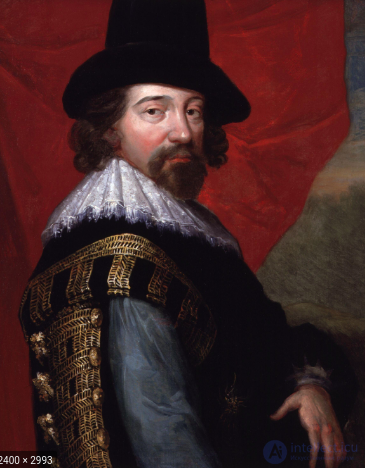
Francis Bacon (1561 -1626) – a member of the British Parliament, later Lord Chancellor, the founder of English materialism, proposed a method of experimental study of nature. Principal works: «Novum Organum», «On the Dignity and Advancement of Learning», «New Atlantis» and others. Famous sayings: «Knowledge is power», «nature is not a temple, but a workshop», «we can do as much as we know». Main ideas: to give man, by means of scientific discoveries and inventions, mastery over the forces of nature; he was the first to carry out a classification of the sciences; he developed the method of induction; he pointed out concrete paths of cognition; he identified the errors, the «idols» of the mind.
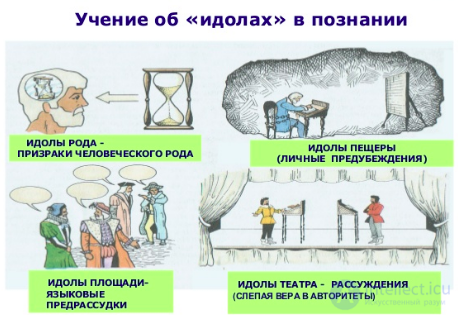
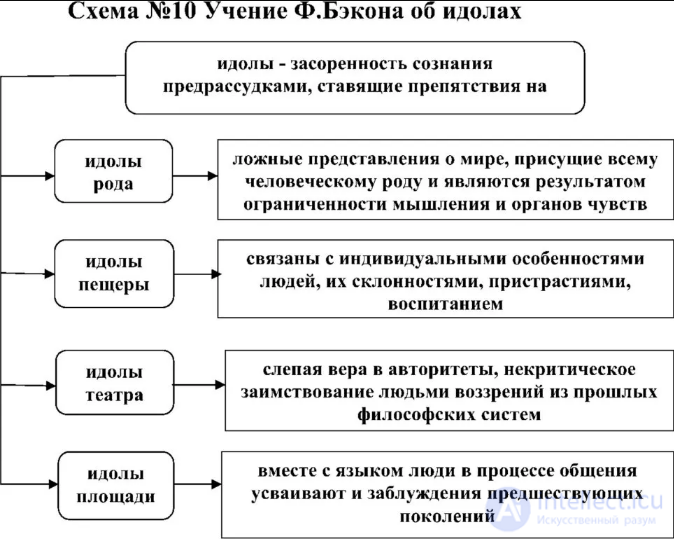
The successes of the natural sciences led not only to a change in the conception of the structure of the universe, but also to a change in conceptions of man, of science, of scientific inquiry and scientific institutions, of the relations between science and society, between science and philosophy, between scientific knowledge and religious faith. The scientific revolution that had taken place made a change of worldview necessary, which posed new tasks for philosophy.
There occurred a gradual replacement of the biblical image of the world by the Copernican model. This was not merely a change of the mathematical scheme of description, but signified a radical revision of the entire worldview. Indeed, in the biblical picture of the world, the Earth is the center of the world, and man is the crown of creation. In the Copernican system, the Earth is a heavenly body just like any other, and man is a blade of grass on its surface, in no way distinguished among natural objects.
The attitude toward reason and toward science is fundamentally reconsidered. Scientific knowledge is not the province of an individual magus's intuition, nor a theologian's mystical revelation, but objective and reproducible knowledge. Therefore, whereas in medieval philosophy commentaries and references to authorities (the Bible, Aristotle, the Church Fathers) occupied an important place, the philosophy and science of the Modern age distance themselves from theology, relying solely on rational proofs and sensory experience.
The role of reason (the reason of the knowing subject) in the philosophy of the Modern age is so great that reality, as something independent of man, and its construction by reason in philosophical concepts, coincide. And if, in the age of science (the 17th century), rationalist thinkers (R. Descartes, B. Spinoza) tried to work out methods of philosophical argumentation and proof common with the specific sciences, then, beginning with Kant's philosophy (the last third of the 18th century), the role of reason becomes self-sufficient, and philosophy already strives to work out its own conceptual apparatus and technique of thinking, based on the specificity of philosophy as a science dealing, first and foremost, with rational self-consciousness and human cognitive activity. From the standpoint of classical philosophy, human reason is the chief authority for the cognition of the world and of being, whose cognition must therefore be based on rational principles natural to reason. This allowed thinkers of the classical period to hold that philosophical conclusions concerning the structure of the world possess the same degree of precision as the conclusions of geometry or mathematics, since the natural light of reason illuminates every field of inquiry equally.
Throughout the 17th-19th centuries, despite the whole diversity of philosophical conceptions, a broadly rationalist model of the philosophical approach to the world predominates, in which any philosophical problem, even the problem of God or of the soul, must be resolved strictly rationally, without recourse to the authority of Holy Scripture. Characteristic of this model is the conception of philosophy as a form of rational-theoretical cognition, by means of which a systematic and integral explanation of the world and of man can be given.
As a result of these changes, the problem of comprehending the phenomenon of knowledge and of placing it upon a rigorous scientific foundation comes to the fore in philosophy. Medieval scholasticism, which could not arrive at any concrete result and was cut off from surrounding reality, no longer satisfied thinkers. Trying to find the cause of the decline of philosophy, they came to the conclusion that the main problem lay in the absence of a scientific method of cognition. Consequently, a reform of philosophy as a science was necessary. If scholastic philosophy recognized faith and authority, these had to be replaced by rational cognition. The philosophy of the Modern age also attempts to determine that subject domain in which cognition can indeed lead to scientific, objective, verifiable knowledge.
Characteristic features of the Modern age:
The natural philosophy of the Modern age, under the influence of the achievements of classical mechanics of the 17th-18th centuries (G. Galileo, I. Newton), worked out specific conceptions of matter, motion, space and time, which received the name of mechanism. Mechanism can be defined as a worldview that explains the laws of the development of nature and society by the laws of the mechanical form of motion of matter, which are regarded as universal and are extended to all types of motion. Although mechanism proper appeared after Newton, in the «Mathematical Principles of Natural Philosophy» (1687), formulated the three classical laws of mechanics (the law of inertia, the law of the proportionality of force and acceleration, the law of the equality of action and reaction), a mechanistic understanding of the world is present in Descartes's physics (with its three laws of motion) and in the philosophy of T. Hobbes.
At this time, the formation of the classical scientific picture of the world takes place, based to a great extent on the mechanics of G. Galileo and the physics of I. Newton. Newton's «Mathematical Principles of Natural Philosophy» contains a number of methodological principles that condition classical natural science. This is the ontological postulate of the simplicity of nature (nature does nothing in vain, therefore one must not admit more causes in the explanation of phenomena than is necessary) and of its uniformity (the same phenomena, as far as possible, must be explained by the same causes). The law of universal gravitation, formulated by Newton, made it possible to describe, in a single formula, both mechanical phenomena and the motions of the planets, forming a truly unified picture of the world, without a division into the earthly and the heavenly. Newton declares that the task of physics is to describe not hidden essences but the observable functions of bodies, in explaining which one need not «feign hypotheses» or fantasize about their essence, but formulate only demonstrable theories.
Mechanism is closely connected with the absolutization of determinism. Determinism, as the conception of a universal cause-and-effect connection, is meant to assert natural causality in all spheres of existence, from the world of nature to the world of man and society. Determinism asserts that there are no causes without effects and vice versa. In this, within mechanistic determinism, the leading role is played by the efficient cause, not the final cause (for example, in mechanics one does not ask for what purpose a ball moves, but under the influence of what force it does so).
The absolutization of the laws of mechanics led to the creation of a mechanistic picture of the world, according to which the entire universe, from atoms to planets, represents a closed mechanical system, consisting of unchanging elements whose motion obeys the laws of classical mechanics. The universe is likened to a clock mechanism which, once wound, thereafter functions unerringly within objective and unchanging spatio-temporal frameworks. At the same time, the mechanistic understanding of the nature of things extends even to living nature. If, for Descartes, animals were merely unreasoning machines, then La Mettrie, a century later, extends this understanding to man as well («Man a Machine», 1747). From La Mettrie's standpoint, human beings are perpendicularly crawling, enlightened machines, working like self-winding clocks. These sentient machines are produced by nature itself and are the highest manifestation of its rational laws.
The successes of mathematical natural science and the emergence of a scientific picture of the world led to the recognition of the necessity of correlating the scientific and religious pictures of the world. The necessity of reconciling faith in God with faith in science led to the emergence of such a conception as deism, quite widespread in the 17th and 18th centuries. Deism – is the conception that God created matter out of nothing and imparted to it an initial impulse of motion, after which the world continued to develop on its own, according to the laws laid into it by God. Thereby, as deists held, God expressed the unlimitedness of his freedom in self-limitation, that is, he freely decided to no longer interfere in the events of the world. It was held that the quantity of motion imparted by God to matter remains constant, which is what explained the observed phenomena of motion.
The subsequent progress of scientific knowledge in the 19th-20th centuries (above all quantum mechanics and the theory of relativity) destroyed the mechanistic picture of the world. The views of modern physics on the Universe proceed from a refusal to regard space, time and motion as absolute. But even earlier, already from the time of German idealism (19th century), the mechanistic worldview was subjected to philosophical criticism, when philosophy made a choice in favor of organic and synthetic forms of comprehending the world.
Empiricism and rationalism in the philosophy of the Modern age
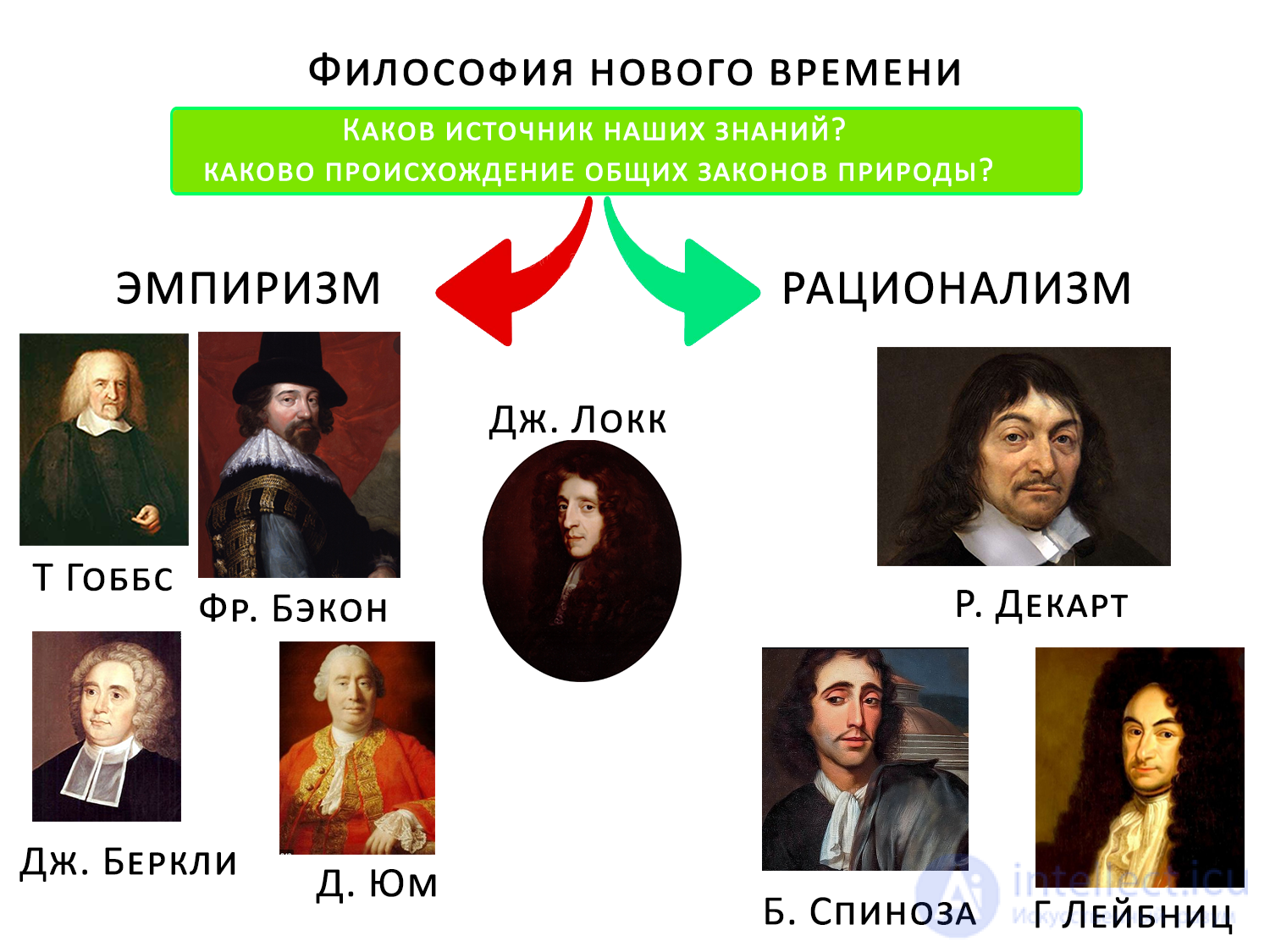
Whereas in science, reliance on sensory experience and rational proofs coexisted, philosophers, striving to clarify these foundations to the end, revealed their mutually contradictory character. Indeed, proofs will be absolutely true if they are derived by a deductive route (that is, when conclusions concerning particular cases are drawn on the basis of knowledge of general laws); experience, however, is in principle inductive in character (when particular cases are generalized). In connection with this, in the philosophy of the Modern age there existed a division into empiricism (the priority of experiential knowledge) and rationalism (distrust of experience, the priority of deductive proofs)
Empiricism (from the Greek empeiria – experience) – a trend in the theory of knowledge that recognizes sensory experience as the sole source of knowledge and asserts that all knowledge is grounded by means of experience. Materialist empiricism (F. Bacon, T. Hobbes, J. Locke, 18th-century French materialism) held that the source of sensory experience is the external world, existing objectively and independently of our consciousness. Idealist empiricism (G. Berkeley) restricted experience to the totality of our sensations and representations, denying that an objective world lies at the basis of experience.
The greatest representative of materialist empiricism, John Locke (1632-1704), declared experience to be the sole source of all our ideas about the world. He called experience everything that acts upon a person's consciousness throughout the whole of his life, forming his knowledge. Prior to the acquisition of experience, human consciousness is, as it were, a «blank slate» (tabula rasa), and only by means of sensations acquired from experience does reason become capable of formulating judgments about the world. Locke shared the thesis of sensualism (the teaching of the dominant role of the senses in cognition, from the Latin sensus – sense, sensation) that «there is nothing in the mind that was not first in the senses».
By means of the ideas of sensation, we perceive in things primary and secondary qualities. Primary (or objective) qualities do not depend on the subject and are unchanging. These are shape, number, motion, extension (volume), and so on. Secondary (or subjective) qualities depend on the subject (that is, they are generated in our experiencing and sensing). Secondary qualities are color, sound, smell, taste, warmth, and so on. Ideas acquired from experience are material for knowledge, but not knowledge itself. To become knowledge, the material of ideas must be processed by the activity of the understanding, which consists in the comparing, combining and abstracting of ideas. By means of this, simple ideas, obtained from experience, become complex ideas of reason. And whereas simple ideas are true when they accurately reflect the properties of things outside us, the truth of complex ideas is confirmed by their mutual correspondence, compatibility, and correspondence between ideas and the processes of the world around us.
However, at this point a question arises: how can we be certain that our ideas correspond to the things being known? Indeed, we can, in essence, compare only ideas with other ideas, not with things. As a result of these conclusions, there arises the idealist empiricism of George Berkeley (1685-1753), who raised the problem of the existence of things beyond sensation. Berkeley asserted that the division into primary and secondary qualities is mistaken, since in fact all qualities are given in consciousness and are therefore subjective, and their existence is expressed in the fact that they can be perceived. Berkeley's principle – esse est percipi – «to exist is to be perceived». Accordingly, this led Berkeley to the conclusion that the concept of «matter», in the sense of its existence not as an idea of our mind but as something objective, substantial, has no meaning. There exists only spiritual being, within which Berkeley distinguished ideas as certain qualities perceived by us. Besides individual subjects, there also exists an absolute subject – God, in whose perception the world is always given, thanks to which our perceptions are more or less ordered and connected by laws. Such a position received, in the history of philosophy, the name of subjective idealism or solipsism1.
The empiricism of David Hume (1711-1776) was distinguished by an even greater radicalism. According to Hume, through the senses we perceive neither general ideas (that is, we always perceive a particular tree, not a tree in general), nor causal connections. Consequently, these bear not an objective but a subjective character, that is, we «think them up», but they are not present in sensibly perceived reality itself. Since empiricism does not provide for any sources of knowledge other than sensory experience, it follows that science, which is built on the cognition of causal connections and universal laws, is not adequate to reality. Thus Hume carried empiricism to the point of skepticism, that is, doubt in the possibility of knowing objective reality.
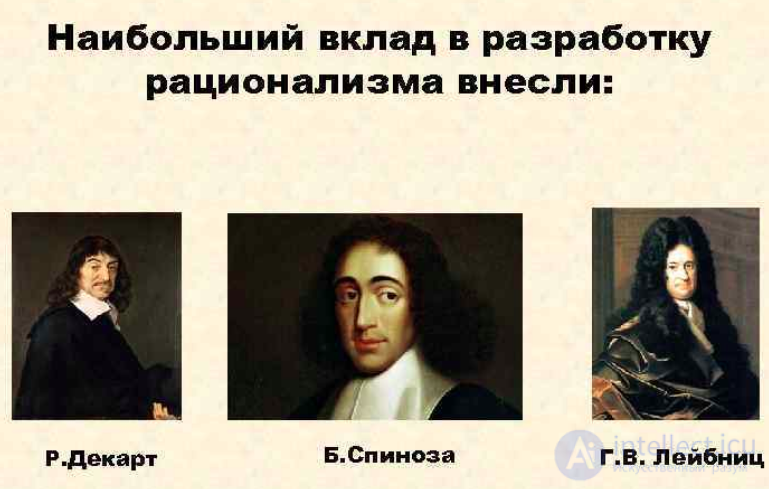
Empiricism was opposed by rationalism (from the Latin rationalis – «rational») – a doctrine in the theory of knowledge according to which universality and necessity, which are the logical marks of scientific knowledge, cannot be derived from experience and sense data. They can be derived only from the mind itself, either from concepts inherent in the mind from birth (Descartes's theory of innate ideas). Experience exerts a certain influence on the emergence of the concepts of reason, but the character of unconditionality and universality is imparted to them only by reason itself, possessing forms of a priori (pre-experiential) knowledge. In this sense, rationalism is the opposite of empiricism. The main representatives of rationalism in the Modern age were R. Descartes (1596-1650), B. Spinoza (1632-1677), and G.W. Leibniz (1646-1716). Rationalism sets philosophy the task of finding methods for attaining apodictic (that is, proven in an incontrovertible manner, absolutely certain) knowledge. Such knowledge could not be obtained by an inductive route (there is always the danger of incomplete induction), and therefore rationalism is oriented toward deduction as a method of cognition, as happens, for example, in mathematics, where theorems are derived and proved on the basis of axioms.
The essence of the doctrine of innate ideas – is that there exists a special kind of knowledge that requires no proof. These truths (axioms) are self-evident and certain from the outset.
Ideas can be of two kinds: v CONCEPTS: God, number, body, soul, will, etc.; v JUDGMENTS: «the whole is greater than its part», «one cannot both be and not be at the same time», etc.
Two main trends of rationalism are distinguished:
The founder and greatest representative of the philosophical rationalism of the Modern age was René Descartes. Descartes sought to discover absolutely certain first principles of knowledge, relying on which it would become possible to rid the mind of prejudices and errors. Descartes's logic is as follows: we can doubt the existence of anything whatsoever, be it the world, truth, or God. But what remains indubitable is the very fact that we doubt, that our doubting thought exists. And this means that there exists one who thinks (who doubts). Hence the famous: «I think, therefore I am» (cogito ergo sum). In this truth, Descartes was convinced, no person can doubt, and therefore it must serve as the absolutely certain foundation of all subsequent reasoning. The main conclusion that Descartes drew consists in the proposition that man is, first and foremost, a thinking being. For the state of thought is always given to us directly, whereas our bodily qualities, and still more the qualities of external bodies, known through the senses, are only more or less probable.
The rationalist methodology of cognition proposed by Descartes asserts that reason (intellectus) is known first of all, and it is only in dependence on reason that we grasp everything else. Hence Descartes's teaching about innate ideas, among which he included the idea of God, as well as the laws of logic. Since the universal and necessary character of mathematical knowledge seemed to Descartes to follow from the very nature of the mind, he assigns the principal role in the process of cognition to deduction (from the Latin deductio – inference, derivation) – the intellectual derivation of some propositions from others. This is an inference of particulars from general propositions, not relying on the senses. Deduction itself rests upon fully certain axioms, intuitively grasped by the mind, whose source of certainty is the innate ideas of the mind itself.
Trying to lay a rigorous, reliable foundation for their systems, the 17th-century rationalists sought, above all, an ontological foundation for the universe – substance.
From Spinoza's standpoint, substance – is «that which exists in itself and is conceived through itself, that is, that whose conception does not require the conception of another thing, from which it would have to be formed». That is, it is that which no longer depends on anything else, is the «cause of itself» and the first foundation of everything, does not arise and is not destroyed, and whose essence is existence. Substance so defined is, in essence, the highest, ultimate reality, that is, God. From Spinoza's definition it followed that there is only one substance (two would limit each other, which contradicts the definition). Such a conception, which posits a single substance as the foundation of all that exists, is called monism.
R. Descartes, as we have seen, proceeded from the givenness, in an act of rational intuition, of the existence of thought, which he connected with a thinking substance – res cogitans. Thinking substance – is a substance whose mode of existence is thought, that is, it is the thinking I of man. But besides the subject there is also the material world, whose most evident property Descartes considered to be extension. Descartes advanced a doctrine of two independent substances: the extended (whose basic attribute (property) is extension in length, width, height) and the thinking (whose basic attribute is thought). Thus, Descartes's ontological position can be characterized as dualism, since he speaks of two substances of equal standing. These substances mutually exclude one another. However, Descartes's dualism is unstable, since Descartes tried to explain the presence of these two opposite substances by recourse to the concept of God, the sole genuine substance, in which the two mutually exclusive substances incomprehensibly merge.
Descartes's scientific method – DEDUCTION, the reliable resources of reason and reliance on knowledge, and only with the help of logical devices, the obtaining of new reliable knowledge.
METHODS OF RESEARCH:
1) To admit as initial premises only reliable knowledge;
2) A complex problemMETHODS OF RESEARCH:
1) To admit as initial premises only reliable knowledge;
2) To break down a complex problem into separate, simpler tasks;
3) To move consistently from questions that are known and proven to those that are unknown and unproven;
4) To strictly observe the sequence, the logical chain of inquiry, without omitting a single link.
G.W. Leibniz formulated several «principles», by means of which the world can be adequately described. These are the principles:
1) of universal differences,
2) of the identity of indiscernibles; 3) of universal continuity;
4) of monadic discreteness,
5) of plenitude, and
6) of universal perfection.
These principles interpret the world as an infinite multitude of diverse phenomena which, while differing from one another, together form a harmonious whole. The whole of reality is composed, as it were, of small leaps. Therefore, from Leibniz's standpoint, the diversity of the world can be described only from the standpoint of the presence, in the world, of a multitude of equivalent, isolated entities (pluralism) – monads (metaphysical units).
The Enlightenment, as a broad cultural-ideological movement of social thought, first took shape in the 18th century in France, where its basic features found expression with classical clarity, consistency and radicalism. The ideology of the Enlightenment – is an expression of the worldview attitudes of the bourgeoisie. Hence its orientation toward progress (a striving for development, above all material) and optimism (faith in man and his reason).
As the foundation of progress, the philosophers of the Enlightenment saw the full-scale application of reason, the critical rethinking of all traditions. At the same time, the exaltation of reason came about as a result of a rethinking of the place of reason in human life. Reason becomes not an abstract characteristic of man, but the most important practical instrument by means of which the transformation of the reality surrounding man becomes possible. Human reason is thus understood, above all, as common sense, which can enable an improvement of human life.
Whereas 17th-century philosophy moved from human reason and its capacity for cognition toward nature and the surrounding world, and drew its grounding, in one way or another, from reason itself, the philosophy of the French Enlightenment proceeded, above all, from the existence of nature and conceived human reason as derivative of it.
The philosophers of the Enlightenment opposed any form of power (tradition, the monarch) with the power of reason, called upon to liberate man and make him master of his own destiny. The Enlightenment – is a century of the expansion of reason into all spheres of human life. Correspondingly, attitudes toward knowledge became more pragmatic. Knowledge was to take the place of myths, superstitions and ignorance and thereby liberate man. Thus human progress was directly linked with the expansion and development of knowledge. But knowledge that was valued was not speculative and abstract, but knowledge that had passed the test of reason and been verified by experience. Therefore the philosophers of the Enlightenment also defended freedom of speech: it must be possible to critically examine any dogma, any proposition, and this must be done publicly, so that all people may have the opportunity to make use of the knowledge obtained.
The first target of the attack of Enlightenment reason turned out to be myths and superstitions. The philosophers of the Enlightenment were often skeptical not only of the church, but of religion itself. The philosophers of the 17th century, holding to deism, prepared the ground for a fundamentally different attitude toward religion. Having allowed themselves their own interpretation of church dogmas, they thereby sanctioned the subsequent emergence of a philosophical religion, namely, a rational and natural religion. This is a religion not of revelation, but a product of human reason. Natural religion is «the moral principles common to the human race»2 (Voltaire). Some philosophers, in doing so, recognized the necessity and naturalness of belief in God, but criticized the external side of religion. Others took the next step: they criticized the necessity of faith altogether, since, in their opinion, it hinders human freedom. Faith was linked with human fear, and therefore the former proposed replacing it with a rational religion, while the latter proposed eliminating it altogether. Man, on their view, is above all a natural being, and therefore he must bring everything into accord with nature, discarding all that is superfluous.
The Enlightenment – is not only a striving to disseminate knowledge, but, above all, the development of the capacity for thought. In his work «An Answer to the Question: What Is Enlightenment» (1784), I. Kant defines Enlightenment thus: «Enlightenment is man's emergence from his self-incurred immaturity. Immaturity is the inability to use one's own understanding without the guidance of another. This immaturity is self-incurred when its cause lies not in a lack of understanding, but in a lack of resolve and courage to use it without the guidance of another. Sapere aude! Have the courage to use your own understanding! – is thus the motto of the Enlightenment»3.
After the criticism of religion by the thinkers of the Enlightenment, it became a commonplace that religion, supposedly, is a dogma enslaving reason, and monarchy is a dogma hindering free criticism and thought. But I. Kant drew attention to one subtle fact: often we are enslaved even without these external factors, without being aware of it ourselves. «Laziness and cowardice are the reasons why so great a portion of humankind, after nature has long since discharged them from external guidance, nevertheless gladly remain immature for life; and why it is so easy for others to set themselves up as their guardians. It is so convenient to be immature! If I have a book that thinks for me, a spiritual advisor whose conscience can replace mine, and a doctor who prescribes my diet, and so on, I need not trouble myself at all»4. Kant thus shows that the cause of humanity's enslavement lies not only in social causes, but in the fact that man himself wants to submit to someone, so as not to have to think for himself and not to be responsible for his own life. Therefore, it is not enough to change social arrangements; to liberate man, it is above all necessary to teach him to think, to use his own reason. Without freedom of reason, no political freedom is possible. It was precisely this task – the liberation of reason – that the Enlightenment pursued above all. And it was precisely in this that it became a precondition of the French bourgeois revolution with its slogan of «liberty, equality and fraternity». Kant writes that «the public can achieve enlightenment only gradually. Through revolution one may, perhaps, achieve the removal of personal despotism…, but never can a true reform of ways of thinking be accomplished through revolution; new prejudices, just like the old ones, will serve as a leash for the thoughtless multitude»5.
One of the means of such a «liberation» of reason was the project of the «Encyclopédie». The «Encyclopédie, or a Systematic Dictionary of the Sciences, Arts and Crafts», was created by a large collective of authors. D. Diderot, J.B. D'Alembert, F. Voltaire, C.A. Helvétius, P. Holbach, E. Condillac, J.-J. Rousseau, C.-L. Montesquieu, A.R.J. Turgot and others took part in the work on the Encyclopédie. Specialists – physicians, artisans, and so on – were enlisted to write individual articles. The Encyclopédie was meant not only to acquaint society with the newest ideas and discoveries in all fields of knowledge. Thus, one of its intellectual inspirers, Denis Diderot, was convinced that the «Encyclopédie» should contribute to changing the customary way of thinking.
The Encyclopédie sought to illuminate, from a scientific, enlightened standpoint, and to philosophically generalize and systematize, all aspects of human life. But, being written by a collective of authors, it was not uniform in its ideas. It contained the entire spectrum of Enlightenment thought, from the moderate to the most radical materialism and atheism. But in any case, all the articles were imbued with the spirit of the Enlightenment: that is, with the spreading of knowledge and the elimination of superstitions. Every tenet of traditional views was subjected to critical assessment.
Also indicative was the inclusion, in the Encyclopédie, of articles on craft processes. Most educated people not only knew nothing about production, but were not even interested in it. The encyclopedists, however, held that, since man is surrounded by things, he ought to know as much as possible about them, including how they are produced. This marked a turn from a contemptuous attitude toward the lower spheres of activity to an interested, respectful attitude toward any human activity
The ontology of the Age of Enlightenment saw the foundation of everything in materialistically understood nature, from which it derived everything, including man and his consciousness.
From this position, Voltaire subjected to criticism the conception of the soul as a substance. From Voltaire's standpoint, God could well have endowed matter with the property of thought; thought depends on the sense organs, that is, on the body, and therefore there is no need to additionally introduce a spiritual substance; the capacity for thought can be explained on the basis of the presence of matter. Denying the soul any substantiality, Voltaire thus interpreted it from the standpoint of functionality and defined the soul as «the capacity to think and feel, just as we call the capacity to see sight, and the capacity to desire will, and so on»6.
Developing the sensualism of the 17th century, E.B. Condillac supplemented it with the conception that not only is all our knowledge derived from the senses, but that man's very cognitive capacity itself is also gradually formed under the influence of sensory experience.
Whereas in the mechanistic picture of the world of the seventeenth century matter was conceived as a passive principle in need of God as the first cause of motion, from D. Diderot's point of view, matter possesses motion inherently: a constant restlessness, a «universal fermentation». Every body is «full of action and force». Living and non-living nature were, for Diderot, closely connected: already in the subtlest structures of matter there are the rudiments of those properties which will subsequently develop into psychic life, into thought. The idea of development was carried through by Diderot in another respect as well: in his opinion, everything is not only in continuous interconnection and in ceaseless change, but also in development; organic species have a history of their formation and pass into one another. All of nature, he said, is a single active world; it is constantly «at work». The universe is a «complex body, subject to turbulent changes… it is a rapid succession of beings, … colliding with one another and disappearing…»7
An emblematic idea of the modern era in the socio-philosophical respect was the theory of the social contract, which was developed by T. Hobbes, J. Locke, and J.-J. Rousseau.
T. Hobbes regarded human nature as egoistic, and therefore in the state of nature (the natural state) people found themselves in a state of «war of all against all». In this state, every person possessed natural rights – to life, liberty, and private property. However, such a state was problematic, since even the chief value of every person – life – was endangered. Therefore people concluded a tacit social contract, by which they alienated from themselves part of their right to liberty and delegated this right to a sovereign, who was to see to the maintenance of order in society. In this way, the state is formed. In this, the sovereign possesses absolute power. Hobbes considered absolute monarchy the ideal form of state structure, since, in his opinion, only the concentration of power in a single pair of hands could prevent civil war within society.
Another proponent of the contractual theory of the origin of the state was J. Locke. Like Hobbes, Locke distinguished between the natural and the social state, but did not consider the natural state to be characterized by a war of all against all. Locke held that in the state of nature people possess natural rights, which include the rights to life, liberty, private property, and the right to defend one's rights. In uniting into a state, citizens retain their rights and alienate only one right: the right to defend their rights in their own way. This right they delegate to the state, which is thereby called upon to protect the natural rights of its citizens. Thus, in the social state, citizens not only do not lose their natural rights but strengthen them. The state, unlike in Hobbes's theory, should, according to Locke, represent not an absolute monarchy but a constitutional one. Since the government has a strictly defined function, Locke stipulates that it should not possess absolute power but should be accountable to society. In connection with this, Locke was the first to put forward the idea of the separation of powers, in which one independent branch of power controls another. Thus, Locke is the founder of liberalism.
Yet another version of the concept of the social contract was formulated by J.-J. Rousseau in the treatise «On the Social Contract». From Rousseau's point of view, in the state of nature all people are equally free. The necessity of obtaining food through labor and unequal physical abilities lead to inequality. Unlike Hobbes and Locke, he did not consider private property to have existed from the outset. From his point of view, private property arose as a result of deception, and its appearance entrenched the inequality of people.
As the means that could extend the freedom of the natural state into society, Rousseau named the social contract. It consists in the fact that «each of us places their person and all their power in common under the supreme direction of the general will, and we together receive each member as an indivisible part of the whole»8. Thus, each person, giving themselves to all, gives themselves to no one, and all remain equal and free. The main pivot of the social contract, for Rousseau, was the «general will».
As a result of such a social contract, Rousseau held, a person even comes out ahead: they «acquire more force for preserving what they have»9, and «the fundamental compact, far from destroying natural equality, on the contrary substitutes a moral and legal equality for whatever physical inequality nature may have imposed upon mankind; so that, however unequal in strength or intelligence, they all become equal by convention and legal right»10. The social state, thus, has many advantages over the natural state for the development of a person's abilities, but a person does not enjoy them fully because of various abuses. The social contract, according to Rousseau, legitimized private property, and there would be nothing bad in this were it not that it leads to the appearance of the rich and the poor. Rousseau formulated three political principles of the social contract: 1) the sovereign is the people; 2) the sovereignty of the people is inalienable and indivisible; 3) legislative power belongs to the people and can belong only to them.
The theory of the social contract was repeatedly subjected to criticism in subsequent centuries, but it was precisely this theory that became a great step on the path from medieval providentialism, when the power of the sovereign was considered to be given by God, to scientific political theories. The idea of natural law – that the state is not a divine institution but the result of a compact among people – eventually resulted in the idea of the possibility of the people correcting the policy of the monarch, while the idea of the natural rights of man resulted in the Declaration of the Rights of Man and of the Citizen (1789), which proclaimed personal liberty, freedom of speech and conscience, and the equality of citizens before the law to be inalienable rights of man, along with the right to resist oppression, and declared private property inviolable.
1 Solipsism – a conception according to which only the person and their consciousness exist, and the world of objects exists only in the consciousness of the individual.
2 Cited from: Kuznetsov V.N. François-Marie Voltaire. Moscow, 1978. P. 156.
3 Kant I. Works in 6 volumes. Moscow, 1966. Vol. 6: P. 27.
4 Ibid.
5 Ibid. P. 29.
6 Voltaire. Philosophical Works. Moscow, 1989. P. 116.
7 Diderot D. Collected Works. Vol. 1, P. 255.
8 Rousseau J.-J. On the Social Contract. Moscow, 1938. P. 13.
9 Ibid. P. 12.
10 Ibid. P. 20.

Comments