
Lecture
Dialectics is a system of philosophical knowledge about development.
Metaphysics – is a philosophical doctrine that examines phenomena outside their mutual connections and outside development.
Table. Comparison of the two concepts of development, dialectics and metaphysics
|
dialectics |
questions |
metaphysics |
|
Yes! From lower to higher |
Does the world develop? |
Yes…, but mechanically |
|
Everything flows, everything changes. |
Does the world change? |
Phenomena are unchanging in their essence. |
|
Quantity turns into quality |
What is the character and direction of development? |
Quantity turns into quantity |
|
Internal contradiction (self-motion, self-development) |
What is the source and cause of development? |
An external force, an outside push, God. Matter is inert, sluggish, immobile. |
|
motion is absolute, and rest is relative |
What is motion? |
motion - the sum of states of rest, which is something constant |
|
Yes! Phenomena are connected and mutually conditioned. |
Is there a connection between phenomena?
|
Phenomena are regarded in isolation |
The opposition between dialectics and metaphysics as approaches to development was examined in Marxism. K. Marx used dialectics as a method for investigating politico-economic processes. He introduced into dialectics subjectivism and the possibility of a historical evaluation of economic and political events.
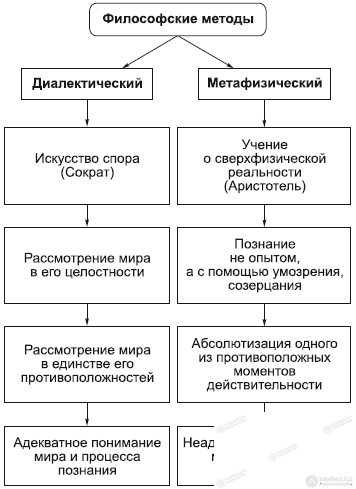
Historically, two maximally general philosophical methods have taken shape: the dialectical and the metaphysical.
The term «dialectics» itself appeared later than the term «philosophy». Socrates (469–399 BC) understood dialectics as the art of conducting a conversation, the discovery of truth through the clash of opposing opinions. The art of debate came to be understood as a way of knowing nature, man and his thought, as the ability to grasp the phenomena under study in their opposing determinations.
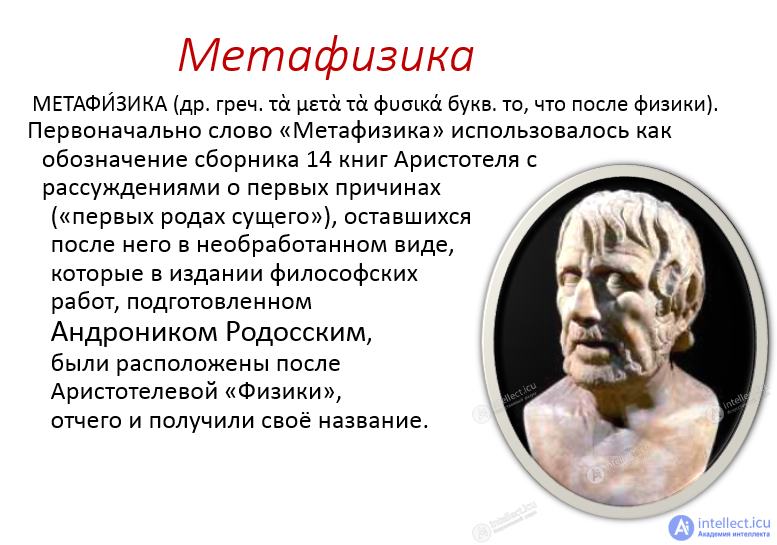
Alongside the formation of dialectics, metaphysics arose. The term «metaphysics» designated a group of treatises by Aristotle (384–322 BC). The Greek prefix «meta» means «beyond», «above». The term «metaphysics» came to designate teachings about that which is «beyond» physical reality, namely teachings about a special suprasensible reality underlying physical, sensibly given reality. This suprasensible reality is grasped not by experience but by means of speculative reasoning. Subsequently, for many centuries, tradition called «metaphysics» any philosophical teaching containing speculative reflections on suprasensible reality.
Later, beginning with Hegel, the term «metaphysics» also acquired another meaning, that of a method opposed to the dialectical one. Since in speculative conjectures about suprasensible being there was always a striving to find certain absolutes, eternal unchanging foundations of sensible being, this methodological orientation itself came to be qualified as metaphysics.
As the antipode of dialectical thinking, metaphysics denies the truth of anything in which contradiction is found.
Metaphysical thinking, in general form, consists in tearing apart from one another and absolutizing certain sides, opposing moments, of reality or of its cognition.
The attainment of truth presupposes the application of the correct method. It must be kept in mind that the metaphysical mode of thought, too, yields a certain positive knowledge. It is sometimes useful to consider the object under study statically, in abstraction from certain connections, and so on. But one should not stop there. Movement toward truth presupposes the use of the dialectical method, which requires a comprehensive analysis and synthesis, the disclosure of the dialectics, the dynamics, and the contradictoriness of the objects under study.
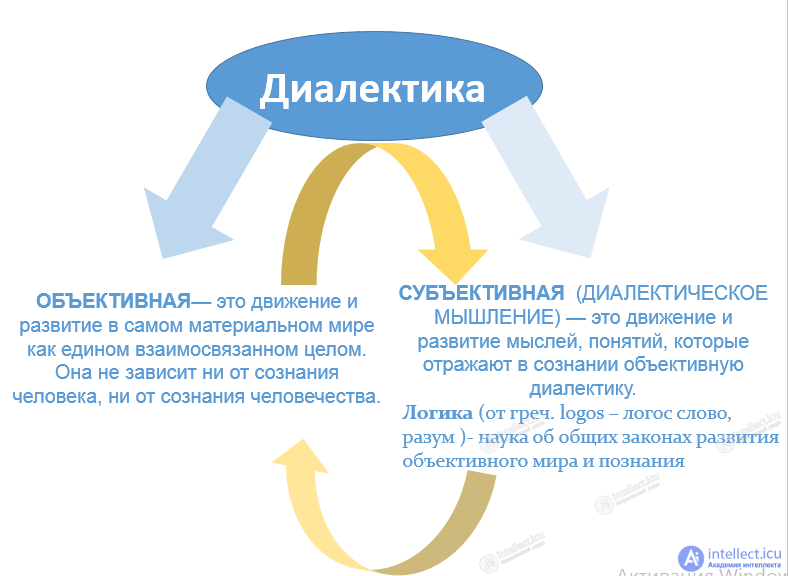
Dialectics is:

Dialectics as a type of philosophical thought first appeared in ancient Greek philosophy.
The Eleatics (the Eleatic school) held that only what is explicable is truly real. Nothing can be real without a rational explanation.
Heraclitus maintained that in the world everything is in motion, everything flows and changes, everything exists and at the same time does not exist, being in an unceasing process of appearance and disappearance.
Unlike Heraclitus, who laid the foundations of an impartial dialectics, that is, a dialectics of the external, material world, Socrates is regarded as the founder of subjective dialectics, that is, a dialectics of ideas and concepts constituting the essence of human thought. Socrates pointed out that the cognition of truth is always achieved by overcoming contradictions. Socrates's dialectical method is a doctrine of the overcoming of contradiction (or a circle of contradictions), of the negation of contradiction and of the avoidance of contradiction.

Plato regarded dialectics as pure thought, developing from within itself.
Aristotle made an attempt at generalizing the most difficult contradictions as a basic category of dialectics as a whole.






The dialectics of I. Kant is based on sensibility, understanding and human reason. According to Kant, everything in this world is subject to the understanding, because it is through the understanding that the cognition of the entire surrounding world occurs. Kant's dialectics is intended to reflect not the contradictions of things themselves, but only the contradictions of the mental activity directed at the cognition of these things, and thereby the subjectivity of Kantian dialectics becomes evident. Precisely because it involves an opposition between the content of knowledge and its logical form, these very forms become the subject matter of dialectics.
The first genuine application of dialectics as a thought process that derives an entire system of determinations from a single general concept can be noted in Hegel. He identifies the immanent dialectics of our thought with the transcendent logos of all that exists. Dialectical thought is the self-consciousness of that which exists, or its consciousness of itself, and outside this consciousness of what exists, nothing exists.

The dialectics of G. Hegel constructs a mobile, dynamic system of the concept, by means of which such important principles of dialectics as the principle of universal connection and the principle of development are realized. As the internal source of development, G. Hegel regarded contradiction.
Hegel maintains that development proceeds from the abstract to the concrete and has the following mechanism: there is a certain thesis, to which there is always found an antithesis – its complete opposite. Through the interaction of two opposing theses a synthesis is obtained – a new statement, which itself likewise becomes a thesis, but at a different level of development. This process repeats itself continually, and each newly formed thesis has an ever higher level of development. According to Hegel's theory, contradictions are the driving basis of progress.

According to N. Hartmann,
…there is something dark, unclarified, mysterious in dialectics. Those who were strong in it have at all times been very few, mere units. In antiquity — three or four minds capable of speculative reasoning. In the modern era, in any case no more — at least among those who created anything noteworthy… There definitely exists something like a dialectical gift, which can be developed but which cannot be taught. It is remarkable that even the dialectically gifted minds themselves do not disclose the secret of dialectics. They possess and use the method, but they cannot convey how they do it. Surely they themselves do not know it. It is — like the creativity of an artist. The creator himself does not know the law by which he creates; but he creates according to it… The geniuses and those akin to genius follow this law blindly and unerringly, like sleepwalkers.[20]:652
In the realm of philosophical systems, Hegel has shown us an instructive phenomenon of high style. A dialectics repeatedly contested — the inner form of his thought — comes out to us from his works and captivates us with a force that penetrates its subject matter. At the same time, knowledge of its essence has always been and remains limited. He perceived it as the highest mode of «experience», but these sparse indications do not reveal to us the secret of this experience. We must seek it in his substantive investigations, that is, in the totality of his life's work.[21]:636—637
Hartmann believes that the investigation of a method is in principle secondary to the application of that method. First someone lays a path of cognition, «giving himself over» to the subject matter and not necessarily knowing how he does it, and then, on the path thus laid, someone else «puts things in order».[21]:636—637
Hegel's dialectics explains the development of thought through the triad thesis → antithesis → synthesis. K. Popper[22] explains this scheme, comparing it to the scientific «method of trial and error», which rejects theories not confirmed by experiment. Popper acknowledges that it is quite reasonable to begin «the development of a certain field of human thought with a single idea — a thesis, open to criticism, which will „create“ its antithesis». A scheme completed by a synthesis of reasonable elements «adds some valuable points to the interpretation of thought in terms of trial and error».
Popper begins his critique with the point that synthesis is subjective — determined not only by the material of the thesis and antithesis, but also by the minds that defend this synthesis[23]. But, while correctly noting that contradictions are the engine of intellectual progress and that they are inevitable, dialecticians draw the extremely mistaken conclusion that it is not even desirable to get rid of contradictions. This is dangerous, says Popper, since the so-called fruitfulness of contradictions is simply the result of our decision not to put up with them[24]. Moreover, he shows how anything whatsoever follows from a contradiction[en]. Reconciliation with contradiction inevitably leads us to abandon criticism, the search for consistent theories, synthesis, and ultimately to the end of rationality and science. Therefore dialectical logic, while quite suitable for the philosophical description of history, should not occupy the fundamental place of formal logical inference in life. And it is all the more absurd to claim that physical reality develops dialectically, as Marx does.
K. Popper notes that in dialectics logical terms are used incorrectly, and that the concepts of «negation» and «contradiction» have a definite logical meaning distinct from the dialectical one. Such terminology, in Popper's view, is merely misleading. Less deceptive would be the terms «conflict», «opposing tendency» or «opposing interest». And Popper calls dialectics' invulnerability to criticism an extremely dangerous «reinforced-concrete» dogmatism.
1. Dialectics literally translates as
2. The founder of dialectics
3. The literal translation of the term «Metaphysics»
4. A pupil of Socrates
5. Introduced the term «metaphysics»
8. Can dialectics exist separately from metaphysics?

Comments