
Lecture
The question of the essence of the human being, its nature, origin, and purpose, its place in the world, values, death and immortality, the meaning of human life – is one of the fundamental problems of philosophical thought. The problem of the essence and being of the human being belongs to the category of eternal philosophical problems. It has attracted the attention of philosophers since ancient times. This problem is eternal and eternally new, since the conditions of life, its content, scientific knowledge, and the human being himself are constantly changing. Each time it is the problem of a different human being, living under different historical conditions, resolving the concrete tasks of his time, a human being thinking, feeling, and understanding the world differently. We have already noted that philosophical reflection on the problem of the human being becomes especially acute during turning-point, crisis periods in the life of human society, periods demanding the maximal exertion of all a person's spiritual and physical strength. The problem of the human being concentrates all other philosophical questions around itself, since any one of them presupposes, at its foundation, the resolution of the problem of the human being, his nature, and his position in the world and in society.
Different images of the human being have taken shape in the history of philosophical thought. For Democritus, the human being is a part of the cosmos, of a single order and structure of nature, a microcosm, a reflection and symbol of the universe. Aristotle defines the human being as a living creature endowed with spirit, reason, and the capacity for social life. Franklin regards the human being as a tool-making animal. In classical German philosophy, the human being appears as the subject of spiritual activity, creating the world of culture, as the bearer of universal human consciousness, of the universal principle – the absolute spirit, reason. Kant sees in the human being a being belonging to two different worlds – natural necessity and moral freedom. At the center of Feuerbach's philosophical teaching stands the human being, understood as the crown of nature, as the harmonious unity of "I" and "Thou".
There are also well-known, highly figurative definitions of the human being. For example, the French writer François Rabelais (1494-1553) called man the animal that laughs. Schopenhauer held that the human being is a tragic animal, endowed with rational cognition and instinct, though instinct insufficient for confident and unerring action. For Nietzsche, what is essential in the human being is not consciousness and reason, but the play of vital forces and drives. The Marxist interpretation of the human being is based on understanding him as both a product and a subject of social-labor activity. From this point of view, a person's formation occurs through participation in social heritage, in culturally and historically formed traditions, as well as through the mechanisms of biological heredity. Thus, each human being is a unique individuality and, at the same time, a particle and bearer of the universal human essence of the species, a subject of the historical process.
In the philosophical tradition, the human being has simultaneously been regarded as a natural principle, included in the diversity of natural processes at the level of the body; a social principle, reproducing in spiritual experience sociocultural connections and relations; and a concrete-individual principle, realizing its free will, fate, and destiny.
Corresponding to these principles, the following basic interpretations (conceptions) of the understanding of the human being have taken shape: the naturalizing, the rationalistic, the sociologizing, and the existential-personalist. Within the framework of the naturalizing conception, the human being is understood as an element of nature, similar to animals, and hence subject to the very same laws of functioning.
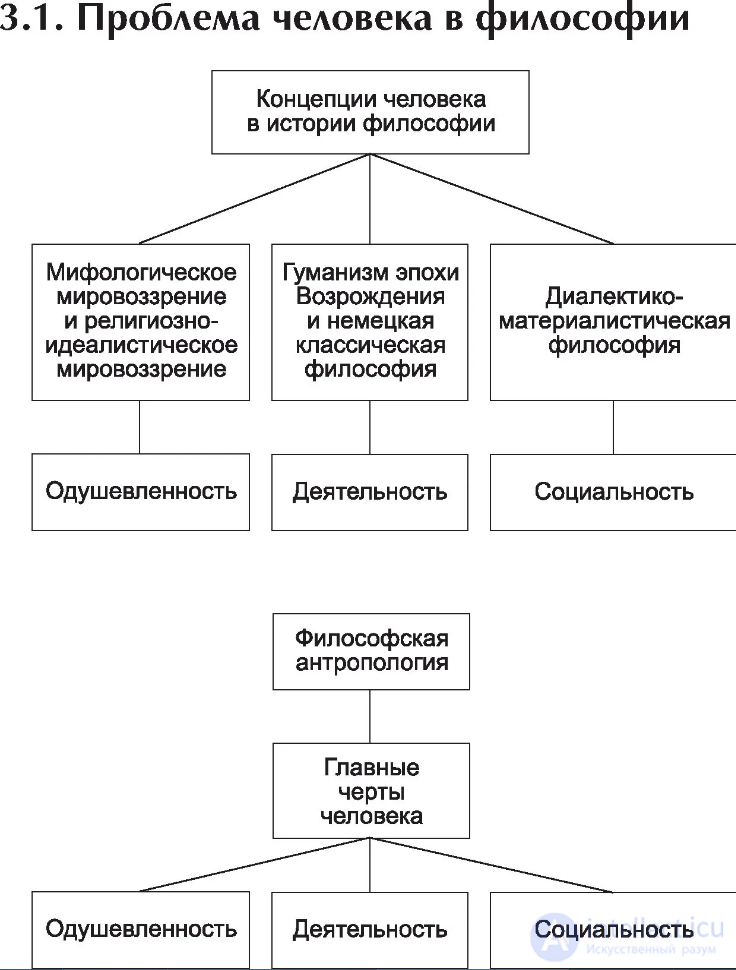
The rationalistic conception links the essential features of the human being to the presence in him of reason, consciousness, and purposive activity, in distinction from the animal. Moreover, reason is regarded as the basis not only of the human being, but also of natural-cosmic existence.
The sociologizing conception regards the human being as a product not so much of biological as of social evolution. The human being finds himself only in society, where, in the process of socialization, his genetically inherited qualities are realized. Thus, in the Marxist conception, the essence of the human being is the totality of all social relations. In structuralism, the human being appears as an element and derivative function of the various social structures and political factors that condition him.
The existential-personalist interpretation of the understanding of the human being, characteristic of non-classical philosophy, regards him as a special principle in the world, not reducible to external laws, but explained from the point of view of individually unrepeatable experience and fate, uniqueness, authenticity, freedom of choice, and such phenomena of human existence as suffering, fear, loneliness, and others.
The understanding of the human being in Eastern and Western civilizations differs quite considerably. These differences concern the human being's relation to himself, to the world, to nature, and to society. As we have already said, the human being of Eastern civilization is characterized by an indissoluble bond with nature, by an orientation toward harmonious integration into nature, into the surrounding environment, rather than by a striving actively to change it, as is characteristic of the human being of Western civilization. Let us recall that the ideal of a careful attitude toward nature was expressed by the principle of "wu wei" ("non-action"), which took shape in ancient Chinese culture and meant not passive inaction, but following the natural order of the world, an orientation toward minimal interference with this order. For the human being of technogenic civilization, by contrast, a different orientation was characteristic, according to which the human being, armed with knowledge, must conquer, change, and subjugate nature, regarding it as a "workshop", a boundless storehouse for satisfying his needs, and extending such a "forceful attitude" to the social restructuring of the world as well. The vector of activity of the Eastern human being, unlike that of the Western one, is directed not outward but toward inner self-perfection, self-knowledge.
The basic norms of Buddhist ethics are quite illustrative in this respect, aimed at deep concentration, imperturbable reflection, and complete deliverance from suffering in nirvana. If, in Western civilization, the engine of progress and the active proponent of innovation was the individual, the citizen-proprietor, then in the ancient Eastern civilizations only those innovations were accepted that corresponded to the norms of corporate ethics and the interests of the state, which was the basis for the absence of freedom of choice, equality, and democracy in the European understanding of these phenomena. The determining features of human life in the ancient Eastern civilizations were stability, immobility, traditionalism, definite social institutions, customs, rites, a careful attitude toward social and cultural heritage, and a canonized style of thought. For the human being of Western civilization, by contrast, the priority values are the active sovereign individual, the value of innovation and progress, individual freedoms and rights, and the feelings of the citizen.
What is the status, at the present stage, of the problem of the philosophy of the human being; can the culture of the twenty-first century limit itself, in studying the phenomenon of the human being, to the knowledge about him arising within the individual sciences? Despite all the interest in the problem of the human being at the present stage, significant divergences are revealed in the understanding of the character and subject matter of the philosophy of the human being, of philosophical anthropology, of the real content of these concepts, and of the specific features and characteristics that distinguish and characterize a genuine philosophy of the human being. Moreover, despite the recognition of the eternal nature and priority of this theme in philosophical reflection, postmodernism has proclaimed the "death of man" as a unique, self-sufficient principle in the system of being and knowledge, the role in which it played in classical approaches.
The special status of the political, ideological, and semantic structures influencing contemporary man has shaken his claims to freedom, creativity, and independence, and the dimensions of research into the phenomena of power, language, politics, and other external forces that predetermine the essence of the human being and make him, as it were, a "function" in relation to them, have created the preconditions for a certain "erosion" of philosophical interest in the human being as an object of holistic, systematic comprehension.
The vigorous development of the particular sciences of the human being (psychology, sociology, ethnography, biology, medicine, physiology, computer science, and others), offering a wide range of concrete, evidence-based knowledge about various dimensions of the human being, adds a considerable measure of skepticism regarding the necessity of a philosophical approach to the problem of the human being. A number of researchers already openly declare the self-sufficiency of a purely scientific study of the human being and, accordingly, the elimination (exclusion) of this theme, traditional for philosophy, from its professional problematics.
Studies of human thought show that culture, for all the significance of the scientific description of the human being, cannot limit itself to this knowledge alone – knowledge that is necessary and indispensable, but not sufficient, for it is knowledge of what exists, but not of what ought to be, knowledge of some concrete dimension of human existence (his memory, abilities, temperament, and so on), but not of the human being as an integral being, questioning the meaning of life, his value aspirations, the finitude of being, his duty, dignity, death and immortality. No particular science, apart from such an interdisciplinary field of research as the philosophy of the human being, can ground the system of values by which both the human being and the individual sciences – including the sciences of the human being himself (biotechnology, genetic engineering, bioethics, transplantology, and so on) – ought to be oriented. Moreover, a definite philosophical conception of the human being, as the contemporary philosopher J. Agassi emphasizes, underlies any psychological, sociological, economic, linguistic, or cybernetic theory (and conversely, by the principle of feedback, the development of these scientific fields contributes to a certain revision of general philosophical conceptions of the human being). Assertions of the "death" of the philosophy of the human being are clearly exaggerated, for the very achievements of the particular sciences not only fail to eliminate the philosophy of the human being, but even further underscore its significance, contributing to the formulation of new problems of philosophical rank. An adequate conception of the human being can be attained by way of a synthesis of the particular sciences, which is possible as a result of the philosophical comprehension of scientific data about the human being. On such an approach, the human being appears as a kind of point of intersection of various projections of human existence, including its natural, social, culturological, and personally unique dimensions.

Comments