
Lecture
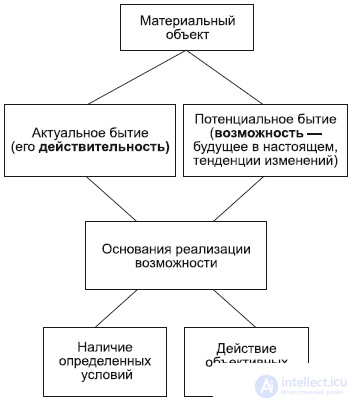
Continuing the analysis of the essence of a material object consists in distinguishing within it the aspects of potential and actual being, of possibility and actuality.
The concept «actuality» is used in two senses. In the broad sense, its content is close to the concepts «matter», «the material world» (as when one speaks, for example, of «the actuality surrounding us»). But the concept of actuality in this sense cannot be juxtaposed with the concept of possibility, since matter, the material world, exist as such not in possibility, but actually. The other sense of the concept «actuality» is the concrete being of a particular object at a given time, spatially localized, with definite qualitative and quantitative characteristics, under definite conditions. Actuality in this sense has as its dialectical partner possibility (as the possibility of this particular object). We shall use the concept «actuality» precisely in this sense.
The basic features of actuality are reality (actuality) and historicity. The actuality of an object is the whole wealth of its content, of its internal and external connections at a given time. But the actuality of a particular object is not something frozen and unchanging. Every concrete phenomenon arose at some point. The actuality that existed before has passed into the present actuality, and the present actuality will sooner or later turn into another. The historicity of actuality consists in the fact that it is the result of the change of preceding actuality and the basis of future actuality.
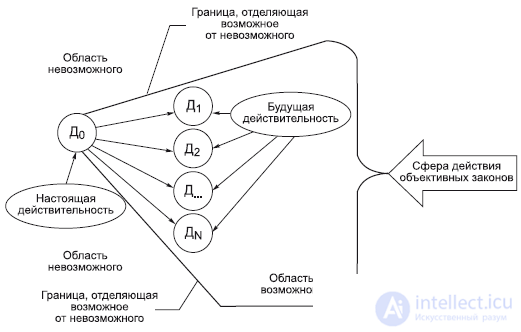
The given content of an object (actuality) contains within itself the preconditions for the emergence of a new actuality. The category «possibility» reflects the dialectic of the interconnection of present and future actuality. Possibility is the future of an object within its present, definite tendencies, directions of the object's change. Possibility does not exist somehow apart from actuality, but within actuality itself. A given actuality, in the general case, contains within itself a certain multiplicity of possibilities; a certain indeterminacy is inherent in the character of its change. The present, in the general case, cannot unambiguously determine which of the possibilities will be realized, since the conditions for their realization have not yet matured. Each concrete possibility is fully determinate, but the fate of each individual possibility – whether it will be realized or not – is relatively indeterminate.
In a concrete material object, not everything is possible. The set of its possibilities is limited by the laws of the object; law is that objective criterion which restricts the range of the possible, separating it from the impossible. Not all possibilities are objectively equivalent; this circumstance is reflected in the classification of possibilities.
A distinction is drawn between real and abstract possibilities. By a real possibility is understood one that can turn into actuality on the basis of existing conditions, while an abstract possibility is one that is not realizable on the basis of existing conditions, although it is admitted in principle by the laws of the object. An abstract possibility differs from an impossibility. The impossible contradicts the laws, and is therefore not admitted by them. It is precisely because there exists an objective law of the transformation and conservation of energy that attempts to create a «perpetual motion machine» are futile.
Every possibility has its own objective basis – the unity of the content of the object and the conditions of its existence. As the content of the object and the conditions of its existence change, the basis of the possibility likewise does not remain unchanged. Possibility has a quantitative characteristic, which is called the measure of possibility – probability. Probability is the measure of the realizability of some possibility. Determining the measure of possibility, that is, probability, is of great importance in practical activity.
Possibility and actuality are interconnected. In their unity, actuality plays the determining role; possibility exists on the basis of a definite actuality.
Two factors are necessary for the transition of the possible into actuality: the action of objective laws and the presence of definite conditions. As conditions change, the probabilities of various possibilities change. Within the object there occurs a kind of competition among possibilities. Laws only restrict the range of admissible possibilities, but do not determine the realization of one strictly definite possibility from among them; the latter depends on the complex of conditions.
The process of the realization of possibilities in natural, un-transformed nature proceeds spontaneously. In nature as transformed by people, the realization of possibilities is mediated by the subjective factor. A person can create conditions under which some possibilities are realized and others are not. Conscious human activity plays an even greater role in the realization of possibilities in society. In society there is a multitude of different, and often opposite, possibilities, and here the subjective factor plays a large role.
The analysis of the ways in which possibility is transformed into actuality leads to the concepts of necessity and chance.

Comments