
Lecture
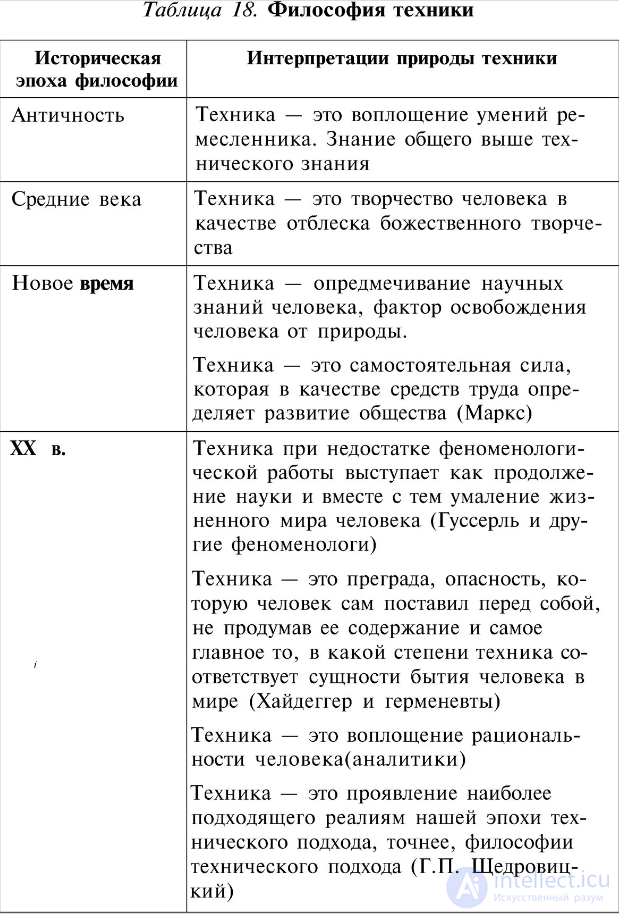
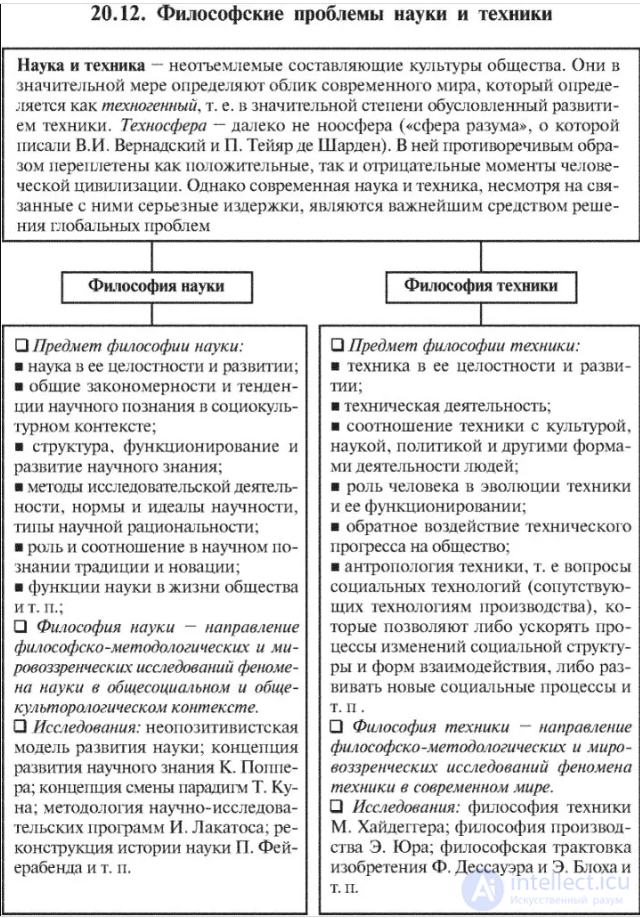
Philosophy of technology — the study of the first causes of technology. The founder of this branch of philosophy is Ernst Kapp, who wrote «Grundlinien einer Philosophie der Technik» (Basic Directions of the Philosophy of Technology). Toward a History of the Origin of Culture from a New Point of View" (1877) . In 1898 works devoted to the philosophy of technology were published by the German philosopher Fred Bon (one of the chapters of the book «On Duty and the Good») and the Russian engineer Peter Engelmeyer (the pamphlet «The Technical Outcome of the Nineteenth Century»). This discipline became a subject of systematic study only in the twentieth century. Various aspects of the philosophy of technology are examined in Marxism, transhumanism, and a number of other schools of thought.
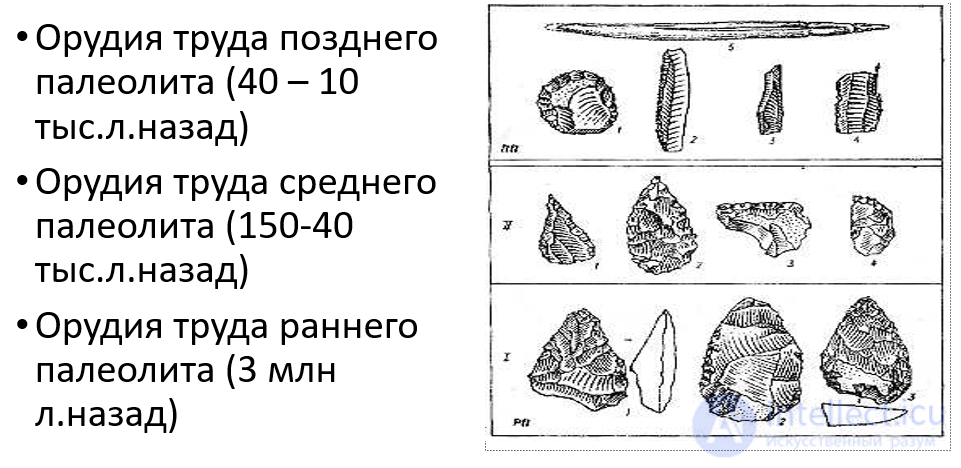
The ancient world – the animistic understanding of technology
Technology = magic
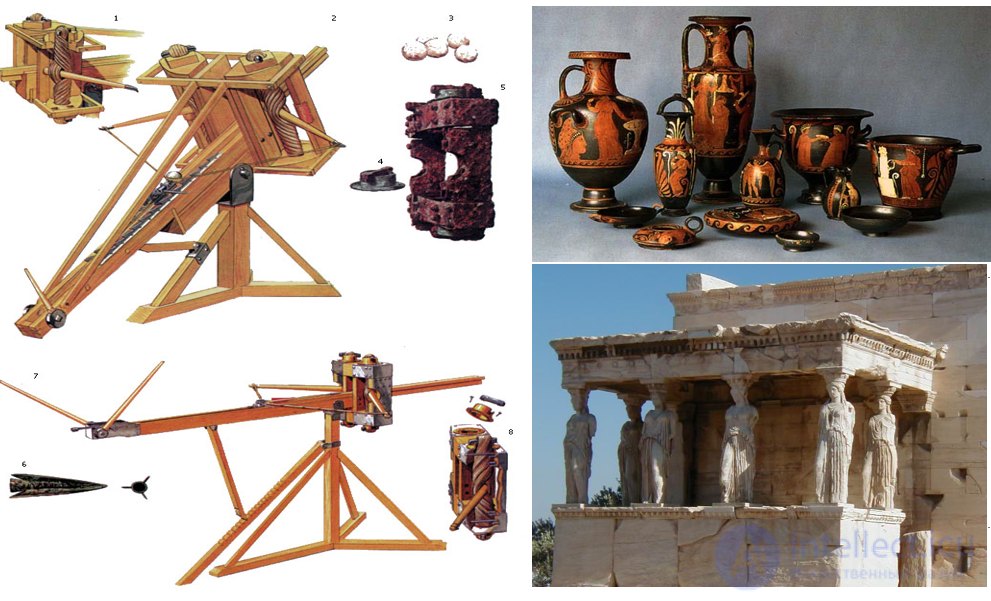
«techne» in Antiquity – the art of making things
The Modern Age: technology as the action of the laws of nature and, properly speaking, engineering creativity
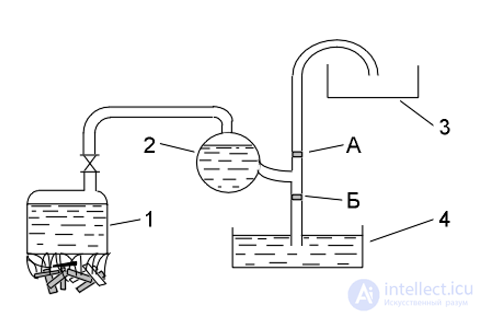
T. Savery's steam-powered water-raising engine for pumping water out of coal mines, 1 – boiler, 2 – water tank, 3 – receiving vessel, 4 – water source; A, B – valves
Johann Beckmann (1739–1811): Technology is an independent science, the area of investigation of which is the material-technical side of the production process. Technology is an independent science, the area of investigation of which is the material-technical side of the production process.
Two sources for the theoretical study of the development of industry:
1. The labor of the craftsman; 2. Books. «Introduction to Technology, or on the Knowledge of Guilds, Factories, and Manufactories..», 1777. Technology – the science of the processing of natural objects. «An Outline of General Technology» – the problem of terminology
Ernst Hartig (1836–1900): Asserts the necessity of creating a new science, "technologic", aimed at the logical elaboration of technical material
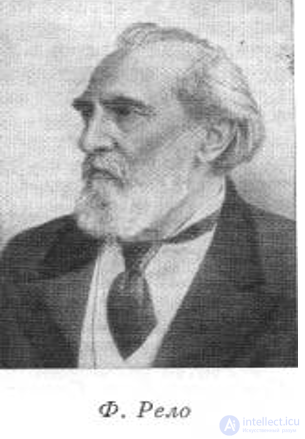
Franz Reuleaux (1829–1905): 1854–56 – engineer 1854–56 – engineer at the Cologne machine factory at the Cologne machine factory 1856 – professor of the mechanical-technical department of the Zurich Polytechnic 1856 – professor of the mechanical-technical department of the Zurich Polytechnic – director of the Trade Academy – director of the Trade Academy
Works of F. Reuleaux: «The Constructor» (Der Constructeur) 1854. «The Constructor» (Der Constructeur) 1854. «Theoretical Kinematics» 1875. «Theoretical Kinematics» 1875. «The Kinematics of Machinery» 1861. «The Kinematics of Machinery» 1861. «Technology and Culture» 1884. «Technology and Culture» 1884.
Questions formulated in «Technology and Culture»
1. «What place, properly speaking, does the technology of our day occupy in the general labor devoted to the task of culture».
2. The question of the main features of the method by which technology pursues its goals.
3. The question of technical instruction.
two methods of technology characterizing culture – manganism and naturism
1. Manganism – manganon (Greek) – skillful contrivance. The use of the forces of nature, when knowledge of the laws of nature allows one to control its forces.
2. Naturism – the unreflective use of certain forces of nature, for the purpose of protection from nature.
Eduard von Mayer, «Technology and Culture», 1906.
Ulrich Wendt, «Technology as a Cultural Force in its Social and Spiritual Connections», 1906.
Ulrich Wendt, «Technology as a Cultural Force in its Social and Spiritual Connections», 1906.
Nikolai Berdyaev, «Man and the Machine», 1933.
The journal «Culture and Technology» (Union of German Certified Engineers)
Alois Riedler (1850–1936) headed the laboratory for the scientific testing of automobiles and the Berlin Polytechnic. Works:
1. «German Higher Technical Institutions and the Demands of the Twentieth Century»
2. «The Goals of the Higher Technical Schools»
«German Higher Technical Institutions and the Demands of the Twentieth Century»
«The Goals of the Higher Technical Schools»: Features of the Engineering Approach:
Ernst Kapp (1808–1896), «Grundlinien einer Philosophie der Technik»
«Grundlinien einer Philosophie der Technik»: the basis of the work:
The basis of the work: the principle of "organ projection": in all his creations the human being unconsciously reproduces his own organs, and comes to know himself on the basis of these artificial creations.
Man – the measure of all things – the anthropological criterion; the distinction between the "natural" and the "artificial"
Fred Bon, «On Duty and the Good», 1898.
DUTY:
Determining the essence of the technical: The structure of a scientific statement: «If a, then b». The structure of a scientific statement: «If a, then b».
The structure of a technical statement: «If you want to obtain b, then you must bring about a». The structure of a technical statement: «If you want to obtain b, then you must bring about a».
Technology in the narrow sense – industrial (engineering) technology based on the statements of physics and chemistry
Technology in the broad sense – any purposeful activity conditioned by movement from the technology of the natural sciences to the technology of the sciences of the spirit
Technology is a theoretical guide to the carrying out of activity and, together with science, builds the edifice of theory.
Practice is any professional activity
The ultimate technical goal is the attainment of happiness, and all the questions – "what ought I to do in order to…?" – are united in a single question: "what ought I to do in order to be happy?»
.
technikus (Latin) most often designated a teacher of the arts, and, along with this, a practical man of affairs.
The Latin word ingenium (skillfully accomplished).
The activity of the engineer is creative
The activity of the technician is executive
The «theory of creativity» – euriology – the science of creativity
The theory of the three acts: desire, knowledge, skill.
Basic approaches to understanding technology:
1. The linear model.
2. The evolutionary model.
The linear model: technology is a discipline applied in relation to fundamental science.
The evolutionary model: science, at certain stages of its development, uses technology instrumentally to obtain its own results, and conversely – it happens that technology uses scientific results as an instrument for achieving its own goals; technology sets the conditions for the choice of scientific variants, and science, in turn, sets the conditions for technical ones; technology sets the conditions for the choice of scientific variants, and science, in turn, sets the conditions for technical ones
8 types of cultures:
The following stages in the development of technical knowledge are distinguished:
There are several possible relations between philosophy of science and philosophy of technology:
Both in antiquity (Hero of Alexandria) and in the Middle Ages, technology had not only the aspect of accomplishing its purpose or benefit, but always also an aspect of magic. The Neo-Kantian Ernst Cassirer pointed out in 1930 (in the essay Form und Technik) [19], that today's technical culture already finds echoes in the magical worldview of pre-technical cultures (Homo divinans). At the basis of technical thought and action there always lies a distancing from the nature being transformed. Without the subject's distancing from the objective world, technical development is impossible (technical idealism). This first objectifying relation, as the first reflection of the structure of the world and of nature, is inherent in the magical worldview. It is based on the conviction that one can influence the world by means of rituals and actions. Arbitrariness, or belief in the all-encompassing and dominant power of fate (the divine), already recedes into the background in magical actions. However, such a distanced relation to nature does not mean that nature is objectified by technologies.
In the twentieth century, the philosophy of technology came under the close attention of many scholars. In the 1930s it was discussed by leading representatives of the «Union of German Engineers», such as F. Dessauer (the founder of the religious current in the philosophy of technology ), K. Tuchel, and other specialists. The intensive development of the philosophy of technology began in the era of the «computer revolution» (the 1970s).
The foundations of the philosophy of technology in Russia were laid in 1898 by Peter Engelmeyer, author of the pamphlet «The Technical Outcome of the Nineteenth Century» (published in 1898) and of the works «The Theory of Creativity» (published in 1910) and «Philosophy of Technology» (published in 1913), the founder of one of the currents in the philosophy of technology — technicism , which he defined as «the doctrine of the technical being, that is, of the human being — a doctrine showing what is necessary and sufficient for a person to become such a being».
A significant role in the development of the philosophy of technology in the USSR and contemporary Russia was played by Doctor of Philosophical Sciences, Professor V.G. Gorokhov (1947—2016), who worked at the Institute of Philosophy of the Russian Academy of Sciences, at Moscow State University in the Department of History and Theory of World Culture of the Faculty of Philosophy , and at the Karlsruhe Institute of Technology, Germany.
Among those who have worked on problems of the philosophy of technology are, in particular:
Technology assessment (English: Technology assessment) — a special field of complex social research into the consequences of scientific and technological progress. On the one hand, research on technology assessment is characterized by interdisciplinarity and problem orientation; within its framework, significant questions of ontology, epistemology, axiology, and the ethics of scientific-technical activity are addressed. On the other hand, technology assessment is an instrument of expert support for the process of political decision-making. In this connection, scientific-technical development is examined from the point of view of the qualitative transformation of social and natural reality, in which technology functions as a connective communicative fabric, receiving and retransmitting impulses issuing from the subsystems of society or from individual social actors[12]. In Russia, contributions to the study of the philosophical aspects of technology assessment were made by V.G. Gorokhov[13] and D.V. Efremenko.
1. How many main aspects of the being of science are distinguished?
2. Name the main aspects of the being of science.
3. The essence of science includes moral and value content.
4. Name the tasks of the philosophy of science as a scientific discipline.
5. How many subtypes of problems of the philosophy of science can be distinguished?
6. Empiriocriticism is a direction that denies the objective existence of the material world and regards it as a phenomenon of consciousness and a combination of sensations.
7. Name the features of scientific cognition.
8. How many divisions of knowledge did G. Hegel identify?
9. Aristotle distinguished theoretical, practical, and creative knowledge.
10. Name the main functions of science.
11. Science is included in the system of the general division of labor and carries out activity aimed at the formation and development of scientific knowledge.
12. Science acts as the most important factor in the economic and cultural development of peoples.
13. In what year was hydrogen discovered?
14. Who introduced the concept of the chemical element?
15. The creator of the first integral theory of evolution.
16. Name the foundations of scientific knowledge.
17. How many ideals of scientific rationality are distinguished historically?
18. Scientific rationality is the totality of rules, norms, and standards of scientific-cognitive activity that ensures the scientific truth of the result of cognition.
19. A method of scientific cognition is a way of achieving some goal, of solving a specific task; a totality of techniques of the practical or theoretical cognition of reality.
20. How many methods of scientific cognition are distinguished?
21. Name the general logical methods of scientific cognition.
22. Name the empirical methods of scientific cognition.
23. The empirical level of scientific cognition is the totality of scientific factors that form the basis of theoretical knowledge.
24. Measurement is a cognitive procedure connected with determining the relation of the magnitude of the object under study to a reference magnitude.
25. The theoretical level of scientific cognition ensures a holistic perception of reality, that is, the diverse empirical methods fit into a single system.
26. Name the theoretical methods of scientific cognition.
27. Formalization reveals the relations between the parts, the elements, characterizing the form of an object, abstracted from its content.
28. Forms of scientific cognition are distinguished at the empirical and theoretical levels.
29. Name the forms of scientific cognition at the empirical level.
30. Name the forms of scientific cognition at the theoretical level.
31. Name the main methodological problems of the philosophy of technology.
32. In contemporary philosophy of technology, considerable attention is devoted to value-based and moral problems.
33. The philosophy of technology is the established name for a direction of contemporary philosophy investigating the general laws of the development of technology, technological processes, engineering-technical activity, and so on.
34. Technology in the narrow sense refers to technical devices, artifacts created by a person from elements of nature to solve specific cultural tasks.
35. Technology in the broad sense is a characteristic of an action, a technique that complicates or facilitates the action itself.
36. The essence of technology is that it is a means of rationalizing human activity, ensuring human existence in the processes of activity.
37. How many stages are distinguished within the philosophy of technology?
38. The industrial stage of the development of technology is characterized by…
39. The zero-cycle stage was
40. Who invented the vacuum cleaner?
41. In what year was the trolleybus invented?
42. Who invented the radio receiver?
43. Name the essential features of a technical theory.
44. A technical theory is a system of generalized knowledge about technical objects and their systems.
45. Distinctive features of the abstract objects of a technical theory: «homogeneity» and «assembly» according to certain rules.
46. Constructive-technical knowledge is oriented predominantly toward the description of the structure (or construction) of technical systems, representing a totality of elements possessing a certain form, properties, and mode of connection.
47. The empirical level of technical theory contains not only constructive-technical and technological knowledge, but also special practical-methodological knowledge.
48. Technological knowledge fixes the methods of creating technical systems and the principles of their use.
49. How many main levels does the theoretical level of scientific-technical knowledge include?
50. A functional scheme fixes a general representation of a technical system, independent of the mode of its realization, and is the result of the idealization of a technical system on the basis of the principles of a certain technical theory.
51. A flow scheme, or scheme of functioning, describes the natural processes taking place in a technical system and connecting its elements into a single whole.
52. The method of decomposition is applied to solve complex technical problems and consists in dividing a system into subsystems and elements for the purpose of detailed investigation with subsequent synthesis.
53. Modeling includes the process of creating a model of a technical object, investigating the model, transforming the model, and moving from the model to the technical object.
54. Graph theory makes it possible to carry out an isomorphic transformation of the graphic image of a graph-object.
55. Name the features of systems engineering.
56. Name the functions of professional engineering communities that arose in the eighteenth–nineteenth centuries in Europe and America.
57. The contemporary stage of the historical formation and development of engineering activity is connected with the development of systems engineering and social engineering.
58. In what forms is technical creativity historically realized?
59. In what forms is the practical level of engineering activity realized?
60. Discovery is the revealing of natural things and regularities, really existing in nature, but not previously known.

Comments