
Lecture
Ancient philosophy is a complex of ideas and doctrines produced by ancient Greek and ancient Roman thinkers during the period from the eighth century BCE to the sixth century CE, characterized by a certain unity of problems, content, and style. Ancient philosophy is a product of a non-traditional type of culture, based on dynamic social development and the formation of critical thinking. Specific to this type of culture is the formation, within it, of a special meta-level (meta-culture), oriented toward the reflective reconsideration of the deep worldview foundations and universals of traditional culture, the overcoming of mythological stereotypes of thought, and the development, on this basis, of new ways of seeing the world; moreover, the orientation toward plurality of knowledge characteristic of non-traditional cultures makes possible the parallel coexistence of different versions of understanding the world.
Ancient philosophy is the first phenomenon of meta-culture in the history of Europe, and not only the first historical type of philosophizing, but also the first form of conceptual thought as such. Because of this, it contains within itself subject areas that would in the future be constituted as independent theoretical disciplines (mathematics, astronomy, medicine, linguistics, and others). The development of ancient philosophy is the most important stage in the historical dynamics of the subject matter of philosophical cognition, having played a fundamental role in unfolding the problem fields of philosophy as such. Within ancient philosophy, ontology and metaphysics, epistemology and logic, anthropology and psychology, philosophy of history and aesthetics, moral and political philosophy all began to take shape.

The philosophical creativity of the Hellenes is an autonomous, independent philosophy that quickly freed itself from the authority of myth, mysticism, and ritual. The scientific knowledge of the Chaldeans and Egyptians, the Phoenicians and Persians, entered into Greek culture through creative reworking. The forms of Greek life that prepared the birth of philosophy are well known: the poems of Homer and the gnomic texts, the public Olympian religion and the Orphic mysteries, the sociopolitical and economic conditions. The mythology of the Hellenes, reworked and reinterpreted many times, recounts that the world process begins with Chaos – the formless state of the universe – from which the gods are then born: Gaia – Earth, Uranus – Heaven, Tartarus – the underworld, Eros – the beautiful world, Nyx – Night. The generations of gods in the universe, succeeding one another, constitute the kingdom of Zeus the thunderer, a world that resembles the Indian one: a similarity of traditions in the attitude toward the gods, who are vain and dependent, not omnipotent, for, like human beings, they are in the power of fate (among the Greeks – Moira, Ananke, Moros). The sociomorphic model of the cosmic process emphasizes its lawfulness, interpreting the cosmos by analogy with a state ordered according to law and on the basis of justice. Such a juridical coloring of ancient sociomorphism is connected with the particular way ancient Greek philosophy understood the mythologeme of fate, which combines in its semantics the aspects of necessity, objective lawfulness, on the one hand, and justice, on the other.
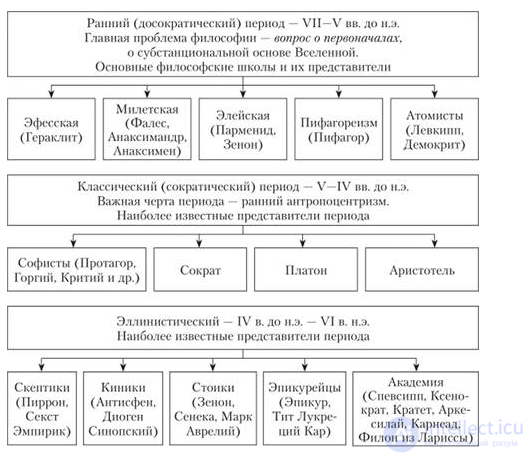
In the seventh and sixth centuries BCE a turn of minds occurs, connected with the crisis of the ritual Olympian religion and an acute awareness of spiritual-practical, existential problems – the search for the meaning of human existence, the relation between the individual and the universe, and so on. Being the result of a reflective, rational reconsideration of the universal worldview foundations of mythological culture, ancient Greek philosophy, in the early stages of its development, reveals traces of its mythological heritage within its properly philosophical content. This can be observed, above all, in terms of subject matter: the central object of knowledge in ancient Greek natural philosophy is the cosmos, and the basic form of philosophical doctrine is the cosmological model. In terms of problems, the mythological heritage manifests itself in the fact that genetism, as a strategic explanatory principle, is characteristic of the pre-Socratic philosophical doctrines. (Because of this, the central question of ontology – the question of the essence and structure of the world – is illuminated from the angle of the question of its origin).
The «seven sages» – the most authoritative keepers of wisdom for ancient Greek consciousness – played a great role in raising and clarifying this problem. There are many variant lists, as well as varying numbers of participants, but the name of Thales of Miletus (seventh – sixth centuries BCE), the first philosopher of Hellas, is invariably present in all of them. Like the lawgivers (Solon, Cleobulus, Chilon), he was concerned with morally reasonable human conduct, with the search for the measure that ensures happiness and prosperity for people. Thales is the founder of the Milesian school of the pre-Socratic period. He and his pupils – Anaximenes and Anaximander – brought about a spiritual revolution, forming a philosophical tradition in Hellas by transforming mythological conceptions of the origins of the world into philosophical reasoning about the origin of the many from a single source – arche (water, for Thales), apeiron (the boundless element, the substantial and generative principle of the cosmos, for Anaximander), air (for Anaximenes). They also considered this infinite and eternal element amid the change of things to be the ultimate foundation of human life and activity, and connected it with the determination of the human being's place in the world. Anaximander, for example, reasoned about the processes of nature and the world order itself (the interrelation of the cosmic elements, the change of the seasons and of things themselves) by analogy with the legal and moral norms of the polis. The cosmic elements, in which things arise and perish, render just retribution to one another for injustice at an appointed time. Hence the conception of the dominance in the world of a universal justice.
The spontaneous dialectician Heraclitus of Ephesus (520 – 460 BCE) also speaks of this, but regards world justice and universal harmony as the result of the struggle of opposites inherent in the nature of things and in the world order. The cosmos is primordial. It represents an ever-living fire and a universal logos, which, expressing the rationally ordered and harmoniously just structure of things, constitutes cosmic wisdom, to which people should orient their words, deeds, thoughts, actions, and way of life. The language of Heraclitus's philosophy, as follows from the fragments that have come down to us, is metaphorical, yet it touches on almost the entire range of questions proper to philosophy and its methodology. Thus, having formulated the principles of absolute changeability («One cannot step into the same river twice»), of non-repeatability, and of the opposition of one and the same thing, he forms the foundation of the first historical form of spontaneous dialectic as a method of knowing the world. Nature and the human being, in pre-Socratic philosophy, constitute a unity. However, the pre-Socratics did not identify nature and the human being, or soul and body, and did not separate the human being from the natural environment.
The Pythagoreans – a powerful religious movement, an order that arose within Orphism – sacredly preserved the traditions concerning their founder, the great ascetic, wonder-worker, and scholar Pythagoras (second half of the sixth – beginning of the fifth century BCE), son of Hermes, which resembles the tradition concerning the Buddha. All members of the community – mathematicians, the keepers of the secrets, and acusmatics, the novices who knew only the outward side of the doctrine – practiced an ascetic way of life, followed dietary restrictions and ethics: its foundation was the doctrine of what is proper, of the rule, of the limit that must not be crossed. Virtue was understood as control over the passions, as measure, and its absence as excess. The Pythagoreans studied the relations between numbers, the character of numbers, which led to a certain absolutization and mysticism of numbers. Numbers were elevated to the level of the real essence of all things. The first simple concept is the unit, as discrete and multiple; opposed to it is the dyad, difference, particularity. In geometric interpretation these numbers correspond to: the point, the line, the square, the cube. The sum of the numbers gives the sacred «decad», as the ideal number. This was historically the first attempt to comprehend the quantitative relations between really existing things. The Pythagoreans taught the immortality of the soul and the subordination of the demos to the aristocracy. Their way of philosophizing was the opposite of the spontaneous dialectic of the Milesian school, which was rather an intuitive explanation of the essential and at the same time universal features of dialectic.
The Eleatic school (end of the sixth – first half of the fifth century BCE) not only laid the foundation for abstract Western European metaphysics, setting a programmatic model of speculative construction of the model of being, but also carried out a deontologization of knowledge (the separation of the «way of truth» from the «way of opinion»), thereby giving impetus to making knowledge a special subject of philosophical analysis. Thus Xenophanes, Parmenides, Zeno, and Melissus examined being, the ontological problems of philosophy, although Xenophanes was more concerned with theological and cosmological problems. He criticized popular conceptions of the gods, believing that people had created them in their own image and likeness. God is singular, unmoving, spherical (perfect), representing not a body but a thought. Yet in striving for a naturalistic explanation of natural phenomena, he regards universal being as eternal and unchanging, which lends his philosophy features of immobility. The senses cannot provide the basis for true knowledge, but lead only to opinions, to appearance. Parmenides (540-470 BCE) held that many opinions can be expressed about any thing, but there is only one truth. What, then, is the world in truth? Only by being guided by reason, and not by the senses, can we find the answer. But even following reason does not guarantee truth: for one may admit non-being, and the opinion that being and non-being are the same thing. He demonstrates that this leads to contradiction. Being is indivisible and unmoving, the one – God. In his teaching, cosmology is transformed into ontology (the theory of being). There are three ways of investigating the One: the way of absolute truth, the way of changeable opinions, and the way of opinions worthy of praise. He approaches the idea of the identity of being and thought.

The gap between the intelligible reality and the evident became the basis for the reasoning of his pupil, Zeno of Elea, who invented aporias, or examples of difficulties that arise for thought if it admits the existence of non-being and its consequence – motion and the divisibility of being. And although this contradicted the evident, he said that a flying arrow rests at every moment at a determinate point, and that swift-footed Achilles cannot catch up with the slow tortoise, since to each of his steps corresponds a step of the tortoise. Behind these inconsistencies lie the contradictions between sensory opinion and rational cognition. Zeno maintained that he was proving not the absence of motion, but only that it is unthinkable. In the world of thought there is no motion. This philosophy is brought to completion in its systematization by Melissus of Samos (fifth century BCE), through the recognition of being as «infinite», «bodiless», and the decisive elimination of the sphere of opinion, for the One neither suffers nor grieves. That which is, is eternal, boundless, and entirely homogeneous; there is no motion, though it seems that there is. This doctrine combines Anaximander's apeiron with Parmenides's being, synthesizing Ionian and Italic philosophy.
In place of the quantitative characteristics of being, Anaxagoras (500 – 449 BCE) proposes qualitative, structural elements of it. He holds that the goal of philosophizing is contemplation. At the basis of what exists lie the homoiomeries – like-substanced seeds of things, moved by the power of mind. Mind moves the world and knows it. In a certain sense Anaxagoras prepared the way for atomistic doctrine. Democritus (460 – 370 BCE) creates a general picture of the world, taking as the basis of being the atom (an indivisible particle), which is eternal, without content, but with a definite form and magnitude. The diversity of the phenomena of the world is ensured by the multiplicity of forms. The void separates the moving atoms, which, through their interaction, create the qualities of things. Order (cosmos) is the result of the mechanical interaction of atoms, which leads to the recognition of the objectivity of nature and its change. Cognition is explained as the result of the contact of the atoms of bodies, which emit effluences, with our senses. Combinations of moving atoms give rise to worlds and, of necessity, become the cause of their disappearance. The possibility of chance is excluded. Democritus proclaimed: «The wise man is the measure of all things», that is, his philosophy is the view of the sage contemplating the world. Philosophical truth is difficult to grasp; it is hard to live knowing that everything in the world is illusory except atoms and the void. Democritus devoted considerable attention to the problem of culture and the human being. In his moral judgments he reflects the ripening of a crisis situation in ancient society. In atomistic theory, which is the summit and completion of the natural-philosophical period in the development of ancient philosophy, the problem of the reflection of the unity of the cosmos in the logic of concepts is in fact posed explicitly – the question of the adequacy of the philosophical vision of the world to the world itself comes to the fore.
The formation of classical Attic philosophy marks a radical turn toward logico-epistemological, sociopolitical, moral-ethical, and anthropological problems. A definite sign of this situation was the appearance of the Sophists – sophisticated experts in knowledge, paid teachers of thinking. Their knowledge was superficial, and they were often regarded as unprincipled polemicists, but they played a role in the formation of the technique of philosophical discussion, in the development of the art of logical argumentation – in what it was customary in Hellas to call dialectic. The Sophists discussed politics, rhetoric, language, religion, education – that is, the cultural sphere of the ancient human being. They created schools of rhetoric, as well as eristic – the art of verbal dispute, in which argument is an end in itself. Nevertheless, they made a certain contribution to the development of philosophy, being the first to advance the opposition between the unchanging laws of nature and the changeable establishments of human beings, pointing to changeability as the main property of reality, and to the existence of everything only in relation to and through another. Their conclusions contributed to the elaboration of the position that truth is relative and that usefulness is its criterion. The thesis of Protagoras (fifth century BCE), «Man is the measure of all things», points to the problem of human needs and interests in relation to the world. The Sophists shifted the center of gravity into the sphere of anthropology, into the doctrine of the human being and of cognition, pointing to the relativity of moral norms, the indeterminacy of the world, and its unknowability.
The crisis and decline of Athenian democracy after the defeat of Athens in the Peloponnesian War (431 – 404 BCE) became fertile ground for a general spiritual crisis, which is reflected in the later Sophists. But these phenomena were also, in their own way, a challenge of the times, to which the response was a spiritual upsurge among a narrow circle of intellectuals connected with the names of Socrates (469 – 399 BCE) and his pupils, which marked a new, classical period in ancient philosophy. Although the striving for self-knowledge was characteristic of early Greek philosophy, it was Socrates alone who made the formula of wisdom «Know thyself» the central part of his teaching. Socrates's philosophy is a search for ethical definitions by means of dialogue. Although this search led him to the skeptical conclusion, «I know that I know nothing», he was convinced that ignorance, or rather, knowledge of one's ignorance, ultimately turns into knowledge, albeit always relative knowledge. For Socrates, the meaning of human life lies in philosophizing, in constant self-knowledge. He held that human actions are determined by the degree of a person's knowledge (no one does evil of his own will, but only out of ignorance). Socrates's method is an idealist dialectic of concepts, the art of revealing contradictions in an interlocutor's views by bringing points of view into collision. Its component parts are «irony» and «maieutics» (in form), and «induction» and «definition» (in content). Irony is the bringing of an interlocutor into contradiction with himself. Maieutics – the midwife's art – helps listeners to be reborn, to come to know the «universal» as the basis of «true morality». Induction helped to discover what is common in particular virtuous acts, while definition brought individual concepts under the «universal». Socrates's irony and sharpness of mind led Athenian democracy to accuse him of corrupting the youth and undermining the foundations of society, as a result of which he died from the poison he was made to drink.
Several schools of Greek philosophy recognized Socrates as their founder. The Socratic schools include the Megarian (Euclid, Stilpo, Diodorus Cronus), the Elis-Eretrian (Phaedo, Menedemus), the Cynic (Antisthenes of Athens and Diogenes of Sinope), and the Cyrenaic (Aristippus) schools. In them, in various ways, the doctrine of the correct way of life, of ethical principles, of happiness and the overcoming of the passions, and of an existence worthy of a philosopher was discussed. Euclid showed the inapplicability of the propositions of discursive logic in paradoxical situations of cognition, which is why the works of the skeptics were not concerned with establishing truth, but with exposing falsehood and demonstrating the untruth of human judgments.
Aristippus of Cyrene believed that we know only our own states, those which are either pleasant or unpleasant, and only those characteristics of them which give us grounds for choosing between them. And in fact we always care only about the pleasant and avoid the unpleasant. This means that the pleasant is the sole good, and correspondingly the unpleasant is the sole evil. This position derives from the Greek term meaning pleasant, and came to be called «hedonism». Aristippus was apparently the most resolute and uncompromising hedonist that the history of ethics has known. The fact that he could be called a Socratic rested, most likely, on the fact that he, like Socrates, connected the good and pleasure, whereas Aristippus held that pleasure was the sole good.
Among the pupils of Socrates a special place is occupied by Plato (427 – 347 BC), who founded the Academy – a philosophical school combining features of a scholarly community and a religious community. Plato's teaching is the result of an ordering of the various moments of his creative work. His philosophy is clothed in the artistic form of the dialogic genre, resembling plays. The mouthpiece of Plato's point of view in the dialogues is Socrates. However, Plato goes beyond the limits of the sensory world, since he arrives at the conviction of the existence of an unchanging suprasensory world of ideas, a world of «true being», affirming the primacy of the general, existing outside and above the particular. Truth, goodness, beauty, the good, and justice bear an ideal, unchanging character. Ideas represent the form-giving principle, while matter personifies possibilities. The world soul ensures their purposeful combination. Idea, matter, and soul are the cause of the world of objects, ordered by the demiurge, god, the highest idea. It is precisely the demiurge who ordered chaos into cosmos, ordered mind in the soul, and soul in the body.
Plato is usually considered the founder of objective idealism, that is, the philosophical doctrine according to which thoughts and concepts exist objectively, independently of human consciousness, and constitute genuine being. But this notion is a modernization and an attribution to Plato of convictions that took shape considerably later. In the psychological and moral sense he was undoubtedly an idealist, since the most important problem for him was the relationship between the ideal and reality, for the world does not know justice and does not live in accord with it. The ideas of the good, the beautiful, and justice are present in people's consciousness, which means that this world cannot be truly real. Consequently, besides it there must exist another world of genuine values and unshakable order, undisturbed by any human arbitrariness. Confidence in the existence of such a world is a vital necessity. The nature of the human being, according to Plato, is determined by the soul, which consists of three parts: the first expresses the ideal-rational capacity, the second – the desiring-volitional, and the third – the instinctive-affective. On which of these predominates depends a person's fate, the direction of their activity, and the meaning of life. Souls migrate into a person from the world of ideas and recall what they contemplated before their incarnation in the body. The demiurge, as a divinity, creates things according to the ideas. Plato's philosophy includes a theory of knowledge, dialectics, rhetoric, art and eroticism, and a doctrine of the state and society. «The Republic» and «The Laws» are a synthesis of ethico-philosophical and political-legal views. In the state there exist three estates: the philosopher-rulers (holding all power), the warriors (guarding the state from external and internal enemies), and the artisans and farmers (the production of material goods). In any state there are the poor and the rich. Overcoming social injustice is possible through the abolition of private property and the family, as well as the education of a new generation of people free of destructive egoism.
The last great philosopher of Hellas was Plato's pupil Aristotle (384 – 322 BC) of Stagira, who also founded his own school – the Lyceum, combining an educational institution and a scholarly union. He treated Plato's conception as a theory describing the universe. Being encyclopedically versatile (he engaged in the natural sciences, poetics, and problems of state structure, and was the creator of logic and psychology), Aristotle is known, above all, as a philosopher. His writings on questions of nature are called the «Physics»; there are also the treatises «On the Soul», «Nicomachean Ethics», «Poetics», «Rhetoric», «Analytics», «Politics», «Economics», and others. His principal work – the «Metaphysics» – a compendium of his lectures, edited by his pupils and so named three centuries later by the commentator Andronicus of Rhodes – is devoted to the investigation of the first causes and principles apprehended by speculative reason.
Aristotle covered almost all branches of knowledge accessible in his time. In his «first philosophy» (metaphysics) Aristotle subjected Plato's doctrine of ideas to criticism and gave a solution to the question of the relationship in being between the general and the particular. The particular is that which exists only «somewhere» and «now»; it is sensibly perceptible. The general is that which exists in any place and at any time («everywhere» and «always»), manifesting itself under certain conditions in the particular, through which it is known. The general constitutes the subject of science and is apprehended by the mind. To explain what exists, Aristotle posited 4 causes: the essence and the essential nature of being, by virtue of which every thing is what it is (the formal cause); matter and the substrate – that out of which something arises (the material cause); the moving cause, the origin of motion; and the final cause – that for the sake of which something is accomplished. Although Aristotle recognized matter as one of the first causes and considered it a certain essence, he saw in it only a passive principle (the possibility of becoming something), while he ascribed all activity to the remaining three causes, and to the essence of being – form – he ascribed eternity and immutability, while he considered the source of all motion to be an unmoved, but moving, principle – god. Aristotle's god is the «prime mover» of the world, the highest goal of all forms and formations developing according to their own laws. Aristotle's doctrine of «form» is a doctrine of objective idealism. Motion, according to Aristotle, is the transition of something from possibility into actuality. Aristotle distinguished 4 kinds of motion: qualitative, or change; quantitative – increase and decrease; locomotion – motion through space; and coming-to-be and passing-away, reducible to the first two kinds.
According to Aristotle, every really existing individual thing is a unity of «matter» and «form», with «form» being the «shape» inherent in the substance itself, which it takes on. One and the same object of the sensible world can be regarded both as «matter» and as «form». Bronze is «matter» in relation to the sphere («form») that is cast from the bronze. But that same bronze is «form» in relation to the physical elements whose combination, according to Aristotle, constitutes the substance of bronze. The whole of reality thus turns out to be a sequence of transitions from «matter» to «form» and from «form» to «matter».
In his doctrine of knowledge and its kinds, Aristotle distinguished «dialectical» and «apodictic» knowledge. The domain of the first is «opinion», obtained from experience; that of the second is reliable knowledge. Although opinion can attain a fairly high degree of probability in its content, experience is not, according to Aristotle, the ultimate court of the reliability of knowledge, for the highest principles of knowledge are contemplated directly by the mind. Aristotle saw the goal of science in the complete definition of the subject, attainable only through the combination of deduction and induction: 1) knowledge of each individual property must be acquired from experience; 2) the conviction that this property is essential must be proved by an inference of a special logical form – a category, a syllogism. The investigation of the categorical syllogism, carried out by Aristotle in the "Analytics", became, alongside the doctrine of demonstration, the central part of his logical teaching. Aristotle understood the connection of the three terms of the syllogism as a reflection of the connection of consequence, cause, and the bearer of the cause. The basic principle of the syllogism expresses the connection between genus, species, and the individual thing. The totality of scientific knowledge cannot be reduced to a single system of concepts, for there is no concept that could be a predicate of all other concepts: therefore for Aristotle it proved necessary to indicate all the highest genera – the categories – to which the remaining genera of being are reducible.
Aristotle's cosmology, for all its achievements (the reduction of the whole sum of visible celestial phenomena and the movements of the luminaries into a coherent theory), was in some respects backward in comparison with the cosmology of Democritus and the Pythagoreans. The influence of Aristotle's geocentric cosmology persisted right up to Copernicus. Aristotle was guided by the planetary theory of Eudoxus of Cnidus, but ascribed real physical existence to the planetary spheres: the universe consists of a series of concentric spheres, moving at various speeds and set in motion by the outermost sphere of the fixed stars. The «sublunary» world, that is, the region between the orbit of the Moon and the center of the Earth, is a region of disorderly, non-uniform motions, and all bodies in this region consist of the four lower elements: earth, water, air, and fire. Earth, as the heaviest element, occupies the central place, above which are successively arranged the shells of water, air, and fire. The «supralunary» world, that is, the region between the orbit of the Moon and the outermost sphere of the fixed stars, is a region of eternally uniform motions, and the stars themselves consist of the fifth – most perfect – element, ether.
In the field of biology one of Aristotle's contributions is his doctrine of biological purposiveness, based on observations of the purposive structure of living organisms. Aristotle saw examples of purposiveness in nature in such facts as the development of organic structures from seed, the various manifestations of the purposively acting instinct of animals, the mutual adaptation of their organs, and so on. In his biological works, which for a long time served as the main source of information on zoology, Aristotle provided a classification and description of numerous species of animals. The matter of life is the body, the form is the soul, which Aristotle called «entelechy». Corresponding to the three kinds of living beings (plants, animals, humans), Aristotle distinguished three souls, or three parts of the soul: the vegetative, the animal (sentient), and the rational.
In Aristotle's ethics, the highest place is given to the contemplative activity of reason (the «dianoetic» virtues), which, in his thinking, contains within itself a pleasure peculiar to it alone, one that intensifies energy. This ideal reflects a feature characteristic of slaveholding Greece of the fourth century BC: the separation of physical labor, which constituted the lot of the slave, from mental labor, which constituted the privilege of the free. Aristotle's moral ideal is god – the most perfect philosopher, or «thought thinking itself». Ethical virtue, by which Aristotle understood the rational regulation of one's activity, he defined as a mean between two extremes (metriopathy). For example, generosity is a mean between stinginess and extravagance.
Aristotle regarded art as a special kind of cognition based on imitation, and placed it as an activity depicting that which could be higher than historical knowledge, which has as its subject the reproduction of one-time individual events in their bare factuality. This view of art allowed Aristotle – in the «Poetics» and «Rhetoric» – to develop a profound theory of art, close to realism, and a doctrine of artistic activity and of the genres of epic and drama.
Aristotle distinguished three good and three bad forms of government. He considered good those forms in which the possibility of self-interested use of power was excluded, and in which power itself served the whole of society; these are monarchy, aristocracy, and «polity» (the rule of the middle class), based on a mixture of oligarchy and democracy. Conversely, Aristotle considered tyranny, pure oligarchy, and extreme democracy to be bad, as it were degenerate, varieties of these forms. Being a proponent of the ideology of the polis, Aristotle was an opponent of large state formations. Aristotle's theory of the state rested on the enormous factual material about Greek city-states that he studied and that was gathered in his school.
On the basis of his ethical and psychological conception, Aristotle developed a theory of the education of «freeborn citizens». According to Aristotle, the three kinds of soul correspond to three interconnected aspects of education – physical, moral, and mental. The goal of education consists in developing the higher aspects of the soul – the rational and the animal (volitional). Natural inclinations, habits, and reason are, according to Aristotle, the driving forces of development on which education relies. Aristotle made the first attempt in the history of pedagogy to provide an age periodization. Regarding education as a means of strengthening the state order, he held that schools should be state-run only, and that in them all citizens, excluding slaves, should receive the same education, accustoming them to the state order.
Aristotle worked out philosophical problems in substantial depth, developed exemplary models of systematic, abstract-theoretical philosophical conceptions, setting the canon of the West European philosophical tradition, which allowed him, in the thought of G.W.F. Hegel, to remain, until the sixteenth century, the «prince» of philosophers.
The economic and political crisis of Greece in the Hellenistic period (the turn of the fourth–third centuries to the second century BC) is also reflected in Greek philosophy. Instead of the cognition of the objective world, it occupies itself with ethicizing, moralizing, and skepticism. The heir of Aristotle's philosophy is the Peripatetic school (the school of those who stroll), which propagated his writings mostly through commentary. The transformation of Greek, Hellenic culture and the spread of the cosmopolitan ideal, the discovery of the individual, bring Epicureanism, Stoicism, skepticism, and eclectic philosophy onto the scene.
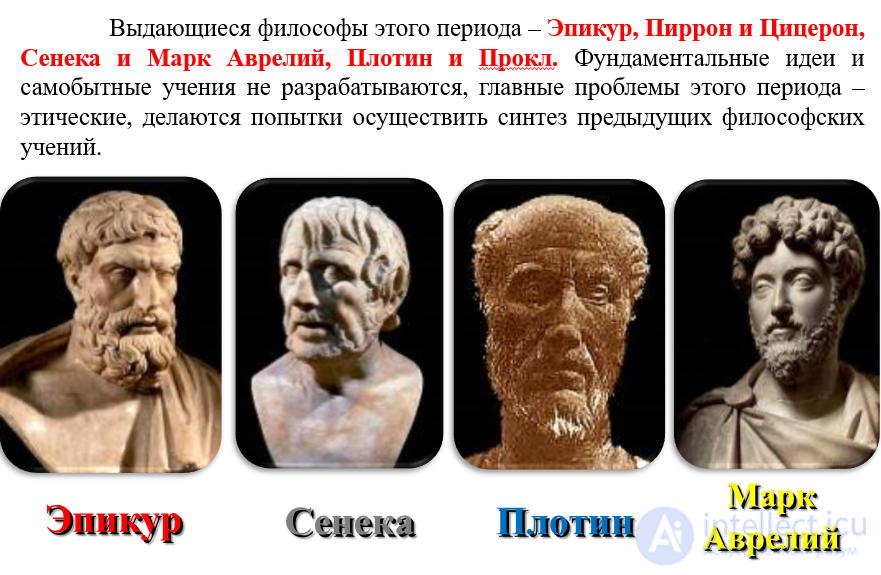
Epicurus (342 – 271 BC) established, in opposition to Plato's Academy, the Garden, preaching new ideals. Philosophy is an activity that, through reflection and inquiry, gives people a happy and untroubled life free from suffering. Philosophy consists of the following parts: ethics (the doctrine of the ways of attaining happiness), physics (the doctrine of the natural principles of the world), canonic (or logic), and epistemology (knowledge of the criterion of truth and the rules for the cognition of physics). Having absorbed the preceding materialism, Epicurus asserted two propositions in physics: nothing is born from non-being, and the universe is constant and infinite. The soul is a structure of atoms, the finest matter, dispersed throughout the whole body. From this follows the immortality of the soul.
At the end of the fourth century BC, another school was born in Athens, founded by Zeno, who held his classes in the Portico (Greek – Stoa), for which reason the school was called Stoic. The Stoics, following Aristotle, believed that there exists a single world, whose fate, like that of every person, is determined by an impersonal god-logos, of which the human reason may be a part. Thus Zeno asserted that the human mind is not merely similar to the divine, but is itself god, a part of the divine substance in its pure or active state. Thus a strict determinism was ultimately transformed in their teaching into a theological view of the nature of the world and of man. The action of inexorable fate – the logos – excludes any freedom, including freedom of the will. Freedom is possible only for particular individuals, sage-heroes. Hence the division proposed by the Stoics into the wise and the foolish, the spiritually free and slaves.
The Stoics were not interested in studying man as he is. They investigated his possibility of becoming a sage (what he ought to be). Zeno and Chrysippus held that moral perfection does not depend on man's natural inclinations, but solely on mental exercises, on his intellectual efforts, which allow him to be indifferent to life and death, to fame and infamy, to wealth and poverty, to sickness and health. The goal of life – is the attainment of happiness, the harmony of thoughts, feelings and desire. Virtue – is the art of right living. Man's highest goal – is a life in accord with nature. In ancient Rome, the Stoics defended the idea of eternal peace, linked fate with the individual, and considered a life following duty, obligation and pleasure to be moral. Ethics is inseparable from utility. The single goal of all the virtues – is happiness. God – is the world Logos, the beauty of nature. Providence – is the law of nature and of will in man.
In contrast to the Stoics and Epicureans, the Cynics saw the foundation of happiness and virtue in disdain for social norms, in the rejection of the benefits of civilization. Antisthenes of Athens was the founder of this school, whose name derived from the gymnasium of Cynosarges, where he taught. At first he was a pupil of Gorgias, and then of Socrates, whom he closely resembled in appearance. Antisthenes belonged to the Athenian proletariat and set forth its ideology in his doctrine. A pupil of Antisthenes was Diogenes of Sinope (died in 323); and the most outstanding pupil of Diogenes, in turn, was Crates of Thebes, who, together with his wife Hipparchia and other members of his family, belonged to the Cynic school.
Valuing only a life «in accordance with nature», the Cynics rejected all social and state institutions, finding them conventional (contractual). Following Socrates, they asserted that virtue is the same for all; attaching significance only to virtue, and not to origin or property, they considered all people equal. The Cynics opposed all forms of inequality, and were for the equal rights of women and slaves. They did not recognize state borders, and considered themselves citizens of the world, «cosmopolitans».
Skepticism is also characteristic of the declining Hellenistic philosophy. The founder of this trend, Pyrrho of Elis (360 – 270 BC), denied the truth of all cognition, and preached abstention from judgments about things. Equanimity in judgment and inactivity, silence (aphasia) and detachment, indifference (ataraxia) – these are the foundations of their philosophizing. The skepticism of Sextus Empiricus (2nd century BC) upheld an ethics of common sense, bringing it, like life itself, into accord with experience and with following the promptings of nature, the impulses of our affects, the necessity of respecting the laws and customs of one's own country as practically necessary, not remaining inert, but exercising one's skills. However, one must live in accordance with circumstances, neither proving nor refuting, but merely accepting one's Fate with dignity.
These conclusions assert the impossibility for an individual to change life, circumstances. The founder of Roman eclecticism, Marcus Tullius Cicero (106 – 43 BC), asserted that genuine philosophy – is ethics, as the science of the establishment of social relations. As genuine encyclopedists, the representatives of eclecticism held that the combination, in their views, of various philosophical schools was not without foundation, since they offer their own recommendations for the cultivation of the virtues.
A vivid representative of the traditions of ancient materialism was the Roman poet and philosopher Lucretius (99 – 55 BC). He rejected the religious teaching of the creation of the world, which, in his opinion, has always existed and always will exist. Giving a materialist explanation of the world, he regards man as its component part, as the creator of culture and technology. The goal of philosophy – is to point man toward the path to happiness, to free him from fear of the gods, of death, and of punishment beyond the grave. His teaching had a great influence on the formation and development of the philosophy of the Renaissance.
The last flowering of the philosophy of the pagan ancient world is seen in Neopythagoreanism, in its variations, and in Neoplatonism. Interest in ethics becomes exceptional (Seneca). In the first centuries of our era, Cynicism, skepticism, Aristotelianism and Stoicism are revived. But the progressing crisis of Roman society, both in the last years of the republic and in the first years of the empire (1st century BC), is naturally also reflected in philosophy. Distrust of the rational appropriation of the world, which had manifested itself earlier, together with the strengthening of Christianity, increasingly reinforces and multiplies irrationalism and mysticism. Neopythagoreanism attempted to fortify itself by a return to the mysticism of numbers. Philo of Alexandria strives to unite the philosophy of the Greeks with Jewish religious exegesis. He declares that the goal of philosophy – is the knowledge of God. The mind aids cognition only of its image in the Logos. The sensory reflection of the Logos – is the Cosmos. God – the existent – is one and absolutely simple, unchanging, transitory. Ideas, in turn, are both logoi, and angels, and powers. The world arises by way of emanation (outflowing) from the One. Unlike the Stoics and the skeptics, the Gnostics and the Manichaeans do not believe in the capacity of human reason and place their hope in transcendence toward the supernatural. The Gnostics and Manichaeans devoted great attention to the problem of dualism (the struggle of light and darkness, good and evil, spirit and matter). The methods proposed by the Gnostics for solving the problem of overcoming dualism are discussed. The reasons for the irreconcilability of Christianity with the Manichaean position on the substantiality of evil are examined.
Neoplatonism, which developed in the 3rd – 5th centuries of our era, was more fundamental. Being the last integral philosophical worldview to arise in the period of antiquity, it took shape in the same atmosphere as Christianity. This is a specific reflection of the social hopelessness and the progressing disintegration of the social relations of Rome. Plotinus (205 – 270) – is the last original voice of Greco-pagan antiquity, uniting Plato and Aristotle. The foundation of all that exists is the «One», producing itself, the Good in itself. The One is supra-sensory, supernatural, supra-rational, unknowable. It is graspable only through penetration into the center of pure contemplation and pure thought, which becomes possible only through a «withdrawal» of thought – ecstasy. A gradation of existences is created, from the outer (the true) to the lower (the untrue). At the summit of this system stands the One, then the divine soul and nature. The soul – is the transition from the divine to the material. The originality of Plotinus's thought consists in the fact that he grounds a creative contemplation. Contemplation possesses, as it were, both a rational form and a creative one (pure contemplation).
In 529, the Roman emperor Justinian closes the Academy. The end of ancient pagan philosophy arrives.
Neoplatonism was its last refuge. The Neoplatonic schools: the Alexandrian (Ammonius Saccas, Plotinus, Porphyry), the Syrian (Iamblichus), the Athenian (Plutarch, Proclus), the Second Alexandrian, and Pergamum (Julian the Apostate) had their own orientations.
1) Plotinus and Ammonius – a metaphysical-speculative tendency (philosophical discourse and an independent «positive» religion, magical-theurgic practice).
2) Iamblichus and the Athenian school – a combination of philosophical and mystical-theurgic approaches, the foundation of a polytheistic religion.
3) The school of Pergamum was engaged in religious-theurgic practice.
4) A simplification of Platonism takes place in the Second Alexandrian school.
These philosophies, with their irrationalism, their aversion to all that is corporeal, their emphasis on asceticism and the doctrine of ecstasy, exerted a significant influence not only on early Christian philosophy, but also on medieval theological thought.
Antiquity, or more precisely, Greece itself, left an extraordinarily broad spectrum of various philosophical conceptions: systematic and critical, dogmatic and skeptical philosophies, dualist and monist views of the world, idealism and realism, variabilism and invariabilism, theism, atheism and pantheism, the logic of concepts and the logic of statements; in the philosophy of nature — mechanism and dynamism; in the theory of knowledge — empiricism and apriorism, sensualism and rationalism; in ethics — moralism and hedonism. In the final period, Greek culture merged with Roman culture, on the one hand, and with Eastern culture, on the other; it learned (under the influence of Rome) to treat philosophy from the standpoint of the needs of life, and also (under the influence of the East) developed mysticism, theocentric metaphysics, an ecstatic theory of knowledge, and transcendental ethics.
A brief excursus into the history of ancient philosophy shows that:
1) all the main branches of philosophy are represented, as a rationalized worldview oriented toward the search for the substantial first-principle of the Cosmos, the Soul, Man, Society, which ensured the cognition of the world, of society and of man, and the attainment by him of happiness;
2) the ancient thinkers reflected a spontaneous dialectic and materialism, characteristic both of nature and of thought;
3) the development of science and productive practice exerts a direct influence on philosophy, which itself, in turn, contributes to their progress;
4) philosophy is directly connected with the spiritual culture of society;
5) ancient philosophy prepared the ground for medieval philosophy, its conceptual apparatus, and the emphasis on the spiritual principle for the theoretical grounding of nascent Christianity.
On the whole, the development of ancient philosophy – is a unique stage of the history-of-philosophy tradition, for within its bounds practically the entire spectrum of trends of the further historical dynamics of the subject of philosophical cognition is set, the formation of the initial, basic categorial apparatus of philosophy is carried out, and all the vectors of the unfolding of the problem fields of philosophical knowledge take shape. In the philosophy of antiquity, practically all the modes of the existence of philosophy in culture are laid down: teaching, doctrine, the discursive practice of discussion, esoteric forms of philosophizing, philosophy as a way of life (and, bearing Socrates in mind, of death as well). The philosophy of antiquity laid the beginning for the development of the independent traditions of ontology, epistemology, logic, psychology, ethics, aesthetics, the philosophy of history, and the philosophy of spirit. In the course of the development of ancient philosophy, the constitution of practically all the genres of philosophizing typical of the European tradition takes place: the first natural philosophy, gravitating toward positive knowledge (the Milesian school); the first speculative-contemplative metaphysics (the Eleatic school); the first experience of mystical philosophizing (Pythagoreanism); the first version of European enlightenment (the Sophists); the first system of refined idealist intellectualism (Plato); the first universal and all-embracing world schema (Aristotle); the first examples of relativism, skepticism, and many others.
The influence of ancient classical culture on European culture cannot be overestimated. From Plato's conception of absolute models originates not only the tradition of philosophical idealism, but the whole of European aesthetics as well, and Neoplatonism serves as the categorial-methodological foundation of Christianity. Aristotle's syllogistic lays the foundation of the logical framework of the European style of thought, and it is with Aristotelianism that the intention of Western culture toward ordering classificatory schemes is connected. Ancient philosophy, thus, in many ways determined the most important tendencies of the development, not only of European philosophical thought, but of Western culture as a whole.
In the philosophical thought of antiquity, in a far clearer form than occurs later, worldview clashes and struggles are projected. The original unity of philosophy and of the expanding special scientific fields of knowledge, and their systematic separation, explain quite graphically the interconnection of philosophy and the special (particular) sciences. Philosophy permeates the entire spiritual life of ancient society; it was an integral factor of ancient culture. The richness of ancient philosophical thought, the posing of problems and their solution, was the source from which the philosophical thought of subsequent millennia drew.

Comments