
Lecture
THE SPIRITUAL SPHERE – a system of ideas about the world and the human being, about human society and relations among people, about values and their hierarchy, as well as a system of relations among people that reflects the spiritual and moral life of society, represented by such subsystems as culture, science, religion, morality, ideology, and art. The structure of the spiritual sphere includes such elements of social life as religion, science, and art. These are the three most important elements of social life.
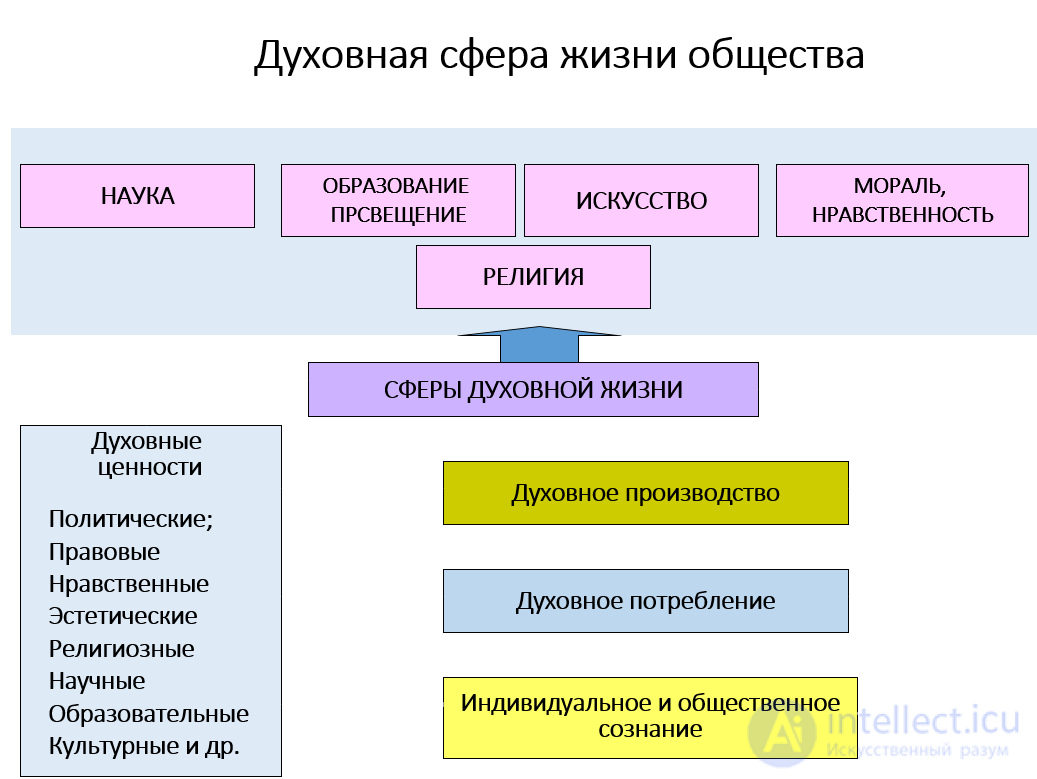
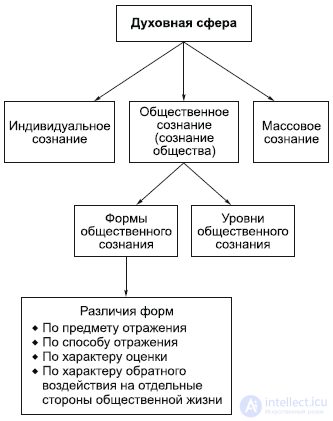
The core of the spiritual sphere is social consciousness (or, as it is otherwise called, the consciousness of society).
Social and individual consciousness are connected to one another, but they are not identical. A person's individual consciousness is his spiritual world, his diverse feelings, knowledge, interests, and views of the surrounding environment, and so on, in which reality – the natural and social environment – is reflected. Individual consciousness takes shape on the basis of personal experience, the immediate conditions of a person's life, and also as a result of communication with other people, education, and upbringing.
In expressing a person's everyday, immediate, diverse interests, his individual consciousness is not always capable of reflecting the whole of his being. But the individual consciousness of each separate person has common features with the consciousness of other people. The spiritual world of a single person represents a unity of the particular and the general. Individual consciousness includes not only its specific (professional, age-related, gender-related) features, but also feelings, views, and theories common to its people. Individual consciousness reflects the facts of social life and evaluates them. This evaluation depends above all on how specific events were reflected in the personal fate of the participants in these events and their loved ones.
Although society is a collection of individuals, the consciousness of society is not reducible to a simple sum of individual consciousnesses. The point is that society as a whole reflects reality far more deeply than separate individuals do. Just as society is not a simple sum of the people composing it, so too the consciousness of society is not a simple sum of the consciousnesses of separate individuals. It is a qualitatively distinct spiritual system which, having been generated by social reality, lives its own relatively independent life, exerting influence on every person. It is, in a sense, a supra-individual collective mind.
The thought of an individual person can become a fact of the consciousness of society when it goes beyond the bounds of personal existence and becomes the property of other people.
The bearer, the material substrate, of individual consciousness is a specific person. But who or what is the bearer of the consciousness of society? The bearer of the consciousness of society is, above all, the individual person. But its bearer is also the entire system of society, social formations, the whole totality of social objects created by human beings, in which human consciousness is «objectified.»
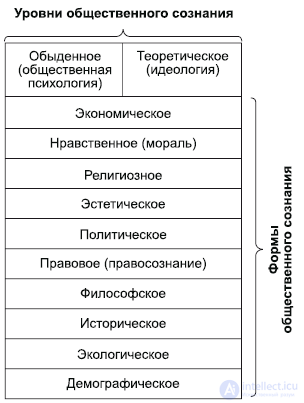
Social consciousness represents a complex subsystem of society. It includes various forms and levels. Before proceeding to characterize them, let us note that there are certain ambiguities and differing interpretations in the understanding of the structure of social consciousness.
In the traditions of Marxist philosophy, what is above all singled out within social consciousness are the forms of social consciousness. Each form of social consciousness is a certain complex of knowledge, ideas, and feelings, distinguished from the content of another complex by a number of parameters.
• By subject of reflection. Each form of social consciousness reflects a particular aspect of social life. Thus morality reflects the relation of the individual to other individuals and to society; political consciousness reflects the relations among classes, nations, and states. And so on.
• By manner of reflection. Thus morality is expressed in moral norms, customs, and traditions; law – in legal statutes; political consciousness – in political programs. And so on.
• By the character of the evaluation. Within social consciousness there exist moral, aesthetic, political, and other kinds of evaluation.
• By the character of the reciprocal effect on particular aspects of social life. Thus we have already spoken of the specific influence of economic or political consciousness on the life of society.
If we approach the classification of the forms of social consciousness from a historical point of view, we can first point to those forms that arose already in primitive society. These are the economic, moral, religious, and aesthetic forms. To this, perhaps, should be added the rudiments of ecological, demographic, and historical consciousness. Then, in class society, political and legal consciousness appear, as well as philosophical consciousness. Sometimes ethnic and national consciousness are also classed among the forms of social consciousness. But whether they exist as independent forms of social consciousness, or whether they represent a certain unity of a number of forms of social consciousness, is a debatable question.
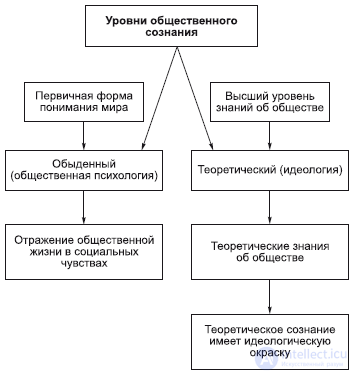
From a gnoseological point of view, two levels are distinguished within social consciousness: the everyday (ordinary) and the theoretical. Here we are speaking of the depth to which social life is reflected in social consciousness. Let us note that «everyday» by no means means «inferior» or «philistine.» Everyday consciousness is, as it were, the primary form of understanding the world.
The distinguishing of forms and levels within social consciousness does not mean that the forms and levels exist somehow independently of one another; each form of social consciousness, as we have already noted earlier, has two levels.
Everyday consciousness reflects social life in the empirical knowledge and social feelings that arise among social groups in the course of their everyday life and activity, in everyday communication – the exchange of this knowledge and these feelings. The process of reflecting social phenomena is accompanied by more or less conscious experiences. The unity of reflection and experience forms people's social feelings: moral, aesthetic, religious, and so on.
Social feelings are inseparably linked with the needs of people and social groups. Social feelings express the satisfaction or dissatisfaction of needs; in them is the experience of phenomena of the natural and social environment as useful or harmful. A person determines for himself what is «necessary,» «important,» «interesting,» and so forth.
The higher level of social consciousness includes theoretical knowledge about society. Let us note that not every judgment can be assigned to the theoretical level of social consciousness. It is enough to compare, for example, the judgments: «I live in St. Petersburg» and «Religion is a distorted, fantastic reflection of real social forces,» to see that theoretical consciousness comprises not judgments about individual facts, but judgments about the essence or essential connections of social phenomena. In theoretical consciousness, social life and the phenomena of social life are not only described but also explained (their laws, causes, contradictions, and so on are disclosed).
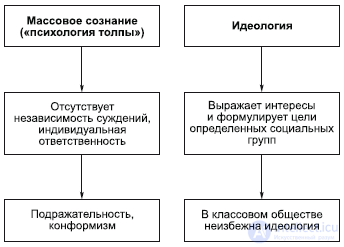
In a society made up of various social groups, theoretical consciousness takes on an ideological coloring. Ideology is a body of ideas and theories that reflect and evaluate the phenomena of social life from the standpoint of one or another social group. Ideology includes conceptions of society's ideals and of the strategy and tactics for attaining these ideals. As long as social groups with their various interests exist, ideology will exist. Ideology is created consciously by theoretically trained representatives of social groups who are devoted to them – their ideologists. They specially study society and construct conceptions of social development.
Ideology is worked out by people engaged in intellectual labor. In creating theories, ideologists take into account the social psychology of their social groups and of society as a whole. Since the interests of social groups differ, their ideologists construct conceptions that explain one and the same society in different ways. These conceptions may be scientific, unscientific, or eclectic. In terms of its role in society, ideology may be progressive, conservative, or reactionary.
The relationship between ideology and science is quite contradictory. Scientific cognition strives to reflect objective laws and to attain objective truth with a certain detachment from people's interests, while ideology expresses the interests of social groups. But that is only one side of the matter. On the other hand, ideology has a cognitive aspect, and science – an ideological one, especially where the social sciences are concerned.
In class society, ideology is inevitable. Therefore, behind the thesis of de-ideologization (as if ideology as such hindered the development of society and therefore ideology in general must be discarded) one should see nothing more than a stance against a particular ideology.
A special place in social consciousness is occupied by what is called mass consciousness (sometimes also called «crowd psychology»). The mass, the «crowd,» is characterized by a number of specific qualities. In people united into a «crowd,» independence of judgment is lost, the sense of their own strength sharply increases, the awareness of individual responsibility falls, and suggestibility grows. A «crowd» readily yields to the influence of «leaders.» It is interesting that even Plato wrote that the demos (the «crowd») is a special kind of animal, and the demagogue (the «leader») is a trainer who knows how to manage it. In a crowd, freedom is not gained but lost.
In the formation of mass consciousness, the mechanisms of contagion and imitation play a special role. Generally speaking, a person's convictions are based on knowledge and understanding. A person without convictions readily succumbs to manipulation of his consciousness. It is also known that the lower the level of a personality's development, the higher its tendency to imitate and conform.
Mass consciousness plays a significant role in the formation of public opinion. Thus, at meetings and rallies an evaluation of the political situation and an attitude toward particular individuals, and so on, are formed. Sometimes mass psychoses are set off, leading to tragic consequences.
At present, the development of the means of information is proving an ever stronger factor in the massification of social consciousness. Mass information shapes standards of thinking and behavior, consumer demand, and so on.
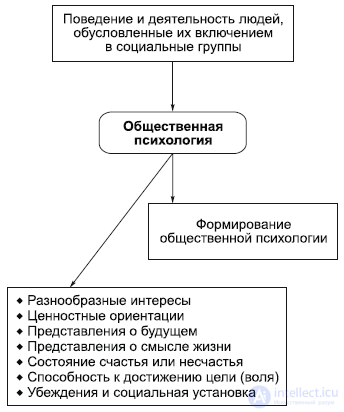
Within everyday consciousness, social psychology is distinguished.
This is a body of feelings, moods, habits, inclinations, directions of will, experiences, and thoughts that arise on the basis of the social group to which the individual belongs. Social psychology also includes motives of behavior and people's attachment to a certain way of life. Social psychology includes those thoughts and ideas that have not yet found a fully clear and precise formulation and systematization. Within social psychology, the following take shape:
The noted features of social psychology stand in a complex interrelation. People who belong to a social group constantly perceive, experience, understand, and evaluate diverse social phenomena and the activity of their own and other social groups. History bears witness that every social group has its own social feelings and views, which take shape on the basis of the specific needs of that group.
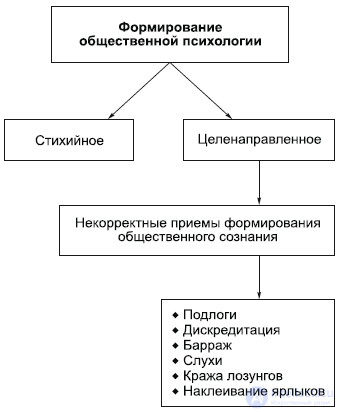
Social psychology forms in two ways:
The ruling strata try to instill in the oppressed masses their own psychology, their own social feelings, so that the masses evaluate events not from the standpoint of their own interests, but from the standpoint of the interests of the ruling strata. In the purposeful formation of social consciousness, various techniques are used, including ones that deserve moral condemnation. Let us note a few.
Despite all these techniques, the popular masses generally understand who their enemy is. The objective course of events, especially in periods of calamity and deprivation for the popular masses, does not fit within the framework of the imposed psychology and demands a different explanation. Doubt arises about the correctness of the policy being pursued, the authority of the existing power falls, a desire arises to understand for oneself what is happening, and the activity of consciousness awakens. Thus the preconditions are created for the creation and reception by the masses of a new ideology.
In primitive society, intellectual labor, people's consciousness, as Marx noted, was «directly interwoven with material activity and material intercourse among people, with the language of real life» [22]. This state is called syncretism. With the division of labor, a stratum of people appeared for whom spiritual activity became the primary form of activity. The development and increasing complexity of social life led to the development of social consciousness, its differentiation, and the emergence within it of independent forms and levels.
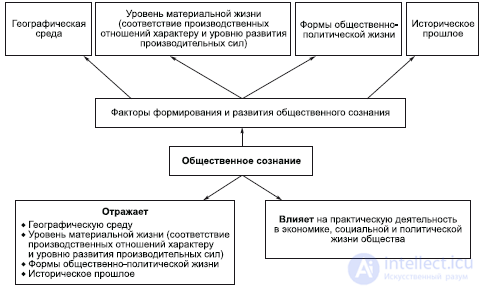
The formation and development of social consciousness is influenced by a number of factors, among which the following can be singled out:
At a certain stage of the development of social consciousness, it corresponds more or less to the character of the social order and social life. The objective basis of this correspondence is the correspondence of the productive forces and the relations of production. When this correspondence is disrupted, the possibility arises for the emergence of a new social consciousness, which prevails in the competition with the old social consciousness. The new social consciousness will correspond to the new correspondence of productive forces and relations of production.
But the transition to a new social consciousness is not a complete negation of the old. With the changing of society, with the emergence of a new social consciousness, elements of the old are preserved. Thus works of art, moral norms, and so on do not vanish into oblivion. They continue to exist, though undergoing a certain reinterpretation. And although ancient society and the society of the Renaissance era have long ceased to exist, the works of art of these epochs retain their artistic value even today.
The social consciousness of each era relies on the customs, traditions, views, and theories of preceding eras. At the same time, social consciousness may in a certain sense lag behind the new level of social life, when survivals of the past remain strong within it. But on the other hand, new ideas and theories may run ahead of the level of development of the social system.
One should note a certain unevenness in the development of social consciousness. In different historical eras, one or another form of social consciousness receives predominant development.
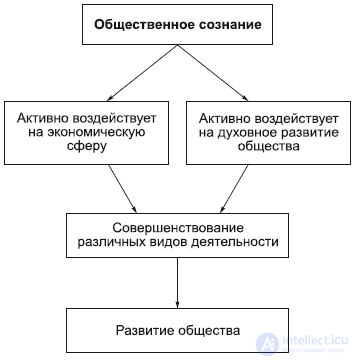
Social consciousness exerts an active influence on all spheres of social life. On the basis of their views and theories, people carry out practical activity in the economy, politics, and so on. Social consciousness turns out to be a spiritual stimulus, directing people toward the transformation of nature and society, the creation of diverse values. Let us examine this in more detail.
1. Economic consciousness becomes a stimulus for practical activity in creating the products and services necessary for people's lives.
2. Moral consciousness orients people toward actions and behavior that contribute to achieving social order and combining personal and social interests.
3. Ecological consciousness contributes to the preservation of nature.
4. Demographic consciousness influences the dynamics of population.
5. Aesthetic consciousness stimulates activity aimed at creating artistic values and enriching people's spiritual world.
6. Religious consciousness helps overcome fear and suffering arising from people's dependence on the elemental forces of nature and on social influences unknown to them.
7. The political consciousness of a social group directs its policy toward gaining or retaining power in order to realize its interests.
8. Legal consciousness leads to practical activity aimed at creating and maintaining order and the laws of the state in the interests of the ruling groups.
9. Historical consciousness contributes to the preservation of social heritage.
If we consider the levels of social consciousness as a whole, ordinary (everyday) consciousness serves as a spiritual stimulus for people's practical activity aimed at satisfying their everyday, immediate needs – labor, activity related to the production and consumption of material and spiritual goods, actions, the performance of religious rites, and so on. Ideology, meanwhile, is a spiritual stimulus for the practical activity of social groups aimed at realizing their fundamental economic, social, political, and spiritual interests.
Social consciousness is formed as a reflection of social reality, but it also exerts a reverse influence on the whole of social life, stimulating the emergence and improvement of various kinds of activity.
In previous chapters we have already touched on some forms of social consciousness. But we have not yet had a more or less detailed discussion of morality, religion, and aesthetic consciousness. Let us turn to their characterization.
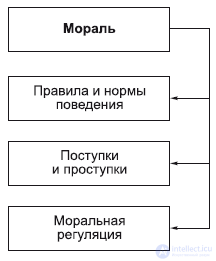
The concept of morality includes two aspects: a set of rules and norms of human behavior that regulate people's relations to one another and to society, and a person's ability to evaluate their own intentions and actions. Besides the concept of morality, the concept of ethics (nravstvennost') is also used. Their relationship is interpreted in different ways. Sometimes they are distinguished, with morality understood as a set of behavioral norms, and ethics (nravstvennost') as the manner of behavior of people who observe (or violate) the norms of morality. Sometimes morality and ethics are understood as synonyms. We will follow the latter approach.
Morality regulates human behavior in various spheres of social life, in intra-group and inter-group relations. From the standpoint of moral norms, one evaluates those actions through which the social relations among people are manifested, i.e., the relations of individual to individual, of one collective to another, of a collective to an individual, and so on. Moral norms regulate only conscious, willed behavior; the actions of the mentally ill, as well as of small children, are morally indifferent.
Moral activity consists of actions as its elements. An action itself is composed of motive, intention, purpose, deed, consequences, self-evaluation, and the person's attitude toward the evaluation of others. Moral behavior becomes fixed in customs and traditions (stable behavior repeated from generation to generation). A special variety of action is the misdeed; a misdeed is an action which, in its content, represents a violation of the requirements of morality. Misdeeds can be intentional or unintentional, deliberate or non-deliberate.
Morality and law are similar in that both propose a system of rules of behavior. Some norms of morality and law coincide. But there are also differences between morality and law. Some actions are subject to the judgment of morality but do not fall within the competence of law (for example, from a moral point of view one should give up one's seat on the subway to an elderly person, but this is not a legal norm). Moral norms extend to relations among people that are not regulated by law (for example, friendship, comradeship, love). The fulfillment of legal norms is ensured, when necessary, by measures of coercion (administrative, criminal, and economic sanctions) with the help of a special apparatus of justice. Morality, unlike law, has no special institution that would compel compliance with moral norms.
Moral regulation is carried out by society as a whole; behind morality stand the force of persuasion, example, public opinion, tradition, and the force of the moral authority of individuals. Moral sanction is exercised mainly through measures of spiritual influence. Public opinion acts as a collective evaluation of behavior, manifested in the encouragement of people whose actions constitute a social good, or in the condemnation of actions that do not conform to moral norms. Morality performs its function of regulating people's behavior by relying on public opinion.
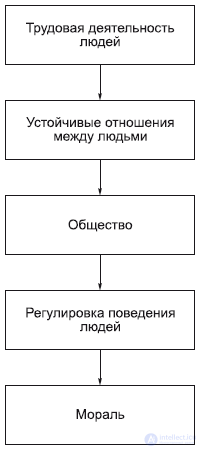
Morality, like all other social phenomena, was formed and has developed historically. The emergence of morality is connected with the formation of society, above all with social labor. The social-labor activity of people, however primitive it may have been at its initial stages, presupposes more or less stable relations among people. In primitive society, zoological egoism was curbed by the force of the collective. The criterion of good and evil was determined by what benefited or harmed the clan and tribe. Europeans who became acquainted with peoples living at the level of primitive society were struck by such traits as courage, fairness, and truthfulness. Rousseau spoke of a golden age in the past, while Voltaire said he felt like running off into the forest on all fours.
However, one should not idealize primitive society. The low level of production imposed two requirements on a person: physical strength and the ability to endure suffering. The rite of initiation, tattooing (when, for example, salt was rubbed into deep cuts) were aimed precisely at forming these qualities. When a person became weak, he was a burden to the collective. It is no accident, therefore, that the elderly were left behind at an abandoned campsite of the clan or tribe, which in effect led to their death.
The regulation of the relationship between personal and social interests was originally carried out through a system of prohibitions on certain actions – taboos. A differentiation of actions into positive and negative arose, i.e., actions that should be performed and actions that are forbidden. Morality becomes a means of orienting a person in the social environment.
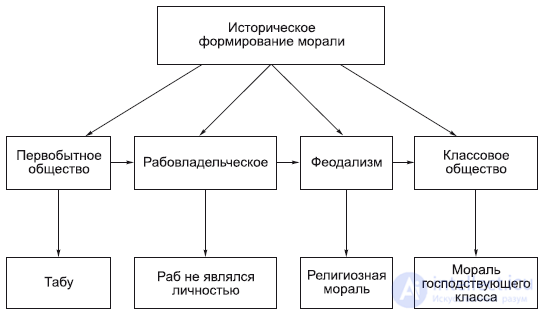
With the formation of class society, new moral relations and norms arise. In slave-owning society a system of mores develops that does not extend to slaves; they were not considered persons. This morality, in particular, cultivated contempt for physical labor. But this morality also had progressive aspects; in particular, it put an end to cannibalism and group marriage.
In the age of feudalism, religious morality spreads. In Christian Europe the ideal of a person was one full of humility, detached from worldly goods. Behind this ideal one can discern a social meaning – the upbringing of the masses in a spirit of obedience. On the other hand, economic considerations conditioned a positive moral evaluation of marriage of convenience. Here there is not a word about love.
With the formation of capitalism, a new system of mores takes shape. The thirst for life of the young bourgeoisie is incompatible with the ideal of medieval asceticism. The morality of the early bourgeoisie is frank: private property is sacred and inviolable; the principle of individualism becomes the norm; a person strives for pleasure and avoids suffering; vices are as necessary as virtues.
In class society there exists a morality of various classes. But at the same time, every morality contains universal human elements, so-called simple norms of ethics and justice. At all times, greed, cruelty, cowardice, hypocrisy, treachery, slander, envy, and arrogance have been condemned in one way or another, while courage, honesty, self-control, generosity, and modesty have been encouraged. It is true, however, that at different times the conditions and limits of applicability of these qualities, and their relative significance, have been understood differently.
In the process of socialization, people become aware of social interests, understand which actions correspond to the social good or may harm society, and in connection with this their moral consciousness is formed.
Moral consciousness includes moral evaluation; in the act of evaluation, the correspondence or non-correspondence of a person's actions and way of life to moral requirements is established. When evaluation is directed at oneself (self-evaluation), moral feelings such as conscience, shame, remorse, and so on arise. It should be noted that morality is determined not by a single final result but by the overall orientation of a person's behavior; in morality, not only people's actions are evaluated, but also their motives, impulses, and intentions.
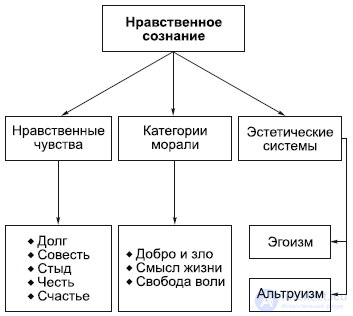
The structure of moral consciousness includes moral feelings, categories of morality, and value orientations.
The basic moral feelings include duty, conscience, shame, honor, and happiness.
Duty – a person's awareness of their obligations. At the basis of duty lies a sense of the necessity of combining personal and social interests. As an individual feeling, duty is connected with a person's understanding of their responsibility to society and their striving to shape their behavior in accordance with society's moral norms.
Conscience – a feeling of moral responsibility, self-evaluation of one's behavior, an «inner court».
Honor – a feeling expressing the notion of human dignity. Honor is characterized by a person's conscious fulfillment of social duty. The behavior of people who place social interests above personal ones is valued very highly by society (one speaks of valor and heroism).
Happiness – a moral feeling of joy, pride, satisfaction, and fullness of life that arises in a person in the process and as a result of realizing personal interests, and at the same time as a result of others' recognition of their actions as worthy. Without such recognition, the feeling of happiness turns out to be incomplete. Happiness is moral satisfaction derived from the awareness of the rightness of one's basic life stance.
The fundamental categories of morality are good and evil, the meaning of life, and free will.
In the categories of good and evil, people's actions are evaluated positively or negatively.
Regarding the meaning of life, one can distinguish optimism (there is a meaning to life and it is in principle attainable), skepticism (it is unclear whether there is a meaning to life, and if there is, it is unclear whether it is attainable), and pessimism (life appears meaningless). When it is recognized that there is a meaning to life, it is understood in different ways. The meaning of life is seen as lying in obtaining pleasure and enjoyment (so-called hedonism), in achieving success (pragmatism), in recognition within the group to which a person belongs (corporatism), in personal self-improvement (perfectionism), in serving other people (humanism), and so on.
An important category of morality is free will; free will is the possibility for a person to choose the line of their behavior. Descartes noted: «Our will strives toward some goal or avoids it depending on whether our reason represents it as good or bad»[23]. It should be noted that actions are moral in the full sense when they are performed not as a result of external compulsion, but out of an impulse to do good. Self-regulation, self-education, and self-evaluation are important features of the moral regulation of behavior.
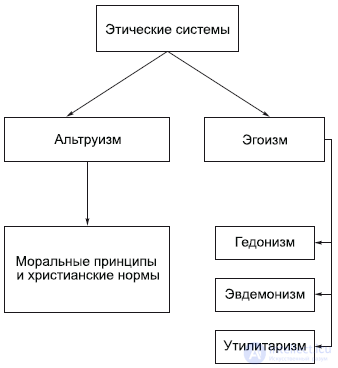
At the theoretical level of moral consciousness, ethical systems are formed and moral codes are created. One of the first questions that ethics attempts to answer is the question of what constitutes a correct human life. The ethical conceptions of antiquity proceeded from the premise that if we know what a correct life is, then, of course, we will act so as to achieve it.
In the ethical systems of antiquity, the so-called «golden rule of morality» was formulated – do not do to another what you do not like done to yourself. This rule, in various formulations, became part of different ethical systems (for example, Kant's categorical imperative). Another widespread principle of morality was the idea of the «golden mean». To achieve happiness, one must avoid extremes in one's actions and observe moderation. It is true, as Aristotle noted, that for different people this «mean» is different.
In the subsequent history of ethics, two common variants can be distinguished: either the interests of the individual are put in first place (egoism), or common interests (altruism).
In the first variant, a special role is asserted for:
In the second variant of ethical conceptions, the moral principle placed at the foundation prescribed compassion for other people, selfless service to them, and readiness for self-renunciation for the sake of their good and happiness. This principle found its expression, in particular, in Christian morality – «love thy neighbor as thyself». The ethics of altruism is usually oriented toward benevolence and philanthropy.
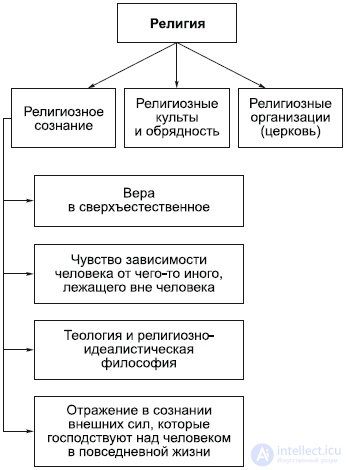
One of the most ancient forms of social consciousness is religion. Religion and philosophy form the worldview foundation of society, which determines their important role in the life of society. The content of religion as a social phenomenon includes three elements: religious consciousness (religious feelings, ideas, notions); religious cults and religious ritual; religious organizations (the church).
The essence of religious consciousness is an illusory doubling of the world: the recognition, alongside real natural and social being, of another, otherworldly world. The chief characteristic of religious consciousness is belief in the supernatural.
Religion grows out of mythology. In the early forms of religion, natural forces, plants, and animals are deified. In the history of religion, polytheism (belief in several gods) usually came first, followed by monotheism (belief in one god). The transition to monotheism was characteristic of that historical epoch when large monarchies were formed; instead of the many cults characteristic of tribal unions and early states, a cult of a single, omnipotent God is created, onto whom the attributes of other gods are transferred.
Religious consciousness began with problems caused by natural phenomena, and later problems caused by social life gradually came to the fore. Religious consciousness manifests itself in the performance of religious worship - the worship of God, the observance of rites (prayer, the rite of baptism, and others).
Since every people has some form of religion, it follows that there is some need, some socio-psychological interest, that is in one way or another satisfied by various forms of religion. The fact is that through certain ritual acts and prohibitions, believers seek to obtain help from God. For millennia the idea has been instilled in people's minds that without faith in God there can be no morality, that the source of morality is God. In Christianity, the moral ideal is the image of Christ.
The union of believers for the joint performance of religious worship gives rise to the third element of religion - the religious organization of believers, the church, headed by clergy. The church is a social institution by means of which religious worship is maintained, religious faith is spread, and adherents of a given religion are united.
At the theoretical level of religious consciousness stand theology and religious-idealist philosophy. The central problem here is the proof of the existence of God.
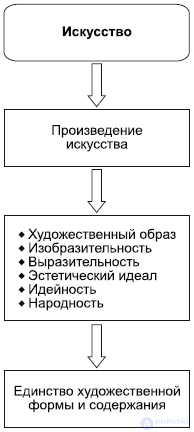
Art encompasses aesthetic consciousness and those phenomena of social life that are experienced as aesthetic values. The latter include products of material production (which are perceived with aesthetic appraisal; a special case here being works of decorative and applied art, design), phenomena of nature, and the human being (assessed from the standpoint of beauty), as well as art proper as a body of artistic works.
Individual works of art are the product of artistic creation as a unity of spiritual and practical human activity. In terms of its mode of existence, a work of art is a material product of artistic creation.
Although a work of art is made of a particular material and cannot exist without it, what matters most in it is the artistic image. The artistic image of a work is created by the artist in accordance with their conceptions of the real or fantastical world, and is a material representation of phenomena of nature and society, or of fantastical, imagined events. Representational quality is the basic property of art. But not every representation created by a person functions as an artistic image. A representation becomes an artistic image if it possesses particular properties, content and form.
A work of art possesses both representational and expressive qualities. Representational quality is the fundamental attribute of art, and expressiveness and other properties of art depend on it.
Every artist has some conception of the ideal of beauty in life and in the human being. It is from the standpoint of this ideal that they depict reality. An aesthetic ideal also exists for society and for social groups. The aesthetic ideal is always bound up with political views and moral principles. The social position of the artist is revealed in what their aesthetic ideal is; it is disclosed in which phenomena they reflect, how they reflect them, and what evaluation these phenomena receive from the author.
In a work of art, the artist expresses the social consciousness of particular groups. Ideological content is a necessary property of art. The ideological orientation of art may manifest itself not only in its class character, but also in its national/popular character (narodnost'). The national character of art is manifested in the fact that it depicts the life of the people, their feelings and interests, and conveys the national distinctiveness and uniqueness of each people.
The content of a work of art is the totality of the artistic elements composing it.
The interconnections among the artistic elements in a work of art create the artistic form as a particular structure of that interconnection. The artistic form includes composition - a particular ordering in the relation of the elements to one another.
The correspondence of artistic form to content is the most important criterion of the artistic quality of works of art and of the principles for evaluating them.
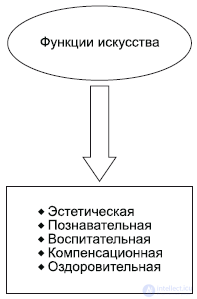
Art performs a number of functions in social life. First and foremost among these is the aesthetic function. People's perception of works of art is one of the effective means of forming aesthetic consciousness in people. And aesthetic consciousness gives people great spiritual pleasure, the capacity to perceive and evaluate beauty, and serves as a spiritual stimulus for people's aesthetic activity.
Aesthetic consciousness has two levels: the everyday (the perception, experience, and evaluation of aesthetic values) and the theoretical (the understanding and explanation of the essence of aesthetic values and of the processes of their creation and perception, which is provided by aesthetics as a discipline).
Besides the aesthetic function, art performs a number of other functions. First and foremost among these is the cognitive function.
By affording people aesthetic enjoyment and deepening our knowledge of life, art also educates people, that is, it performs an educational function.
By broadening human knowledge and educating a person, art gives them the opportunity to experience what they have not lived through, compensating for the lack of various experiences (such as happiness, love, grief, and so forth) that a person needs in life, that is, it performs a compensatory function. In this respect, art makes up for what is lacking in a person's ordinary life.
Besides those already mentioned, art has a number of secondary functions. Art is capable of calming and consoling people, relieving psychological tension (which has become especially pronounced in our time), and overcoming negative stress. Art has long been used in medicine for the prevention and treatment of mental illness. Dance, music, and the visual arts have medical-therapeutic significance and are used in the training of athletes, and so on. Thus, art performs a therapeutic function.
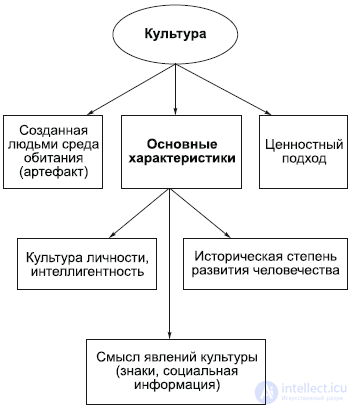
Culture is grounded in human activity; it is through culture and thanks to culture that the natural and the social worlds are joined together. Here culture is characterized as the connecting link between nature and society; the basis of this connection is the human being as the subject of activity, cognition, and communication. Culture is the result of the objectification, the material embodiment, of human strivings, goals, and interests. The concept of the artifact is used to characterize culture. Artifacts are the products and results of human activity. Culture is then interpreted as a world of artifacts. Here it is emphasized that the artifact, as a product of human activity, is dual in nature - it combines both objective and subjective moments. Culture here is interpreted as everything that has been created by people, as a habitat created by people.
Culture is bound up with the meanings that people ascribe to their creations. Material objects, taken by themselves, have no meaning at all. Meaning is invested in them by human beings. But meaning is expressed by means of language. Culture functions as a kind of informational infrastructure of society.
The concept of culture applies not only to artifacts but also to the human being as such; one speaks of a cultured (or uncultured) person. The culture of an individual is a system of that individual's moral norms and way of life, characterized by such traits as decency, kindness, honesty, modesty, diligence, and the ability to understand another person, and so on. Sometimes, as a synonym for high culture, one speaks of intelligentnost' (cultivation/refinement). Cultivation is broad knowledge, social responsibility, and high culture.
A cultured individual knows how and loves to work; laziness, shoddy work, and mistakes are not culture. A cultured individual knows how to control themselves, has skills of self-control, and is capable of communication. A cultured individual is oriented toward goodness, humanism, and justice. The culture of the individual includes the ability to make rational use of time, without wasting it on secondary matters and pursuits.
The content of culture can also be approached through a value-based approach, according to which culture is:
Values serve to satisfy needs. Since there are material and spiritual needs, values are divided into material and spiritual. There exist enduring spiritual values.
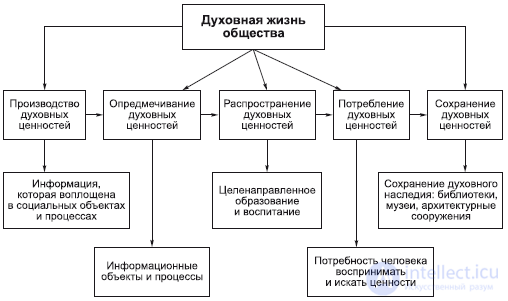
The role of spiritual values and of social consciousness has always been recognized by people, to a greater or lesser degree. There exists a social need for the creation of spiritual values and the improvement of social consciousness. This is accomplished through a special kind of activity, in the process of spiritual production. If material production is directed toward the production of material goods, then spiritual activity, spiritual production, is directed toward the production of spiritual values and the improvement of consciousness.
Spiritual production is scientific, artistic, and other kinds of activity, as a result of which scientific and artistic works, religious texts, ideological conceptions, and so forth are created.
In the process of spiritual production, the knowledge and feelings that have taken shape become objectified, for otherwise they would not become the property of society. Here it should be stressed that the main product of spiritual production is not objects as such, but rather the information embodied in social objects and processes.
Spiritual production is carried out by scientific, artistic, ideological, and other personnel, who are united into special institutions (scientific and ideological institutions, theater companies, and so on). Spiritual production makes use of material resources and specialized technology.
Once spiritual values have been created and fixed (objectified), the next stage of spiritual life is their dissemination. Thus, scientists disseminate the knowledge they have obtained either orally (for example, in reports and lectures) or in writing (in scientific works). In art, literary works are reproduced, copies of films are made, and so on.
For spiritual values to have their effect on people and their consciousness, people must have developed a need to perceive and seek out these values. These needs and abilities develop both in the course of everyday life and as a result of purposeful education and upbringing. Education is directed toward the formation of knowledge, upbringing, social feelings, and social psychology (although these processes cannot be sharply separated, as they are interconnected).
Spiritual values are transmitted from generation to generation. For this to be possible, the products of spiritual production must be preserved (for example, books in libraries, paintings in museums).

Comments