
Lecture
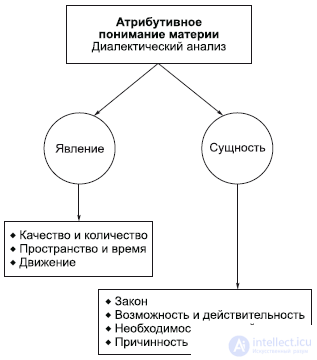
Dialectical analysis of a material object presupposes the splitting of a unity into opposites. Dialectical analysis, as a consistent transition from «the concrete to the abstract» (K. Marx), must begin with the most «concrete» (that is, the most complex, most content-rich) attributes. Here, in order to avoid subjectivism in studying the attributes of a material object, one must constantly keep in mind the principle of the unity of theory and practice. Dialectical analysis of an object must rely on the history of practical activity (in particular, the history of technology), the history of all the sciences (in particular, natural science), and the history of philosophy. Let us begin with the last of these.
Already the thinkers of the ancient world «split» the world into something external, sensibly given, and something that lies behind it and determines it. In Plato, in the spirit of idealism, such a splitting underlies his doctrine of the «world of things» and the «world of ideas». Throughout the whole history of philosophy runs the fundamental division of the world into the external, that which appears, and the internal, its essence.
Scientific cognition, directed at studying the material world, is guided by an important methodological principle: to move from a description of the object under study to its explanation. Description deals with appearances, while explanation presupposes turning to the essence of the objects under study.
Finally, the history of technology provides rich material demonstrating the profound meaning of distinguishing between appearances and their essence. A vivid example of this is the uncovering of the essence of technological processes that were once kept secret (Chinese porcelain, Damascus steel, and the like).
All that has been said gives sufficient grounds for the conclusion that a material object, in the course of dialectical analysis, must first of all be «dissected» into appearance and essence.
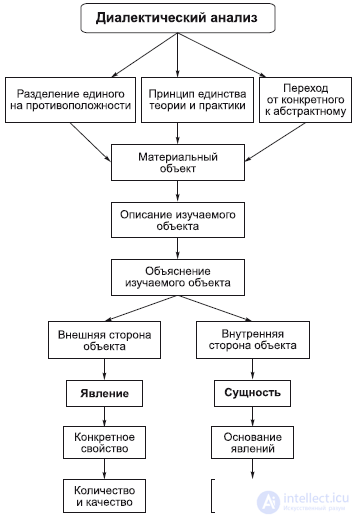
The concept of appearance presents no particular difficulties. Matter «appears» to us in the most diverse forms: in the form of a thing, a property, a relation, a set, a state, a process, and so on. Appearance is always something individual: a concrete thing, a concrete property, and so on. As for the concept of essence, there have historically been many disputes and various interpretations surrounding this concept; idealists built around this concept a multitude of scholastic and even speculative mystical schemes.
To characterize the content of essence, one should proceed from the practice of studying various phenomena. From a generalization of the results of such studies, it follows above all that essence appears as the internal side of an object, and appearance as the external one. But «internal» here should not be understood in a geometric sense. For example, the parts of a mechanical watch mechanism are, in the geometric sense, «inside» its case, but the essence of the watch does not lie in these parts. Essence is the foundation of appearances. In a watch, the internal, the foundation, is not the mechanical parts but that which makes them a watch, the regular oscillatory process. Essence consists of the internal, deep connections and relations that determine appearances. Let us give a few more illustrations. The essence of water is the combination of hydrogen and oxygen; the essence of the motion of celestial bodies is the law of universal gravitation; the essence of profit is the production of surplus value, and so on.
Essence, in comparison with appearances, functions as the general; one and the same essence is the foundation of a multitude of appearances. (Thus, the essence of water is the same in a river, in a lake, and in rain, and so on.) Essence, compared with its manifestations, is relatively more stable. The distinctiveness of essence, from an epistemological standpoint, lies in the fact that, unlike observable, visualizable appearances, essence is unobservable and non-visualizable; it is cognized by thought.
Thus, essence is the internal, general, relatively stable foundation of appearances, cognizable by thought.
After the «dissection» of a material object into appearance and essence, the task arises of further analyzing appearance and essence. A generalization of the practice of scientific research and of the data of the history of philosophy shows that, to describe appearance, one must use the categories of quality and quantity, space and time, and others, while to disclose the content of essence one must use the categories of law, possibility, and actuality, and others. These ontological categories have no independent significance alongside the categories of «appearance» and «essence», but reflect particular aspects of the content of appearance and essence as the most complex attributes of a material object. The next task is to subject appearance, and then the essence of the object, to analysis.

Comments