
Lecture
Ontology (New Latin ontologia, from Ancient Greek ὄν, gen. ὄντος — being, that which exists + λόγος — teaching, science) — the study of being ; the doctrine of being as such; the branch of philosophy that studies the fundamental principles of being, its most general essences and categories , structure, and regularities . The philosophical doctrine of the general categories and regularities of being, existing in unity with the theory of knowledge and logic . Sometimes the term «ontology» (the metaphysics of being) is used in opposition to the term «henology» (the metaphysics of the one).
Being — in its broadest sense — existence.
The concept of being is a central philosophical concept. Being is the subject of the study of ontology. In a narrower (Heidegger holds that the question of being, which, in his view, is the fundamental philosophical question, has been forgotten throughout the entire history of Western philosophy, beginning already with Plato. Being was interpreted incorrectly, since it had no purely «human» dimension. Already in Plato, the world of ideas is in its objectivity indifferent to the human being. «Only the clarification of the essence of human being reveals the essence of being» ) sense characteristic of the fundamental ontology of M. Heidegger, the concept of «being» fixes the aspect of the existence of beings, as distinct from their essence. If essence is determined by the question: «What is the being?», then being is determined by the question: «What does it mean that the being is?». The concept of being was introduced into the Russian philosophical language by Grigory Teplov in 1751 as a translation of the Latin term «ens» .
Since being can be understood as the sole one (see Parmenides), the term «being» is often used to designate the world as a whole. It is the subject of the study of ontology. The opposite concepts are «non-being» and «nothing.» Essential philosophical problems — the relation of being and thinking, the relation of being and time, the relation of being and non-being.
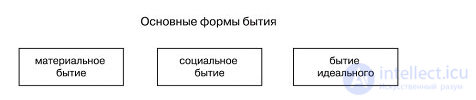
It is customary to distinguish a number of differing yet interrelated basic forms of being :
The basic question of ontology: «What exists?»
The basic concepts of ontology: being, beings, structure, properties, forms of being (material, ideal, existential), space, time, motion.
Ontology, thus, represents an attempt at the most general description of the universe of what exists, one that would not be limited to the data of individual sciences and, possibly, would not be reducible to them.
A different understanding of ontology is given by the American philosopher Willard Quine: in his terms, ontology is the content of a given theory, that is, the objects that are postulated by that theory as existing.
Questions of ontology are the most ancient theme of European philosophy, going back to the pre-Socratics and especially to Parmenides. The most important contribution to the development of ontological problems was made by Plato and Aristotle.
In medieval philosophy, a central place was occupied by the ontological problem of the existence of abstract objects (universals).
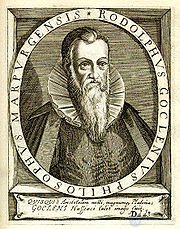
The concept was introduced into scholarly use by the German philosopher and pedagogue Jacob Lorhard . In 1606 he published the work Ogdoas scholastica, in which the word "ontologia" first appeared. The term «ontology» was included by Rudolf Goclenius in 1613 in his «Philosophical Dictionary» («Lexicon philosophicum, quo tanquam clave philisophiae fores aperiunter. Francofurti») and, somewhat later, by Johann Clauberg in 1656 in the work «Metaphysika de ente, quae rectus Ontosophia», who proposed it (in the variant «ontosophy») as an equivalent of the concept «metaphysics.»
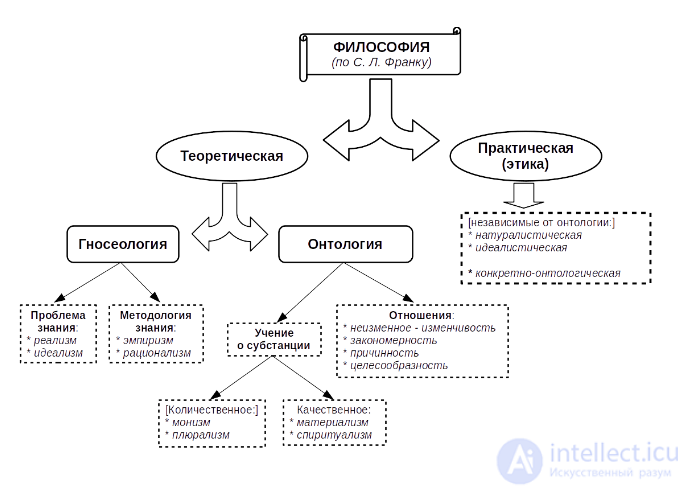
Scheme of philosophy according to S. L. Frank
In practical usage the term was established by Christian von Wolff, who explicitly separated the semantics of the terms «ontology» and «metaphysics.»
In 20th-century philosophy, philosophers who dealt specifically with ontological problems included Nicolai Hartmann («new ontology»), Martin Heidegger («fundamental ontology»), and others. Particular interest in contemporary philosophy is drawn by the ontological problems of consciousness.
Karl Popper formulated the concept of three worlds: (1) the world of physical objects and states, (2) the world of psychic and mental states of consciousness, and (3) the world of the objective content of thought (this includes the content of scientific hypotheses, literary works, and other objects that do not depend on subjective perception) .
In the process of studying the semantic meaning of being, semantics traditionally turns to the oldest sign, the ouroboros — the serpent biting its own tail, which describes the cyclical character of being, or eternity. In mathematical logic the sign of infinity is sometimes used in this case, but in fact, because the sign of infinity describes quantitative changes, it is likewise unsuitable for use in describing being. Prototype theory comes to the rescue. A number of experiments conducted by authors in cognitive psychology show, in particular , that on the basis of common features certain prototypes are formed, including a prototype of being. Many cultures describe being as a kind of line — a process  which may have its beginning — birth
  , its middle — some event of being (an occurrence)
 , or a sequence of events — a system (a regularity) — and an end — death
  , and may also exist in the form of the smallest part of time — a moment of being
  , or may reflect its entire length — from beginning to end — a period of being
  [.
[.
In information technology and computer science, ontology is understood as the explicit description of a set of objects and the relations between them (conceptualization): Eng. Ontology is the theory of objects and their ties .
Formally, an ontology consists of
The striving to comprehend the essence of the surrounding world, as the history of philosophy testifies, manifested itself in various ways under different circumstances. Researchers often tried to comprehend this world as a whole, as it is, endowing it with the features of actuality, reality, and being, seeking the most general regularities of the processes and phenomena composing it, uncovering its fundamental bases, and determining the categories that would allow the fullest reflection of the essence of the world.
In doing so, no small number of disagreements and interpretations arose; not one of the conceptions fully repeated another. But there was also much in common among them. Thus, many scholars, in constructing their philosophical systems concerning the most general principles and regularities of the development of the world, used the category «being.»
Being — reality existing independently of consciousness (a distinction is drawn among material-objectual, objectively-ideal, and personal being); a category fixing the basis of existence.
Research of this kind, and the theories arising from it, are customarily classified as ontological. And the philosophical discipline that unites views on the most general regularities of the surrounding world is called ontology.
Ontology can be defined as the philosophical discipline concerning the most general and fundamental regularities of the existence and development of the world. It identifies and investigates those foundations — the most general principles, laws, concepts, propositions, and so on — that determine the basis of the conception of the surrounding reality. In this connection, ontology is sometimes identified with the philosophy of nature.
Ontology (from the Greek on — being, logos — word, teaching, concept) — the doctrine of being as such, the branch of philosophy concerning the fundamental principles of being; the most general principles and categories of beings.
The concept of «ontology» appeared only in the 17th century, introduced by Rudolf Goclenius (1547–1628) as a synonym for metaphysics, though the subject matter of ontology has existed since ancient times. Therefore the definition of ontology as «first philosophy» quite accurately reflects its role in the system of philosophical (and even, in general, scientific) knowledge. At the same time, the attitude toward ontology in philosophical circles is ambiguous. Thus, the ontological approach to the surrounding reality was criticized by I. Kant, who held that the perception of the surrounding world is possible only through the a priori forms of consciousness. That is, according to Kant, ontological questions entirely depend on consciousness itself, and outside of consciousness and its a priori forms the posing of ontological questions is impossible. In 20th-century postmodern philosophy, the only recognized mode of being of the surrounding world was the development of text (the processuality of narrative) about what may surround, be thought of, or be perceived by the human being; being turned out to be represented through the being of interpretation of the world.
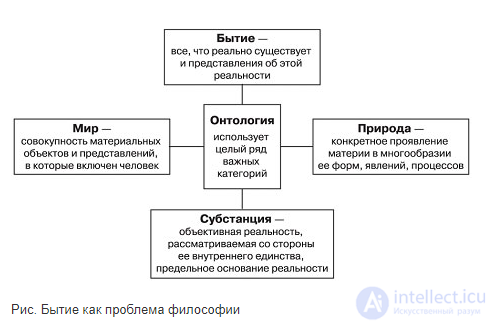
Fig. Being as a problem of philosophy
However, any explanation of the surrounding world, to one degree or another, contains an ontological component, represented by a set of basic principles, evaluations, and attitudes toward reality, toward the world.
The basic questions addressed by ontology relate to the origin of the surrounding world, to the formation of the main regularities of its coming-into-being and development, to the relation of the world and its constituent parts, to the problems of the qualitative, quantitative, and temporal parameters of the world and its elements, to the degree of mutual conditioning of the objects, processes, and phenomena of the surrounding world, and to identifying their mutual arrangement and the sequence of their coming-into-being. Ontology poses questions about the most general causes of everything that exists, about the sources, character, and directions of the development of the Universe and of the large and small systems that compose it.
The categories of ontology reflect what is most important in conceptions of the world. Owing to the fact that these conceptions differ (the approaches of different philosophical schools and traditions may contradict one another), different categories underlie reflections on surrounding reality. Different opinions arose as to which of the categories reflects the most general understanding of the surrounding world, and which of them should be placed at the foundation of the comprehension of reality. In doing so, one must remember that categories are always connected with something that the philosopher, the researcher, thinks of as actual, that is, with that system, object, process, phenomenon, property, aspect, and so on, which the scholar designates by the given category.
Thus, researchers who consider that our world represents a totality of material objects, in relations of varying quality and intensity with one another, hold that such a «starting» category should be matter. In the interpretation of the materialists, matter exists eternally — it is created by no one and by nothing, and is indestructible. It is in constant motion, in the course of which it manifests itself in various forms, forming a complex hierarchy of the most diverse systems (from atoms to galaxies, from relatively simple material objects to the most perfect living organisms and human society). Matter becomes the source of a multitude of processes and phenomena, including consciousness, which is inherent in the human being.
The ontological conceptions of materialists are constructed in a similar way, though different materialist schools may have their own peculiarities of ontology. The starting point for the investigation of the surrounding world may be nature, in its materialist understanding, as the concrete manifestation of matter and the diversity of its forms, phenomena, and processes. Close to nature are the categories cosmos, universe, and universum. Sometimes cosmos and nature are perceived as synonyms. In this case they signify all that exists, the whole world in the diversity of its forms.
Differences may also be found between these categories. Thus nature is conceived, rather, on the basis of an understanding of that earthly world (earthly nature, the immediate habitat of the human being) that is familiar to human perception. At the same time, this «earthly nature» is conceived as included within «nature in general» — within the whole material world, including that part of it (such manifestations) which is not only outside the human being's «field of vision,» but of which the human being may not even suspect the existence. The cosmos, on the other hand, is conceived as the entire diversity of the material (of matter), within which the world familiar to the human being is conceived as one of the fragments of this infinitely complex formation.
Nature, cosmos, and universe as categories can be interpreted not only from materialist positions. In some philosophical teachings, Nature is identified with God (pantheistic teachings; for example, this is how B. Spinoza interprets nature). Cosmos, like nature, can be interpreted both in a materialist and in an idealist vein (as well as in dualist, positivist, or other philosophical traditions).
The ontological views of idealists are no less diverse than the views of materialists. What they have in common is that matter no longer has the status of the basis of everything that exists. The source of everything that surrounds the human being, and in many cases also the cause of the very existence of the human being, turns out to be an ideal principle. God, the World Idea, the Cosmic Mind, the Absolute — categories of this kind can lie at the foundation of the philosophical systems of idealists (objective idealism). The starting category may also be individual consciousness (subjective idealism). According to such views, it is precisely individual consciousness that determines the surrounding world.
Considering the problem of being from the point of view of structural-typological analysis, one can distinguish the basic levels and kinds of being.
Levels of being
|
Actual being |
Potential being |
|
|
being present at a given moment in time |
given |
being that has not yet arisen at a given moment in time but that could in principle become such |
The categorial pair «actual being — potential being» defines the world as a process, that is, characterizes it as something in the process of becoming, possessing a certain degree of indeterminacy in its development. Any object, from the point of view of its presence at the current moment in time, can be characterized as actual being, but before this moment it did not yet exist, that is, it possessed only potential being, into which it will pass again after a certain time. Therefore any object is an inseparable unity of actual and potential being.
Kinds of being
|
MATERIAL-OBJECTUAL BEING |
The being of first nature: the being of objects and phenomena in their natural givenness |
|
The being of second nature: the being of objects changed or created as a result of human activity |
|
|
THE BEING OF THE HUMAN BEING |
The being of the human being in the world of things (in E. Fromm's terminology, the being of the human being in the status of «Having») |
|
Specifically human being (in E. Fromm's terminology, the being of the human being in the status of «Being») |
|
|
SPIRITUAL BEING |
Individualized spiritual being (the consciousness of a specific person) |
|
Supra-individual spiritual being (the existence of the spiritual in impersonal universal forms) |
|
|
SOCIAL BEING |
The being of the individual as a social subject |
|
The being of society as an integral multilevel system |
The basic kinds of being are material and spiritual being. The criterion for distinguishing the material and the spiritual can be the principle proposed by B. Spinoza: «causa sui» – that which is the cause of itself. Material being includes everything that exists outside of and independently of consciousness, that is, that is the cause of itself. This type of reality is called in philosophy objective reality.
Spiritual (ideal) being is subjective reality, since it experiences a certain dependence, in its existence, on material being. This dependence manifests itself both in the fact that the content of consciousness (the spiritual) is a phenomenon of the real world (consciousness is always consciousness of something), and in the fact that the products of individual consciousness can exist for the Other, that is, become part of culture, only by acquiring objectified embodiment in sign forms.
Objective and subjective reality are interconnected, forming an inseparable whole. The existence of the human being and of society, the world of culture, cannot be unambiguously assigned solely to material or to spiritual being. The mode of their interconnection is human activity.
Material-objectual being
«First nature» – the totality of objects and phenomena in their natural givenness. It arises as a result of biological-cosmic evolution and possesses the status of objective and primary reality. The primacy of nature is understood in the sense that the human being and their spirit are born in nature and thanks to nature, being one of the later links in the infinite chain of the evolution of being. Nature is primary and objective also in the sense that without it human life and activity itself is impossible.
«Second nature» arises in the process of human activity, embodies the labor and knowledge of the human being, that is, it is created consciously to ensure certain sociocultural needs of people. The being of «second nature» is the unity of the material and possibilities of «first nature» and the needs of the human being, realized in their goal-setting, conscious activity. Thus «second nature» represents the result of the interaction of material and spiritual being and, in comparison with first nature, is a reality of a new type, possessing a complex (natural-spiritual-social) character.
The being of the human being
The primary prerequisite for the existence of the human being is the life of their body. The human body is created by nature. It is precisely corporeality that makes the human being a finite, mortal creature. The natural character of the body allows the problem of human being to be included within the broader problem of the evolution of nature and the emergence of the human being (anthropogenesis). In order to think, one must ensure the life of the human body, satisfy at least its most necessary, fundamental needs. The existence of the human being as a natural organism is subordinate to all the laws of life, above all the laws of heredity. The natural-biological «dimension» of human being is a special world, relatively autonomous and integral, and at the same time inscribed within the wholeness of nature.
The being of the human being is a unity of body and spirit. The body is connected with the work of the brain and nervous system, and through them – with the psyche, the mental and spiritual life of the individual. For themselves, the human being is not only first but also «second nature,» since thoughts and emotions, being the most important side of human life, influence the life of the body.
The peculiarity of human existence consists in the emergence, unique to living nature, of a non-rigid and non-universal determination of human being by the natural character of their body, since the body itself is in close interaction with thinking, the psyche, emotions, will, and self-consciousness. The specificity of human being consists in the joining of three dimensions of its life:
– the human being as a sentient body;
– the human being as an individual belonging to the species Homo sapiens;
– the human being as an actively acting and thinking socio-historical creature.
The being of people is a unique unity of the natural and the spiritual, the personal and the social. People do not merely exist in the world, but are capable of transforming the world and themselves. Only the human being is capable of knowing their own being and being in general, of experiencing anxiety for the «fate of being.» It is no accident that, on the threshold of the 21st century, the problem of the human being's responsibility for the fate of humanity, civilization, and culture acquires particular significance. Special hopes are placed on the spirituality and rationality of the human being.
The being of the spiritual
The spiritual is the unity of the diverse manifestations of consciousness and the unconscious. It includes knowledge, materialized in languages (natural and artificial), the norms and principles of human communication, morality, law, artistic creation, and so on.
The spiritual is divided into individual and supra-individual spiritual being.
Individual spiritual being is represented by the real life of the individual's consciousness. Its specificity lies in the fact that:
– it is unrepeatable and unique, and it is practically impossible to reconstruct the stream of consciousness in its entirety;
– the processes of individual consciousness arise and die together with the birth and death of individual people;
– individual consciousness is «manifested,» articulated by means of forms worked out by culture (sign, language, symbol, and so on), which have a universal character, and therefore the preservation of the results of the activity of individual consciousness is possible only as a result of their transformation into an extra-individual (sign-symbolic) form of existence.
The specificity of objectified spiritual being lies in the fact that it is capable of being preserved, perfected, and freely moving in social space and historical time. Moreover, it contributes to the formation of the spiritual life of society, of humanity as a whole. Growing richer, the world of ideas acquires relative autonomy. Stable forms of the spiritual, objectively present in culture, arise, such as religion, morality, art, philosophy, science, and so on.
The being of the social
The essential characteristic of the human being is their being as a collective, social subject. However far back into history we might try to look, the human being has always existed by uniting into various forms of social communities – the clan, the tribe, the family, the ethnos, the state, the class, and so on. The sociality of the human being is directly connected with their mode of life activity – the capacity not only to fit into the surrounding environment, which is also characteristic of animals, but to actively transform their habitat, forming a «second nature,» culture. Sociality should not be understood merely as collectivity (plurality), that is, joint domestic and productive activity. Even in situations of conscious or forced withdrawal from society (for example, in situations of monastic seclusion), the human being nonetheless remains a social being, realizing their sociality in a «sublated,» mediated form: the human being carries out their cognitive activity within those intellectual «horizons» that humanity has already opened up, formulates their knowledge in the sound and graphic writing habitual to them, and satisfies their needs in the manner typical of their culture. Therefore, in fact, all the characteristics of the human being are their characteristics precisely as a social being.
The world — is also an important category of ontology. One should distinguish the world as a synonym for the secular (extra-ecclesiastical) component of society, of society as a whole, as the earthly habitat of the human being, or as a state of relations between social systems (countries, unions of states), when contradictions arising between them are resolved by non-violent methods, from the world in the ontological sense. In ontology, the world is the totality of material objects and ideal representations, in which the human being is included. In this case, the human being's worldview can be recognized as the «point of reference.» And the world is the being of the human being in nature.
In other words, the world is the aspect of nature, the universe, the cosmos, that is actual for the human being. Consequently, the world can bear various characteristics. It can be the world of a separate individual and of the whole of humanity, a real and an irreal world, a material and an ideal world, and so on. In its turn, reality (as matter and the material, idea and the ideal) is also an important category of ontology. It denotes the objects, processes, and phenomena of the surrounding world that are actual for the human being and perceived by them. Reality also often turns out to be identical to nature, matter, the universe, being. In doing so, reality can be either explored, known, or not yet discovered, unknown. That is, reality is connected with the discovery of the forms, relations, and systems surrounding the human being, in which the world is manifested. It is reasonable to hold that reality can be material – these are the objects, processes, and phenomena of the material world. Such reality is called objective: it exists independently of the consciousness and will of the human being (material objects created by the human being subsequently exist also independently of the consciousness of their creator).
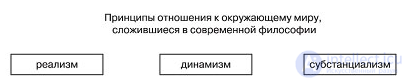
Among the most significant categories of ontology, one should name substance. This too is objective reality, but considered not from the side of the diversity of its forms, but from the side of its inner unity (irrespective of the diversity of forms and manifestations). In other words, substance is the ultimate foundation of reality, that which everything perceived by the human being ultimately is, that with which they one way or another come into contact (that which they have known before, that which they may encounter in the future). For materialists this is matter; consciousness, from their standpoint, is merely one of the phenomena that arose as a result of its development, a phenomenon that, though very important and complex, is «non-autonomous.»
Such a hierarchy does not suit all philosophical schools. Some philosophers are inclined to hold that the basis of everything is a certain ideal essence, which either creates matter, or, on the basis of scattered sensations, creates a representation of the external environment, mistakenly taken for the material world, which in reality may not exist. Thus, objective idealists hold that the source of everything surrounding us is an objective ideal principle, which also creates matter. From the standpoint of subjective idealists, the representation of the world is formed by individual consciousness. There are philosophers (dualists) who hold that two equal substances are real – matter and consciousness; the result of their interaction is the existing world in all the diversity of its forms. Pluralists, on the other hand, hold that there are many substances.
Thus, each of the categories of ontology, on the one hand, characterizes the reality surrounding the human being from a certain side, lending a particular specificity to the subject's understanding of it. On the other hand, many of these categories are often connected with a certain worldview position. This or that correlation of categories, a particular (with an indication of the sequence, hierarchy, and significance of each of them relative to the others) unification of them into a general system, gives an idea of the author's position. The categories complement one another, and attempts to ascribe to any one of them a universal significance, to elevate it to the status of the fundamental, the most general, are subject to criticism from philosophers holding other points of view.
The category most frequently used in ontological conceptions is being. Many thinkers begin the «construction» of their understanding of surrounding reality precisely with it. In many cases this category turns out to be the most universal; the other categories of ontology are often defined through being. Thus nature is sometimes interpreted as the nature or natural being of natural phenomena, and the world of the human being – as being-in-the-world.
Moreover, ontology itself is most often interpreted as the doctrine of being. Being as such is precisely the central problem of ontology.

Comments