
Lecture
The metaphysical absolutization of the moment of stability in motion led to a denial of development. In the eighteenth century the idea of the immutability of nature prevailed. But from the end of that century, the idea of development began to take shape in natural science (Kant's cosmogonic hypothesis, evolutionary paleontology, Darwin's theory, and so on).
Today one would hardly find a person who denies development altogether. But it is understood in different ways. In particular, the question of the relationship between the categories of motion and development remains debatable: which of them is broader, or are they perhaps identical?
Analysis of the factual material shows that development is not identical to motion. Thus, not every qualitative change is development; hardly anyone would consider the melting or freezing of water, or the destruction of a forest by fire, to be development. Development is a particular kind of motion, a particular kind of change.
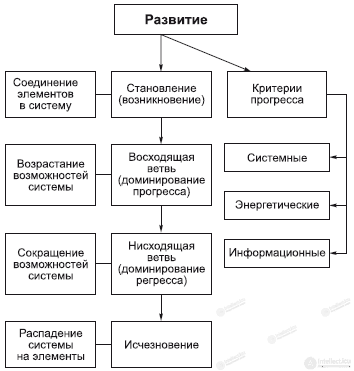
Let us use the model of a developing object (system) proposed in our philosophical literature. In the course of its development, four stages can be distinguished: emergence (formation), the ascending branch (attainment of a mature state), the descending branch, and disappearance.
At the first stage a system is formed from elements. Naturally, a material object does not arise "from nothing." The process of emergence usually proceeds as "self-construction," a spontaneous combination of elements into a system. The manner of combination is determined by the properties of the elements. With the emergence of the system something new appears — something that is not present in its elements and that can be represented as a non-additive sum of the properties of the elements.
After the system has formed, it enters the ascending stage. This stage is characterized by increasing complexity of organization and a growing set of possibilities.
A material system passes through a certain highest point of development and enters the descending branch. At this stage there occurs a relative simplification of structure, a reduction in the set of possibilities, and an increase in the degree of disorder.
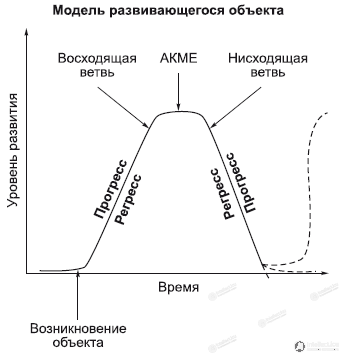
A particular material system cannot exist and develop forever. Sooner or later it exhausts its possibilities, a process of disorganization of internal connections sets in, the system becomes unstable, and under the influence of internal and external factors it ceases to exist, passing into something else.
To further specify the concept of development, the concepts of progress and regress are used. Sometimes the ascending branch is characterized as progressive change and the descending branch as regressive change. From our point of view, such an understanding is unwarranted. The facts show that both progress and regress are present at both stages, but the matter lies in their different ratio: on the ascending branch progress dominates, on the descending branch regress dominates. Understanding the ascending and descending branches as a unity of progressive and regressive changes is an important methodological idea, since it removes the possibility of metaphysical crudeness in the understanding of development.
To define the concept of progress (regress) one can use the concept of the level of organization. In general terms, progress can be defined as a form of change in a system associated with a rise in the level of organization, and regress as a form of change in a system associated with a decline in the level of organization.
The proposed understanding requires an indication of the criteria for the level of organization. Three groups of criteria are distinguished: systemic, energetic, and informational. Systemic criteria characterize the level of organization from the standpoint of the complexity of the system, the diversity of its elements and structural connections, the degree of stability, and so on. Energetic criteria show the degree of efficiency of the system's functioning (the expenditure of matter and energy needed to achieve a given goal). Informational criteria characterize systems by the number of communication channels and the volume of information received from the environment, and by the state of the control systems.
An adequate assessment of the level of development of particular material systems requires taking all these criteria into account. But it seems that special attention should be paid to the systemic criteria, since the others depend on them in one way or another.
Nowadays the problem of development is often examined from the standpoint of synergetic ideas. The central problem here is the relationship between order and chaos. In these terms one can interpret the level of organization of material systems. In material systems there are two tendencies: a tendency toward an unordered state (a decrease in the level of organization) — in closed systems; and a tendency toward order (an increase in the level of organization) — in open systems. Synergetics translates the fundamental questions of development into its own language.
Among the problems of the theory of development, the following questions come to the fore: why does it occur, how does it occur, and toward what is it directed? Dialectical philosophy offers answers to these questions in the laws of dialectics.

Comments