
Lecture
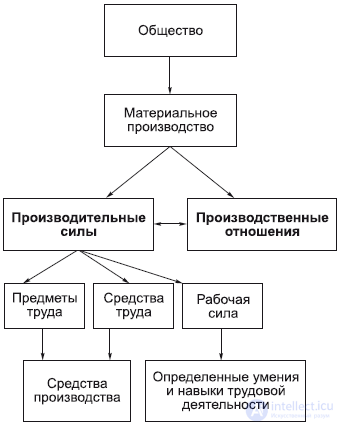
Material production is the basis of all social life. Let us examine the components of material production and their interrelations.
In any branch of production, labor is possible given the presence of an object of labor, means of labor, and labor power.
The object of labor is everything to which a person applies his labor: for a miner it is the coal seam, for a farmer the plowland, for a turner the workpiece, and so on. Objects of labor are initially taken from nature. But objects existing in nature are not in themselves yet objects of labor; they become such when they are drawn into the process of production. Objects that have already passed through the production process also become objects of labor; for example, various machine parts are made from smelted steel. Sometimes the concept of raw material is used as an equivalent to the concept of objects of labor.
Means of labor are everything by means of which a person acts upon objects of labor. First and foremost, tools of labor belong to the means of labor. To set tools of labor in motion, people use various sources of energy, ranging from the muscular energy of the person himself to atomic energy. In the broad sense of the word, the means of labor include not only tools of labor and sources of energy, but also other material elements of production: land, production premises, transport (including oil pipelines and gas pipelines), and means of communication (including computer networks).
Objects of labor and means of labor together are called the means of production.
Labor power is not simply some quantity of people. A person becomes labor power when he possesses certain skills and abilities for labor activity. The effectiveness of material production depends on his professional training, physical health, consciousness and will, his morals, and so on.
A person, as labor power, performs two basic functions in the process of material production: he is a source of energy and he manages production. As production develops, first, the role of the person as a source of energy decreases (in the process of mechanization). Today, the share of human energy in the total volume of energy used in production is negligibly small. Second, the person's role in managing production processes decreases (as automation proceeds). Put differently, as material production develops, the expenditure of a person's physical and intellectual powers decreases.
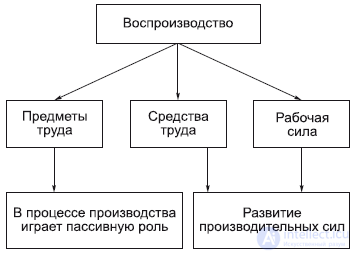
All three elements – the object of labor, the means of labor, and labor power – are necessary for the process of production. But their role in production is not the same.
The object of labor plays a passive role in production – it is subjected to the action of labor power by means of the means of labor. What substances and objects of nature are worked upon depends on the level of development of the means of labor and the needs of society.
The specificity of production in each historical epoch is determined above all by the level of development of technology, of the tools of labor. It is no accident that historians distinguish epochs of history (the Stone Age, the Bronze Age, the Iron Age) according to what means of labor production is carried out with.
The level of development of labor power is connected with the character of the tools of labor. As technology develops, the requirements for the qualification of labor power change. Once new tools of labor have been created, people must adapt to them. A change of technology requires new labor skills and production experience. With the appearance of new tools of labor, new professions arise. But this is only one side of the matter. For tools of labor, technology, are created and perfected by people. People participating in production not only set tools of labor in motion, but also change them, improve them, modernize them, and so on. The interaction of technology and the person (labor power) is a source of the development of both technology and labor power. Here one could also point to the role of the person as the creator of new technology. The interaction of the means of labor and labor power turns out to be an important determinant of the development of the productive forces.
For society to exist and develop, the production of material goods must be carried out continuously. Therefore the process of production is a process of reproduction, that is, a process that is renewed again and again. Not only articles of consumption are created and reproduced, but also the means of production necessary for the continuation of production – raw materials, fuel, tools of labor, and so on. As raw materials are used up, their stocks must be replenished; tools of labor wear out – new ones must be produced to replace the old. In addition, it is necessary that people, workers, restore their strength by receiving the articles of consumption necessary for their life and labor, and that new workers be trained to replace those who have retired because of old age, illness, or death. Thus all the elements of production – objects of labor, means of labor, labor power – must be constantly reproduced.
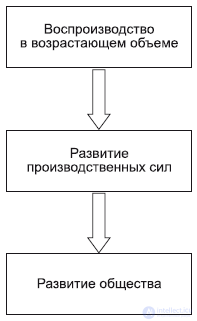
Reproduction can take place on the same scale. But such simple reproduction cannot ensure the development of society (if, moreover, one bears in mind population growth). For society to be able to develop, to advance its culture, expanded reproduction is necessary, that is, the recreation of all the elements of production on an increasing scale.
The branches of contemporary production are divided into light industry, which produces articles of consumption (foodstuffs, footwear, clothing, and so on), and heavy industry. The latter produces means of production – machines, instruments, fuel, and so forth. For expanded reproduction to take place, society must invest a significant portion of its resources and labor in heavy industry.
The development of the productive forces is not merely their quantitative increase. Development consists in the replacement of means of labor by new, more effective ones. Consequently, the development of the productive forces is possible on condition that society expends its labor not only on satisfying today's needs, but also on the further increase and improvement of production. And this concerns technology, personnel, and the existing or possible object of labor alike.
In concluding the characterization of the productive forces, let us touch on a debatable point regarding terminology. There are two approaches to the definition of the concept of productive forces. In the first variant, all three of the components indicated are included in their composition: the object of labor, the means of labor, and labor power. In the second variant, the productive forces include only the means of labor and labor power. The argument for the second variant: the productive forces are that which produces, whereas the object of labor itself produces nothing – it is that from which things are produced. We leave it to the reader to determine his own position.
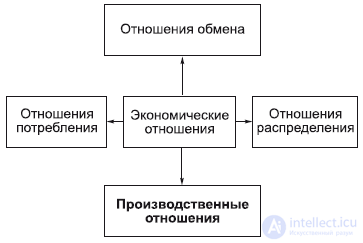
Relations of production are not material, as the productive forces are, but they are equally objective. What, then, do they represent?
A peasant, a farmer, in the past and even now, may think that he is independent, that he is not bound up in production relations with others. He himself plows, sows, and harvests the crop. But this is only the peasant's apparent independence from others. Here he buys, for example, a plow, an agricultural machine, and so on, and this means that he enters into economic relations with other producers. In order to have the means to purchase tools of labor, he sells part of his harvest, and thereby again enters into economic relations with other people. These relations are not determined by his wishes.
For example, the price at which he sells grain does not depend on his wish. The whole complex system of economic relations that develops on the basis of the production and exchange of goods is practically unknown to the peasant; he clearly recognizes his immediate goals – to sell his grain more profitably and to buy the tools of labor he needs more cheaply. But the economic relations that have taken shape in society subordinate price formation to themselves, and subordinate his conduct of his economy to themselves.
The relations that develop among people in the process of producing material goods are called relations of production. These relations are a necessary side of social production.
Production is never carried out by people who are completely isolated from one another. From the very beginning of human society, people hunted together, built dwellings together, and so on. The production of the means of subsistence was, from the outset, social production. The individual conduct of a household by separate families arose at a later time. The development of tools of labor led to a gradual, multistage division of labor. Whereas in early communities the same people could do everything necessary, later a division of different kinds of labor among different workers takes place.
The division of labor is economically advantageous. When people engage in a particular kind of work, labor becomes more productive, since the worker more quickly perfects his production skills.
Together with the division of labor, an exchange develops among people of the products of their labor, the property of individual producers and individual families appears. Commodity-money relations take shape among groups of people specializing in agriculture, cattle breeding, crafts, trade, and so on.
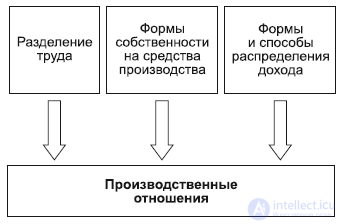
At the base of the relations of production of every society lies one or another distribution of the means of production among the members of society, that is, one or another form of property. If the owners of the means of production are individual persons or a part of society, while others are not, then we are dealing with private property. If the owners of the means of production, in one form or another, are all the members of society, then it is social property.
The forms of ownership of the means of production determine the relations between individual owners, and between the owners of property and the direct producers. Ownership of property is fixed legally, regulated by law, and protected by state power and by tradition.
Ownership or the absence of ownership of the means of production determines a person's property status, the quality of his nutrition, the comfort of his housing, the level of his medical care, his children's education, his role in political and cultural life, and so on. The sociopolitical aspects of society's life depend substantially on people's differing relations to property in the means of production.
In the contemporary world, the absence of ownership of the means of production does not always mean poverty and a low quality of life, as was characteristic of capitalist society in the nineteenth century. The development of a market economy in society leads to a situation in which the condition for entrepreneurs' economic success becomes stable, solvent demand among the population. The latter, in turn, is possible only with certain economic concessions in the payment of labor to the working masses.
Finally, from people's differing relation to the means of production there follows the third component of relations of production: the forms and ways of distributing the products created, the quantitative proportions in the distribution of income. Such forms may be profit, rent, and so on for the owners of the means of production, and wages for the workers. And of course the owners of the means of production will receive a proportionally significantly larger share than the workers.
Production relations and economic relations in general must be distinguished from technological (or organizational-technical) relations. The latter include, for example, the relations between individual workers on an assembly line, between shops in a factory, and so on. Technological relations are relatively independent of the relations of production. When the form of property changes, technological relations may remain unchanged.
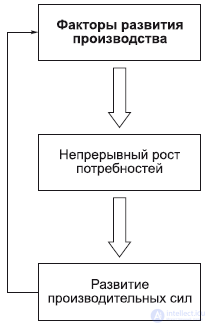
Material production is ultimately oriented toward satisfying the needs of the person and of society. In the development of society an objective regularity is observed – the continuous growth of needs. The increase in needs is connected both with population growth and with changes in people's way of life. As society develops, new, more perfect ways of satisfying old needs arise, as well as new needs that did not previously exist. Needs are a driving factor of people's activity. P. Lafargue once remarked, half in jest, that laziness (the need to work less) is the lever of culture. But how do needs arise?
People must first come to know that toward which a need will later appear, and only then seek its satisfaction. Let us ask: did a person start to roast meat because he already had a need to eat precisely roasted meat, or, on the contrary, was it because he once ate roasted meat that a need for it appeared in him? It seems more logical to reason thus: after a fire, people found a scorched animal, ate its meat, noticed that roasted meat is easier to chew, tastes good, and that after it a person feels better, and so on. First there were deeds, and then needs. One could ask many analogous questions: did cinema appear because a need for it had arisen, or, on the contrary, was cinema invented and only then did a need for it appear? And so on.
The use of the forces of nature and the development of the productive forces gave rise to ever new needs. Thus, having come upon ears of grain and having eaten the grains, people began consciously and purposefully to seek out cereals. When they began to cultivate the land, it became possible to produce grain, and then, with the invention of millstones, a need for bread. Biological needs – the need to eat, drink, rest, and so on – served as the initial basis for the formation of new needs. A number of needs arise on the basis of the development of social relations. Thus exploitation gives rise to the need to struggle against the exploiters.
Needs develop, die out, and new needs arise on the basis of the changing and emerging productive forces and relations of production. In turn, new needs become a stimulus for the development of the mode of production. The interaction of needs and production is a determinant both of the development of production itself and of society as a whole.
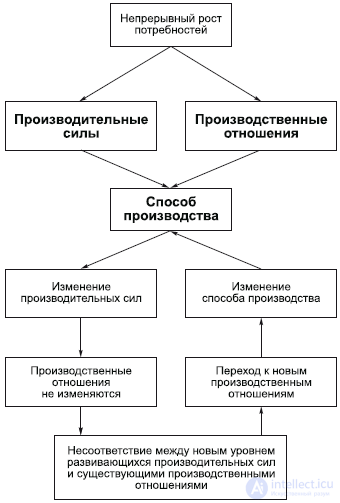
In the course of the history of society, both the productive forces and the relations of production change. The productive forces and the relations of production are aspects of a single whole – the mode of production. But they are different aspects, they change unequally, and they play different roles in the development of society.
People cannot establish relations of production at their own arbitrary will. These relations take shape depending on the attained level of the productive forces. The character of the means of labor dictates the necessity of certain relations among people. Thus, the transition from feudal to capitalist relations of production was prepared by the development of the productive forces. Under capitalism, manufacture, and then machine technology, gave rise to the capitalism of free competition, and then to state monopoly capitalism. And today a higher level of the productive forces and of the socialization of labor has brought about the appearance of transnational corporations.
The dynamics of the interrelation between the productive forces and the relations of production can be represented as follows.
• A change in the mode of production begins with a change in the productive forces.
• As long as the relations of production allow room for the development of the productive forces (in particular, allow scope for raising the productivity of labor), society develops progressively.
• Since the relations of production do not change, as the productive forces develop a discrepancy arises between the new level of the developing productive forces and the existing relations of production.
• Since the ruling class tries to preserve its economic base, the existing relations of production, in the course of social revolutions and reforms a transition to new relations of production takes place.
• New relations of production allow scope for the further development of the productive forces; society again develops progressively. And so on.
Every form of relations of production exists only as long as it provides sufficient scope for the development of the productive forces. Throughout history one set of relations of production has replaced another, and this opened up new possibilities for the development of the productive forces. Thus capitalist relations of production created conditions for a more rapid development of the productive forces than feudal ones, since the guild organization of craft production was rejected.
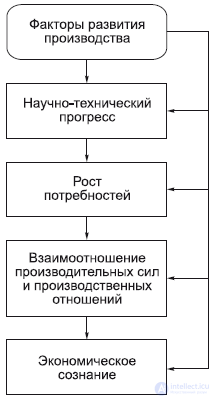
The productive forces develop at uneven rates. History reveals a pattern — an acceleration in the rate of development of the productive forces with the transition from one formation to another. This is especially noticeable in the modern era. What causes the growth of the productive forces?
An important role in the development of production is played by the application of science to the improvement of technology and the organization of production.
In the twentieth century a scientific-technological revolution is under way. A revolution in technology is the creation and introduction of technical devices that bring about qualitative changes in production, transforming its energy and material basis and its technology. A revolution in science is understood as the creation of new fundamental theories as a result of the discovery of new laws. Whereas in the past science and technology developed relatively independently, and the links between them were episodic in character, the present-day scientific-technological revolution is understood as an organic interconnection of revolution in science and in technology. This amounts to the transformation of science into a direct productive force of society.
The scientific-technological revolution affects all spheres of society. In the course of the scientific-technological revolution the character of labor and the requirements placed on workers change, and changes are required in the system of education and upbringing, in management activity, and so on.
The development of material production is determined by a complex of factors, among which are the influence of the geographical environment and population growth, the interaction of productive forces and relations of production, of needs and production, the interaction of the labor force and the means of labor, and the influence of science and its transformation into a direct productive force.
Material production cannot be represented as some purely material process that takes place independently of human consciousness. Economic consciousness is woven into material production.
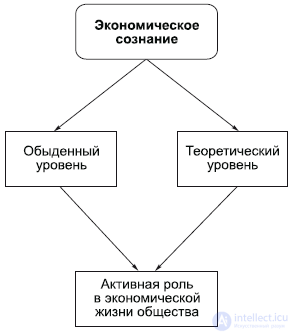
From the very beginning of the existence of human society, people had certain knowledge of how to manage an economy and produce material goods. As the economy developed, this knowledge — reflecting various aspects of the process of production, exchange, and distribution of material goods, and knowledge of the organization and management of production and economic activity — formed a special kind of social consciousness: economic consciousness.
Like other forms of social consciousness, this consciousness has an everyday-practical level and a theoretical level. At the theoretical level, economic consciousness was already present in antiquity, for example in Aristotle, who among the "practical" sciences distinguished politics, economics, and ethics, understanding economics as the science of household management. Aristotle already had a number of important economic concepts and ideas, for example concerning the essence of money.
Economic consciousness at the theoretical level began to develop rapidly in the era of capitalism. The founders of political economy as a science of economic activity, of production and its management — A. Smith, D. Ricardo, and others — developed the labor theory of value. The views of these thinkers, after critical reworking, served as one of the theoretical sources of Marxism.
Bourgeois economic consciousness, both at the everyday-practical level and at the theoretical level, regards the acquisition of private property and personal enrichment as the basis and goal of all economic activity. At the same time, bourgeois economic science has developed concepts that make it possible to give capitalist production a dynamic character, allowing private initiative to be combined with state regulation.
Economic consciousness plays an important role in the development of the economy and of social life. Depending on whether it reflects and assesses reality correctly or not, it can serve either as an accelerator or as a brake on economic development. Social life reacts sharply to the application of various economic concepts, ideas, and models. In this respect, for example, the "secret" of Japan is interesting. The successes of its economy can hardly be explained solely by low military expenditure or by the specific character of the national temperament; much is explained by the introduction of economic thinking aimed at fierce competition, special attention to personnel training, a sense of obligation to the firm and to partners, collective discussion of problems, moral incentives, and so on.

Comments