
Lecture
Ethical behaviour — a set of behavioural norms adopted across all sections of Wikipedia, which must be adhered to when editing articles, in the course of discussing any questions whatsoever, and when writing comments on edits. Unethical behaviour can be briefly characterized as personal attacks, which create a conflictual atmosphere and tension. The norms of behaviour adopted in Wikipedia require all participants to behave ethically toward one another. This is one of the most important rules of Wikipedia.
Let us clarify what ethical norms are and what forms they take. Ethics (from the Greek etos — custom) is a branch of philosophy that studies morality.
It is believed that the first person to combine several concepts of human behaviour under a single word was the well-known Aristotle. In his treatises he put forward the concept of «ethics» as «the virtues or excellences manifested in human behaviour». In his view, ethics should help one understand which actions are permissible and which are not.
From the definition of the concept of moral culture follows the notion of a deep, organic interconnection between the concepts of "morality" and "behaviour". In this connection there arises the need to clarify such concepts as "activity", "behaviour", "deed", "motive", as well as the relationship between the concepts "organizational behaviour", "business behaviour" and "official behaviour".
Activity is a totality of actions that bring about changes in the surrounding world or in the subject of the activity itself.
The category of activity is studied by philosophers, psychologists, and sociologists.
Philosophers study activity as a specific form of active engagement with the surrounding world, the content of which consists in its purposeful change and transformation.
Psychologists, proceeding from the postulate of the unity of the psyche and activity, regard the latter as a dynamic system of "interactions between the subject and the world, in the course of which a psychic image arises and becomes embodied in an object, and the subject's relations, mediated by it, are realized within objective reality" .
Sociologists study activity as a complex, multidimensional system — practical and spiritual — as a mode of existence and development of social reality, a manifestation of social activity, and the purposeful reflection and transformation of the surrounding world .
What unites all these approaches is that human activity is regarded in them as a specific mode of the human relation to the world, one distinguished by the purposefulness of actions, uniting in indissoluble unity external objective activity and the activity of consciousness, and is evaluated from the standpoint of its significance both for the agent himself and for those around him.
The study of activity as a category of ethics makes it possible to single out its moral side from the whole diversity of people's social practice, and, from all the kinds of motivations (material interests, habits, inclinations, etc.) — "specific moral motives: the desire to do good, submission to the sense of duty, the striving to realize particular ideals". Therefore moral activity in ethics is understood to mean only those acts that are consciously subordinated to definite moral aims.
The concept of "moral activity" is often used in contemporary ethical literature as a synonym for the concept of "moral behaviour", regarded as a property of social behaviour. Indeed, if the concept of moral activity characterizes purposeful and morally motivated actions, then behaviour, as the totality of a person's acts that can be subjected to moral evaluation, is that same conscious, purposeful action in indissoluble unity with subjective motivations and socially significant consequences, the practical actions of the individual and the substructures of his consciousness (knowledge, convictions, feelings, habits). "Since human activity is distinguished by the conscious positing of goals and the choice of means for achieving them, human behaviour includes, as an essential element of its own, the activity of consciousness as well. Therefore... it is meaningless to speak of human behaviour apart from its connection with the activity of consciousness... Outside behaviour there is no morality..." .
Behaviour is a specific form of human activity, a totality of acts in which a person's personality is manifested, along with the particularities of his character and temperament, his needs and tastes, and in which his attitude toward surrounding reality is revealed ; it is an object of legal, moral and other evaluation and regulation; a reflection of the level of an individual's moral culture.
Moral behaviour, as a special form of individual activity connected with people's mutual relations, represents a totality of a person's acts as elementary, morally significant units of human activity, carried out under conditions of alternative choice and considered from the standpoint of the unity of motive and consequence, intention and deed, ends and means.
An act — an action, together with the moral consciousness activity that precedes it, encompassing impulse, motive, intention, choice, and decision, as well as the moral consciousness activity that follows, encompassing a person's self-assessment of his act and the attitude of others toward his act.
An act is an integral phenomenon that inseparably combines subjective-personal motives with objectively significant results. Its structure includes the subjective motive, the socially significant result, and the external conditions for the transition of the motive into the result, i.e., the accomplishment of the act. From the standpoint of ethics, the most important thing in an act is its moral value.
Motive (French motif — impulse) — an impulse to activity, connected with the satisfaction of a subject's needs; a totality of external and internal conditions that arouse a subject's activity and determine its direction; a conscious reason underlying the choice of actions and acts of a person.
Sociologists define motive (motivation) as impulse toward the activity of a subject (a person, a social group, a community of people), connected with the striving to satisfy certain needs. Psychologists, broadening the boundaries of this concept, examine motive both as a totality of external and internal conditions that arouse a subject's activity and determine its direction, and as an object, that impels and determines the choice of direction of the activity for whose sake this activity is carried out, and as a conscious reason, which underlies the choice of a person's actions and acts.
The moral values developed within society or a person's immediate environment determine the content of an individual's moral motivation, which, interacting with other regulators of human behaviour, is one of the most important factors conditioning a person's behaviour, its driving force.
Conviction — a conscious need of a person that impels him to act in accordance with his own value orientations.
Any elements of human consciousness may serve as motives:
The idea of the unity of consciousness and behaviour received thorough argumentation and elaboration in the works of Russian psychologists L. S. Vygotsky, S. L. Rubinstein, A. N. Leontiev, D. N. Uznadze and others. Sociological analysis of social behaviour became the subject of the closest attention on the part of the most prominent representatives of world sociology — P. Sorokin, T. Parsons, R. Merton, R. Dahrendorf and others.
Consequently, human behaviour can be analysed only in connection with the activity of one's consciousness.
many organizations are open to anyone willing to help improve the services they provide, which, however, often leads to disputes over whether a given change actually «improves» them. In the course of such disputes it can sometimes be quite difficult to set aside subjectivity in assessing the situation. clients, trying to justify as clearly as possible the changes they have made, may sometimes express themselves with excessive harshness. On the other hand, some participants may be very sensitive to having their text replaced by someone else's, allegedly «improving» the service — especially if the meaning of what was said is substantially altered in the process.
Dry and impersonal comments cannot convey all the nuances of live communication and are therefore often misinterpreted. One careless, impolite remark can easily lead to a heated discussion that strays far from the essence of the problem. Drawn into conflicts, participants forget about working on articles, thinking more about «victory» over the «enemy».
This rule is intended to help avoid such situations.
A violation of the principles of ethical behaviour occurs, for example, when a participant who has just created a new article is told: «If you were already set on writing an unnecessary article, could you at least remove the spelling mistakes from it?». It is enough to simply reply: «Mind your own business» — and one single impolite remark leads to a conflict.
Such a style of communication drives newcomers away, distracts participants from working on tasks important to the project, and harms the whole community.
In most cases, participants make unethical remarks at tense moments of a protracted conflict. Unethical behaviour, as a rule, cuts off discussion. A participant may often subsequently regret the rudeness committed. There is therefore no need to object if he (or someone else) wants to remove an incorrect remark or soften it.
It should also be taken into account that impolite behaviour may be caused by reasons unrelated to the substance of the problem, — fatigue, personal problems, simply a bad mood, and so on, — which, in turn, may affect a participant's ability to adequately assess his own and others' words.
Some participants may deliberately push an opponent toward violating ethical norms while themselves seemingly not crossing the line of violation. Such behaviour is a form of trolling and undoubtedly violates ethical principles.
It also happens that a person deliberately behaves provocatively, — either in order to distract «opponents» from the substance of the matter, or in an attempt to make them leave a particular article or Wikipedia altogether, or, finally, in order to provoke an opponent into outright rudeness that could lead to his public censure or blocking. In such situations, one should not expect regret or apologies from the offender.
On the other hand, certain participants tend to nurse a grudge for whole days or even months over careless words said by someone, and to seek «the restoration of justice».
Remember that adding, to remarks that violate this rule, introductory phrases such as «I don't want to make this personal, but…», «Don't take this the wrong way, but…» does not eliminate the personal attack or the rudeness.
Impolite behaviour:
Behaviour — a certain established pattern of interaction with the surrounding environment. Behaviour is determined by the capacity to change one's actions under the influence of internal and external factors . Behaviour — a characteristic feature of the animal type of organization , it has enormous adaptive significance, allowing animals to avoid negative environmental factors ; although behaviour is also characteristic of simpler organisms as well — for example, protozoa display the capacity to move in response to environmental stimuli and are capable of elementary forms of learning. In multicellular organisms, behaviour is under the control of the nervous system. On the whole, behaviour arises at a high level of organization, when an organism acquires the capacity to perceive, store and transform information, using it for the purposes of self-preservation and adaptation to the conditions of existence .
Behaviour, unlike the psyche, is available for direct observation and is the subject of a wide range of sciences, from psychology, ethology, zoopsychology and comparative psychology to behavioural ecology. A. N. Leontiev proposed regarding the capacity of living organisms to react to «biologically neutral stimuli» on which the organism's life does not depend as an objective criterion of the psyche (as distinct from behaviour) .
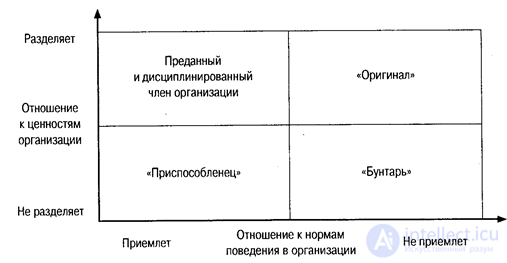
It is evident that the perception and evaluation of one's own experience, as well as the process of adapting to the conditions and demands of the organizational environment, are to a large extent individual in character. In the same environment, people behave differently. A person, as it were, has two degrees of freedom in shaping his behaviour within an organization. On the one hand, he has freedom in choosing forms of behaviour: to accept or not to accept the forms and norms of behaviour existing in the organization; on the other hand, he may accept or not accept the organization's values, share or not share its goals and philosophy. Depending on the combination in which these fundamental components of behaviour are combined, four limiting types of a person's behaviour in an organization can be distinguished.
The first type: the values and norms of behaviour are fully accepted. In this case, a person tries to behave in such a way that his actions in no way come into conflict with the interests of the organization. He sincerely tries to be disciplined, to fulfil his role fully in accordance with the norms and form of behaviour accepted in the organization. Therefore, the results of such a person's actions depend mainly on his personal capabilities and abilities and on how accurately the content of his role has been defined. This type of behaviour can be characterized as the behaviour of a devoted and disciplined member of the organization.
The second type: a person does not accept the organization's values, yet tries to behave in full accordance with the norms and forms of behaviour adopted in the organization. Such a person can be characterized as an opportunist. He does everything correctly and by the rules, but he cannot be considered a reliable member of the organization, because although he is a good and efficient worker, he may nevertheless leave the organization at any moment or commit acts that may conflict with the organization's interests but correspond to his own interests. For example, such a person will readily take part in a strike in order to achieve a pay rise.
The third type: a person accepts the organization's values but does not accept the norms of behaviour existing within it. In this case, the person may create many difficulties in relationships with colleagues and management; he appears to be an eccentric. However, if the organization can afford to depart from established norms of behaviour with respect to individual members and to create a state of freedom to choose forms of behaviour for such members, they may find their place in the organization and be of benefit to it.
The fourth type: the individual accepts neither the norms of behaviour nor the values of the organization. This is an open rebel, who is constantly in conflict with the organizational environment and creates conflict situations. It would be incorrect to consider this type of behaviour absolutely unacceptable in an organization and to think that people behaving in this way are not needed by the organization. However, in most cases «rebels» create numerous problems that substantially complicate the organization's life and even cause it great harm (fig. 4). [14, p. 61]
Fig. 4 - Matrix of types of a person's inclusion in an organization
In cases where violations of ethical norms continue or take a crude form, try addressing the participant on his discussion page. It is best to cite specific links to page edits.
Often a swift examination on the merits (or the isolation) of some particular question that constitutes the subject of the conflict helps to reduce the conflict situation as a whole, and it is therefore best to concentrate efforts on this first.
Some participants react painfully to unethical comments made about them, which prevents them from concentrating on the substance of the matter. Try to draw their attention to the fact that violations of ethics can, of course, not be welcomed, but this should not hinder consideration of the matter on its merits.
An offended participant may come to understand that the words spoken by an opponent should not be taken literally, and decide to forget about the incident.
When carrying out mediation between conflicting parties by email, it may sometimes be useful for the mediator (a third, neutral party), in order to establish a dialogue, to rephrase an unfortunate remark by participant A so that his opponent (participant B) can focus only on its substance. For example, participant A's remark: «I will not allow neo-fascist views to pollute Wikipedia!» can be rephrased for participant B as follows: «Participant A is concerned that you may be paying too much attention to a single approach».
Upon completion of the mediation process, it would be good if both conflicting parties, at the suggestion of an administrator or mediator, agree to remove on their own the incorrect remarks they made in the course of the discussion. Such actions will help reduce tension, as well as help participants forgive one another and forget about the incident more quickly.
Apologies are not directly related either to solving the problem or to the mediation procedure. However, this is a certain ritual, usually mutual, aimed at restoring good relations, and therefore apologies can serve as a good basis for further conflict-free work.
For some participants, an apology from the offender may be very important, so a sincere apology is often the key to resolving a conflict. If one of the participants has engaged in unethical actions or comments, he is strongly recommended to apologize to his opponent.
Official conduct — the totality of the acts and actions of an official or a group of officials, carried out within the limits of powers established by law, in the process of interaction within the internal environment and with the external environment, in connection with the performance of their official duties.
Since external environment is understood to mean society, citizens, employees of other organizations, nature, and so on, with which a civil servant interacts in carrying out his professional functions, the concept of "official conduct" appears broader than organizational and business behaviour, which are regarded as "intra-firm", or corporate.
Universal ethical norms express the common human moral requirements of communal life. The «Golden» rule of ethics: treat others as you would want them to treat you
General ethical norms extend their requirements to all members of a given society, serving as a means of regulating and evaluating people's relations and interactions.
Group ethical norms ensure the inclusion of the individual in the group. A person assimilates given norms and develops
personal norms, prescribing for himself his own position and forms of behaviour
Personal ethical norms serve as a characteristic of a person's subjective «inner» world.

Comments