
Lecture
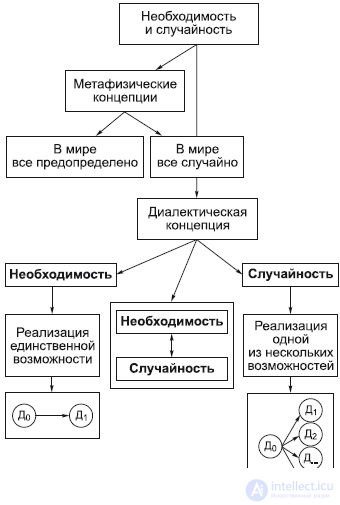
In the history of philosophy there have been various conceptions of necessity and chance. Among them two turned out to be the most widespread.
The first recognized an objective content in the category of necessity, while chance was treated merely as a subjective opinion, a result of ignorance of the causal dependencies of phenomena (Democritus, Spinoza, Holbach, and others). Since everything is causally conditioned, everything is therefore necessary. From this it followed that everything in the world is predetermined; applied to society and man, such a position led to fatalism.
The second, opposite conception, denied necessity any objective existence. The world is a chaos of chance occurrences, of elemental forces; there is nothing necessary or lawlike in it. If the world seems logical to us, it is only because we ourselves ascribe logic to it (Schopenhauer, Nietzsche, and others).
Dialectical philosophy emphasized the causal conditioning of both necessity and chance; it spoke of the illegitimacy of identifying necessity with causality, and of the different determination of necessity and chance. The following definitions of necessity and chance were given. Necessity – is that which follows from the internal, essential connections of an object, that which inevitably must occur precisely in this way and not otherwise. Chance was understood as that which has its cause in something else, which follows from external connections, and which may therefore either occur or not occur, and may occur in different forms. Thus, chance and necessity are considered from the point of view of their conditioning by nonessential and essential connections, whereby external connections were regarded as nonessential and internal connections as essential.
Such a treatment of necessity and chance raises legitimate objections. Here the external and the internal are somehow sharply opposed to each other. Yet in reality their distinction is relative. Moreover, if one considers a finite closed system, then all changes within it are caused by internal factors, and consequently there is nothing accidental in it. But this contradicts experience, since systems are known (inorganic, biological, and social) in which, even under conditions of isolation from external influences, chance phenomena occur. It turns out that chance can have an internal basis. Thus, for a number of reasons, there arises a need for a definition of the categories of necessity and chance different from the one indicated above.
In studying the transformation of possibility into actuality, two variants are found.
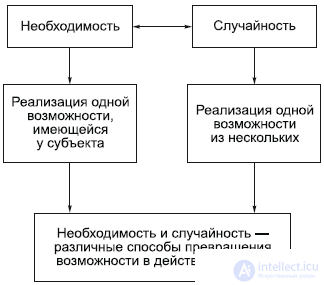
1. In an object, under given conditions and in a definite respect, there is only one possibility, which can turn into actuality (for example, an object deprived of support falls; for any living being there is always a limit to its lifespan, and so on). In this variant we are dealing with necessity. Necessity is the realization of the sole possibility available to an object under definite conditions and in a definite respect. This sole possibility sooner or later turns into actuality.
2. In an object, under given conditions and in a definite respect, there are several different possibilities, any of which could in principle turn into actuality, but as a result of an objective selection only one is realized. For example, when a coin is tossed there are two possibilities for which side will come up, but only one is realized. In this variant we are dealing with chance. Chance is the realization of one of several possibilities available to an object under definite conditions and in a definite respect.
Necessity and chance are defined as different ways in which possibility turns into actuality.
Metaphysical thinking sets necessity and chance against each other, failing to perceive any interconnection between them. In material objects, however, necessity and chance exist in unity. Between the various possibilities within one object, something similar can be found. Whichever possibility is realized, this common element is realized unambiguously. For example, when a die is thrown, each individual outcome on this or that face represents chance. But in all these outcomes there is something similar and, moreover, unambiguously manifested – namely, landing precisely on a face (under the conditions of the game a die cannot land on an edge or a corner). Consequently, necessity is manifested in chance.
In material objects there is neither «pure» necessity nor «pure» chance. There is not a single phenomenon in which moments of chance would not be present to one degree or another. Nor are there phenomena that are considered accidental but in which there would be no moment of necessity. Let us recall statistical regularities. In a mass of homogeneous chance phenomena, stability and repeatability are found. The peculiarities of individual chance phenomena are, as it were, mutually leveled out, and the average result of a mass of chance phenomena turns out to be no longer accidental.

Comments