
Lecture
The decisive factor of the spiritual history of the Middle Ages is a fundamental rethinking of all social values: from a predominant interest in the earthly and material, society turns toward a system of morality and religion centered on transcendent ideals; the highest reality is the world beyond, and earthly existence is a preparatory stage toward the heavenly kingdom. This shift in spiritual orientation manifested itself with complete clarity in Christianity (from the Greek Christos, literally the anointed one, the messiah) – one of the three world religions alongside Buddhism and Islam.
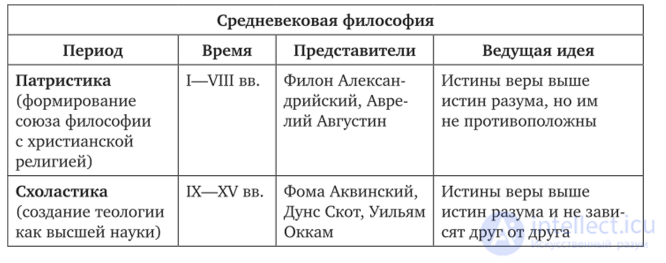
Diagram 3.7. Medieval philosophy: general characteristics
The leading problem of all medieval philosophy is the reconciliation of Holy Scripture (the Bible) with scientific and philosophical knowledge, and the transformation of theology into the highest form of knowledge of the world.
Scholastics are often divided into schools depending on how they answer the question «Where and how do general concepts (universals, the forms of things) exist?»
Features of medieval philosophy
1. Theocentrism as the fundamental worldview orientation. God is the source of all being.
2. Creationism. God created the world (the cosmos) out of nothing.
3. Religious character (monotheism). Reliance in philosophizing on religious faith and Holy Scripture (revelationism).
4. Personalism. The human being, created in the image and likeness of God, possesses free will, freedom to choose his own future.
5. Providentialism. God governs the world he created, taking into account human free will.
6. Eschatologism. The history of this world has its own culmination
Christianity. Christianity arose in the 1st century in Palestine and initially spread among the Jewry of the Mediterranean diaspora; however already in the first decades it gained more and more followers among the «pagans», i.e. non-Jews. By the 5th century so-called Judeo-Christianity, which had remained merely a heresy within Judaism, had faded away, and the Jews, the first followers of Christianity, ultimately remained the only non-Christian people within the Christian world.
In examining the structure of Christianity one must bear in mind that Christianity is, first, a variety of theism, that is, of a religious worldview in which the central concept is the absolute as an infinite divine person, transcendent to the world, freely creating the world and freely acting upon it. This understanding has its roots in the world of the Bible – a collection of ancient texts canonized by the religious tradition of Judaism and Christianity as «Holy Scripture». Second, Christianity is a religion of salvation as the ultimate goal of a person's religious efforts and as the highest gift on the part of God. For Christianity the individual human soul is dearer than the whole of the natural cosmos.
Christianity carries the central idea of theism — the personal understanding of the absolute — to its logical limit and expresses it in two basic dogmas: the dogma of the Trinity, or theological dogma, according to which the single divine essence is within itself a personal relation of three «hypostases» — the Father, the Son and the Holy Spirit, and the Christological dogma, according to which Jesus Christ combines in a personal unity the full fullness of both the divine and the human nature.
Everything pertaining to the body of dogmas entered into the composition of theology, which, in its terminological meaning, is the doctrine of God (divinity), and in present-day usage denotes the entire body of disciplines whose subject is the Christian religion. Although, as the history of theology shows, it cannot do without the conceptual apparatus of philosophy, it is nevertheless distinct from philosophy, including from religious philosophy. Within theology, reason is assigned an exegetical role, where the word «exegetics» means the doctrine of the methods of interpreting speeches or writings, as closely as possible to the meaning invested in them by the author, and is applied to the interpretation of biblical texts (hermeneutics): reason is assigned a subordinate hermeneutic role: it only receives and elucidates the «word of God». Theology is authoritarian and in this sense differs from any autonomous thought, including philosophy.
In the Christian medieval world it was only from the 13th century that philosophical schools appeared in the faculties of arts, and philosophy of a scientific level began to intrude on the theological faculties. In philosophy people began to see theoretical knowledge obtained by means of the natural resources of human cognition, and thus problems arose concerning the relationship between philosophy and theology. Here we are speaking of philosophy as a strictly scientific method, which can be contrasted with philosophy in the broad sense as a worldview. Philosophy as a worldview, as a way of understanding the world, is widely represented in the 1st–12th centuries in so-called patristic philosophy, and almost entirely disappears in the 13th century – the century in which so-called scholastic philosophy flourished.
PATRISTICS Patristics is divided into: 1. Western, created in Latin and widespread in the West of the Roman world – later passing into Western European Catholic scholasticism 2. Eastern, created in Greek and widespread in the eastern regions of the Roman Empire – later developed further in the philosophy of the Byzantine Empire. After Rus' accepted Christianity from Byzantium, it formed the basis of Old Russian philosophy. .
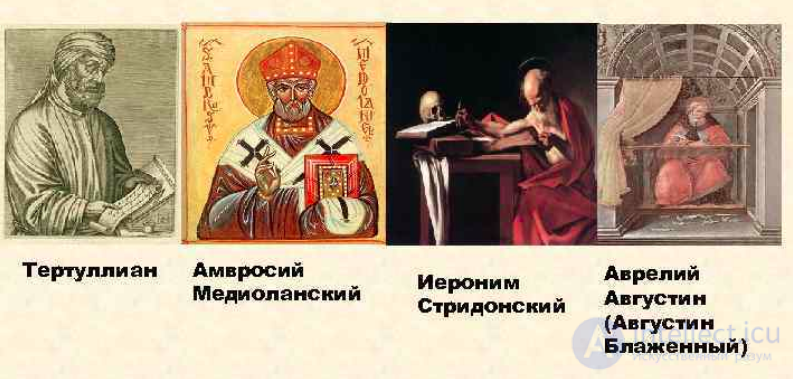
Western patristics: Tertullian, Ambrose of Milan, Jerome of Stridon, Aurelius Augustine (Saint Augustine). Western patristics: Tertullian, Ambrose of Milan, Jerome of Stridon, Aurelius Augustine (Saint Augustine).
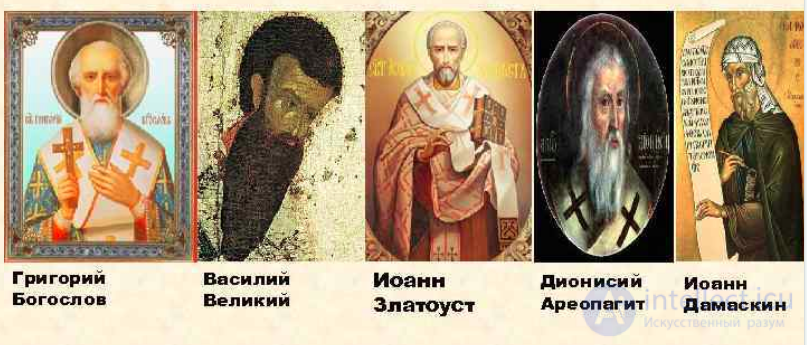
Eastern patristics: Gregory the Theologian, Basil the Great, John Chrysostom, Dionysius the Areopagite, John of Damascus. Eastern patristics: Gregory the Theologian, Basil the Great, John Chrysostom, Dionysius the Areopagite, John of Damascus.
In patristics two levels, as it were, take shape: a lower one – philosophical theorizing about the absolute as essence, first cause and goal of all things (that which Aristotle already called theology – a synonym of «first philosophy», or metaphysics) and an upper one – truths of revelation not attainable by reason. Such a structure of theology is characteristic of traditional doctrines. In scholasticism these two types of theology received the designations «natural theology» and «mystical theology» (revealed theology).
The universal form of Christian thought and perception is the symbol, which does not conflate object and meaning (as happens in paganism) nor separate them (in the spirit of philosophical rationalism), but gives both «unmerged» and «undivided». The descent of the otherworldly into the this-worldly, of meaning into object, of God into the world of human beings, is «kenosis» (Greek, literally «emptying», «self-abasement»). But this is not the involuntary outflowing of an emanating spiritual substance, nor an involuntary dialectical self-unfolding of the spirit (as in the systems of Neoplatonism), but rather a distinctive act of love and humility on the part of the deity, providing an unconditional divine norm for human self-determination in the world.
The preconditions of medieval philosophy, and of the whole spiritual life of medieval culture, are found from the 3rd century AD onward. From this time the countdown begins in the formation of European thought founded on the idea of Christianity.
After many years of persecution of Christians, during the reign of the Roman emperor Constantine (306–337), Christianity became the official state religion of Rome. The main reasons for the recognition of Christianity come down to the following: 1. The wide spread of Christian ideology among slaves and free paupers, whose numbers under the conditions of the crisis of the Roman Empire were continuously growing. To this is added the constantly increasing proportion of Christians in the Roman army, both among Romans and among barbarians, the latter making up a significant part of the personnel of this army, which led the ruling strata of Roman society to the conclusion that it was impossible to eradicate the Christian faith. 2. Anti-Christian sentiments in the Roman Empire were not of a strictly organized character, unlike the Christian church organization with its unified system of views on the world and its «iron» discipline.
All this constitutes the external causes of the establishment of Christianity. But there were also internal causes, rooted in the very essence of Christianity itself. Above all this is the proposition that only the «humble» and the «obedient» may be called a Christian, as well as the idea of the possibility of achieving happiness after death (in the afterlife). The latter is achieved only after passing a «probationary period» on Earth, after enduring all manner of hardship within the bounds of earthly, this-worldly life. The ruling strata of Roman society attempted to use such attitudes of Christianity in overcoming the political and social crisis of Rome. The logical culmination of this process was the legal establishment of the status of Christianity as the state religion of the Roman Empire in 451 by the Council of Chalcedon.
In 476 the king of the Ostrogoths, Alaric, put an end to the existence of the Western Roman Empire (the Eastern Empire survived until 1463), and in 529 the emperor of the Eastern Roman Empire, Justinian, closed the philosophical, non-Christian schools in Athens, in which paganism prevailed. Persia accepted the refugee philosophers, but local customs of polygamy and incest forced the thinkers of the Greco-Roman tradition to return home, where they «sank into oblivion», sealing the rupture in the cultural development of the Greco-Roman world.
The question arises, why did Christianity not disappear from the scene after the fall of the Western Roman Empire, with the coming of the barbarians? Being unable to withstand external pressure, the emperors of the Eastern Empire granted self-government to the cities of the Western Empire, and handed the command posts in the city organs of power to the barbarians – the Germans, who were for the most part Christians. Such courting of the barbarians had as its main purpose the prevention of an attack by the western barbarians on the territory of the Eastern Roman Empire.
The transfer by the emperor Constantine of the capital of what was then still a unified Roman Empire to Constantinople marked the division and consolidation of secular power – behind Constantinople, and of spiritual power – behind Rome. The proximity and strength of Rome also contributed to the Christianization of the barbarian population living on the territory of the Western Roman Empire.
The science and philosophy of antiquity, built on rational foundations and possessing rational grounds, like the rationalized pagan religion, were alien and incomprehensible to the overwhelming majority of the barbarian (from the Latin «barbarus» – bearded) tribes, most of whom were quite ignorant.
The pervasive wars and universal sufferings of that time could not find rational explanations, and did not lend themselves to reasoned interpretation. Rational versions of personal happiness found no fertile ground in a period of universal chaos, after the great migration of peoples, thereby sharpening the feeling of faith and hope. The uncertainty of the present and the hopelessness of the near future could be compensated only through hope in a better, distant future, which found its support in the Christian religion, in contrast to Greco-Roman philosophy, which presupposed the possibility of achieving happiness and the good beyond the bounds of earthly life.
Features of the medieval style of thought. What was new about the transition to a Christian worldview? What were the achievements and shortcomings of the style of thought of the medieval era? Here, above all, one must pay attention to the following:
The Middle Ages mark an era within which religion becomes the dominant form of consciousness of the Western European person.
Under the slaveholding mode of production, in the material sphere of human life there exists a direct, personal form of power of the slaveholder over the slave. In the feudal mode of production, by contrast, this personal form of power is replaced by its economic form, which fixes the dependence of the peasant on the feudal lord. The same thing takes place in the spiritual sphere of human life, where the direct power of the pagan gods and goddesses over a person's thoughts, feelings and deeds is replaced by the mediating power of the Christian church.
Christian monotheism qualitatively changes the functions of religion in human life. In polytheistic pagan religion a person turns to a god for help in the specific affairs of his everyday life: agricultural, craft-related and others, and therefore paganism governs not so much a person's spiritual life as his productive, material life, having thereby a practical orientation and performing a pragmatic (from the Latin «pragma» – «action») function. At the same time Christianity moves away from questions of ensuring a person's immediate life activity, performing instead the function of the salvation of the soul after death.
In Christianity significant changes take place in the understanding of God. Whereas the pagan gods live in a single world, together with all humanity, and the various levels of the real world (higher and lower) only fix the distinction between gods and people, the Christian God is placed beyond the bounds of the human world, beyond the limits of human existence, as a result of which he represents a transcendent being.
In the Middle Ages changes also take place in the understanding of the human being. In paganism each of the gods personifies one or another human virtue, and in accordance with the hierarchy of the gods a hierarchical system of human values is built: courage, pride, strength, and so on. Christianity, by contrast, equalizes all people before God, regarding the human being as a cosmopolitan creature, as a result of which individual values are lost, and the leading virtues become humility and obedience.
Philosophy, called by Aristotle the science of sciences, becomes, under conditions of the dominance of the Christian worldview, the «handmaiden of theology». Accordingly, philosophical problems also change. The necessity of philosophy is now derived from the necessity of solving the basic problems of Christianity: the problem of the theoretical struggle against paganism and Christian heresy, which flourished on the territory of the Eastern Empire, the problem of working out a single symbol of the Christian faith, as well as the problem of explaining the dogmas of the Trinity and of the Incarnation.
The main problem of medieval ontology gradually becomes the problem of disclosing the essence of God, as well as identifying the reasons for his creation of the world and man. The main problem of epistemology becomes the problem of the possibility or impossibility of the knowledge of God, and of the forms of his manifestation, in connection with which there also arise problems concerning the specific means and mechanisms of this knowledge. Within the solution of this latter question priority is given to faith, in contrast to classical antiquity, where all forms of knowledge are based on reason.
Medieval philosophy is divided into patristic philosophy (from the Latin for fathers, meaning the «fathers of the church»), where this term denotes the teachings of the first Christian theologians, the so-called church fathers, and into scholastic philosophy (from the Latin for learned discourse, school), which saw the path to the comprehension of God in logic and reasoning, rather than in mysticism, i.e. in supra-rational contemplation and feeling.
Patristics. Arising in the 2nd century AD, patristics took shape in a struggle against gnosticism, according to which faith is transformed into knowledge through cognition; against Manichaeism, the teaching of the Persian Mani, who denied the human nature of Christ, considering him a false teacher, while regarding himself as the true messenger of the divine kingdom of light; against Montanism – the teaching of a religious sect of the 2nd century, whose founder Montanus held the essence of Christianity to lie in religious ecstasy; and against Neoplatonism, according to which at the head of the hierarchy of being stands the supra-existent One – the Good, attainable only in supra-rational ecstasy and expressible only by means of negative (apophatic) theology, and which for several centuries laid claim to the role of state religion of the Roman Empire.
The pre-philosophical period of Christian literature, traditionally called the «apostolic» period, ends around the mid-2nd century. It is known above all for the activity of the Apostle Paul, a legendary religious figure of the 1st century B.C., whose name is linked to the emancipation of Christianity from Judaism.
At the center of the ethics of Paul's numerous epistles stands the antinomy of «law» and «freedom». The «law» (i.e. the Judaic system of moral-religious prohibitions, of which the traditional morality of pagan peoples is regarded as a lower duplicate) is historically necessary and given by God, but by itself can only generate moral evil, «multiply sin». Christianity is understood as an exit from the world of the external compulsion of the «law» into the world of «freedom», characterized by the following complex of concepts: «grace» – God's action upon the human will, drawing it out of the inertia of evil, «spirituality», mystical «knowledge», «faith», «love». All this places man above the «law». It is precisely in this sublation of the «law» that its justification lies: it was necessary as an educator of humanity toward «freedom» in the spiritual-moral sense.
From the mid-2nd century begins the era of the so-called Apologists – polemicist writers who defended Christianity amid the repression of the authorities and the attacks of philosophers. The Apologist movement created an extensive literature, with rhetorical propaganda predominating among its Latin representatives (Minucius Felix, Tertullian, Arnobius, Lactantius) and philosophical speculation among the Greek ones, among whom are Justin Martyr, Athenagoras, and especially the philosophers of the Alexandrian school, Clement of Alexandria and Origen, who laid the foundation of Christian theology as a scientific system.
The Church Fathers, as apologists of Christianity, became defenders of the faith against pagan wisdom, i.e. philosophy, and contributed to bringing the content of the faith closer to the results of ancient science. Thus Tertullian (160–220) carries the Apostle Paul's idea that revelation abolishes the wisdom of this world, philosophy, to the paradoxical formula: «I believe because it is absurd». While Christian thinkers of his time strove to bring biblical teachings and Greek philosophy into a single system, Tertullian in every way emphasizes the gulf between faith and reason. In his words, «What has the Academy to do with the Church: the Son of God was crucified, we are not ashamed, because it ought to be shameful. And the Son of God died, this is entirely certain, because it is absurd. And after burial he rose, this is certain, because it is impossible».
The transition of Christianity to the status of state religion in the 4th century and the first attempt at its dogmatic constitution in 325 at the Council of Nicaea led to the situation in which polemical, fragmentary philosophizing gave way to work on the systematization of dogma, resting on philosophical theorizing. The systematic period of the development of patristics begins, reaching its culminating point in the activity of the circle of the «Cappadocians» (Basil the Great, Gregory the Theologian, and Gregory of Nyssa) in the East and Augustine the Blessed in the West, and ending with the latter's death.
Aurelius Augustine (354–430 A.D.) – the greatest representative both of patristics and of the whole of medieval thought. He was a scholar and a broadly educated man. He was well acquainted with Greek philosophy, with the teachings of Plato, Aristotle, and the Stoics. Augustine's works «Confessions» and «The City of God» remain to this day a source for the development both of Christian ideas (Protestantism, neo-Thomism) and of ideas of irrational philosophy.
In Augustine's conception, God is primary, and this primacy manifests itself in ontology, epistemology, and ethics. Above all, for Augustine God is the highest essence, as a consequence of which only His existence can be necessary, while the rest of the world, nature, and man exist not necessarily but contingently, and only by the will of the God who created them. Only the existence of God is independent of anyone and anything, and therefore He is the final cause of the existence of all things and everyone.
God not only created the world and man, but continues to create this world constantly. Augustine asserts that without God nothing can be either known or accomplished. The world is a free act of God's will, and this willing is based on God's own idea.
In contrast to Neoplatonism, where the One and man, as an emanation of the One, are of the same type but on different levels, Augustine regards God as an eternal and unchanging spiritual being, as the opposite of the world. This attention to the eternal and the changing leads Augustine to pose the problem of time. Here Augustine does not accept the solution proposed by the ancient philosophers, who made time dependent on the motion of the heavenly bodies, objecting reasonably that the heavenly bodies themselves were created by God and therefore are not eternal. According to Augustine, time is the measure of the motion of all things created by God, and before the creation of the world and man there was no time, for God is the unity of past, present, and future, the real embodiment of absolute eternity. As for man, the past exists for him as memory, and the future as hope.
In Augustine's epistemology, God is the chief object of knowledge, while the world He created cannot be the true goal of true knowledge. According to Augustine, God is spiritual being, and therefore He must be known by the spiritual principle in man, namely the soul, which possesses superiority over the body, as a result of which it is necessary that man care for the soul and suppress the sensual pleasures of the body.
Knowledge of God is in principle possible; one need only find a reliable means of knowing. For this it is necessary to eliminate entirely sensory knowledge, which leads away from the truth. «To what question can a man answer with certainty?» – asks Augustine. And he answers: «To the question about the content of his own inner world». From this the medieval philosopher concludes that man draws all his knowledge from the depths of his own soul, created and, in a certain way, filled by God. Therefore there are no grounds for speaking of a rational basis for knowledge. According to Augustine, it is impossible to rationally comprehend God, just as it is impossible to find rational means of disclosing Him, or, more precisely, of discovering God (Augustine uses the term «revelation»). The only means of revelation, of disclosing God, according to Augustine, is faith – faith that God will reveal Himself if man calls upon God: «How shall I call upon my God?... I shall call upon Him within myself… I would not exist, if Thou wert not in me… I would not exist, were I not in Thee, from Whom all things are, through Whom all things are, in Whom all things are». Faith, according to Augustine, pertains not to reason, which analyzes the world external to man, but to the will.
The orientation toward God is natural for man, and only through union with Him can man attain happiness, Augustine believes. Happiness is the goal and meaning of life; here Augustine continues the tradition of the philosophers of Hellenism, sharply opposing his conception to ethical naturalism. Whereas naturalistically understood man is the highest stage in the development of nature, Augustine tears man out of it: for man in a certain way resembles God, because he has a soul – an immaterial principle proper only to man and, most importantly, eternal, unlike everything created.
God is absolutely good, and therefore the world created by Him cannot be evil and cannot produce evil. According to Augustine, God created nature originally good, while evil proceeds exclusively from man's will, arising there and then where and when man does not walk God's path, does not do his deeds according to God's command, that is, evil is committed by those who apostatize from God. There is no absolute evil, only good is absolute, like God Himself. Therefore evil is a simple absence of good, and people who do evil (sinners) must be punished, since they do not perform good deeds. (From this reasoning of Augustine's the Church borrowed the idea of the Inquisition).
Why then does man become an apostate from God? From Augustine's point of view, God directs man as a puppeteer directs a marionette, and if man possesses knowledge of his complete dependence on God's will, then he possesses true knowledge, which gives him the possibility of living according to God's will and observing the requirements of the Church. Giving himself into God's hands, man becomes not only happy but also virtuous, that is, doing good. Thus knowledge of complete dependence on God promises the one who knows it a happy and virtuous life.
If, however, man believes that he is independent and free, if he comes to know the world and act with knowledge of the matter, that is, with knowledge of the world in which he lives, then he possesses only apparent knowledge, and in essence is an ignorant man. The world was created by God, and knowledge of the created is knowledge of God's creature: such knowledge, according to Augustine, leads man away from the path of truth and leads him to evil, to the commission of all manner of sins and misdeeds, as a result of which an independent, free man will never be happy, for he will never be «under God», so that all his actions are colored black – the color of the apostate and, at the same time, the color of independence and freedom.
According to Augustine, all who are born are equal before God, but man's independence, his pride, and the idea of a life without God arising on its basis, are the foundation of social inequality. Augustine taught that a man who does not know the truth, that is, who does not believe in divine predestination, who is proud, self-loving, evil-doing, a heretic and a pagan, lives in the «earthly» kingdom. On the contrary, in God's kingdom, in the «City of God», only the God-chosen, virtuous man who has received salvation from God can live. Humanity's movement along the path toward the City of God constitutes progress in the development of humanity.
Such is the essence of the philosophical teaching of Aurelius Augustine, whose dominance in Western European Christian thought lasted almost a millennium, exerting a significant influence on various aspects of medieval life.
The final period of patristics is characterized by the encyclopedic codification of the sciences under the aegis of theology, which in the West was carried out by Boethius (480–524), and it ends with the appearance of the works of John of Damascus and John Scotus Eriugena, who laid the foundations of Eastern and Western scholasticism.
John of Damascus (458–538), a Greek Neoplatonist philosopher whose activity falls in the 4th–7th centuries of the development of Byzantine philosophy, when the struggle around the Christological problem was under way, that is, disputes were taking place over the interpretation of the concept of Christ, and Neoplatonism was developing. Damascene sought to emphasize even more sharply the inexpressibility and unknowability of the primordial One. According to Damascene, after the super-existent primordial One come the super-existent one-many and many-one, and only after this level is a transition to the sphere of being possible.
Boethius entered the spiritual history of the Middle Ages as the founder of the scholastic method. Thanks to his translations into Latin of treatises on logic (above all those of Aristotle) and his commentaries on them, as well as his own logical works, the Middle Ages assimilated the intellectual instruments of ancient philosophy.
Scholasticism. Scholasticism, or medieval philosophy from the 9th to the 15th century, made religion its chief subject of thought, subordinating philosophy to theology. At the same time, within scholasticism philosophy represents a certain independent field of inquiry. The basic character of scholastic philosophizing is formal-logical and linguistic analysis of theological concepts, since, with very few exceptions, there was no study of nature. Scholasticism attached special importance to the systematization of knowledge. The ideal of formal-logical systematization of knowledge is the system of Thomas Aquinas, the summit of scholastic philosophical thought.
SCHOLASTICISM – (from Lat. schola – school) – «school philosophy», dominant in the universities. The basic task of scholasticism – the substantiation, defense, and systematization of religious dogmas by logical means. It earned the nickname: «Philosophy – the handmaiden of theology».
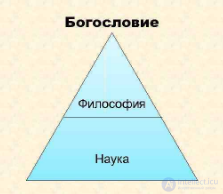
Both Holy Scripture and Holy Tradition, as well as the legacy of ancient philosophy, were actively used by scholasticism and functioned within it as a closed normative text. It was assumed that all knowledge has two levels – supernatural knowledge, given in «revelation», and natural knowledge, sought by human reason; the norm of the first is contained in the texts of the Bible, accompanied by authoritative commentaries of the Church Fathers, the norm of the second – the texts of Plato and especially Aristotle, surrounded by authoritative commentaries of late antique and Arabic philosophy.
Potentially the «eternal truth» is already given in both sets of texts, and it is necessary to derive from the texts the full logical consequences by means of correctly constructed inferences. That is why the genre of summae – comprehensive encyclopedic works – is characteristic of developed scholasticism. Scholastic thought constantly proceeds by way of deduction and almost never by induction, and its basic form is the syllogism. In a certain sense all scholasticism is philosophizing in the forms of interpretation. In this it is opposed to the science of the modern era with its striving to discover truth through the analysis of experience, as well as to mysticism with its striving to «behold» truth in ecstatic contemplation.
In the history of scholasticism the following periods are distinguished: the formation of scholasticism (5th–10th centuries), early scholasticism, known as Platonic realism (11th–12th centuries), late or mature scholasticism, known as Aristotelian realism (13th–14th centuries), and crisis (15th–18th centuries). The main representatives of scholasticism are John Scotus Eriugena, Anselm of Canterbury, Abelard, Albert the Great, Thomas Aquinas, John Duns Scotus, William of Ockham.
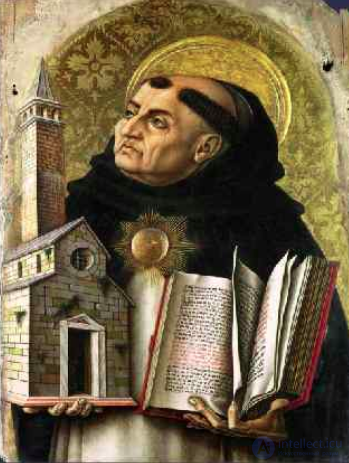
The greatest representative of the «golden age» of scholasticism – Thomas Aquinas (THOMAS AQUINAS) (1225–1274).
THE HISTORICAL SIGNIFICANCE OF THE PHILOSOPHY OF THOMAS AQUINAS:
To sum up, it can be said that scholasticism is identical with theology, which people wanted to turn into a science.
. An outstanding role in the formation of scholasticism was played by John Scotus Eriugena (815–877), an Irish monk who lived and taught for a time in Paris under the patronage of King Charles the Bald. According to Eriugena, understanding and reason occupy an equal position, and any doubt with respect to religion can be refuted by reason.
Eriugena's philosophy represents a complete system attempting to combine Neoplatonism with Christianity, a system in which theological propositions are closely interwoven with philosophical speculation. Eriugena's most important work is the dialogue «On the Division of Nature». Eriugena sees the central task of knowledge as dividing, combining, and articulating the nature of all things that can be comprehended, and indicating the proper place of each thing. True reality is constituted by the general (universal), and the hierarchical combination of concepts forms the truly existing world. The world of individual corporeal things is only a semblance, an appearance of the ideal.
All being falls, in Eriugena, into four «natures». 1. Nature uncreated and creating – this is God, as the highest cause of the world; 2. Nature created and creating – these are the ideas in the divine Logos, as creative causes; 3. Nature created and non-creating represents the sensible world; 4. Nature uncreated and non-creating – God, but God as the final goal of the world. Thus the movement «downward» is replaced by movement «upward», and in God the circle of being is closed.
Eriugena's philosophical teaching became known only by the 12th century, and already in the 13th century his main work «On the Division of Nature» was condemned by the Church for pantheism, that is, the identification of God with nature.
The initial period, or early scholasticism, is known for the dispute over the question of the nature of universals (general concepts), which divided scholastics into realists and nominalists. Essentially the question was as follows: are universals something real, that is, as it was then expressed, things existing outside our mind, or are they merely words. This latter term in the 12th century was usually replaced by the word nomen («name»). Hence the name of the two rival currents: realists and nominalists.
Realism and nominalism, in turn, can be divided into a number of types and shades. Extreme realism proceeds from the position that universals are real; existing outside our mind, they have a spiritual nature, are transcendent to the sensory world, and precede individual things. It is evident that the roots of such an answer should be sought in the philosophy of Plato with his world of ideas – prototypes. Moderate realism emphasizes that universals are real; they coincide, in essence, with «forms» and, as such, are immanent in the things of the sensory world. The Aristotelian character of this kind of realism is evident. Nominalism, in contrast to realism, asserted that universals are names (designations) that come after things. Only individual, particular things are real. Universals do not exist either in heaven or on earth, either in divine consciousness or in the sensory world. They are devoid of objective significance beyond human thought and language. According to conceptualism – the most moderate kind of nominalism – the general exists, but only in human concepts, which fix similar features in individual things.
«The last father of the Church and the first scholastic» is the name given to Anselm of Canterbury (1033 – 1109). In philosophy, Anselm was a follower of Augustine. For him, knowledge is the servant of faith: «I believe in order to understand, and do not try to understand in order to believe».
Unlike Eriugena, Anselm considered faith the basis of knowledge. The conclusions of reason can be accepted only if they accord with «holy scripture». True reality is possessed only by general concepts. Earthly life is a difficult preparation for the return of the soul to its heavenly homeland. In expounding the thoughts of Augustine and attempting to give a philosophical grounding to theology, Anselm determined the basic content of early scholasticism.
Anselm gained particular renown for his so-called ontological proof of the existence of God. This proof is based on the identification of being with a concept: to a clear and distinct idea in the mind there necessarily corresponds the real existence of what is thought. People have a concept of God as the most perfect being, above which there is nothing. A real being, that is, one existing not only in our mind but also outside it, is higher than one that is not real, that is, one existing only in the mind. The mark of existence is necessary for complete perfection. But the concept of God is the concept of a being above and more perfect than which there is nothing. Therefore, God must really exist. Anselm attached the greatest significance to his proof, considering it the result of direct divine revelation. But even among his contemporaries voices were raised pointing to the unsoundness of such reasoning. A person, said Anselm's contemporaries, may have a representation of some wonderful and beautiful islands, but it does not follow from this that these islands actually exist.
If the content of the early scholastic systems was suggested by Anselm, then their form, or more precisely their method, was established by Abelard.
Pierre Abelard (1079 – 1142) did not leave behind a completed metaphysical system. He was seriously influenced by Plato, although of the original texts he knew only the «Timaeus». Abelard's main knowledge of Plato was drawn from the works of the Roman eclectic Cicero (Abelard's favorite author) and of Augustine.
But Abelard was alien to Platonic mysticism. His starting position was: «I understand in order to believe».
He formulated his own teaching, reproducing certain features of the Aristotelian conception, which came to be called «conceptualism»: universals do not possess independent reality; only individual things really exist, yet universals acquire a certain reality in the sphere of the mind as concepts, representing the result of the abstracting activity of the mind, its isolation of the individual properties of things.
At the basis of knowledge lies sensory perception; in the act of sensory contemplation only the individual thing is given to a person.
Ideas exist only in the divine mind, capable, in the act of contemplation, of clearly and distinctly grasping any multiplicity.
In Abelard, unlike in Anselm of Canterbury («I believe in order to understand»), reason is partly separated from faith and becomes its preliminary condition («I understand in order to believe»). Even the authority of church tradition and dogma must be verified by reason. The general method of testing questions of faith is «dialectic», that is, logic as the art of disputation and argumentation. It is precisely after Abelard that «dialectic» in this sense becomes the main pivot of philosophical-theological education.
Opposite to the pole of extreme realism was the extreme nominalism of Roscelin (1050 – 1112). Objective reality, in Roscelin's opinion, is possessed only by individualities, particular things. Individual things exist, and the human race is only a common name, a word – nothing more. This is not even a mental concept in the true sense, for one cannot conceive of «mankind» or «animal» without conceiving this or that human being or a concrete animal. «Mankind» is not an object, but only a sign, a word, a name for an essence. There is no «black» except in language; there is a «black thing». There is a «wise soul», but not «wisdom» as such.
Anselm of Canterbury attributes to Roscelin the interpretation of universals as a mere breath of wind, as a sound, as a «shaking of the air». Anselm correctly connects nominalism with sensualism. He reproaches Roscelin for having become wholly immersed in sensibility and being unable to understand that which must be considered by reason, independently of sensory representations. Roscelin, according to Anselm, is incapable of freeing himself from sensory views and relying on purely spiritual knowledge.
Mature scholasticism developed in the medieval universities, and its pan-European center was the University of Paris. One of its most important sources was Arabic-language philosophy of the seventh–twelfth centuries, the basis of which was the ideology of Islam. A specific feature of Islam, within which Arabic-language philosophy developed, is its greater simplicity in comparison with the other religions that prevailed in the historical period of its emergence (Christianity, Zoroastrianism, Buddhism, Hinduism). Having arisen seven centuries after Christianity, Islam discarded the unclear and difficult-to-understand moments of Christian religious mysticism, which contributed to its very rapid acceptance by the various peoples of the Near Eastern region and to their unification on the basis of the Islamic religion into the Arab Caliphate, which exceeded the Roman Empire in territory. Moreover, its relative simplicity did not offer much scope for the emergence of heretical movements, which had served as a source of anxiety for church authorities throughout the whole history of the Christian world.
Arab culture flourished in the sixth–ninth centuries in the territory where ancient culture had once been widespread. In this period the sciences developed intensively: algebra, psychology, astronomy, chemistry, and certain branches of biology and medicine. In parallel, there was a philosophical reflection on the natural-scientific results obtained, and an attempt was made to unite religion with science by means of philosophy. Unlike in the West, where acquaintance even with Plato took place by way of the interpreters – the Neoplatonists – in the East, already in the fourth century, Aristotle had been translated. It is precisely thanks to the Arabic-language philosophers that acquaintance with Aristotle would occur in the West as well, though several centuries later.
The most famous and popular thinkers of the East, who made a significant contribution to the development of medieval thought, were such representatives of Eastern Aristotelianism as Ibn Sina (Avicenna) and Ibn Rushd (Averroes).
Ibn Sina (980 – 1037), better known under the Latinized name Avicenna, regarded the world as the creation of the divine reason. According to the ideas of this Arabic-language philosopher, God himself is impersonal, but God is the sole being by necessity, and consequently God is necessity itself. The world was not created in time; it represents a derivative of divine necessity and is an emanation of the First Cause, from which arises a hierarchical system of things as relations of matter and form. According to Avicenna, the derivative world is not absolutely opposed to God; it is a pure possibility of being, and moreover a universal possibility, dependent on God – Necessity. And since only God possesses absolute existence, in order for matter (as possibility) to become actuality, the first motion of God must take place, which is not an act of will, as in the Christian-oriented philosophy of the West, but represents a rational creative act.
Proceeding from the natural-scientific practice of his time, Avicenna resolves the problem of general concepts, first outlined by Plato. In his opinion, general concepts exist prior to concrete individual things in the divine reason. On the basis of these concepts, God shapes the pure possibility of the world of things into an actual world. On the other hand, general concepts are present in concrete things as a divine principle placed within matter: it is precisely general concepts that shape possibility into actuality and become the essence of things. And finally, general concepts exist after things: in human thought, in human memory, as a concept of the thing.
The Arab philosopher acknowledged the immortality of the individual soul, which he grounded not so much in a rational kinship with God, as was the case with Aristotle, as in purely moral considerations, in a person's responsibility for their thoughts and actions.
In the twelfth century, Avicenna's works were translated into Latin and became the property of West European philosophy, exerting a significant influence upon it.
Another major representative of Arabic-language philosophy of the medieval era is Ibn Rushd (1126 – 1198), the Latinized Averroes, who received the nickname the Commentator for his commentaries on the works of Aristotle. Averroes was not merely a popularizer of Aristotle's views; he was an original commentator, with attempts at creatively resolving the problems posed by Aristotle.
Like Ibn Sina, Ibn Rushd understands the relationship between God and the material world by analogy with the relationship between possibility and actuality, potentiality and actuality. However, in contrast to Ibn Sina, Averroes speaks out against the creation of the world by God. Actuality, according to Averroes, is not merely external to possibility, just as form is not external to matter. Matter, co-eternal with form, that is, existing together with form in eternity, contains within itself all its future forms, includes within itself all its future potential shapings and modes of formation. But in this, God, for Ibn Rushd, as for Aristotle, is not a creator, but only a prime mover. Thus, in the medieval era, a philosophical understanding of God took shape, fundamentally different from the religious one: God is maximally removed both from nature and from man, while the latter, in turn, are maximally independent of God, who is immersed in himself and does not take part in the functioning of the sublunary world, the world of man, the world of things.
In epistemology, Ibn Rushd introduces a new idea about the relationship between philosophy and theology. He consistently draws a distinction between two levels of knowledge: practical knowledge and theoretical knowledge. The former represents the sphere of deed, the sphere of action. This is the knowledge that Aristotle called rhetorical, which is worked out by ordinary thought and is based exclusively on persuasion rather than on demonstration, which makes it universally accessible and easily assimilated even by ignorant people. In other words, practical knowledge is produced by religion.
Theoretical knowledge, in contrast to practical knowledge, Ibn Rushd defines as the sphere of rational faith. According to Aristotle, there are two kinds of theoretical knowledge: dialectical and scientific (philosophical). The first is knowledge in the process of becoming, not demonstrated, and therefore not yet actually knowledge; it is not scientific, not necessary, but represents only probable knowledge. Such knowledge is not reliable, for falsehood is possible within it. And when theologians try to dialectically, rationally justify faith, they fall into contradiction, for it is impossible to dialectically justify faith, since the dialectical style of thought does not yield demonstrative certainty. Thus, Ibn Rushd recognizes the legitimacy of religious knowledge as practical knowledge, but opposes theological knowledge as dialectical, probable knowledge.
Ibn Rushd contrasts theological knowledge with philosophical knowledge, as theoretical, precise, and reliable, as the knowledge of rational faith. Such knowledge, according to Averroes, proceeds from necessary premises, based on Aristotle's syllogistics and on the rules of logical inference, which makes it apodictic, that is, necessary. This apodictic knowledge is the true knowledge of faith.
Thus, rational religion, according to Averroes, represents philosophy, while figurative-allegorical, or religion proper, is intended exclusively for uneducated people. In this scheme, theology, as a contradictory construction of reason, finds no place in Ibn Rushd's conception. Ultimately, the problem of the relationship between philosophy and religion is transformed, in Ibn Rushd, into the theory of the «double truth», which was later developed by the medieval philosophers – the Averroist Siger of Brabant (1236 – 1282) and the nominalist William of Ockham (1285 – 1349), as well as by the Renaissance philosopher Pietro Pomponazzi (1462 – 1525).
The greatest scholastic systems of the thirteenth century emerged from within two main schools: the Dominican and the Franciscan. It was the Dominicans who became Aristotelians as such. It should be noted that in the Middle Ages religious orders replaced, for a person, their homeland. Each of them had its own particular aspirations, its own particular rules, its own saints, and its own particular temper. The struggle between them constituted a vital element of scholasticism.
The first major representative of scholastic Aristotelianism was the Dominican Albert von Bollstädt (1207 – 1280), nicknamed the Great. Albert the Great astonished his contemporaries with his erudition, for which he was nicknamed «the universal doctor». He was familiar with Greco-Roman, patristic, and Eastern (Arabic and other) literature.
Thanks to Albert the Great, all the works of Aristotle entered into common use in medieval philosophy, which he expounded and commented upon from positions acceptable to Christian theology. The assertion that matter and time were created gives Albert the Great the possibility of legitimizing, within the framework of scholasticism, Aristotelian physics with its doctrine of the continuity of matter as the basis of change. According to Albert the Great, first in the order of creation were the so-called four co-eternals: matter, time, the nature of angels, and the empyrean heaven. In Albert the Great's cosmology, the motionless empyrean heaven is the highest in the hierarchy of heavens and is encompassed only by the heaven of the Trinity, identical with God. The empyrean heaven is an analogue of the unmoved mover; having the nature of light, it is the cause of the many lights that make up the spheres of the stars and whose influence conditions the motion of the elements and thereby of everything in the world. Whereas Aristotle, in his doctrine of the soul, allowed for the existence only of an absolutely simple immaterial essence (in Averroism it is unique and common to all souls, which thus turn out to be mortal), Albert the Great accepted the existence of composite immaterial essences (angels and active intellects, constituting the immortal part of each human soul), basing himself on the distinction, going back to Boethius, between the simple, whose essence coincides with the source of its being, and the composite, whose being is not identical with its essence. Albert the Great's ethics is formed by the doctrine of the practical reason, which, through cognition, directs the will and action of the human being. Conscience also belongs to the practical reason, by virtue of which a person possesses by nature universal principles of moral conduct. Theology, as the doctrine of salvation, is not identified, in Albert the Great, with metaphysics, as is the case with many scholastics.
Albert the Great established, in the common practice of scholasticism, the body of natural-scientific knowledge contained in the writings of Aristotle and the Arab scholars. Alongside a great deal of systematizing work in the field of natural science, he also carried out his own research, based on observation and experience.
The flourishing of scholasticism falls in the 13th century, when Thomas Aquinas (1225 – 1274) created the system of official philosophy of the Catholic Church, drawing on the system of Aristotle.
In his teaching he removes the contradiction between faith and reason, asserting that faith does not contradict reason and cannot be unreasonable, since it is supra-rational and represents reason in its highest manifestation. It is precisely the harmony of faith and reason that excludes the Augustinian understanding of reason as the handmaiden of the devil; reason complements faith, just as the body complements the soul. However, reason in this respect is far from universal – it cannot know everything, and therefore many principles of religion, the sacraments and miracles, cannot be explained rationally. The sphere of reason is quite broad; it guides a person in his everyday life, yet it is limited and incapable of assimilating religious dogmas – not at all because they are irrational, but because they are supra-rational. According to Thomas Aquinas, reason is confined to the sphere of the sensible, the sphere of human experience; thought processes only sensory material. Religious principles, on the contrary, are rooted in the divine reason and are not given to man in his experience, in his sensations, and therefore cannot be disclosed by reason. And although there is only one truth, it is disclosed in different ways: either from God (through faith), or through rational awareness of divine creation. In this, only theology can know the truth of revelation, the essence of God.
Thomas taught that essence and existence are, in principle, identical [in God]. God is conditioned by nothing, connected with nothing. He is simple being and pure necessity. The created world, or the world of individual things, by contrast, is not necessary: in it there is present a multitude of contingencies and interdependencies. It is extremely complex and diverse, and therefore its existence is not identical with its essence. The latter represents a manifestation of the general properties of the world and of a range of divine principles, while the existence of the world is a manifestation of a range of its individual (contingent) properties.
According to Thomas's teaching, the cognition of the existing world is the concern of science, while the domain of philosophy is the logical demonstration of the connection between God and the world He created. The three domains of being thus correspond to three kinds of knowledge: the supra-rational apprehension of truth corresponds to theological knowledge, the sensory, experiential cognition of the created world to scientific knowledge, and rational cognition to philosophical knowledge. Together they all disclose, from various sides, a single truth, naturally under the primacy of faith.
On this basis, Aquinas resolves the problem of universals: universals exist as a divine idea, as an exemplar, as essence prior to the thing; universals exist in the thing itself as the realization of God's essence, as embodied divine essence; universals exist in the human mind when it turns away from the material world, from the existence of the world, and strives toward the apprehension of essence, of form, that is, after the thing.
According to the teaching of Thomas Aquinas, the foundation of the human capacity to apprehend the essence and form of a thing, to know the essence of the world, is the incorporeal and immortal human soul, independent of the body, of the material world. It is the soul that is the foundation of philosophizing.
The philosophical-theological system of Thomas Aquinas became, from the 14th century, the banner of the Dominican schoolmen in their disputes with Augustinianism and Franciscan Scotism – a philosophical school of the 14th – 15th centuries, which arose among the pupils and followers of Duns
продолжение следует...
Часть 1 Philosophical Thought of the Middle Ages (Medieval Philosophy)
Часть 2 See also - Philosophical Thought of the Middle Ages (Medieval

Comments