
Lecture
The problem of the human being in philosophy is one of the central questions that philosophers have investigated for centuries. It concerns the nature, essence, and place of the human being in the world, as well as human possibilities, limitations, and the meaning of human existence.
Philosophy addresses such questions as: What does it mean to be human? What is the role of the human being in the universe? What features distinguish human beings from other living creatures? What is the nature of reason, consciousness, and freedom in the context of human nature? What are the moral and ethical aspects of human existence?
Philosophers of different schools and movements have proposed their own concepts and answers to these questions. For example, Socrates and Plato turned to the concept of the soul and ideals, Aristotle emphasized reason and human potentials, while Enlightenment philosophers such as René Descartes and Immanuel Kant stressed the significance of reason and rationality.
Contemporary philosophy also continues to investigate the problem of the human being. Questions of existence, freedom, meaning, individuality, and social influence remain relevant and continue to be discussed by philosophers of various trends.
On the whole, the problem of the human being in philosophy is complex and multifaceted, and studying this problem helps us better understand the essence of human existence and its place in the world.
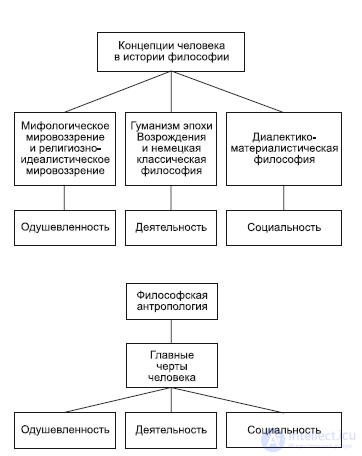
The individual human being combines the universally human, inherent in him as a member of the human race, social traits characteristic of him as a member of a particular social group, and individual traits, peculiar to him alone. Since the most ancient times, beginning with themythological worldview, there has existed the notion that the human being is dual, consisting of body and soul. For a long time it was asserted that the main thing in the human being is ensoulment, consciousness, reason. In the religious-idealist worldview the human soul was understood as a manifestation of a higher, divine principle. The body is mortal, the soul is immortal. In the materialism of the Ancient world the soul was interpreted as the result of a specific combination of material principles (in atomism – a combination of atoms having a special shape). As a rule, the soul was understood as the «bearer» of the human being's inner spiritual world, his consciousness, emotions, and reason.
In the Renaissance, and especially in German classical philosophy, emphasis was placed on human activity, agency, and freedom. German classical philosophy regarded activity as an essential characteristic of human being, but understood activity mainly as spiritual, mental activity. The rational principle in the human being is created by the activity of the subjective «I».
Dialectical-materialist philosophy, distinguishing material and spiritual activity, asserts the foundational role of material, practical activity. The very capacity for spiritual activity is historically formed and perfected in social conditions, with the development of social practice. The human being is a social being.
As philosophy developed, the main traits of the human being were identified: ensoulment, activity, sociality. It must not be forgotten that the human being is also a biological organism. The human being is formed both as a natural-biological and as a social being. The human being is born three times: physically, socially, and spiritually. And there is great meaning in this.
Although the human being has always been an object of close attention in philosophy, in the twentieth century a proposal was advanced for the need of a special philosophical science oriented toward the study of the human being – so-called philosophical anthropology. One of its founders, M. Scheler, asserted that all the main questions of philosophy come down to the question of what the human being is and what position he occupies in the world. The starting problem of philosophical anthropology is the problem of the becoming of the human being.
There exist various conceptions and theories that attempt to explain the becoming of the human being. The scientific-biological perspective points to the evolution of the human being from earlier primates and identifies various stages and mechanisms of this process. Within this perspective, special attention is given to anthropogenesis – the process of evolutionary development that led to the emergence of the modern human being.
The cultural-historical perspective emphasizes the role of sociocultural factors in the becoming of the human being. It links the evolution of the human race with the formation of language, tools, social organization, and other cultural aspects that contributed to the development of thinking, creativity, and social interaction.
Religious and mythological traditions offer their own interpretations of the becoming of the human being, based on beliefs and sacred texts. They usually connect the appearance of the human being with divine creation or mythological events.
From the fossil remains of ancient creatures, paleontologists have assembled a general picture of the evolution that led to the human being. Biochemical studies of humans and anthropoid apes (chimpanzee, gorilla) have shown an insignificant genetic difference between them. The time parameters have been refined. It is believed that the splitting of the evolutionary branch (from common ancestors into the line leading to humans and to anthropoid apes) occurred about 5 million years ago.
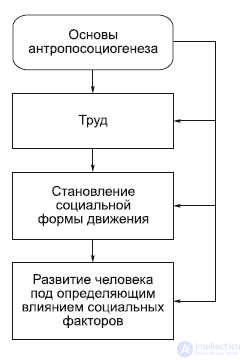
The idea of a kinship between humans and the higher apes was expressed long ago, but its acceptance proceeded with great difficulty, provoking fierce objections, above all from churchmen. In the previous century a lively discussion was sparked by Charles Darwin's book «The Descent of Man, and Selection in Relation to Sex» (1871). Darwin compared humans and animals across a range of traits, which still arouses considerable interest today. In Darwin one finds the outline of an approach to understanding the human being as a biosocial creature. Dialectical-materialist philosophy, taking into account the achievements of contemporary science, likewise asserts the dual, biosocial nature of the human being. In resolving the problem of the becoming of the human being and society it proceeds from the following fundamental propositions.
• The decisive role in the becoming of the human being was played by labor.
• The becoming of the human being and society is a transition from the biological form of the motion of matter to the social form. In this, of course, the biological form of motion does not disappear, but is dialectically «sublated» by the social form.
• After the becoming of the human being, his development proceeds under the determining influence of social factors.
Initially, natural objects were used as tools of labor: a stick, a stone. By using the first «natural» tools, the human being entered into new relations with nature; a new power came into his possession.
Our ancestors' use of «natural» tools opened up possibilities for diverse kinds of activity, away from narrow specialization. With the emergence of the rudiments of labor activity, the nervous system developed, a flexible hand adapted to grasping various objects developed, and the transition to permanent movement on the hind limbs was accomplished. The use of the first tools of labor contributed to the maturation of social bonds. The specifics of the way of life began to be determined not by biological but by social relations. Socially conditioned needs formed in the human being.
At the next stage, a transition took place from «natural» tools of labor to artificial ones. With the manufacture of tools began that which does not exist in the animal world – material production.
There exist various theories and approaches to explaining the origin of consciousness. Some of them include:
Physicalist approach: According to this approach, consciousness is the result of physical processes in the brain. It links consciousness with neural activity and brain functions. Such theories suggest that consciousness can be explained through the study of the brain and its biological mechanisms.
Emergentist approach: According to this conception, consciousness is an emergent property of the complex organization of the brain and its activity. This means that consciousness arises at a high level of organization of neural activity, when simpler components combine into more complex structures and processes.
Phenomenological approach: This approach focuses attention on consciousness itself and its subjective experience. It emphasizes that explaining consciousness requires taking into account not only neurophysiological and cognitive aspects, but also the phenomenological study of consciousness in itself.
At present there is no unambiguous scientific answer to the question of the origin of consciousness. This remains an active area of research and discussion. Neuroscientists, philosophers, and psychologists continue to investigate brain activity, the structure of consciousness, and the connections between them, in order to expand our understanding of this complex phenomenon.
One of the most important problems of philosophical anthropology is the problem of the origin of consciousness. Uncovering the nature of consciousness and resolving the question of its connection with material phenomena is a matter of enormous importance, not only theoretically but also practically; clarifying the dependence of the course of mental processes on objective conditions opens up possibilities for the directed change of people's consciousness.
The study of consciousness encounters a number of difficulties. The fact is that consciousness is not directly given to us. The images that arise in the brain are not externally observable. Externally one can observe a person's behavior, his emotions, his speech; in studying the brain one can observe the physiological processes occurring in it. But observing consciousness, even with the aid of instruments, is impossible. Images in consciousness do not possess the material properties that the objects reflected by these images possess (thus, fire burns, but the image of fire in consciousness does not have this property). Therefore it turns out that when the physiological activity of the brain, human behavior, emotions, and speech are studied, what is being studied directly is not consciousness itself but its material basis and its materialization in human activity. In this case consciousness can be judged only indirectly, mediately.
A special way of studying consciousness is self-observation (introspection) of one's own spiritual life. Here, however, there is a specific difficulty. Thus, for example, if we begin to analyze our own emotions or thoughts, then in the course of this analysis they begin to disappear (the thought about a thought displaces the thought itself).
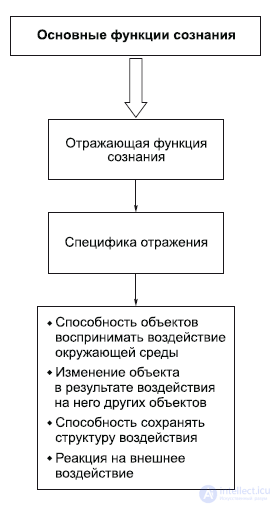
However, despite all the difficulties in understanding consciousness, for further discussion of it and of its origin it is necessary to attempt at least an undeveloped, working definition of consciousness. In dialectical-materialist philosophy a definition of consciousness is developed that includes an indication of its two basic functions: the reflective and the regulative. Specifying this approach, one can propose the following definition: consciousness is the human being's capacity to display material objects in ideal images and to purposefully regulate his relations with these objects. Here it must be noted that such a definition of consciousness somewhat narrows its content, since consciousness operates not only with images of material objects but also creates various images not directly connected with the reflection of material objects. However, the fact is that the initial images of consciousness are precisely images of material objects.
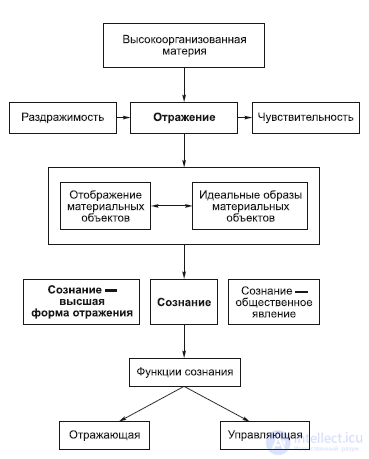
Consciousness is a property of highly organized matter. Being a specific property of highly organized matter, it has its objective foundations in matter.
In explaining the origin of human consciousness, some philosophers of the past (though such exist today as well) supposed that consciousness is, as it were, «dispersed» throughout the whole of nature, that all matter is «ensouled» (this point of view is called «hylozoism»). Between the consciousness inherent in all natural objects and human consciousness there is only a quantitative difference. The hylozoist conception is mistaken on the whole, but it contains a rational element – concerning the preconditions of our consciousness in nature.
V. I. Lenin advanced the idea of reflection as a universal property of matter. «It is logical to assume,» Lenin wrote, «that all matter possesses a property essentially akin to sensation, the property of reflection». In the course of the development of dialectical-materialist philosophy and science, the idea of reflection as a universal property of matter received its substantiation and specification.
Reflection is connected with the interaction of objects. Without interaction there can be no reflection. At the same time reflection is not identical to interaction. The specificity of reflection is revealed in the following moments.
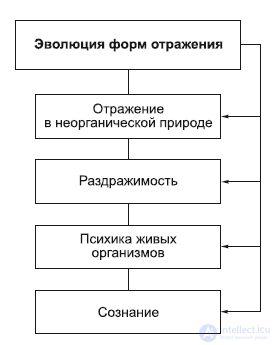
Reflection is the capacity of material objects to perceive certain influences of the surrounding environment, to change under the influence of these effects, to preserve in their structure the features of the influencing objects, and to manifest their internal content in a responsive reaction.
The initial form of reflection in living nature is irritability – the capacity of a living organism for the simplest specific selective reactions in response to the action of specific physicochemical stimuli.
As living organisms develop, the specialization of cells and tissues takes place; nervous tissue is formed, concentrating within itself the capacity to perceive influences of the external environment, and muscular tissue, concentrating within itself the capacity for motor reactions. On the basis of nervous tissue, sensitivity appears – the capacity to display the environment in sensations, in sensory images.
The further complication of reflection in animals is connected with the fact that the living organism orients itself in the environment, reacting not only to those influences that are directly involved in metabolism, but also to those that warn of the possibility of the appearance of the former (that serve as their signals).
The highest form of reflection is human consciousness. The human brain reflects the environment in ideal images and governs human behavior. The brain, like the human being as a whole, was formed in the course of biological and social evolution. This evolution is the path from a creature adapting to environmental conditions to a conscious human being transforming the environment (and himself) in accordance with his needs. This transition was a qualitative leap in the development of reflection.
The material basis of consciousness is the brain. The evolution of the brain proceeded, first, under the influence of natural, biological conditions. But natural conditions alone cannot explain either the evolution of the brain or the emergence of consciousness. The decisive significance for the emergence of consciousness belonged to the social environment, the development of the human form of life. The social factors in the formation of consciousness were labor activity, communication, and the exchange of information (language).
Labor, as purposeful activity aimed at making and using tools, played a determining role in the development of human mental abilities.
Consciousness is a social phenomenon in its origin, in its content, and in the functions it performs. Consciousness was not only historically shaped under the determining influence of labor, communication, and language – they play a determining role in the formation of every individual consciousness always, in any historical epoch.
The structure of human consciousness is complex and multifaceted. Consciousness represents a domain of mental life in which we are aware of ourselves, the surrounding world, and our inner states. Although the precise structure of consciousness remains a subject of research and debate, several main components and aspects characteristic of human consciousness can be identified.
Perception and sensation: This aspect of consciousness is connected with the perception of the external world through our sense organs and the processing of the information received. Perception includes sensations such as sight, hearing, touch, smell, and taste, which help us interact with our environment.
Thinking and cognition: This aspect of consciousness relates to our capacity to think, reason, analyze, and process information. It includes such aspects as logic, abstract thought, conceptualization, problem solving, memory, and attention.
Emotions and feelings: This aspect of consciousness is connected with our emotional states and feelings. It includes such aspects as joy, sadness, fear, rage, love, and states of well-being or discomfort. Feelings and emotions play an important role in our perception of and response to the world.
Self-awareness and mindfulness: This aspect of consciousness is connected with our awareness and perception of ourselves as individuals. It includes self-understanding, self-identification, and understanding of one's own thoughts, emotions, and actions.
Will and intention: This aspect of consciousness is connected with our capacity to make decisions, exercise free choice, and act purposefully. Will allows us to govern our behavior and achieve goals.
These are only some of the aspects that may be included in the structure of human consciousness. The interaction and interconnection among these components form the rich and complex world of our consciousness.
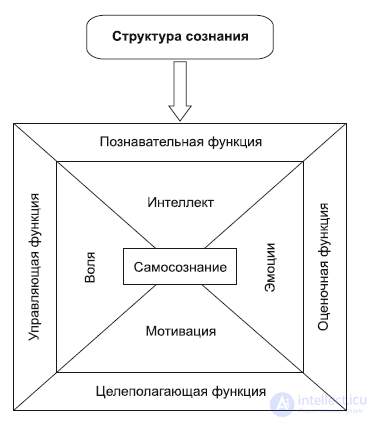
Consciousness exists as a fundamental property of the brain. At the same time, it must be understood that there is an essential difference between consciousness and material objects. The reflection of external objects in the brain is not the formation of their physical imprints. The image of an object, the thought of it, and the object itself are not one and the same thing. Images of consciousness do not possess the properties of, and are not subject to the laws governing, material objects; they have, for example, no volume, mass, hardness, and so on. Images of consciousness are something subjective, spiritual, ideal. Consciousness consists of subjective images of the objective world. The subjectivity here lies in the fact that consciousness belongs to individual people, to subjects, and also in the fact that, although the images of consciousness are objective (they reflect reality more or less accurately), these images nonetheless contain a subjective moment — a dependence on the state of the organism, on a person's experience, on the conditions of perception, and so on.
Consciousness is the reflection of objects in the form of ideal images. Objects are reflected in sensory-perceptual and logical-abstract images. The system of these images constitutes the content of consciousness. Consciousness, as a reflection of reality, represents knowledge, information about objects.
The reflection of reality in consciousness is not a simple mirror reflection, a copying, but a very complex process, in the course of which newly arising images combine with previous ones, are reworked, and are comprehended. In consciousness, representations and concepts can be created of things that do not exist or that may come into being. But any ideas and notions, however fantastic, ultimately arise on the basis of data obtained in the process of reflection.
An important element of consciousness is memory — the brain's capacity to store and reproduce information. Consciousness cannot exist without memory, cannot build complex images on the basis of simple ones, cannot create abstract images and ideas.
Consciousness includes not only cognitive but also emotional, motivational, and volitional components.
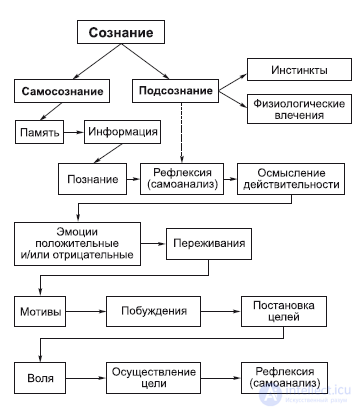
A person does not merely reflect various phenomena of reality; in his consciousness there arise emotional experiences, evaluations of these phenomena. These experiences and evaluations may be either positive (joy, satisfaction, and the like) or negative (sorrow, anxiety, and the like). Emotional states differ in strength and duration. Emotions, so to speak, single out objects from the standpoint of human needs, and stimulate a person's actions and motivation.
Motivation is the totality of a person's goals and impulses toward particular actions. Motivation is connected with goal-setting; at the basis of goal-setting lies dissatisfaction with the world and with oneself. Creative imagination, the representation of the results of one's own activity, and the working out of ideals all play a large role in motivation. A person constructs an ideal, a certain image of how the world ought to be arranged and of what he himself ought to be, and then raises the question of how to attain this ideal. For the latter, will is needed. Will is the capacity to act consciously, striving to realize a goal one has set. This requires a specific psychic tension — an effort of will. Thanks to will, consciousness is realized in practical action. The volitional effort, as it were, completes the dynamic of consciousness. The volitional control of human behavior rests on knowledge, emotions, and motivations.
In the further disclosure of the structure of consciousness it is necessary to point next to self-awareness. The formation of self-awareness begins in a person in early childhood, when he begins to distinguish himself from everything else. Later a person gradually develops an integral conception of his own "I." Self-awareness can be characterized as a person's awareness of his feelings, thoughts, interests, and his position within the system of relations with other people, and so on. Communication with other people, and taking their opinions of oneself into account, plays an important role in self-awareness.
In self-awareness a person subjects himself to reflection. Reflection (introspection) can be represented in a manner analogous to the structure of consciousness examined above.
1. Self-knowledge, self-observation, knowing oneself, one's position, abilities, and so on.
2. Emotional evaluation (positive or negative) of one's own qualities.
3. The working out of motivation, the determination of goals and methods of self-change.
4. Volitional effort to achieve goals, self-regulation, self-control.
The concept of consciousness is often correlated with the concept of conscientiousness. The concept of conscientiousness, of course, presupposes consciousness in a person, but consciousness and conscientiousness are not identical. Conscientiousness is connected with an understanding of social duty, a sense of responsibility for one's actions; one may say that the greater the place occupied in motivation by an understanding of social duty, the higher a person's level of conscientiousness.
Continuing the analysis of the structure of consciousness, it is necessary to single out the level of consciousness and of the subconscious (unconscious).
Language plays a key role in human existence. Language is the primary means of communication and of transmitting information between people. Here are some of the main aspects of language and communication in human beings:
Language as a system of symbols: Language consists of sound-based, visual, or other symbols that have an agreed-upon meaning and syntactic rules. People use language to exchange messages, transmit information, and express thoughts and emotions.
Grammar and syntax: Language has grammatical rules that determine the structure of sentences and their syntactic form. These rules allow us to create meaningful utterances and to understand the messages of other people.
Semantics and vocabulary: Semantics relates to the meaning of words and expressions, while vocabulary comprises the word-stock of a language. People use words and their meanings to convey information and express their thoughts, feelings, and needs.
Speaking and listening skills: Communication involves both the ability to speak and the ability to listen. People develop speaking skills in order to articulate sounds and words, and listening skills in order to understand and interpret the messages of others.
Nonverbal communication: Communication also includes nonverbal elements, such as facial expressions, gestures, intonation, and body movements. These elements convey additional information and emotional context in communication.
The social aspect of communication: Communication has a social nature and serves to establish and maintain connections with other people. Language allows people to exchange information, express their identity, coordinate actions, and create communities of meaning.
Communication and language are important aspects of our culture and social life. They allow us to express our thoughts, understand other people, transmit knowledge, and create a shared understanding of the world around us.
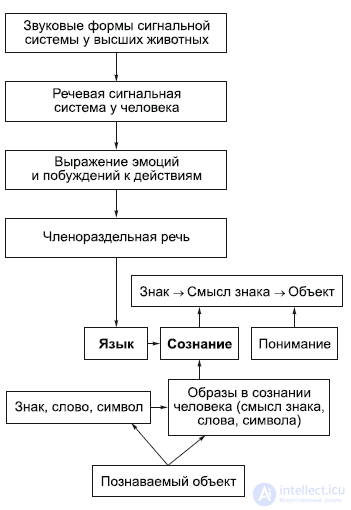
By language is meant any system of signs that serves people for obtaining, storing, and processing information. Primary among these is natural human language, historically evolved speech, a system of words that serves for thought and communication.
The prerequisites for human language were the complex motor and sound forms of signaling that existed among higher animals. In the process of transition from animal ancestors to humans, a speech signaling system was formed; sounds, from being a means of expressing emotion and a stimulus to action, became a means of designating things, their properties, and their relations, and came to serve for deliberate communication.
The emergence of articulate speech was a powerful means for the further development of humankind and of human consciousness. Through language the transmission of social experience, cultural norms, and traditions is carried out; it is through language that continuity between different generations and historical epochs is realized.
One of the interesting problems is that of the relationship between consciousness and language. There is an opinion that a person can think without words, and only when he wishes to convey his thoughts to someone does he clothe them in words. In some cases a person has difficulty conveying his thoughts; it seems to him that he has a clear thought and that the difficulty lies only in the fact that suitable words and phrases cannot be found. Some people believe that it is possible not only to think without language, but that precisely such thinking is "real" thinking. However, this point of view cannot be accepted.
From the very moment of its emergence, consciousness exists in the material shell of language; through language it becomes real, accessible to perception by other people. "From the start 'spirit' bears the curse of being 'burdened' with matter, which here makes its appearance in the form of moving layers of air, sounds — in short, in the form of language. Language is as old as consciousness itself; language is practical consciousness that exists for other people as well, and only thus does it exist for me myself as real consciousness."
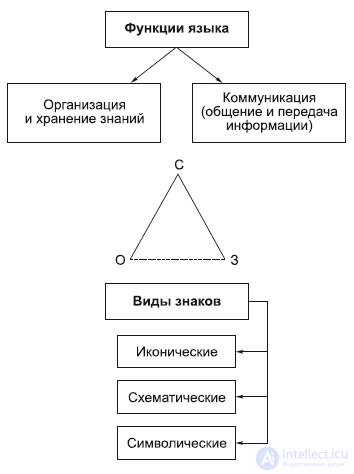
Thought takes on a material, verbal form not only when we speak or write, but also when we think. There is a specific speech center in the brain. The process of thinking is connected with signals that go to this center from the organs of speech, hearing, sight, and so on. It has been shown experimentally that the linguistic shell appears together with the thought.
Language consists of signs. A sign is a certain material phenomenon; but not every material phenomenon is a sign. A given material phenomenon becomes a sign when it is included in a sign situation. This situation is schematically expressed by the semantic triangle. Here O is a certain object, Z is another object that serves as the sign, and C is the images in a person's consciousness. Between O and C, and likewise between Z and C, there is a causal connection; between O and Z there is a special connection, called the connection of substitution. The sign situation consists in the following: a certain phenomenon, called the sign, substitutes for the phenomenon O; the sign is perceived by consciousness, and in consciousness there arises an image of the object O. Later the situation becomes more complex, and signs arise that designate other signs.
Various kinds of signs function within language. Some signs (so-called iconic signs, from the Latin icon — similar) are identical to the phenomena they replace. Others, so-called schematic signs, are not identical but resemble in certain respects the phenomena they designate. Still others, so-called symbolic signs, have neither resemblance nor similarity to the objects they replace, and are accepted as a result of convention. The overwhelming majority of signs are symbolic. A person's mastery of language, beginning in childhood, consists in being drawn into a system of conventions.
Language performs two main functions:
1) the organization of knowledge and its storage;
2) communication, social interaction, the transmission of information.
In its first function, language fixes the results of thought. The history of language clearly shows how, as thought passes from the concretely-particular to the abstract, language undergoes a process of developing words that designate general concepts.
The process of understanding is connected with comprehension, whereby a definite meaning is attributed to particular signs of language and to linguistic expressions. This meaning has a general character for people who use the same language. Shared meanings are realized in individual consciousness in accordance with how far a person has mastered the information available in society. The basic condition for communication is a shared understanding of utterances and shared emotional experiences on the part of the partners in communication.
Human activity relates to a person's active interaction with the surrounding world and to the carrying out of various kinds of activity. It covers a broad range of spheres of human life and may be physical, mental, creative, or social. Here are several of the main aspects of human activity:
Physical activity: Includes all kinds of physical actions performed by a person using his body. This may be physical labor, sport, physical exercise, walking, running, and other physical activities.
Mental activity: Relates to the activity of the mind and intellect. It includes the processes of thinking, cognition, problem solving, information analysis, planning, decision making, and other mental tasks.
Creative activity: Connected with the manifestation of a person's creative potential. It includes such kinds of activity as art, music, literature, design, architecture, and other forms of creativity.
Social activity: Relates to a person's interaction with other people and participation in social relations and events. It includes communication, cooperation, teamwork, participation in public life, and other social activities.
Professional activity: Connected with work and the pursuit of a particular profession or occupation. It includes the performance of tasks and duties associated with a particular profession or occupation, regardless of whether it is paid or voluntary.
Human activity is an inseparable part of a person's life and development. It allows a person to interact with the world, achieve goals, develop, and contribute to society.
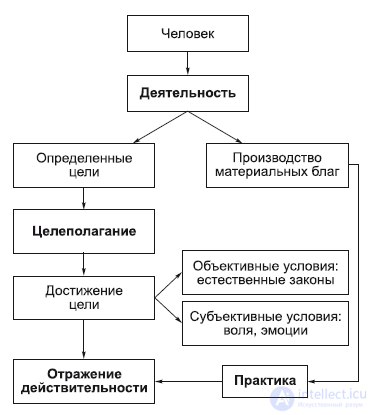
The reflection of reality in consciousness, as it were, passes over into activity, is completed in it. In this the unity of consciousness and activity is manifested.
Activity is a mode of human existence. But not all actions and processes in a person count as activity. A person breathes, eats, and so on — here he is no different from the actions of animals. A person with a cold coughs, a sleeping person snores, and so on — these actions do not belong to the philosophical category of activity. Human activity is distinguished by its purposeful character. Human activity, on the one hand, obeys natural laws, and on the other hand serves definite goals that a person sets for himself.
A person's action is preceded by goal-setting — the formation of an image of what may come about as a result of the action. Before doing anything, a person envisions what the result of the activity will be, envisions a certain sequence of actions that may lead to the realization of the goal.
Purposive activity differs from instinctive activity. The latter is carried out without any prior conception of a goal, plan (method, way) of action; it proceeds according to a genetically established program on the basis of unconscious reflection. Such are precisely the actions of animals. In this connection Marx wrote: «A spider conducts operations that resemble those of a weaver, and a bee puts many a human architect to shame by the construction of its wax cells. But what distinguishes the worst architect from the best of bees is this, that the architect raises his structure in imagination before he erects it in reality. At the end of every labor process, a result emerges which had already been conceived by the worker at the beginning, hence already existed ideally»[10]. Animals adapt to the environment, while man, through his activity, transforms it, creating a «second nature,» an artificial environment.
It is precisely purposiveness that distinguishes human activity from processes occurring in nature. Purposiveness and reflection are interconnected. At the basis of purposive activity lies the reflection of reality, of its laws; knowledge of them makes it possible to achieve a goal. At the same time, reflection itself is stimulated by purposive activity. It is an interesting fact that emotional activation is necessary (although not sufficient) for productive reflective activity. Let us recall the well-known thesis that without human emotions there can be no search for truth.
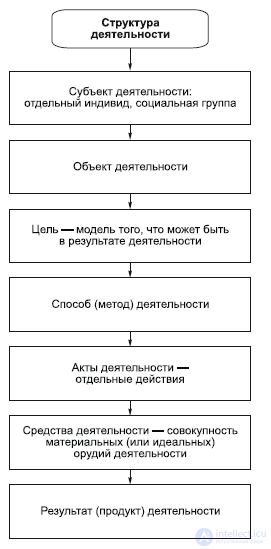
The structure of activity can be represented as follows.
Achieving a goal presupposes will, which orients one toward attaining the goal and overcoming obstacles that arise. It should be noted here that, in the general case, there is no complete coincidence between goals and the results of actions. Activity usually leads to two kinds of results: direct results, which correspond to the consciously set goal, and side results, which were not foreseen in advance or even recognized. Side results can sometimes be not only unexpected but also undesirable.
Activity may be reproductive, reproducing what is already known and existing, or creative, producing something new and socially significant. Images may form in consciousness that, in a certain sense, run ahead of reality. On the basis of reflecting the possibilities and tendencies of reality, man possesses the capacity for foresight and for organizing his activity accordingly.
On the whole, the activity of consciousness is characterized by purposiveness, imagination, the generation of new ideas, and the management of activity.
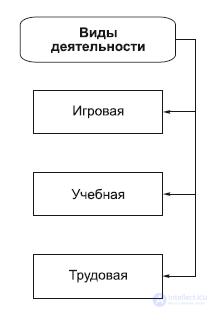
Human activity is extremely diverse. Today there is no single, generally accepted classification of types of activity. If we approach the identification and classification of its types from the point of view of an individual's development, we may proceed from the following considerations.
The first type of activity, predominant in early childhood, is play activity. It is of great importance: in play, children come to know reality, master norms of behavior, and develop physical and mental abilities. Play activity accompanies a person throughout his entire life, being an important element of leisure.
The second type of activity is learning activity. In the course of study, knowledge, abilities, and skills are acquired for one's entire future life. A person is prepared for independent life. Study does not end in youth; a person learns throughout life.
The third, principal form of activity is labor activity. It is directed toward the creation of products and services necessary for satisfying needs. Labor here is understood in the broad sense of the word, including both physical and mental labor.
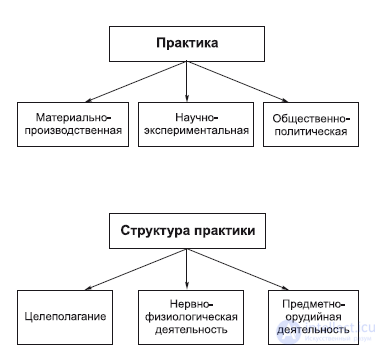
The basic form of labor activity is the production of material goods. The goals that people set for themselves in the process of production are determined by material needs. The goals a person sets for himself cannot be achieved while remaining in the sphere of reason alone. From the mere fact that a person has set this or that goal, nothing happens by itself. In order to bring about changes in reality and achieve the goal, one must act upon the surrounding world by material means, practically.
Practice – is the sensuous, objective, material activity of people, by means of which they purposefully transform the surrounding natural and social world. Practice – is not just any movement, action, or effort, but conscious activity with a conception of the goal, conditions, and means directed toward the object of the practice. In practice there is a synthesis of objective activity with the creative nature of consciousness.
Practice includes three main types of activity: material-productive, scientific-experimental, and socio-political. The first is directed at the natural environment, the last at the social environment, while scientific-experimental activity is oriented toward both the natural and the social environment.
The practical process includes three components: goal-setting, material-physiological activity, and instrumental activity. The goal is a precondition for the material-practical act of activity. The transition from the goal to an objective result begins with setting in motion this or that organ of the body (above all the musculature) and is completed with the use of material instrumental means.
As technical progress advances, changes occur in both the physiological and the instrumental aspect of practice. The state of the nervous system becomes increasingly important, while at the same time the instrumental provision of practice develops. In a certain sense, man is a product of his own labor and practical activity. In changing the world, man changes himself, both materially and spiritually.
The personality is a complex of unique characteristics, qualities, and behavioral and psychological traits that determine the individuality of each person. The personality is formed as a result of the interaction of genetic, biological, psychological, sociocultural, and environmental factors. Here are some key aspects of personality:
Identity: Identity refers to the awareness of oneself as a separate and unique individual. This includes self-awareness, self-determination, and awareness of one's values, beliefs, interests, and roles in society.
Temperament: Temperament reflects individual differences in emotional reactivity, level of activity, and mood. It can be characterized, for example, as calm, hot-tempered, active, or restrained.
Character: Character refers to a set of stable traits, values, and moral attitudes that influence behavior and decision-making. Character may include such qualities as honesty, tolerance, responsibility, fairness, and kindness.
Psychological traits: The personality can be characterized by various psychological traits, such as extraversion, introversion, conscientiousness, emotional stability, openness to new experience, and others.
Social adaptation: Personality includes the ability to adapt and interact in social situations. This includes communication skills, social roles, empathy, and the ability to cooperate and build relationships with other people.
Development and variability: The personality develops throughout life and can change under the influence of experience, learning, interaction with the environment, and personal life events.
The personality is unique and individual for each person. It determines our uniqueness, behavior, thinking, and capacity for adaptation to various situations and the demands of life.
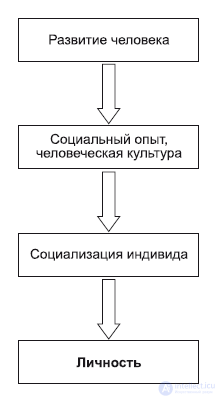
It is said: one is not born a personality but becomes one. Here it is clearly implied that the concepts of "human being" and "personality" are not identical. But what, then, is personality?
In philosophy there have been and still are various understandings of personality. For Hegel, the decisive criterion of personality is «autonomy of the will,» or «self-consciousness.» Here it was said that not every human being is a personality. One must possess the gift of «pure thought» in order to become a personality.
The term «personality» originally denoted the mask of an actor in Greek theater, and later came to denote the actor himself and his roles. Later this term acquired a different, deeper meaning. Personality is understood as the result of human development. A separate human being, an individual (a child, for example), becomes a personality in the course of mastering the experience of humanity.
Social experience is not encoded in nerve cells; it is fixed in the culture created by humanity. The individual becomes a personality by mastering this culture. In principle, every person can master culture. One should not think that a personality is only an outstanding person. Every normal person who is included in culture, who masters it, who is capable of making independent decisions, and who bears responsibility to society for his actions, is a personality.
Dialectical-materialist philosophy asserts that the essence of man as a personality is determined by social relations, above all by social labor. In labor, man distinguishes himself from nature, distinguishes himself from other people, and enters into communication with them; this is then reflected in his consciousness: man becomes conscious of himself as a personality. The content and self-consciousness of an individual personality are determined, besides labor activity, by family and everyday relations, social activity, and so on. A person is influenced by the way of life of the social group to which he belongs. A person speaks a language that is a product of social development, and thinks in concepts worked out by a series of preceding generations. Social content is invested in every personality. The process of the formation of personality is the process of the socialization of the individual.
Concrete personalities, as a result of the socialization of the individual, are unrepeatable even if they have formed under conditions of an approximately identical social environment. There are no two completely identical individualities; every person has his own manner of comporting himself, of communicating with other people, of expressing himself in his actions.
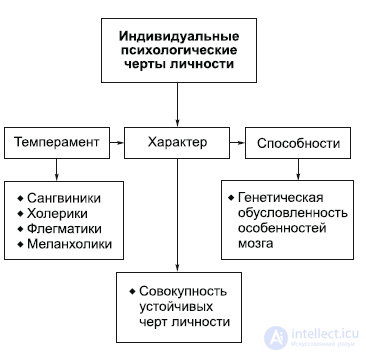
The content of personality is multifaceted. In its structure, its psychological features are, above all, distinguished. Every personality has its own temperament. Hippocrates used the word «temperament» to denote individual capacities and features of human behavior. He believed that all people could be divided by temperament into four types: sanguine, choleric, phlegmatic, and melancholic. Psychologists believe that a personality's temperament depends on the properties of the nervous system. A person has innate properties of the nervous system: sensitivity and reactivity, capacity for work, strength, mobility, and the balance of the processes of excitation and inhibition.
Although the properties of temperament are innate, this is no obstacle to conscious self-education, to compensating for particular properties of temperament through consciously developed habits of behavior. In principle, people of any type of temperament can achieve success in any field of activity.
In organizing the activity of any collective, it is important to know and take into account the temperaments of its workers. Thus, in a collective, choleric individuals can often be aggressive, boastful, vain, and stubborn. Young people with a choleric temperament are characterized by maximalism and negativism. Sanguine individuals are ambitious and tend to display their merits openly, while melancholic individuals usually mask them. Phlegmatic individuals react calmly to criticism. Choleric and melancholic individuals, when fatigued, can easily fall into a state of irritation accompanied by affective outbursts. Naturally, a collective needs psychological compatibility, a balance of the temperaments of its members. Psychologists consider phlegmatic and sanguine individuals to be the most compatible; choleric and melancholic individuals most often come into conflict with one another.
On the basis of temperament, in the course of a personality's life activity, its character is developed – the totality of stable personality traits that determine the typical ways of behavior characteristic of it. A personality's character is manifested in its attitude toward other people, toward itself, and toward its work.
The individual psychological traits of a personality consist not only in temperament and character, but also in its abilities. Abilities are genetically conditioned by the features of the structure and functioning of the brain. Abilities that ensure especially successful activity are called giftedness. It must be emphasized here that abilities and giftedness by themselves do not guarantee that a personality will achieve high creative results; for this, serious labor and volitional effort are needed.
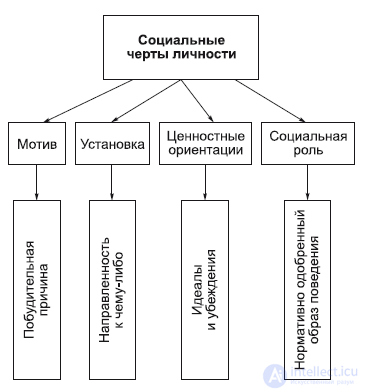
Let us now turn to the social aspect of personality, which includes, above all, motives, attitudes, and value orientations. These stem from the personality's social position and are prescribed by the environment surrounding it.
A motive – is the personality's attitude toward its possible action, determining the choice of momentary behavior. An attitude (set) – is a state of readiness, a disposition toward behavior in a given situation. An attitude determines behavior not only at a given moment but also over a longer period. Value orientations – are a system of attitudes in light of which the personality evaluates situations and chooses a particular mode of behavior. Value orientations are based on the ideals and convictions of the personality.
The social aspect of personality further consists in the system of social roles it performs. A social role – is a normatively approved pattern of behavior expected of everyone occupying a given position in society (for example, a young person performs the social role of a student). In the course of his life, a person performs a multitude of social roles, since he may simultaneously or at different times belong to different collectives, in each of which he performs a particular role. Out of the multitude of roles, a personality may choose one for itself as the main, so-called internalized role. If this role is performed over a long period, it exerts a noticeable influence on personality traits (thus, for example, a teacher or an officer can be recognized even outside the school or place of service).
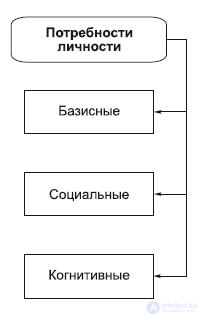
The combination of specific biological, psychological, and social features makes a person, as a personality, unique. This uniqueness is reflected in the concept of the «self.» Every personality, every «self,» has its own composition of needs. Three groups of needs are usually distinguished:
These various needs occupy their own place on the scale of a personality's values. A personality's life path depends substantially on how these needs and values are combined within it. If, say, the satisfaction of biological needs comes to the fore, this can lead to the degradation of the personality (eating turns into gluttony; increasingly frequent consumption of alcoholic beverages leads to alcoholism, and so on). A person may see the meaning of his life differently. For some it is personal success, for others it is caring for others, for still others it is the protection of nature, and so on.
Today calls for «soulfulness» and «spirituality» are often heard. Soulfulness is indeed connected with altruism, with the need to be useful «to others»; «spirituality» is connected with the need for knowledge, the development of the emotional sphere, and so on. There is also talk of the necessity of forming a «comprehensively developed personality.» But how is this to be understood? Since ancient times a conception of such a personality has been taking shape; its characterization includes a number of parameters:
The individual and society are interconnected and influence one another. Here are several aspects of the interaction between the individual and society:
Socialization: Society plays a key role in the formation of the individual. Socialization is the process by which an individual learns and internalizes the values, norms, behavioral standards, and cultural features of their society. This happens through interaction with parents, relatives, friends, educational institutions, and other social institutions.
Social influence: The individual is also subject to the influence of social norms, expectations, and values. They may come under pressure from society regarding their appearance, behavior, career choices, and other aspects of life. This can influence the formation of self-identification and the adoption of a social role.
Social role: Society assigns certain social roles and expects the individual to conform to these roles. The individual takes part in various social contexts, such as the roles of parent, spouse, employee, student, and so on. Conformity or non-conformity of the individual to social expectations can influence self-esteem and the sense of belonging.
Cultural influence: The culture, language, traditions, and values of society shape the cultural identity of the individual. Cultural norms determine which behaviors and values are considered acceptable or unacceptable in a given cultural environment. The individual adapts to their culture and at the same time can contribute to cultural processes and changes.
Interaction and cooperation: The individual exists within a social context and interacts with other people. They build relationships, cooperate, and depend on other people. Communication with other people allows the individual to develop, to learn, and to contribute to social processes.
On the whole, the individual and society interact with one another and influence each other's formation and development. The individual adapts to society, but also contributes to social processes and dynamics, shaping their own individuality and influencing society as a whole.
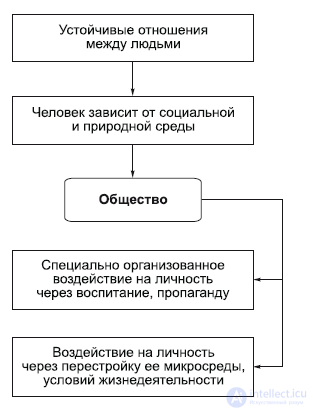
In beginning a discussion of the relationship between the individual and society, one must bear in mind that historically there have always existed specific societies with specific types of personality. But in these specific societies and specific types of personality there were certain common features, which is what allows the question of the relationship between the individual and society to be posed in general terms. Furthermore, one should not imagine matters as though separate people first existed and only later united into society. Aristotle already wrote that man is by nature a «social animal».
Society represents a stable system of relations between people. Society, as a system of relations between people, exerts an influence on individual persons as its elements. Sociologists point to two ways in which society influences the individual:
A person is a product of the time and circumstances in which they live. Views and ideas are, in general, determined by society; a person thinks as the «spirit of the times» compels them to think. With a change in the social system, the position of the individual, their interests and needs, changes.
The relationship between the individual and society is, above all, a relationship of interests. Public interests express that in which society as a whole is interested (the development of the economy, means of communication, environmental protection, and so on). The interests of the social groups of a given society also belong to public interests. Personal interests express the needs of an individual person connected with providing for their material needs and spiritual demands.
There are various conceptions concerning the relationship between public and personal interests. One of them gives priority to the interests of the individual. This conception has been given concrete form, for example, in the demand for freedom of private enterprise, non-interference by the state in the affairs of entrepreneurs. The conception of the priority of individual interests sometimes grows into the conception of absolute freedom of the individual. But if one looks at the actual state of affairs, a person cannot after all be independent of the surrounding environment, both social and natural. Moreover, if one individual could become absolutely free, this would mean the unfreedom of others. Although there can be no absolute freedom of the individual, people are nevertheless vitally interested in an increase in the degree of freedom, in liberation from oppression, exploitation, and violence.
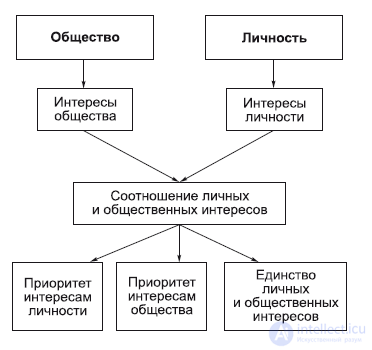
Another conception asserts the priority of public interests over personal ones (for example, the conception of «natural morality» of F. Bacon).
And finally, a third conception asserts the necessity of combining public and personal interests into a certain harmonious unity. Here, of course, one must bear in mind that a complete coincidence of personal and public needs and interests cannot be achieved. The interests of people here need to be considered in relation to the main features of the way of life of their social environment.
In our country the idea of a harmonious combination of public and personal interests was officially propagated; mutual assistance and mutual responsibility, and the growth of the socio-political activity of people, and so on, were considered the ideal way of life. But in fact individuals had virtually no opportunities for all-round development; individuality was regarded with suspicion, and even the term «individualism» was usually interpreted as «bourgeois individualism». The interests of the state were placed first, yet in fact, behind «all-people's», state interests, lay hidden the interests of a certain social group—the leading stratum of the party-state bureaucracy.
The founders of dialectical-materialist philosophy asserted the conception of humanism. Humanism, in the broad sense, means the assertion of the human being's right to freedom, happiness, the development of their abilities, equality, and social justice. The good of the human being is the criterion for evaluating any social actions and institutions.
Today two tasks confront us. The first is to restore the true meaning of public interests, without identifying them with state interests and the interests of certain separate groups. The second is the development of the individual, their initiative, originality, and so on. The realization of these tasks is no easy matter, presupposing such a democratization of society as we are still fairly far from.
In analyzing the problem of the relationship between the individual and society, attention is drawn to a phenomenon called alienation.
Alienation is understood as the estrangement of people, their inability to friendship and love, insecurity, moral nihilism, and so on.
The problem of alienation among people is one of the key themes in the social sciences and humanities. Alienation refers to the state in which a person feels separated, estranged, or alienated from themselves, other people, society, or nature. Here are several aspects of the problem of alienation:
Alienation from oneself: This is a state in which a person feels the loss of their own identity, autonomy, and self-determination. They may feel that their actions, values, or aspirations do not correspond to their true needs and desires. Alienation from oneself can lead to inner conflicts, dissatisfaction, and a loss of meaning in life.
Alienation from others: This is a feeling of separation, isolation, or misunderstanding in relations with other people. It can arise from a lack of emotional connection, social exclusion, misunderstanding, or disagreement. Alienation from others can produce a feeling of loneliness, indifference, and the loss of social support.
Alienation from society: This is a feeling of not belonging or of being alien in relation to social structures, values, and norms. A person may feel that they do not correspond to social expectations, that their needs and interests are not taken into account, or that they cannot find their place in society. Alienation from society can give rise to distrust of power structures, social inequality, and a sense of hopelessness.
Alienation from nature: This is a state in which a person feels separated from the surrounding natural environment. They may experience apathy, alienation, and an insoluble conflict between their needs and ecological responsibility. Alienation from nature can lead to environmental problems and the loss of harmony with the surrounding world.
Alienation can have a negative effect on a person's physical and mental well-being. It can lead to stress, depression, apathy, social isolation, and a loss of meaning in life. To overcome the problem of alienation, it is important to create conditions for maintaining emotional connection, mutual understanding, social integration, and harmony with the surrounding environment. This can include strengthening personal relationships, seeking support in the community, participating in social activity, and taking a conscious attitude toward oneself and the surrounding world.
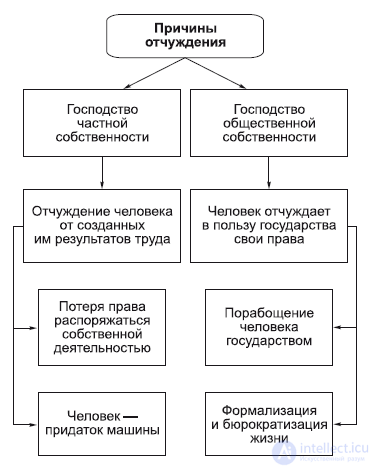
Let us note the main conceptions of alienation. In the conception of the social contract (Hobbes, Locke, Spinoza, Rousseau, and others), it was held that, under conditions of private property, the individual alienates their natural rights in favor of the state; the state must guarantee citizens security, protection of property, and so on. But this alienation creates the possibility of the enslavement of the individual by the state.
Hegel spoke of the alienation of the human being from the results they have created through «physical and spiritual skill». In this, the individual is alienated from «universal life», becoming dependent on an «alien power»—the state, law, morality, and so on.
For Marx, alienation is:
Marx held that the source of alienation is private property.
Alienation is the process by which the results and products of human activity are transformed into something independent of and dominant over the person. As a consequence of this, activity is deprived of creative content. Under the classical capitalism of which Marx spoke, the worker is alienated from the product of their labor. Under private appropriation, workers cannot feel attachment to the product of their labor. The assembly line destroys the creative principle in work. This was so in the past. But has it now disappeared?
Not only the worker is subject to alienation. A characteristic feature of our time is the participation of large numbers of scientists, designers, engineers, and people of other specialized professions in monopolized industrial production. These people, too, are alienated from the products of their creativity.
Alienation affects the creative artistic intelligentsia as well. The vacuity and spiritual emptiness of many works of literature, cinema, music, and so on are often attributed to the «low taste» of the masses. But in fact these works are the result of the alienation of their creators, as a consequence of which these works are not the fruit of free imagination but must follow the standards of «mass» culture.
The entrepreneur, too, is in a certain sense subject to alienation. They are alienated from the workers. The workers are needed by the entrepreneur for work at their enterprise, and the entrepreneur relates to them in a certain sense as to appendages of machines.
It is usually held that alienation is brought about by the unlimited dominance of private property. But there is another side to the coin. The practice of the twentieth century has shown that alienation is also brought about by the unlimited dominance of public property. What is public is, by that very fact, not mine, and I relate to it accordingly. This was clearly manifested in totalitarian regimes. The way out of the extremes that give rise to alienation apparently lies in a combination of private and public property.
Alienation has its origins not only in economic relations but also in certain socio-political relations, when there occurs the removal of the people from the leadership of the state, the specific manipulation of public opinion, the suppression of individuality, the estrangement of people from one another, and so on.
The process of alienation also occurs in the spiritual life of society. The transformation of the individual into an object of exploitation, political subjugation, and manipulation by dominant groups gives rise, in the consciousness of the person, to a rift between their desires and social norms, a perception of these norms as alien and hostile to the individual, a feeling of isolation, loneliness, and so on. The external social world is perceived as alien and hostile to the individual. Durkheim spoke of «anomie» as the loss by people of an understanding of the significance of social norms, the disappearance of a person's sense of solidarity with this or that social group.
Alienation as a psychological phenomenon is an inner conflict, a rejection of something that is, as it were, located outside the person yet connected with them. In a number of cases alienation is specially engineered. An example may be found in interethnic and international relations. Alienation here finds its expression in chauvinistic images of «monsters», when this or that people is represented as inferior, as sub-human, and so on. The hater, placing themselves in an exceptional position, ascribes to others all the cruelty and inhumanity toward which they themselves feel an inclination.
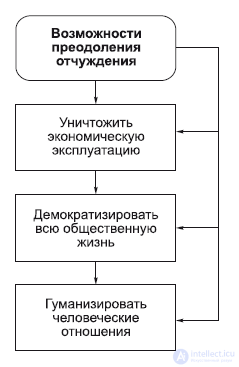
Communication and separation are a contradictory, perennial situation in the life of the individual. Sometimes a person wants to communicate, sometimes to be alone, and there is nothing wrong with this. As long as one does not fall into extremes. And these extremes are conformism, on the one hand, when a person loses their individuality in excessive communication, and alienation, on the other hand, when a person self-isolates from other people, seeing them as their enemies. To overcome the roots of alienation, it is necessary to eliminate economic exploitation, democratize the whole of social life, and humanize human relations.

Comments