
Lecture
Method of philosophy – the means by which philosophical investigations are carried out.
Philosophical methods are not a "set" of rigidly fixed regulations, but a system of "soft" principles, operations, and devices that bear a universal, all-embracing character, i.e. that are located at the very highest (limiting) "levels" of abstraction. Therefore philosophical methods are not described in the strict terms of logic and experiment, and do not lend themselves to formalization and mathematization.
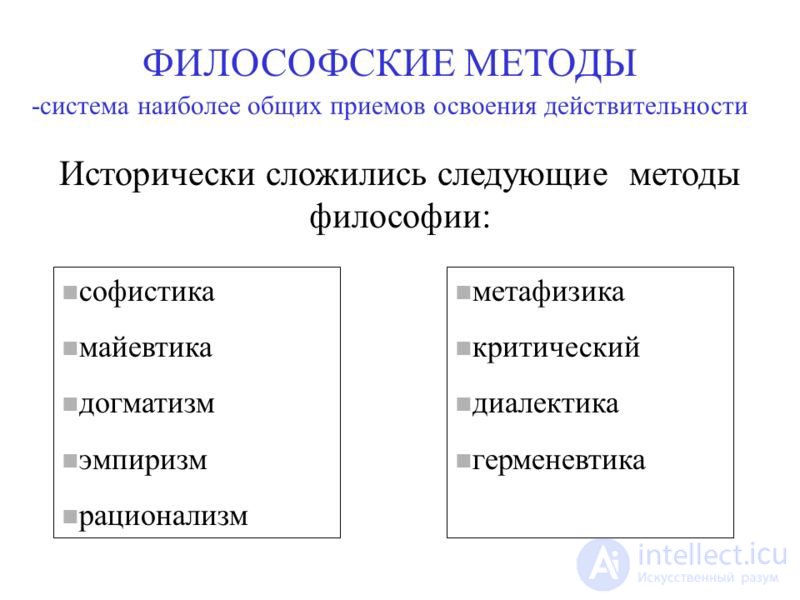
It should be clearly understood that philosophical methods set only the most general regulatory guidelines for research, its general strategy, but do not replace specialized methods and do not directly and immediately determine the final result of cognition. Experience shows that "the more general a method of scientific cognition is, the less definite it is with respect to prescribing concrete steps of cognition, and the greater its ambiguity in determining the final results of research"
Dialectics – a method of philosophical inquiry in which things and phenomena are examined critically and consistently, taking into account their internal contradictions, changes, the development of causes and effects, and the unity and struggle of opposites.
Metaphysics – a method opposite to dialectics, in which objects are examined in isolation (rather than in terms of their interconnection), statically (ignoring the fact of constant change), and unambiguously (seeking an absolute truth, paying no attention to contradictions, and not recognizing their unity).
Dogmatism – the perception of the surrounding world through the prism of dogmas – convictions accepted once and for all, unprovable, «given from above», and bearing an absolute character. This method is characteristic of medieval theological philosophy.
Eclecticism – a method based on the arbitrary combination of disparate facts, concepts, and conceptions lacking a single creative foundation, resulting in superficial but outwardly plausible, seemingly credible conclusions. Eclecticism was often used to justify various views and ideas attractive to mass consciousness.
Sophistry – a method based on deriving conclusions from false judgments that are skillfully and improperly presented as true. It was often used in Ancient Greece and was aimed not at obtaining truth but at winning an argument, and was used as a device in oratory.
Hermeneutics – the method of correctly reading and interpreting the meaning of texts.
Maieutics (Ancient Greek μαιευτική — «midwifery», from μαῖα — «midwife») — a term from Plato's dialogue «Theaetetus», denoting a method of philosophizing created by Socrates , consisting in uncovering truth through a sequence of questions, through «examination» (ἐξέτασις).Maieutics was created by Socrates as a method of drawing out the knowledge hidden within every person by means of leading questions.
Empiricism — a school of thought in the theory of knowledge that recognizes sense perceptions as the source of knowledge and holds that the content of knowledge can either be presented as a description of this perception or reduced to it. It stands opposed to rationalism and mysticism.
Rationalism (from Latin rationalis — reasonable) — a method according to which reason is the basis of human cognition and action. Since the intellectual criterion of truth has been accepted by many thinkers, rationalism is not a characteristic feature of any single philosophy; moreover, there are differences in views on the place of reason in cognition, ranging from moderate ones, in which the intellect is recognized as the main means of grasping truth alongside others, to radical ones, in which rationality is considered the sole essential criterion
Philosophical methods are classed among universal, general-scientific methods. However, this claim is not entirely correct. Philosophical methods solve the first methodological problem – the ontological and epistemological one – and constitute a set of regulatory guidelines for research at the "top level" of abstraction, in the most general form. At the same time, every philosophical conception has its own set of regulatory guidelines. Contemporary philosophy presents a significant number of such conceptions-regulations: dialectics and metaphysics, idealism and materialism, positivism, physicalism, phenomenology, pragmatism, and so on. Thus, insisting on the thesis of the general-scientific character, and still more the universality, of philosophical methods seems not entirely correct. Apparently, one should speak of the necessity, the obligatoriness, of the researcher's worldview position, which for most sciences is the starting point of research.
Among the oldest and therefore best-known philosophical methods are the dialectical and metaphysical methods. Let us illustrate the methodological role of philosophical methods using them as an example.
Dialectics (from Greek dialektike – the art of conducting a conversation, an argument) as a method of cognition is based on the teaching of Heraclitus, who demonstrated that in the surrounding world "everything flows, everything changes". The dialectical method received its fullest development in the work of Hegel. The world, according to Hegelian dialectics, is ceaseless movement, change, the development of being, "the unity and struggle of opposites", "the negation of the negation", and so on. Hence the ontological orientation of the methods of cognition, which presupposes the analysis of all possible points of view on the object under study, as well as the development of these methods themselves.
The term "metaphysics" (literally "that which comes after physics") was introduced in the 1st century BC by Andronicus of Rhodes, a commentator on Aristotle's philosophical legacy. He placed Aristotle's works devoted to general questions of being and cognition after the physics and accordingly named them "metaphysics". In modern scholarly society, the term "metaphysics" is used as the antipode of dialectics. The metaphysical approach is usually the name given to a method of cognition based on reflections, that is, on knowledge representing the opinions of the researcher himself, absolutized by him. In this sense, when one wants to emphasize the one-sidedness of a method, it is called metaphysical.
As can be seen from the examples given, philosophical methods determine the worldview principles of disciplinary methods. They shape a person's worldview and understanding of the world and, in this sense, serve as the starting point in research. Of course, the application of these methods depends on the depth of analysis and the level of generalization of the subject and object of research. For example, in cooking one can manage perfectly well without philosophical methods. But if one rises to generalizations such as "what is a human being", "what is food for a human being", and so on, then ontological principles allow genuine discoveries to be made in the preparation of dishes. Then food can be regarded as medicine, as an aesthetic pleasure, and so on, which entails conducting research into the molecular structure of foodstuffs, the biochemical and biophysical peculiarities of preparing dishes, and so on, i.e. it entails moving to a new level of depth of analysis and generalization.
Qualitative and quantitative methods are used mainly at the linguistic level of research. Here scientific methods are classified according to which means, systems of justification (qualitative or quantitative), are used in examining a given problem.
The qualitative method involves a verbal description of the object of research and its features, as well as the relations between the features. That is, the formulation of a concept of the object and subject of research is carried out in words by means of procedures of description, characterization, and comparison. The relations between features, in the form of laws, conclusions, and so on, are likewise described in words, using explanatory procedures: induction, deduction, interpretation, and others. Therefore, at the linguistic level, all logical methods of cognition, especially in the humanities, are qualitative in character, with the main goal being to achieve an understanding of the essential features of an object, as well as the necessary logical (rational) interpretation of them in order to obtain correct conclusions.
However, even in the humanities, and still more so in economics, there is both the possibility and the necessity of expressing features and the relationships between them, and consequently the conclusions, in numerical form. For example, a verbal description of the qualitative features of a country's economic development, such as saying that more houses have been built, or that people have started living better, would hardly satisfy us. It is necessary to express this improvement in specific figures. In these cases, quantitative methods are used.
The quantitative method is based on the use of measurable quantities, as a rule expressed in the form of numbers. It is based on the procedure of measurement. The essence of the method is that, having in mind an image of the object, the researcher links its essential features together in the form of formulas expressing the relations between them. That is, in the language of symbols (usually mathematical ones), a formalized model of the relations of the features identified in the process of qualitative analysis is constructed. By substituting numerical values of the features into the model that has been developed, the researcher obtains results in "digitized" form. Thus, knowing the formulas for calculating gross domestic product and national income, and having statistical data for this calculation, we can estimate rates of growth, increase, and so on. And it is on this quantitative basis that we can characterize the dynamics of economic development.
Many quantitative methods have been developed in statistics and mathematics: mathematical statistics, linear and nonlinear programming, mathematical analysis, probability theory, and so on. In economic science, the combination of the quantitative methods of statistics and mathematics led to the emergence of a separate branch of knowledge – econometrics.
The choice of one method of philosophy or another is based on many factors. For example, the phenomenon or subject being studied is of no small importance. In addition, the choice may depend on the system of values one holds and the categories one operates with.
The way of thinking closest to one of the philosophical doctrines will, accordingly, be based on the methods used by the representatives of that type of doctrine.
It should also be taken into account that some methods are considered theoretically outdated for contemporary philosophy (for example, dogmatic ones)
According to their degree of generality and breadth of application, methods of scientific cognition are divided into three groups:
1. Philosophical methods
2. Scientific methods
3. General logical methods
Philosophical methods are distinguished by the universal character of their application. These methods are used to analyze natural phenomena, social processes, and the regularities of humanity's conscious activity.
Traditionally, two philosophical methods are distinguished:
1. the dialectical method
2. The metaphysical method
These methods differ from one another in their understanding of the problem of connections in the world, as well as in their understanding of the problem of development.
In understanding the problem of connections, metaphysics examines things in abstraction from their connection with other things. The dialectical method, on the contrary, calls for understanding things and phenomena while taking into account their connections with other things and phenomena.
In understanding the problem of development, metaphysics either ignores the development of the object being known or reduces development to simple quantitative changes of the object. Dialectics, on the other hand, holds that an object can be understood only by taking into account the tendencies of that object's development.
Dialectical philosophers say: <<‘Truth is concrete. Truth may be false in one set of conditions and true in another.
Furthermore, development presupposes not only quantitative changes but also qualitative leaps, which occur in the transition from an old quality to a new one.
In the course of the development of science, metaphysics is used at the stage of the accumulation of scientific facts, and dialectics is used at the stage of the theoretical generalization of practical material.
Scientific methods are divided into two levels:
1. Methods of empirical cognition
2. Methods of theoretical cognition
Methods of empirical cognition are realized in the process of scientific experience, where the main role belongs to the senses.
The methods of empirical cognition include:
1) observation — the purposeful study of an object based on the work of the sense organs, without interference in the phenomenon being studied;
2) experiment — the purposeful study of an object under specially created, artificial, and controlled conditions. Here the object is artificially reproduced;
3) comparison — the identification of similar features or differences between objects;
4) description — the recording of the results of an experience, observation, or experiment using special systems of notation. Description is carried out by means of diagrams, tables, charts, and so on;
5) measurement — the performance of cognitive actions with the aim of finding a quantitative, numerical measure of a magnitude.
Methods of theoretical cognition presuppose the leading role of thought in the process of scientific activity.
The methods of theoretical cognition include, in particular:
1) formalization — the representation of scientific knowledge by means of signs and symbols, that is, by means of a formalized language. In formalization, reasoning about objects is replaced by operations with signs, which is clearly seen in mathematics or symbolic logic.
However, not all sciences can be fitted into the framework of formalization. For example, philosophy or cultural studies do not lend themselves to formalization. This method is fruitful, above all, for the natural and technical sciences.
2) the axiomatic method — the derivation of knowledge from certain initial propositions — axioms. Axioms are propositions that are self-evident and require no proof.
General logical methods are common to empirical, theoretical, and philosophical cognition, as well as to other forms of cognitive activity.
General logical methods include:
1) analysis — the mental division of an object into its component parts;
2) synthesis — the mental combination of parts into a unified whole;
3) abstraction — the mental identification of the most important, most essential aspects and qualities of an object. An example of abstraction would be the statement that the essential quality of plants is the capacity for photosynthesis;
4) idealization — a mental operation connected with the formation of idealized objects that do not exist in reality (a point, an ideal gas, an absolutely black body, goodness, justice, honor, and so on);
5) modeling — a method of studying objects and phenomena on the basis of their substitutes — models. A model is an analogue of a certain fragment of reality. The model replaces the original in the process of cognition or practice.
Two types of modeling are distinguished:
- material (object-based) modeling — a model of an airplane, a ship, and so on;
- ideal (mental) modeling — the modeling of one or another situation in the mind. With the development of computerization, this method is becoming increasingly widespread.
Methods of scientific cognition can be compared to a compass that points the way for the scientist. F. Bacon compared the scientific method to a torch that lights the scientist's path to the knowledge of the world.
1. Demonstrate the features of philosophical methods using any concrete example. Provide such a demonstration.
2. How do philosophical methods differ from scientific ones?

Comments