
Lecture
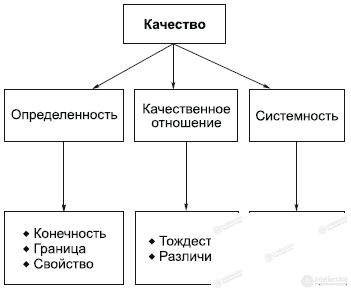
Every phenomenon contains within itself two interconnected attributes – quality and quantity.
The study of quality begins with the fact that the determinacy of a material object, its distinctness from others, its specificity, is reflected and fixed. An examination of an object shows that it has a boundary. Every object differs from other objects and at the same time is interconnected with them. Every distinction, every interconnection presupposes a boundary: if objects have no boundary, then they are indistinguishable from one another and, moreover, cannot be interconnected (if there is no common boundary). Furthermore, since an object has a boundary, it is finite.
In the finitude of an object the contradictory character of its existence is manifested. A boundary simultaneously separates objects from one another and connects them with one another; a boundary characterizes the being of an object, its existence, and, on the other hand, its non-being, its negation. The point is that a finite object cannot be understood as something absolutely unchanging. Everything finite has an internal and external ground for a transition into something else, for going beyond the boundary.
An object, as something determinate, bounded, finite, on the one hand exists as something independent, and on the other hand it exists in interconnection with other objects. In the interaction of an object with other objects, its inner content is manifested. The next aspect of the qualitative determinacy of an object to be manifested is property.
Property – is the capacity of an object, in interacting with other objects, to give rise to certain changes in them and itself to change under their influence. A property has a twofold conditioning: by the internal content of the object and by the character of those objects with which it interacts. An object manifests a multitude of properties in its various interactions with other objects.
If at first the quality of an object appears as the sum of its properties, then, on a more profound approach, it is discovered that the object is a system possessing a definite content and form, that is, it consists of a certain totality of elements and has a certain structure.
The concept of an element denotes certain parts, limiting in a given respect, of which an object consists. One can speak of an element only in a given respect, since in another respect the element itself will represent a system consisting of elements of another level. The concept of structure reflects and signifies the manner of connection of the elements of a material object, their relations within the given whole.
The content of the attribute «quality» includes two aspects: determinacy and systematicity. Systematicity – as the internal aspect, the ground of determinacy. In turn, determinacy is characterized by the moments «boundary», «finitude», «property», while systematicity is characterized by the moments «element» and «structure».
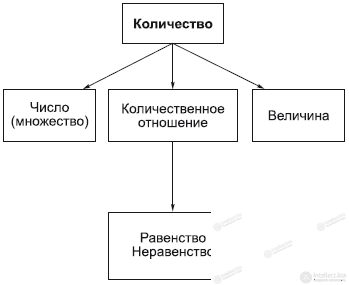
Just as the category of quality reflects a number of aspects of a material object, the category of quantity likewise reflects its «own» moments, which must be identified and characterized. The experience of the history of philosophy and mathematics gives sufficient grounds to single out number (multiplicity) and magnitude as the moments of quantity.
Number, as a moment of the category of quantity, was apparently singled out earlier than magnitude. At the basis of the concept of number lies practical activity: counting, operations on numbers (addition, subtraction, and so on). In the course of counting, an identification of the objects being counted takes place, an abstraction from a number of their qualitative moments. However, this abstraction is relative, since the result of counting is usually expressed by a named number (for example, seven trees, nine thousand rubles, and so on). On the basis of the operation of counting, ordinal numbers arose first (first, second, and so on), and then cardinal numbers (one, two, and so on). The concept of the natural series of numbers was formed. The natural numbers were the original kind of numbers. Then, as a result of the use of the operations of subtraction, division and others, new kinds of numbers arose: the ring of integers, then the field of rational numbers, then the field of real numbers, and finally the field of complex numbers.
The second moment of quantity is magnitude. Every property, every element of an object has a magnitude. Magnitude is characterized by additivity (the magnitude of a certain whole equals the sum of the magnitudes of its constituent parts). If number is characterized by discreteness, then magnitude is characterized by continuity. Both numbers and magnitudes stand in relations of equality and inequality.
Number and magnitude are interconnected. On the one hand, in material objects there are no «pure» magnitudes that could not be represented in the form of some numerical characteristic, while on the other hand there is no «pure» number that would not be connected with some magnitude or with some relation of magnitudes.
Thus, a material object, on its qualitative side, is characterized by determinacy and systematicity, and on its quantitative side, by magnitudes and numbers.

Comments