
Lecture
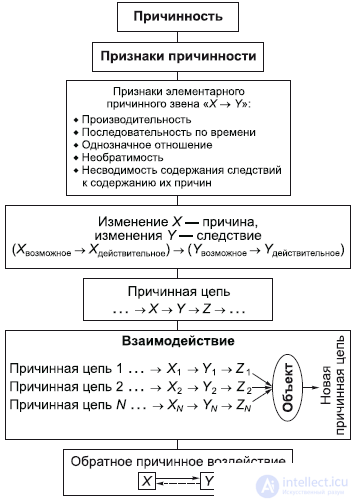
For clarity let us introduce an elementary causal link: (X – Y). Here X – is the cause, Y – is the effect, – the way in which the cause generates the effect. Features of causality:
1) the most important feature of causality is productivity, genetic character.
The cause X produces, generates the effect Y;
2) temporal sequence. The cause X precedes the effect Y. One can «cause» or «generate» only that which did not exist before and then came into being. The time interval between cause and effect may be small, but it is always present. From the fact that a cause precedes an effect, it by no means follows that whatever precedes is always the cause of what follows. For example, day precedes night, which is by no means its cause;
3) unambiguous relation (the principle of the uniformity of nature): one and the same cause under identical conditions produces one and the same effect (for example, identical forces acting on bodies of identical mass produce identical accelerations);
4) asymmetry, irreversibility. The effect of a given cause cannot be the cause of its own cause (if X is the cause of Y, then Y cannot be the cause of X);
5) the irreducibility of the content of effects to the content of their causes. As a result of causal action, something new arises.
An elementary causal link is part of a causal chain, since a given cause is itself the effect of another cause, while its effect is in turn the cause of another effect: … – X – Y – Z – … Detecting causal chains of considerable length is not easy, but it is very important in many cases, for example when analyzing ecological situations.
In the material world there exists not a single causal chain but a multitude of them. The change of an object is determined only in part by another object, but also depends on its own content. There is not only «external» but also «internal» causality.
Real causality appears as the interaction of «external» and «internal» causal factors. In the material world, objects interact. The category of interaction reflects the process of generating reactive causal chains. When one object exerts a causal influence on another, the change in the second produces a reverse effect (a reaction), generating a change in the first object (shown schematically on p. 58).
It must also be kept in mind that there exist both external and internal interactions within an object. The disclosure of the details of interaction turns out to be the final step in disclosing the content of the essence of an object.

Comments