
Lecture
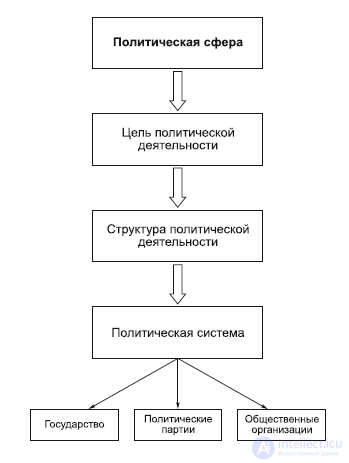
The Greek word «politike» is translated as the art of governing the state. In a broader sense of the word, politics is the sphere of people's life and activity connected with the relations among people united into social groups, classes, nations, and countries. These relations are regulated by special institutions, agencies, and organizations which, taken together, make up the political system of society. Its elements are the state, political parties, and public organizations that take part in the political life of society. Political relations take shape and manifest themselves in the activity of these elements of the political system of society.
Political institutions and organizations, in their activity, strive to realize particular political ideas and conceptions. The structure of political activity includes:
The primary, determining aspect of politics is relations among social groups regarding power:
• In whose hands is power in society?
• Whose interests does this power protect?
• How is the governance of society carried out?
Power in itself is the ability to influence people and control their actions. The goal of political activity is above all – to gain and hold power. But political activity is not reducible solely to the conquest and retention of power. It is directed at satisfying the needs of society, preserving and improving the social structure, combining the interests of various social groups, and defending and realizing the interests of a given society in relation to other societies (for example, defending the interests of a country's population on the international stage). Special institutions are used to maintain public order, which regulate social relations by means of material force and on the basis of certain rules. Let us examine the elements of the political system of society.
Any social phenomenon can be deeply understood when it is examined in the process of its emergence, change, and development, when the causes of this phenomenon are clarified. In accordance with this premise, let us turn to a characterization of the state.
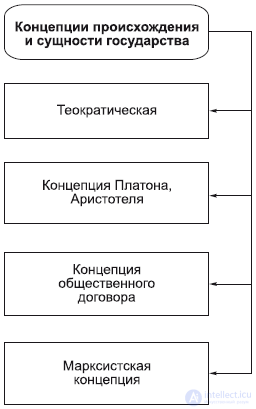
There are various conceptions of the origin and essence of the state. One of the oldest is the theocratic conception, which held that the state arose by divine institution. Thus, even in Ancient Egypt, the priests taught that the first pharaoh was the god Osiris, who taught people all the crafts, established the state, and gave people laws. The theocratic conception was one of the principal links of Christian ideology.
In ancient philosophy, attention is drawn to the conceptions of the state held by Plato and Aristotle. Plato drew an analogy between the three aspects of the soul (rational, spirited, and appetitive) and the three necessary classes in society (rulers, warrior-guardians, and workers). On the basis of this analogy, he asserted the necessity of society being governed by a specific group of persons. Aristotle constructed a historical sequence: family – village – state. The first type of power in the state – monarchical power – was a continuation of the power of the head, the patriarch, in the family.
In the philosophy of the modern era, the conception of the social contract was widely disseminated. According to this conception, humanity originally had a certain «state of nature,» when there was no state. In this state, people's lives were endangered (a «war of all against all,» according to Hobbes). To avoid disorder, people decided to create a state and concluded a social contract. According to this contract, in order to limit the negative manifestations of human nature, state power was created, which, according to Locke, consists of three parts: legislative, executive, and judicial power. Government is based on laws. Democracy is government by laws. The state must serve the people, and if it fails to do so, then, as Rousseau said, it must be replaced by another. Locke promoted the idea of majority rule; J. S. Mill added to this the condition of protecting the minority from possible tyranny by the majority.
The Marxist conception of the state proceeds from the premise that there was no state in primitive society. But this by no means means that people's lives there were somehow chaotic and unorganized. The clan, the tribe, the tribal union was headed by people performing certain social functions – organizing joint work, providing defense, and overseeing the maintenance of customs. The state emerged together with the stratification of society into classes, with the emergence of private property, and with the division of labor. As the division of labor (mental and physical) proceeded, a special social group took shape, laying claim to the leadership of society and demanding – and receiving – corresponding compensation for this. The need arose for an institution that would protect private property. This institution became the state. It was meant to protect the propertied from the propertyless, above all the interests of slaveholders against slaves.
The state represents, historically, that form of organization of society by means of which the ruling class realizes its interests, above all its economic interests (the protection and consolidation of a particular economic order of class society, of a particular system of relations of production). In addition, the state regulates relations among classes and among members of classes, regulates family, ethnic, and national relations, establishes a certain order and sees to its observance, and resolves a number of cultural tasks.
Within the state, law is established. Law is a system of universally binding norms in which the will of the state is expressed and whose fulfillment is guaranteed by the state.
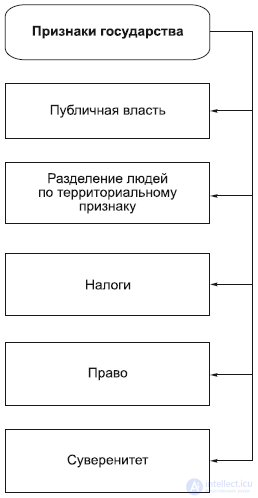
The state organization of society is characterized by the following basic features.
The state and the country should not be confused. By country, one naturally understands a certain territory inhabited by people, by some nation. But the state is the political organization of society, a system of agencies, institutions, and organizations that carry out governing functions on the territory of a particular country with its population.
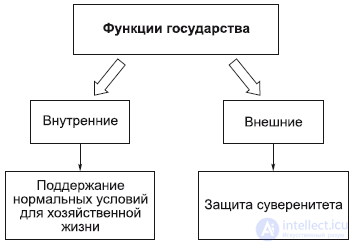
The principal directions of the state's activity are called its functions. Two functions are distinguished: internal and external. The internal function of the state consists above all in maintaining normal conditions for economic life. Since economic inequality gives rise to the struggle of classes and social groups, the state must in a certain manner achieve a balance of opposing forces; sometimes coercion and violence are used for this purpose (for example, banning strikes). But economic and political coercion alone is not enough. The state exerts a spiritual, ideological influence on the population. For this, the education system, a gigantic propaganda machine, art, the church, and so on, are used. Public opinion is worked upon in the direction desired by the authorities. Here it must be noted that propaganda influences people only if it does not stand in complete contradiction with life. Propaganda will show what exists, but only what is useful to the state, not the whole panorama of reality.
One should not think that the internal function of the state is reducible only to coercion and suppression. Any state performs a number of economic and social tasks, regulates people's behavior, protects public order, and so on.
The external function of the state consists above all in the defense of sovereignty. But not only that. The foreign policy of the state is conditioned by the economic order of the given society and is a continuation of the state's internal policy. An internal policy in which the suppression of oppressed classes comes to the fore is supplemented by an aggressive foreign policy; the intensification of exploitation is accompanied by a foreign policy directed at aggression against other states. War and the threat of war are traditionally methods of the foreign policy of exploiting states. But in addition, the state carries out foreign economic, political, and cultural ties with other states, regulates the movement of citizens to other states, and so on. Diplomacy, intelligence, and counterintelligence occupy an important place in the state's performance of its external function.
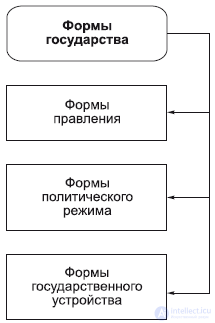
Forms of the state are distinguished. By forms of the state are understood:
There also exist confederations, in which an agreement on joint activity in a number of areas is reached between states, while the sovereignty of these states is preserved.
Today much is said about the need to develop democracy, to create guarantees against the usurpation of power, to include working people in the governance of the country, to take into account the interests of all social groups, classes, and nations, and to develop social self-government. These are good calls. But the task of eliminating the gap between word and deed remains urgent. It seems that no one speaks out against the creation of a genuine rule-of-law state among us (at least not publicly). But the establishment of a rule-of-law state is impossible without the development of social self-government, and self-government is incompatible with the bureaucratic apparatus in the form and to the extent that it exists now. A reform of the state is necessary.
In their social life and activity, people adhere to certain norms and rules of behavior. These norms and rules arise, change, and die out with the development of society.
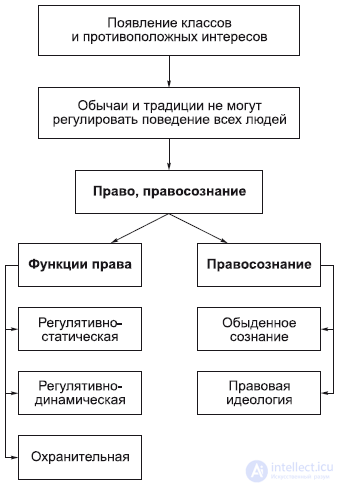
In pre-class society, the behavior of members of the clan and tribe was regulated by customs and traditions passed down from generation to generation. They determined what could and could not be done, what was good and what was bad, and expressed common interests. The fulfillment of norms and rules of behavior was ensured by the whole collective, and violations of them were rare. Such regulation of social relations is possible for a society that did not know the opposition of class interests.
When society split into classes, when opposing interests took shape, customs and traditions could no longer regulate the behavior of all people. The concepts of good and bad, useful and harmful, just and unjust became different among representatives of different classes.
With the emergence of private property, classes, and the state, law arises. In place of customs and traditions came law as compulsory, obligatory norms of people's behavior, established by the state and expressing the will of the economically and politically dominant class.
Since an important purpose of law was the protection of private property, it was precisely with this that the most cruel laws of antiquity were connected (for example, the laws of Draco in Athens).
From the point of view of Marxism, law is the will of the ruling class raised to the status of statute.
Law is a product of the historical development of society, and it itself changes. Legal norms took shape in the history of society in two ways: through the transformation of primitive customs and traditions into legal norms, and through the lawmaking of state organs. The formation of law led to the emergence in society of a new kind of relations – legal relations. The participants in legal relations act as subjects – bearers of rights and legal obligations.
Law and legal relations in specific historical types of society correspond to a particular economic base. Thus, in slaveholding society, slaves are not subjects of law. A slave is merely protected by law as the property of the slaveholder, like other objects of property. In feudal society, law consolidates the feudal lords' ownership of land and the dependence of direct producers on them (the most severe form of this dependence being serfdom). Feudal law legally consolidates the inequality of different estates before the law.
In the legal norms of the state (in constitutions and other acts), the economic, political, and other equality or inequality of people and social groups is consolidated, and their interests and will are expressed through the establishment of the rights and obligations of people and social groups.
Law performs the following functions:
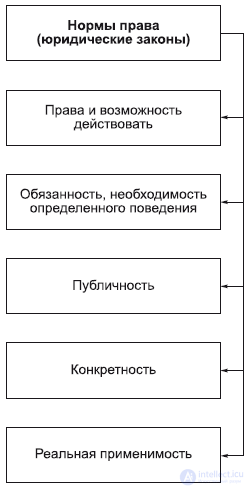
Legal norms, on the one hand, grant people rights and opportunities to act in a certain way, and on the other – impose on people obligations, the necessity of certain conduct. Law determines the measure of an individual's social freedom and at the same time limits and regulates the normatively obligatory elements of social activity.
Legal norms and statutes must satisfy certain requirements. It is not without interest to cite the opinion of V. S. Solovyov on this matter.
«Three distinguishing features of a law:
1) its publicity – a decree not made known to general knowledge cannot therefore have the force of law;
2) its concreteness – a law expresses the norm of actual living relations in a given social milieu, and not some abstract truths and ideals, and
3) its real applicability, or practical enforceability in each individual case, for the sake of which a so-called sanction is always attached to it, that is, the threat of coercive and punitive measures – in case of non-fulfillment of its requirements or violation of its prohibitions»[21].
Within the state there are special institutions that draft and issue laws (legislative organs), monitor their fulfillment (the prosecutor's office), punish their violation (courts, law-enforcement agencies), and maintain the public order approved by law. Within the state there exist civil, criminal, labor, family, international, and other branches of law, and codes of laws (codices) are created.
Law, and the legal activity of institutions connected with it, is reflected and made conscious by a special form of social consciousness – legal consciousness. Legal consciousness operates with such concepts as justice, legality, public order, crime, and punishment.
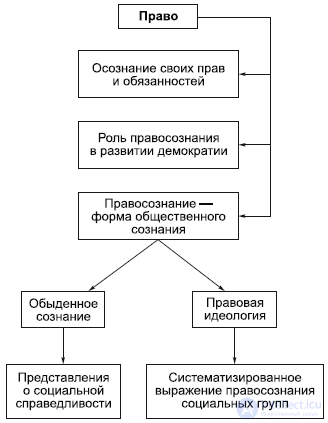
Law and legal consciousness are interrelated. When the state establishes legal norms, it strives, through education, to form in society a legal consciousness corresponding to the established law. But on the other hand, in establishing new legal norms, the state must take into account already existing traditions, morality, law, and legal consciousness.
Within legal consciousness there is everyday consciousness and legal ideology. Everyday legal consciousness is based on the notion of social justice. From this point of view, it evaluates legal norms and the legal activity of legislative, executive, and judicial bodies. It is characteristic that everyday consciousness usually supports the idea of order in society.
Legal ideology is the systematized expression of the legal consciousness of social groups. It theoretically substantiates the equality or inequality of people in society, the rights and duties of people and social groups, and explains what freedom and justice are. Legal ideology substantiates the purpose of legal relations, norms, and institutions, the structure and functions of legislation, the courts and the procuracy, and so on. Legal ideology sets itself the goal of defending or establishing a legal order (legal relations) corresponding to the interests of a particular social group.
The level of legal consciousness plays an important role in the life of society. Being aware of their rights, a person must also be aware of their duties, of what is permitted and what is forbidden, and must also be aware that everyone else has rights that must be recognized. Legal order links people to one another; it represents a system of mutually recognized rights and duties. Legal consciousness is a kind of spiritual discipline, a sense of responsibility, and a sense of proportion in all social manifestations of human activity.
A rule-of-law state presupposes correspondence between word and deed, between norms and actual legal practice, and the unambiguous operation of laws. It is necessary to develop legal consciousness. Genuine democracy is impossible unless every person fully understands their rights and duties, has formed ideas about justice and legality, and understands the nature of legal relations and the specifics of the work of legal institutions and their competence. Democracy presupposes not only legal literacy but also the real participation of citizens in social relations, in self-government. Democracy presupposes, further, not only a developed legal consciousness but also discipline, based not on coercion but on the conscious observance of legal norms, since they express the will of the people, correspond to the interests of the people, and thereby to the interests of every individual as well.
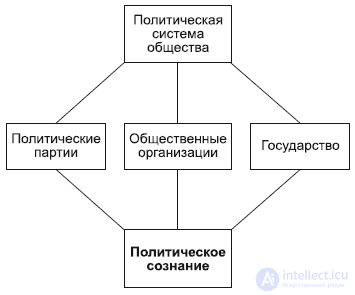
In the political system of society, the state is an important component, but not the only one. The system of political organization of society also includes political parties and public organizations.
Parties are organized groups that formulate, express, and implement the interests of a particular class, nation, or their individual strata. Parties develop the strategy and tactics of the struggle for power, and put forward and propagandize ideals of social life. Theorists and ideologists of parties, carrying out the social mandate of the group whose interests the party expresses, try to prove that only this party is capable of making their country, their people, happy. This is characteristic both of parties in power and of those striving for power.
In totalitarian political regimes there is usually one ruling party; if others are permitted, they do not play a real, independent role on the political arena. In democratic states, multi-party systems exist. A multi-party system is based on the fact that different social groups have different goals and ideals; even if the goal is the same, different means and methods of achieving it are assumed.
Alongside the state and the parties, the political system also includes various public organizations. They are created both among the dominant and among the subordinate strata of society. Examples of the former, defending the interests of the ruling classes, in feudal society were noble unions and church organizations; in capitalist society – unions of industrialists, large farmers, and so on. As the class consciousness of working people grows, they too create public organizations to defend their interests. In capitalist society, these are primarily trade unions. Their main goal is to organize the working class's struggle to improve its economic and social position. In addition, there are public organizations that unite people of the same profession or shared interests in leisure activities, and so on (creative, youth, women's, pacifist, environmental, etc.).
Public organizations and their activity may be either political or non-political in character, although the boundary between them is rather indefinite and permeable. Thus, in our country, church organizations would seem to be non-political, but in fact they become involved in political activity, participating in various state affairs, approving or condemning particular political situations, and so on.
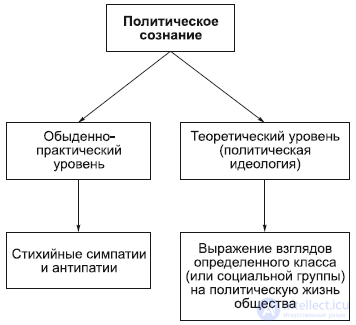
Political consciousness is a reflection of the socio-class structure of society and of political activity. The emergence of political consciousness is directly connected with the emergence of politics, political relations, and political organizations in class society. Political consciousness also indirectly reflects economic relations in society: the economic relations of social groups find their continuation in political relations, and then – in political consciousness.
Political consciousness has two levels: the everyday and the theoretical. At the everyday-practical level are feelings, moods, sympathies and antipathies, illusions, hopes, and so on, generated by politics (for example, feelings of hostility or friendship toward particular social groups, political figures, and so on). Everyday consciousness arises spontaneously, on the basis of people's practical activity and the influence of their immediate environment. In everyday consciousness, on the one hand, the influence of stereotypes and traditions is strong, while on the other hand, it is characterized by instability and dependence on changing immediate experience.
At the ideological-theoretical level – there is the theoretical expression of the views of a particular class (or social group) on the political life of society, on the relations between classes, nations, and so on. Political consciousness formulates the goals and tasks pursued by political actors in their struggle for their interests. Political ideology substantiates and directs the internal and external policy of states, determines the goals and tasks of classes, the strategy and tactics of parties, and a system of views not only on present-day reality but also on the prospects of social development. The form of expression of political consciousness is the programs and charters of parties, the constitutions of states, the theoretical statements of ideologists, political figures, and so on.
Political ideology is the most important weapon in the struggle for political power, in defending, substantiating, and strengthening a particular social order and its economic foundations. Each ideology has its own organization, its own type of propaganda, and other forms of ideological influence on the masses. In doing so, conscious manipulation of public opinion often occurs, when, under the guise of the pressing interests of the masses or of particular social groups, alien and even directly opposite interests are implanted in their consciousness.

Comments