
Lecture
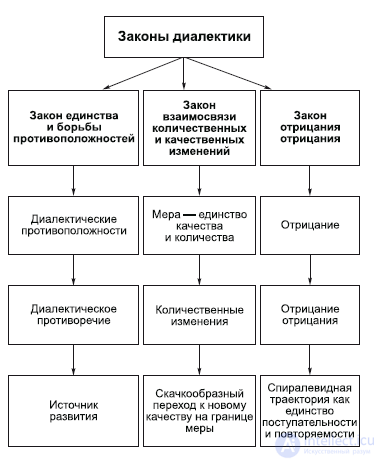
The laws of dialectics are principles that describe and explain development and contradictions in the material and spiritual world. The laws of dialectics were worked out on the basis of the philosophical system of dialectical materialism and are the fundamental principles underlying Marxist philosophy. There are several basic laws of dialectics:
The law of the unity and struggle of opposites: It asserts that all phenomena and processes contain within themselves interconnected and contradictory opposites, which are the source of development and change.
The law of the transition of quantitative changes into qualitative ones: This law asserts that the accumulation of quantitative changes leads to a leap-like transition of the system to a new qualitative level.
The law of the negation of the negation: It asserts that development is a process in which the new arises out of the old through the negation and overcoming of contradictions.
Already within the framework of the mythological worldview, and later in the philosophy of the Ancient world, the idea was advanced that changes in the world are connected with the struggle of opposing forces. As philosophy developed, the recognition or denial of objective contradictions became one of the most important features distinguishing dialectics from metaphysics. Metaphysics does not see objective contradictions, and if they appear in thought, this is taken as a sign of error, of a mistake.
Of course, if objects are considered outside their interconnection, statically, then we will see no contradictions at all. But as soon as we begin to consider objects in their interconnections, in motion, in development, we discover objective contradictoriness. Hegel, to whom belongs the credit for the theoretical grounding of the laws of dialectics, wrote that contradiction «is the root of all movement and vitality; it is only insofar as something has a contradiction within itself that it moves, has impulse and activity» .
We use the concepts «opposite» and«contradiction». But what do they mean? Marx wrote that dialectical opposites are «correlative, mutually conditioning, inseparable moments, but at the same time mutually exclusive… extremes, that is, poles of one and the same thing» . To clarify, let us consider the following example. From point 0, objects move in opposite directions (+x and –x). When we speak of opposite directions, we mean that:
1) these two directions mutually presuppose one another (if there is motion in the direction +x, then motion in the direction –x necessarily exists as well);
2) these directions mutually exclude one another (motion of an object in the direction +x excludes its simultaneous motion in the direction –x, and vice versa);
3) +x and -x are identical as directions (it is clear that, for example, +5 km and -5 km are opposites, whereas +5 kg and -5 km are not opposites, since they differ in kind).
Dialectical contradiction presupposes opposites. Opposites in a dialectical contradiction do not merely coexist simultaneously, are not merely somehow interconnected, but act upon one another. Dialectical contradiction is the interaction of opposites.
The interaction of opposites creates within objects an inner «tension», a «struggle», an inner «restlessness». The interaction of opposites determines the specificity of the object and predetermines the object's tendency toward development.
Sooner or later a dialectical contradiction is resolved either by the «victory» of one of the opposites in the conflict situation, or by a smoothing of the sharpness of the contradiction, by the disappearance of the given contradiction. As a result, the object passes into a new qualitative state with new opposites and contradictions.
The law of the unity and struggle of opposites: all objects contain within themselves opposite sides; the interaction of opposites (dialectical contradiction) determines the specificity of their content and is the cause of the development of objects.
The law of the unity and struggle of opposites has wide application in various fields of human activity. Here are a few examples of the practical application of this law:
Politics: In politics, the law of the unity and struggle of opposites is reflected in the confrontation between various political forces, ideologies, and interests. Changes in the political sphere often occur as a result of the struggle between different political forces expressing different interests and opposing views.
Economics: In economics, the law of the unity and struggle of opposites manifests itself in the contradictions between various economic systems, classes, market forces, and the interests of different groups. The struggle between capitalism and socialism is an example of such opposition and interaction.
Science: In scientific research, the law of the unity and struggle of opposites helps in understanding the development of scientific theories. Contradictions and discussions among scientists spur the development of new ideas and concepts, which contributes to the progress of scientific knowledge.
Culture and art: In culture and art, the law of the unity and struggle of opposites is reflected in the contradictions between various cultures, styles, movements, and artistic conceptions. Interesting and progressive creative ideas can arise through dialogue and struggle between different cultural and artistic currents.
These are just a few examples of how the law of the unity and struggle of opposites is applied in practice. It helps to understand and explain development and contradictions in various spheres of human activity and can serve as a basis for the development of new ideas and concepts.
Material objects undergo quantitative and qualitative changes. The category of measure reflects the unity of quality and quantity, consisting in the existence of a certain limited interval of quantitative change within which a definite quality is preserved. Thus, for example, the measure of liquid water is the unity of a certain qualitative state of it (in the form of di- and trihydrols) with a temperature interval from 0 to 100 °C (at normal pressure). Measure is not simply some quantitative interval, but the interconnection of a definite interval of quantitative change with a definite quality.
Measure underlies the law of the interconnection of quantitative and qualitative changes. This law answers the question of how development occurs: quantitative changes, at a certain stage, at the boundary of the measure, lead to qualitative changes in the object; the transition to a new quality has a leap-like character. The new quality will be connected with a new interval of quantitative changes; in other words, there will be a measure as the unity of the new quality with new quantitative characteristics.
A leap represents a break in the continuity of the change of an object. Leaps, as qualitative changes, can occur both in the form of one-time «explosive» processes and in the form of multi-stage processes.
Development occurs as the negation of the old by the new. The concept of negation has two meanings. The first is logical negation, an operation whereby one statement negates another (if the statement P is true, then its negation not-P will be false, and conversely, if P is false, not-P will be true). The other meaning is dialectical negation as the transition of an object into something else (another state, another object, the disappearance of the given object).
The law of the transition of quantitative changes into qualitative ones has important practical applications in various fields. Here are a few examples:
Science and research: In scientific research, the law of the transition of quantitative changes into qualitative ones helps in understanding progress and development. The accumulation of small quantitative changes can lead to a breaking point, when a system or phenomenon moves to a new level of quality. For example, in physics, a change in the energy of a system can lead to phase transitions or a change in the state of matter.
Technology and innovation: In the field of technology and innovation, the law of the transition of quantitative changes into qualitative ones plays an important role. Small improvements and incremental changes can lead to a point at which a new technology or innovation arises, substantially changing the ways people work and live. For example, gradual improvements in computer processors lead to a leap-like increase in their performance and capabilities.
Education and self-development: In education and the process of self-development, the law of the transition of quantitative changes into qualitative ones helps one understand that gradual effort and continuous learning can lead to a qualitative transformation of knowledge and skills. Gradual improvement and assimilation of new knowledge and skills can lead to a moment when there is a leap in understanding and level of competence.
Social change and progress: In social change, the law of the transition of quantitative changes into qualitative ones can be applied to understand progressive transformations and transitions. Small changes in society, such as social movements or a gradual change in social values, can lead to a qualitative shift and transformation in the system of social relations and structures.
On the whole, the law of the transition of quantitative changes into qualitative ones describes the nonlinearity and dynamics of development in various fields. It indicates that small changes can accumulate over time and lead to qualitatively new states, phenomena, or systems.
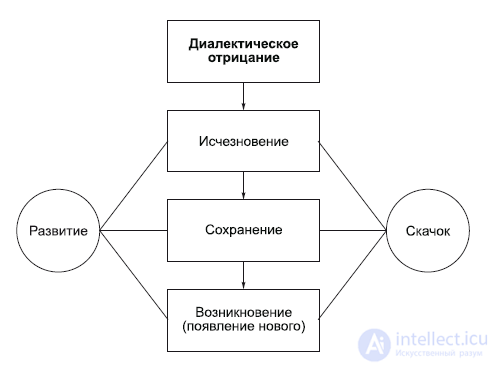
Dialectical negation should not be understood merely as destruction, as the annihilation of an object. Dialectical negation includes three sides: disappearance, preservation, and emergence (the appearance of the new).
Every material object, by virtue of its contradictoriness, is sooner or later negated, passes into something else, something new. But this new thing, in turn, is also negated, passes into something else. The process of development can be characterized as «the negation of the negation». The meaning of «the negation of the negation» is not reducible to a simple sequence of negations. Let us take Hegel's example: grain—stalk—ear. Here the negations proceed as a natural process (unlike, say, the case of: grain—stalk—mechanical damage to the stalk).
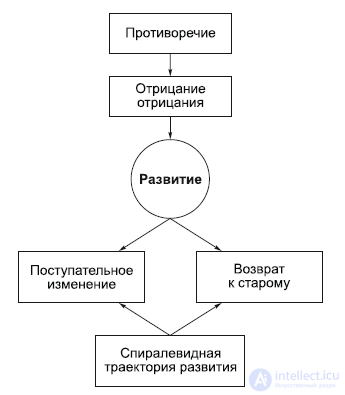
What, then, is revealed in the negation of the negation, when a natural process is underway? First, the preservation of elements of the old together with the appearance of the new determines the progressive character of the process of the negation of the negation. But it would be an oversimplification to regard the development of an object as a rectilinear, progressive change. Alongside progressiveness, there is, in the process of development, repeatability, cyclicity, a tendency to return to the old state. This situation is reflected in the law of the negation of the negation. Let us give a formulation of this law: in the process of development (the negation of the negation) two tendencies objectively exist—that of progressive change and that of return to the old; the unity of these tendencies determines the «spiral-like» trajectory of development. (If progressiveness is depicted as a vector, and the return to the old as a circle, then their unity takes the form of a spiral.)
The result of the negation of the negation, while completing a certain «turn of the spiral», is at the same time the starting position for further development, for a new «turn of the spiral». The process of development is unlimited; there cannot be some final negation after which development ceases.
In answering the question of where development is heading, the law of the negation of the negation at the same time expresses a complex, integral process that may not be discernible over small time intervals. This circumstance is a basis for doubts about the universality of this law. But such doubts are removed if one traces sufficiently large intervals in the development of material systems.
The law of the negation of the negation, also known as the law of double negation, has its own practical application in various fields. Here are a few examples:
Philosophy and science: In philosophy and science, the law of the negation of the negation is applied to the development of theories and concepts. It presupposes that the negation of some assertion or concept can lead to the overcoming of contradictions and the development of new ideas. For example, in science, if an existing theory proves insufficient or untenable for explaining observed facts, this can lead to the negation of that theory and the search for new explanations and models.
Innovation and technology: The law of the negation of the negation is applied in the process of innovation and the development of new technologies. Abandoning old methods and ideas that have proved ineffective or outdated can lead to the emergence of new and improved solutions. The application of this law makes it possible to open up new paths and opportunities for development and progress.
Personal growth and self-improvement: The law of the negation of the negation can be applied at the individual level for personal growth and self-improvement. The negation of the negation in this context means the reconsideration and overcoming of negative beliefs, habits, and limitations. By negating the negative aspects of one's personality and viewing them as opportunities for change and growth, a person can achieve personal transformation and development.
Development of society: The law of the negation of the negation can also be applied to the development of society. By recognizing and overcoming the errors and shortcomings of past historical experience, society can move forward, striving toward a better future. This can include revising political, economic, and social systems, overcoming inequality, and adopting new approaches to the development and well-being of all members of society.
On the whole, the law of the negation of the negation is applied in various spheres to stimulate progress, development, and the search for new solutions. It implies openness to change, flexibility of thought, and a striving for constant improvement.
Let us sum up some results. A material object represents a unity of appearance and essence. Appearance includes the attributes of quality and quantity, space and time, motion; essence includes the attributes of law, actuality and possibility, necessity and chance, causality and interaction. The attributive understanding of matter is continued in the dialectical conception of development.
These laws of dialectics help explain and analyze the development of the material and spiritual world, social processes and contradictions. They serve as the basis for understanding dialectical logic and methodology, which are applied in philosophy, science, and the social sciences.

Comments