
Lecture
The system of philosophical knowledge began to take shape as far back as antiquity. In the 4th century BC, the Stoics developed a scheme that, with some adjustments, remains relevant today: philosophy takes its origin from logic, followed by physics as the study of nature, and then – ethics as the study of the human being and the paths to a wise and meaningful life.
In the 17th century, increased attention was paid to epistemology – the theory of knowledge. In the understanding of that century, this science was broader than logic, since it considered, alongside the abstract-theoretical level, the sensory level of cognition (sensation, perception, representation). Ontology arises separately from physics, and the term «physics» itself acquires a completely different meaning in connection with the formation of special-scientific, experimental knowledge.
In the modern era, a substantial restructuring of the framework of philosophical knowledge takes place. In his «Critique of the Power of Judgment», Kant identifies three parts of philosophy and correlates them with three «faculties of the soul», namely the cognitive, the practical (desire, will), and the aesthetic faculties, which are inherent in a person from birth. In this way, Kant presents philosophy as the doctrine of the unity of truth, goodness, and beauty, which significantly broadens the interpretation of philosophy as merely a theory and methodology of scientific cognition.
The specificity of philosophical knowledge
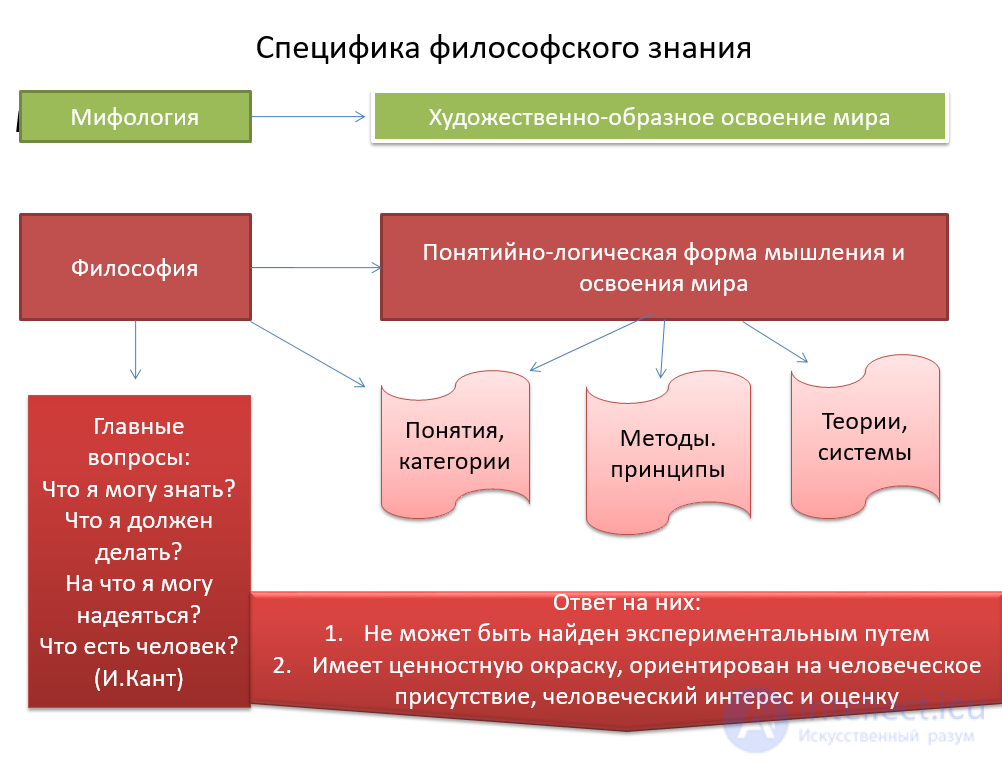
Hegel, for his part, defines his system of philosophy in the form of an «Encyclopedia of the Philosophical Sciences». He distinguishes three areas of philosophy:
The diversity of the areas of philosophical understanding of the world
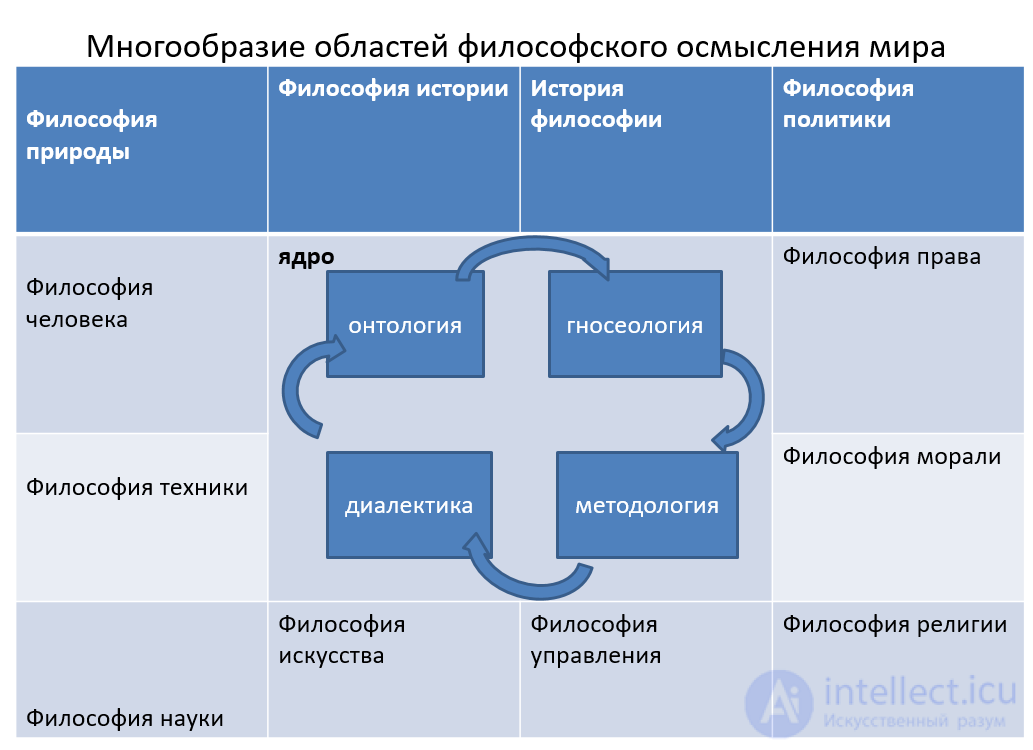
Contemporary philosophical knowledge has a more branched structure. This branching is determined by the spheres of reality that a person can identify and investigate. It is in accordance with these designated spheres that the main branches of philosophy are formed.
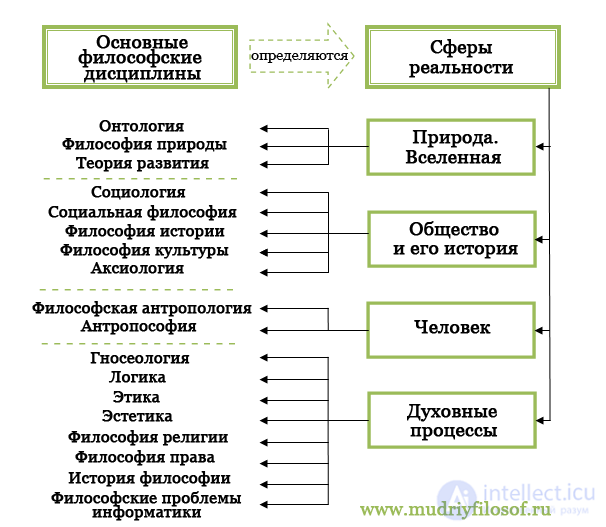
Diagram «The structure of philosophical knowledge»
What, then, is the structure of philosophical knowledge? Below we briefly examine its main elements.
1) Through the understanding of nature and the universe arises ontology (Greek ontos – being, logos – doctrine) as the study of being. Here the problems of being and non-being, material and ideal being, and the being of nature, society, and man are examined.
Philosophy of nature (natural philosophy) is a variety of ontology. The main focus is on what natural being and nature as a whole are.
The theory of development – the doctrine of the universal laws of the movement and development of nature, society, and thought.
2) The philosophical understanding of history and society as a whole forms the following disciplines: sociology, social philosophy, philosophy of history, philosophy of culture, and axiology.
Sociology is a doctrine of the facts and forms of social life (social systems, forms of communities, institutions, processes).
Social philosophy studies society in the interaction of all its aspects, and the regularities of its emergence, formation, and development. Various social processes and phenomena are examined at the macro level, the level of society as a whole as an independent, self-developing system. The main problems addressed by social philosophy are: interaction between different societies; social relations in the process of people's practical activity; the objective interests and needs of society and of the individual; and the motives and goals of a person's activity within a given society.
The subject of the philosophy of history is the determination of the regularities of the historical process, and the identification of the meaning and direction of the movement of human history.
The philosophy of culture investigates the specific character of the emergence and formation of cultural processes, the essence and significance of culture, and the regularities and features of cultural-historical progress.
Axiology is the philosophical doctrine of values and their nature (from Greek axios – value and logos — doctrine), of their place in reality, and of their interrelation with one another and with various cultural and social factors, as well as with the structure of personality.
3) The philosophical understanding of the human being singles out the following elements of philosophical knowledge: philosophical anthropology and anthroposophy
Philosophical anthropology investigates one of the most important problems of philosophy – the problem of man: identifying his essence, analyzing the historical forms of his activity, and disclosing the historical forms of his being. The main range of problems includes: the natural, social, and spiritual factors of human development; essence and existence, man in relation to the universe, the conscious and the unconscious, the individual and the person, and so on. Anthroposophy is specifically concerned with grasping the meaning of the emergence and life of man.
4) Through the study of spiritual life the following complex of philosophical sciences arises: epistemology, logic, ethics, aesthetics, philosophy of religion, philosophy of law, history of philosophy, and philosophical problems of computer science.
Epistemology (gnoseology) is the doctrine of knowledge (gnosis – knowledge, logos – doctrine). The main questions are: the interrelation of subject-object relations in cognition; the sensory and the rational in the process of cognition; problems of truth; the empirical and theoretical levels of cognition; the method of cognition, its means and regularities; and the criteria of the truth of cognition.
Logic is the doctrine of the forms of thought. The object of the study of ethics is morality. Aesthetics determines the regularities of the artistic reflection of reality by human beings, the essence and forms of the transformation of life according to the laws of beauty, and studies the nature of art and its significance in the development of society.
The philosophy of religion determines a particular religious picture of the world and analyzes the causes of the origin of religion and of various religious movements and trends.
Philosophy of law investigates the foundations of legal norms and the human need for lawmaking.
History of philosophy studies the emergence and development of philosophical thought, specific philosophical conceptions, schools, and trends, and also determines the prospects for the development of philosophy.
The philosophical problems of computer science are a special component in the system of philosophical knowledge, representing the knowledge and research of modern means and methods of understanding the world.
As we can see, philosophy represents a multicomponent structure; however, its individual disciplines are not mechanical parts of a whole and cannot be separated from one another and considered in isolation, but only together with all the other elements. Thus, philosophy is a rather complex and heterogeneous formation, consisting of a set of individual disciplines each with its own specificity. However, philosophy cannot be reduced solely to science, since it is akin to art, shaping not only the mind but also the feelings of a person.

Comments