
Lecture
Schizoanalysis ( or ecosophy , pragmatics , micropolitics , rhizomatics or nomadology ) ( French . schizoanalyse ; schizo- from the Greek σχίζειν skhizein , meaning «to split») — is a set of theories and techniques developed by the philosopher Gilles Deleuze and the psychoanalyst Félix Guattari , first set out in their book «Anti-Oedipus» (1972) and continued in their subsequent work «A Thousand Plateaus» (1980).
The schizoanalysis of Deleuze and Guattari is a complex and philosophical approach that examines various aspects of mental disorders, including social, political and economic factors. It has its supporters and critics and is the subject of academic discussion and research.
the aim of schizoanalysis: to analyze the specific nature of libidinal investments in the economic and political spheres and thereby show how, in the desiring subject, desire can desire its own repression — hence the role of the death instinct in the chain linking desire to the social field . [...] Schizoanalysis is at once a transcendental and a materialist analysis .
— Deleuze and Guattari
The practice acquires many different definitions in the course of its development in their joint work and individually in Guattari's own writings.
In his work «Chaosmosis» Guattari explains that «instead of moving in the direction of reductionist modifications that simplify the complex», schizoanalysis «will work in the direction of its complexification, its processual enrichment, toward the coherence of its virtual lines of bifurcation and differentiation, in short, toward its ontological heterogeneity ».
Schizoanalysis [...] has no other meaning: to make a rhizome .
— Deleuze and Guattari
Schizoanalysis was developed by Guattari as a response to the shortcomings of French psychoanalytic practice and as the culmination of his work with institutional psychotherapy at the La Borde clinic . Guattari came directly up against the use of the Oedipus complex as the starting point for analysis and against the authoritative position of the psychoanalyst in relation to the patient. Guattari was interested in a practice that could draw from given systems of enunciation and subjective structures new « assemblages [ agencements ] of enunciation», capable of forming new coordinates for analysis and of creating unforeseen propositions and representations from the standpoint of psychosis .
The new materialism takes from Nietzsche the notion that every body or product is a synthesis of forces, a sign or symptom of a mode of existence. Desire is never something lacking, forbidden, or signified: desire is a force of synthesis that constructs an assemblage in order to increase its capacity to act.
— Philip Goodchild
Later Deleuze broke away from this framework, declaring that «we no longer want to speak of schizoanalysis, because that would mean defending a certain kind of escape , a schizophrenic escape».
Thus schizoanalysis is a form of social analysis in accordance with abstract machines, lines of flight or deterritorialization, regimes of signs, the stratification of molecular elements or their destratification, and planes of consistency. It maps the social unconscious according to its movements and the intensities of desires. [...] so that lines of experimentation or becoming can be constructed by reassembling the abstract machines that lie between the strata and produce them.
— Philip Goodchild
Deleuze and Guattari write in the fourth chapter of «Anti-Oedipus» , «Introduction to schizoanalysis», that in essence schizoanalysis asks: «What are your desiring-machines , what do you put into these machines, what is the output, how do they work? , what are your nonhuman sexes?».
Deleuze and Guattari develop four theses of schizoanalysis:
The schizoanalyst is a mechanic , and schizoanalysis is exclusively functional. [...] Analysis must concern itself exclusively with [...] machinic mechanisms, grasped in the context of their molecular dispersion. [...] every partial object emits a flow [into a field of multiplicity ] [...] Partial objects are the immediate forces of the body without organs , and the body without organs is the raw material for partial objects . [...] The body without organs is an immanent substance [... connecting] Spinozist [... partial-object-like] attributes [which express its haecceity (primitive thisness) ]
— Deleuze and Guattari
The schizoanalyst is not a deconstructionist ; they grind logos through the partial-object text-machine-subject in order to express the practice of subjugation-by power . Schizoanalysis addresses ressentiment , bringing the neurotic subject into a rhizomatic state of becoming . Schizoanalysis uses psychosis as a figurative-philosophical diagrammatic model, creating abstract machines that go beyond the semiotic simulacrum , creating a reality that does not yet exist. Unlike the psychoanalytic axiom of lack, which generates a core within the core of the subject, schizoanalytic desiring-production of intensities decodes «representative territories» through the self-generation of the subject-becoming-BwO as multiplicity . Desiring production is the virtuality of becoming-intense , becoming-Other . Schizoanalysis deterritorializes and reterritorializes found assemblages through rhizomatic desire-production.
The body without organs — is a central concept of schizoanalysis; Deleuze and Guattari write in «A Thousand Plateaus» that it is «the only practical object of schizoanalysis». It is «unproductive, sterile, unengendered, unconsumable», an unorganized body of vague and disordered desires, which they closely identify with schizophrenia , as well as with masochism and repressed forms of love, and which they compare in «Anti-Oedipus» to a kind of desert. Bodies without organs are produced by the unconscious in desiring-production when it reaches its third, non-productive stage; the body without organs «is produced as a whole, but in its particular place within the process of production, alongside the parts that it neither unifies nor totalizes». Deleuze writes in «The Logic of Sense» (1969) that «the body without organs, without mouth and without anus, having renounced all introjection or projection, and having become complete at such a cost» is « closed off from the full depth without boundaries and without exteriority».
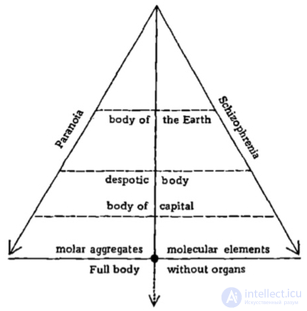
The four ontological dimensions — are concepts within a clinical model of the unconscious, set out in the following scheme:
Territory (the first assemblage to arise upon decoding) — is the social field of deterritorialization and reterritorialization , and flow and type are components of abstract machines. These functors have four circular components that branch off and form rhizomes:
The British philosopher and theorist Nick Land , whose critical writings and experimental texts in the 1990s frequently cited Deleuze and Guattari, wrote that «schizoanalysis shares the delightful irresponsibility of everything anarchic, overwhelming and starkly impersonal». In his 1992 essay «Circuitries» Land described the practice of schizoanalysis as a visionary theory, writing that it «was only possible because we are hurtling toward the first globally integrated insanity: politics is obsolete. Capitalism and schizophrenia have hacked the future, which programs it right down to the punctuation, tying it with imminent inevitability to viral revolution, soft dissolution». Land's later work in the 1990s at the Cybernetic Culture Research Unit also reinterpreted and developed schizoanalysis alongside cybernetics , cyberpunk aesthetics and occultism , most notably in his 1995 essay «Meltdown»:
Machinic synthesis. Deleuzoguattarian schizoanalysis comes from the future. In 1972 it was already engaged in nonlinear nano-engineering; differentiating molecular or neurotropic mechanisms from molar or entropic aggregates of unassembled particles; functional connection from anti-productive stasis. Philosophy is akin to despotism because of its predilection for Platonic-fascist top-down decisions, which always fail spitefully. Schizoanalysis works differently. It avoids ideas and sticks to diagrams: network software for accessing bodies without organs. BwOs, machinic singularities or tractor fields arise through the connection of parts with the whole (rather than with their whole); the organization of composite individuations in a virtual/real circuit.
The Swedish philosophers and futurologists Alexander Bard and Jan Söderqvist build on the schizoanalysis of Deleuze and Guattari in their book «Machines of Loving Grace» (2009), the third and final part of the «Futurica» trilogy (2000-2009), adding Lacan's empty signifier as a supplementary +1 to the properly realized 12+1 structure developed in collaboration with the Royal Institute of Art in Stockholm , as an empty unifier of the soul and a dissolution of social hierarchy. The authors argue that the 12 + 1 model is a psychoanalytic refinement of an otherwise «Kantian, all-too-Kantian» technique of division in psychology. As cultural examples of 12 + 1, they cite the hour before and after twelve o'clock on a clock, Christ as living-present and dead-absent in relation to the twelve apostles in the New Testament , and the ace card as both superior to the king and inferior to the two in a deck of playing cards . In this sense, the socially constructed +1 is nothing other than the subject's name on a passport, understanding capitalist subjectivity as multipolar (twelve being an arbitrary number), akin to the urban intersubjectivities explored in musical theater productions such as Puccini's «La Bohème» and Jonathan Larson's «Rent» .
John Gillespie argues that the writers Amiri Baraka and Frantz Fanon are schizoanalysts through the lens of a critical study of racism (e.g. Black Dada Nihilismus on Dada ).

Comments