
Lecture
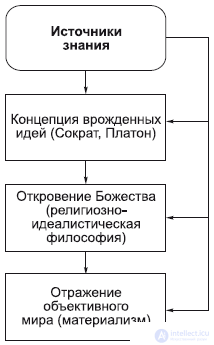
Epistemology (the theory of knowledge) offers a solution to the problems of: what is the source of knowledge, what are the ways of obtaining knowledge, and what are the criteria for establishing its truth. In the history of philosophy several conceptions have been proposed in epistemology; let us point out the main ones.
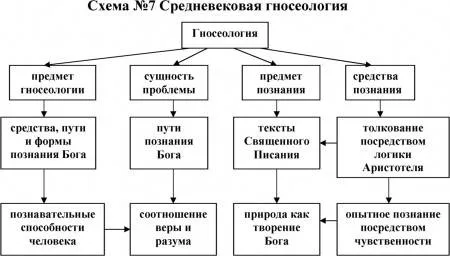
For idealism, since it asserts the primacy of consciousness, of the spiritual, over material being, the source of knowledge is some spiritual principle. Socrates, and following him Plato, proposed the conception of innate ideas and recollection. Plato said that the human soul, before being placed into a bodily shell, dwells in the world of ideas, possesses knowledge of the ideas and of the world lying below, upon which it looks «from above» from the world of ideas, and that what is subsequently taken for human cognition is a «recollection» of what the soul knows and what was, as it were, obscured when the soul became linked with the body. In subsequent modifications of the conception of innate ideas, the derivation of knowledge from a nonmaterial source was likewise asserted.
In religious-idealist philosophy it was asserted that fundamental knowledge has its source in the revelation of the Deity. For example, Kierkegaard said that the transition from ignorance to knowledge is a kind of enlightenment, through which «eternal knowledge» is opened to man by God.
In connection with the solution of the second aspect of the fundamental question of philosophy, let us recall that agnosticism, in one form or another, denies the knowability of the world.
Unlike idealism and agnosticism, materialism in epistemology proceeds from the assertion of the existence of an objective world as the source of knowledge and of the reflection of this world in human consciousness in the form of subjective images. These images are copies of objects of the material world.
Although materialism as a whole proceeds from the principle of reflection, there are significant differences in the understanding of the process of cognition between metaphysical and dialectical materialism. These differences lie, above all, in the understanding of the basic categories of epistemology – the subject and the object and the relation between them (the subject-object relation).
Metaphysical materialism was a contemplative materialism; the process of cognition was understood as the result of the action of an active object upon a passively contemplating subject. Further, the subject of cognition was taken abstractly, without regard to the concrete social environment and historical conditions in which it finds itself. Finally, the object and subject of cognition and the subject-object relation were considered narrowly, only in an epistemological respect.
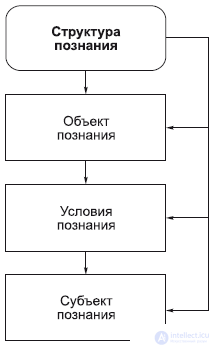
Let us see how the basic concepts are treated in the philosophy of dialectical materialism. Here, above all, the concepts of objective reality and the object of cognition are distinguished. In any historical epoch the object of cognition is a «part» of objective reality. Whereas the category of objective reality reflects the fact of independence of existence from the consciousness of the subject, the category of the object of cognition denotes that «part» of objective reality with which the subject has entered into a cognitive relation. Further, the object of cognition is not only phenomena of the natural world. The object of cognition is nature, society, and cognition and consciousness themselves. Thus, the object of cognition in the broad sense is everything toward which the cognitive activity of the subject is directed.
By the subject of cognition is understood the bearer of cognitive activity, cognizing people. The individual subject of cognition – is a living, corporeal being, a concrete person with the corresponding sense organs and the capacity to think. But here one must bear in mind that the cognizing subject is not an individual isolated from other people (a «gnoseological Robinson Crusoe»). Each concrete individual becomes a subject of cognition insofar as he masters the experience of humanity. Man is a product of a concrete historical epoch, of a concrete society. The capacity to think and to feel, to listen to music, to perceive painting, and so on – all this is formed in society; the social nature of the subject of cognition is determined by his place in the system of social relations, by his belonging to a definite social group.
From the fact that the subject of cognition is a socialized personality, it is sometimes concluded that the subjects of cognition are not only individual persons but also social groups and even society as a whole. This, in our opinion, is a debatable thesis. One recalls Feuerbach, who remarked ironically that just as society has no single stomach, so it has no single head either. It is not society as a whole that cognizes, but individual people. But in this connection, of course, a subsequent socialization of knowledge occurs: knowledge obtained by individual people spreads through society, is accepted or rejected, and becomes social knowledge.
In the structure of the subject-object relation, besides the subject and the object, there is a third component, which is called either the «basis of cognition» or the «conditions of cognition». These are the material means used in cognition (tools, instruments, apparatus, etc.), the information available in society which the subject can use in his cognitive activity, the social-psychological environment, working and leisure conditions, and so on. But this is not all.
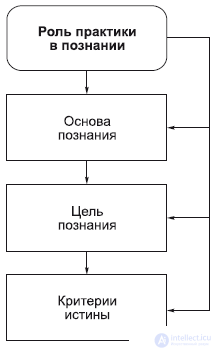
Dialectical-materialist philosophy asserts the connection of the cognitive process with practice. Practice is the basis of cognition.
At the beginning of human history, cognitive activity was directly included in practical activity. But subsequently too, when cognition becomes a special, independent kind of activity, it continually relies on practice.
Practice creates the conditions for cognitive activity, it creates the technical basis of cognition. In man's practical relation to the world, the reflective apparatus of man is formed, sensory cognition develops, and practical operations are reflected in logical regularities.
Practice – is not only the basis of cognition, it is, ultimately, also the goal of cognition. Human cognition is not cognition for cognition's sake. Humanity cognizes the surrounding world in order to change it. And this is possible only thanks to practice. As practice develops, an ever wider range of objects of nature and society is drawn into the practical process. The world surrounding man becomes increasingly «humanized». Man creates for himself a «second nature» and lives within it. In doing so, by changing the world, man changes himself.
In the process of cognition, two levels are traditionally distinguished: sensory cognition and thinking (logical cognition); cognitive images fall into two classes: sensory-perceptual and abstract (concepts). At first glance it might seem that the existence of these two classes of images is a consequence of the biological organization of man's cognitive apparatus (the sense organs and the brain). In reality the matter is explained thus: the existence of these two classes of images is a consequence of the fact that in material objects there is appearance and essence, and the very biological organization of man's cognitive apparatus is conditioned by the contradictory nature of material objects.
Material objects, on the side of their appearance, are reflected in sensations, perceptions, and representations. By means of the sense organs, the organism reflects the properties of material objects and changes in the surrounding environment, and regulates its reactions to these changes. A person deprived of sense organs could not cognize at all; moreover, he could not exist at all. Each sense organ is biologically adapted to respond to certain external influences.
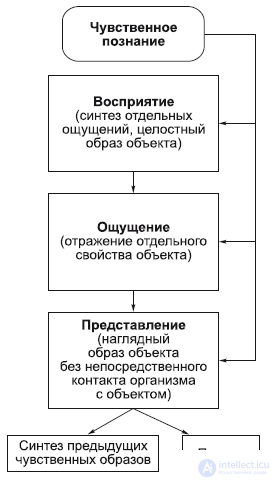
The initial form of sensory cognition is sensation. Sensation – is the reflection of a single property of an object, the result of the action of the object upon this or that sense organ. We have visual, auditory, tactile, olfactory, gustatory, thermal, and other sensations. The biological nature of human sense organs, their number, and correspondingly the number of different sensations, took shape in the course of the evolution of our ancestors. As a result of this evolution, not all objects with their properties lie within the sphere of the possibilities of our sense organs (for example, we do not sense the Earth's magnetic field). But it does not follow from this that there exist, in principle, unknowable objects. If a given object is by its nature such that our sense organs are not adapted to its sensory cognition, then in principle there remains the possibility of finding another object on which the action of the first object manifests itself in a perceptible way. By means of such objects («instruments») the possibilities of sensory cognition of phenomena are boundlessly expanded.
The second form of sensory cognition is perception. Perception – is a holistic image of an object. This image is formed on the basis of the synthesis of individual sensations. Psychologists distinguish a number of features of perception: wholeness (the object is reflected as a single whole), selectivity (the object is singled out from a number of others), constancy (relative stability of the image), apperception (the dependence of perception on the psychic state of the person), and meaningfulness (the influence of prior knowledge on perception).
The third, highest form of sensory cognition is representation. By representation is understood a visual image of an object arising without direct contact of the organism with the object. A representation of some object or its property arises on the basis of memory and of prior sensations and perceptions of the object. Representation, on the one hand, being a synthesis of prior sensory images, is richer than them in content. But on the other hand, in representation there occurs a detachment, an abstraction from certain concrete aspects of the objects being represented.
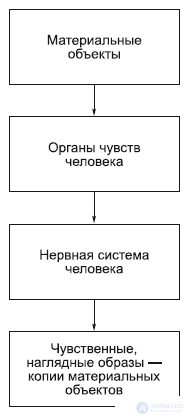
Sensory images are the result of the action of material objects upon our sense organs. The energy of an external stimulus gives rise to a physiological process in the nervous system, the result of which is a sensory, perceptual image. How the process of transformation of the energy and structure of the external stimulus into a fact of consciousness occurs has not yet been studied in full detail. That is not all. Here it should be noted that sensory images are not simply the result of the action of an object upon the sense organs. In the process of reflection the sense organs are active. This is expressed in the exploratory movement of the hands, in the movement of the eyes tracing the visible contour of an object, in the process of listening, and so on. A sensory image will not arise without the activity of the sense organs: a motionless eye is blind, a motionless hand does not touch.
Sensory cognition is the primary source, the direct connection of the organism with the external world. As for thinking, logical images, and concepts, they relate to the world indirectly, through mediation. For their formation, they generally require sensory materials.
Sensory images that reflect material objects are not signs, signals, or symbols of objects, but their copies.
The action of an object upon a sense organ gives rise to an image of that object. It is precisely because sensory images are not signs but reflections, copies of objects, that man adapts to the surrounding environment.
Sensory images have both an objective and a subjective side. As copies of objects, they are objective in their content. Their subjectivity lies in the fact that they exist in the consciousness of the subject and depend on the state of the sense organs and the entire physical constitution of the person, on the conditions of perception.
Sensory cognition has its limits. Going beyond them is accomplished by means of thinking.
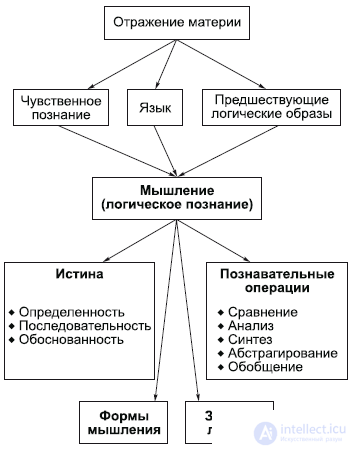
Thinking, logical cognition, is mediated reflection. It is mediated, firstly, by sensory cognition. Thinking arises on the basis of sensory cognition, of sensory images. Secondly, it is mediated by language; as has already been said, thinking is necessarily linked with language.
Thirdly, logical cognition, thinking, is mediated in the sense that this or that logical image is formed on the basis of other logical images. In general, one can say that the process of cognition moves from sensory images to logical ones.
Thinking is not only mediated but also generalizing cognition.
In thinking, not only the particular but also the general is reflected. The reflection of the general is an important feature of human thinking. Generalization promotes the movement of cognition toward essence.
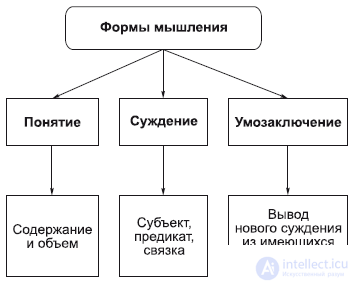
The forms of thinking, of logical cognition, are the concept, judgment, and inference. The initial cell of thinking is the concept. A concept – is a logical image reflecting the general, essential features of phenomena. In the formation of concepts, the following cognitive operations are used: comparison, analysis, synthesis, abstraction, and generalization.
The cognition of any phenomenon begins with our distinguishing it from other phenomena and establishing its similarity with related phenomena. Comparison – is the establishment of similarity and difference between phenomena. Analysis – is a logical procedure in which the phenomenon under study is mentally divided into its component elements, each of which is then examined separately. Analysis is inseparably linked with synthesis. Whereas analysis fixes what specifically distinguishes the parts from one another, in synthesis the mental combination of the parts of a phenomenon divided in the process of analysis is carried out, establishing the interconnection of the parts and cognizing the phenomenon as a whole. Abstraction – is the process of mentally singling out some feature of a phenomenon and detaching it from other features. Finally, generalization – is the fixation of the common features of a certain class of phenomena. It is interesting that the path toward finding the general is outlined already in synthesis, when what is essentially common, linking the parts into a single whole, is revealed. The outcome of these logical operations are concepts. Concepts are linked to a material linguistic shell, the word.
Every concept has content and scope. The content of a concept – is the aggregate of features reflecting the general properties of a certain class of phenomena; the scope of a concept – is that set of phenomena to which the given concept applies. For example, the content of the concept «nation» includes the features: a common language, territory, community of culture, and economic life among a definite group of people, while the scope of this concept is the set of nations on Earth.
The content of a concept is revealed by means of a definition of the concept (definition proper), in which the features of the concept are indicated, while the scope – is revealed either by simple enumeration of the members of the set to which the concept applies, or by means of the division of the concept (classification).
In the process of thinking, concepts are linked with one another. The second form of logical cognition, of thinking, is judgment. In a judgment, on the basis of a connection of concepts, something is affirmed or denied about certain objects of thought. An elementary judgment consists of a subject, predicate,and copula (where the subject and predicate are concepts). For example, in the judgment «Islamist fundamentalists are aggressors», the concepts of Islamists and aggressors are connected. There exist various kinds of judgments: affirmative and negative, particular and general, conditional and disjunctive, and so on. Judgments are expressed in language in sentences.
The third form of logical cognition is inference. In the process of inference, from certain known judgments (called premises) a new judgment (called the conclusion) is obtained. There exist various kinds of inference. In particular, there are deductive inferences, in which thought moves from the general to the particular, and inductive ones, in which thought moves from the particular to the general («All metals are electrically conductive», «Uranium is a metal», whence it follows – «Uranium is electrically conductive» – a deductive inference. From the judgments «Iron is electrically conductive», «Copper is electrically conductive», «Silver is electrically conductive», etc., the conclusion is drawn: «All metals are electrically conductive» – an inductive inference).
Not every combination of judgments constitutes an inference. Joining the two judgments «All gases are compressible» and «Austria is located in Europe» does not yield an inference, since there is no logical connection between these judgments, and there is none precisely because there is no objective connection between the fact that all gases are compressible and the fact that Austria is located in Europe. For a conclusion to follow from two judgments, they must share a common (middle) term. There are many different figures and moods of inference[11].
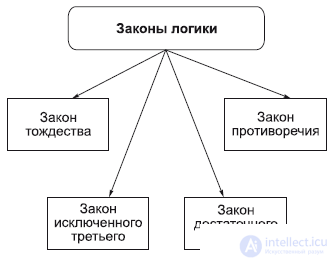
Obtaining new, true knowledge through inference depends on the truth of the original judgments (premises) and on the correct application of the rules of inference in operating with the original judgments. Let us note the general conditions of thinking that lead to truth:definiteness, consistency, and validity.
Definiteness of thought is achieved when the requirements of the law of identity are met. This law requires that every thought which recurs in the course of some reasoning, discussion, or argument retain the same meaning throughout that reasoning (in particular, the concepts used in the course of a specific argument must preserve the same content and scope). This is explained by the fact that as long as a given object remains in a definite qualitative state, we must think precisely about that object with its properties. Thinking cannot lead to a positive result if, in the course of reasoning about some object, we put now one, now another content into the concept of that object and understand its scope differently at different times. Hence a useful recommendation follows: in a discussion or argument, it is essential to establish the meaning of the initial concepts. The law of identity does not forbid concepts from changing. The law of identity requires only one thing: within a given piece of reasoning, in a given connection and under given conditions of thought, concepts must be identical to themselves.
Consistency of thought is ensured by observing the rules (laws) of inference, of which we shall draw attention to two. The first – the law of noncontradiction – asserts that two opposite judgments about one and the same object, taken at one and the same time and in one and the same respect, cannot both be true simultaneously. For example, one cannot assert as simultaneously true the judgments «Elbrus is a high mountain» and «Elbrus is a low mountain» (referring to the same mountain, in the same respect relative to other mountains). The second law – the law of the excluded middle asserts that two contradictory judgments about one and the same thing cannot both be true or both be false at the same time. One of them is true, the other – false. For example, of the two contradictory judgments «Basayev is a bandit» and «Basayev is not a bandit», one will necessarily be true and the other – false, and there can be no third possibility here.
Validity of thought is achieved by meeting the requirements of the law of sufficient reason: every proposition used in reasoning must be substantiated, proven, except for those accepted as axioms and definitions (for the technique of proof we again refer the reader to logic textbooks).
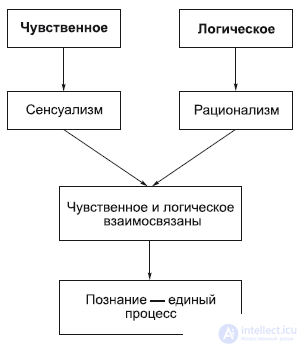
In the philosophy of the Modern era an opposition of sensualism and rationalism took shape. Sensualism (from the Latin sensus – feeling) assigned the decisive role in cognition to sensory perception. Rationalism (from the Latin ratio – reason) assigned the decisive role in cognition to reason. Why did this opposition arise?
The process of cognition in general, as noted above, begins with sensory cognition. Initial empirical concepts are obtained on the basis of sensory material. The absolutization of the fact that the primary source of concept formation is sensory images gives rise to the conception of sensualism.
At the same time, as indicated above, sensory perceptions are meaningful. We do not simply perceive certain phenomena; they have some significance for us. Any sensory image is, in a certain sense, conditioned by concepts, by logical images. Awareness, evaluation, and thinking are organically included in the process of sensory perception. The absolutization of this circumstance creates the basis for rationalism.
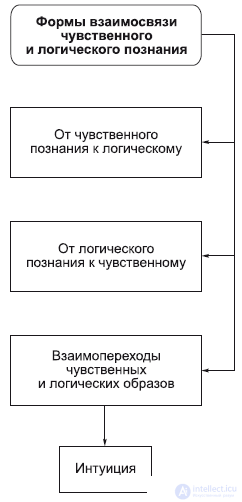
The opposition of sensualism and rationalism is mistaken. Just as the content of a material object cannot be reduced solely to appearance or solely to essence, and the two cannot be set against each other, so the process of cognition cannot be reduced solely to sensory or solely to logical analysis, nor can one be overrated at the expense of the other. Sensory and logical cognition are independent modes of cognition and, at the same time, they are interconnected and cannot exist without each other. Although the «mechanisms» of the interconnection between sensory and logical cognition have not yet been studied in detail, in general form a number of forms of their interconnection can be identified.
The first form of interconnection is from the sensory to the logical. Sensory cognition not only genetically precedes logical cognition but also exerts a constant influence on logical images. Concepts usually become accessible when they are linked to some visual representations.
The second form of interconnection is from the logical to the sensory. This is the meaningfulness of sensory images, i.e. the influence of logical images on sensory ones, their peculiar «interweaving» into sensory cognition. To this it should be added that sensory cognition is usually stimulated by some goal set by thinking.
Phenomena such as fantasy, creative imagination, and intuition are of particular interest in the study of cognition. Explaining them on the basis of the interconnection and mutual transitions of sensory and logical images appears highly promising. Let us turn to intuition.
Intuition is usually characterized by the following features.
Intuition is often presented as a manifestation, in the sphere of consciousness, of cognitive operations performed on sensory or logical images in the sphere of the subconscious, the result of which unexpectedly «surfaces» in consciousness. But such an explanation of intuition leaves the appearance of new knowledge unexplained.
If we bear in mind the appearance of fundamentally new concepts, then they cannot be logically derived from existing old ones; likewise, fundamentally new sensory images cannot be the result of association of existing sensory images. Yet intuition is precisely about obtaining new concepts and sensory images. It appears promising to explain the appearance of new sensory images and concepts on the basis of the interaction of sensibility and thinking. New sensory images arise on the basis of the mediation of existing sensory images by concepts (so-called eidetic intuition); new concepts arise on the basis of the mediation of existing concepts by sensory images (so-called conceptual intuition). These mediations are subtle, hard to grasp, and occur in the sphere of the subconscious, as a result of which the opinion arises that new sensory images are born from existing ones, and new concepts – likewise from existing ones – «by themselves», spontaneously.
In the process of cognition, knowledge is not only obtained but also evaluated. Knowledge can be evaluated from various points of view: usefulness, importance, applicability, etc. The main place here is occupied by the evaluation of knowledge from the point of view of its truth or falsity. The question of truth is the central question of the theory of knowledge. Hegel wrote: «Truth is a great word and an even greater thing. If a person's spirit and soul are still healthy, then at the sound of this word his breast must swell higher»[12].
The word «truth» is ambiguous. Take the question that, according to Christian doctrine, Pilate asked Christ: «What is truth?» For here one can see two different questions: 1) what does the concept of truth mean in general, and 2) which of several existing doctrines is true? Philosophy is interested mainly in the first question, while the second is usually posed in some specialized field of knowledge.
In philosophy, the concept of truth is, as a rule, applied to knowledge, judgments, and conceptions. But the understanding of truth differs among different philosophical schools.
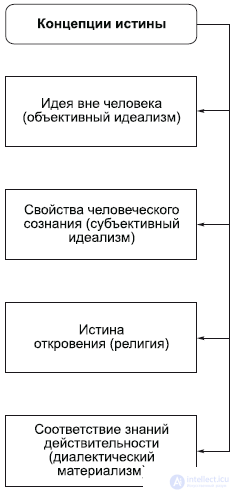
In objective idealism and religion, truth is understood as a certain idea existing outside man. Religion speaks of the truth of revelation. These are, so to speak, thoughts, instructions, and norms of human conduct, emanating from a deity. A thing may likewise be called true if it corresponds to the idea. A true friend is one who corresponds to the concept of a friend (Hegel).
Subjective idealism links truth to the properties and structure of human consciousness, treating truth as an «economy of thought», the consistency of knowledge, a process of thinking leading to useful results, etc.
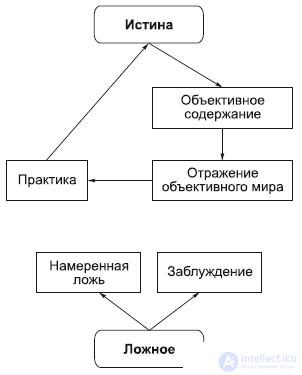
In materialism, the concept of truth applies not to any things or phenomena of the objective world, but to knowledge about these objects and phenomena. The foundations of the materialist understanding of truth were laid by Aristotle; considering truth not a property of things but a property of representations and judgments, he defined the truth of particular judgments as their correspondence to reality. This point of view became known as the classical theory of truth. It was shared by many philosophers (in the philosophy of the Modern era – Holbach, Feuerbach, Marx, and others).
Lenin calls objective truth «the content of knowledge that does not depend on the subject, i.e. does not depend either on man or on humanity»[13]. As knowledge, truth manifests itself in subjective form – it is formulated by a human being – but the concept of truth characterizes knowledge not from the point of view of subjective form, but from the point of view of its objective content. And the content of truth is determined not by the subjective will of people, but by those properties and relations of the objective world that are reflected in knowledge. Objective truth – is such content of human knowledge as corresponds to the objective world.
Objective truth is independent of man and humanity in the sense that it does not depend on the arbitrary will of people, on their subjective wishes and motives. False statements, on the other hand, do not correspond to reality precisely because they depend on the arbitrary will of the person who invented and spreads them. Since man does not dictate his assertions to the objective world but, on the contrary, draws his judgments and their content from the objective world, he speaks the truth.
Speaking of falsehood, one must distinguish between deliberate lying and error. The former occurs when a person is aware that his statement does not correspond to reality yet asserts it as true; one who is mistaken, however, takes the false for the true. Both deliberate lying and error are alike in that they do not correspond to the objects.
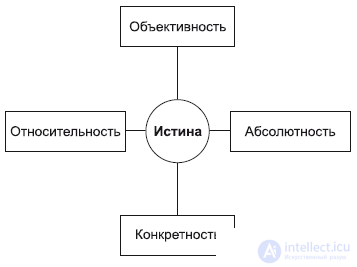
Knowledge can correspond to the object it reflects with varying degrees of completeness and accuracy. Although with each generation humanity reflects the material world and itself more deeply and fully, it makes no sense to speak of the «completion» of cognition. Human knowledge at any given moment is limited and reflects reality only approximately correctly. This limitation is due to the level of development of practice. People's knowledge, which in the main adequately reflects the world and is refined, deepened, and made more specific in the course of the development of practice, is called relative truth. On the other hand, true knowledge always contains elements of exact, absolutely correct knowledge, which is commonly called absolute truth. Absolute truth consists of the results of cognizing individual aspects of the objects under study (for example, in the form of statements of fact: «Bodies consist of atoms», «The side of a triangle is less than the sum of the other two sides», etc.), that is, that content of knowledge which is preserved in the course of further cognition. Absolute truth is also understood in the sense of complete knowledge of the world (which is actually never attainable).
Truth – is a process moving from less exact and complete knowledge to more exact and complete knowledge. This process is a movement toward absolute truth through relative truths. Elements of exact knowledge are present in every relative truth. Along the path of movement toward objective truth, truth coexists with error, illusion, and fantasy; relatively changeable, approximate knowledge coexists with settled, exact, absolute knowledge.
One should not think that objective, relative, and absolute truth are separately existing truths. Truth is one. Every objective truth contains within itself both a moment of the relative and a moment of the absolute. Our cognition is simultaneously both relative and absolute.
To the characterization of truth one must add the feature of the concreteness of truth. Every idea, every theory must be considered under definite conditions, within a definite subject area, in a definite language, in a definite context. There is no abstract truth; truth is always concrete. Take, for example, the atomistic conception of the past. At its foundation it contains a truth: material bodies do indeed consist of atoms, and atoms are indivisible. If, however, we fail to indicate that this concerns certain conditions, and consider atoms to always be indivisible, then we commit an error, violating the principle of the concreteness of truth.
A dialectical understanding of truth requires rejecting the dogmatic, metaphysical style of thinking which absolutizes what has been cognized. One cannot hold that there exist ideas or theories fixed once and for all, unchanging and suitable for all times and in all circumstances of life. However, dialectics is opposed to relativism, which, in arguing against the absolute in truth, ultimately arrives at the denial of objective truth altogether, declaring every truth conditional and declaring any judgments equally acceptable. From here lies the path to skepticism and agnosticism.
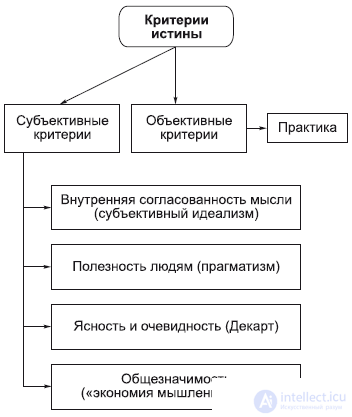
To establish the truth of knowledge, one must use a definite criterion of truth, a method of testing and substantiating knowledge. In the course of the development of philosophy, a number of criteria of truth have been proposed.
Descartes proposed clarity and self-evidence as the criterion of truth. If something is understood clearly and self-evidently, then it is true. Thus 2 + 2=4 is so clear and self-evident that no one will deny it as true. A number of philosophers see the criterion of truth in universal agreement. From the point of view of this criterion, truth is that with which all people (or the overwhelming majority) agree, that which is universally accepted. Mach proposed «economy of thought» as the criterion of truth. True is that which is simple, which is economical to think. Pragmatism proposed the following criterion: true is what is useful, advantageous to people. The internal coherence of thoughts, their value, and so on have also been proposed as a criterion of truth. It is not difficult to see that all such criteria suffer from subjectivism.
Dialectical-materialist philosophy does not deny the significance of clarity of thought, its coherence, and so on, but these cannot be recognized as fundamental criteria of truth. It is necessary to find an objective criterion. And such a criterion is practice.
The entire process of cognition is based on practice; it begins and ends with it. Knowledge is not obtained merely to lie as a dead weight. Knowledge is put into practice, is objectified. Naturally, not every idea can be «objectified», but only a true one. Practice is the criterion of truth because in material activity thought about an object and action upon it are joined and correlated.
Practice as the criterion of truth is contradictory: it is both absolute and relative. The absoluteness of practice as the criterion of truth consists in the fact that it is precisely practice that provides the decisive test of the truth of knowledge, and beyond this test there is no other test. At the same time practice is also relative, since it proves the truth of knowledge for a definite subject area, for definite conditions, and with a definite degree of accuracy. Practice develops historically and at any given moment is limited. But for all the relativity of practice, if at a certain stage in the development of cognition it has confirmed some conception, then that conception contains an objective truth within itself. Even if this conception is subsequently revised, the grain of truth contained in it is preserved.
Truth is that content of knowledge which adequately reflects reality; the adequacy of the reflection is verified by practice.
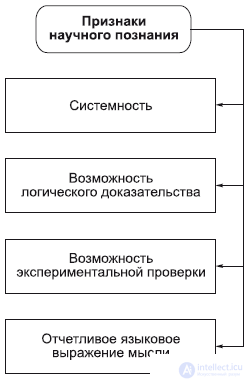
Science is understood both as a system of knowledge and as an activity directed toward obtaining knowledge. What is investigated, and how is it investigated? These are the fundamental questions of science. Scientific knowledge can in principle be characterized from the following standpoints:
• systematicity;
• the possibility of logical proof;
• the possibility of experimental verification;
• a clear linguistic expression of thought.
The methodology of science, as a philosophical discipline, is understood as the doctrine of the methods and forms of scientific research, its structure, its driving forces, and so on. A variety of research methods are applied in the sciences. Some are specific to this or that particular science (for example, the method of conditioned reflexes), others are used by a number of sciences (for example, the method of labeled atoms), and still others are applied in all the sciences (for example, the method of modeling). Philosophical methodology sets itself the task of clarifying the general regularities, the «algorithms,» of scientific-cognitive activity on the basis of studying and generalizing the methods, means, and forms of research used in the sciences.
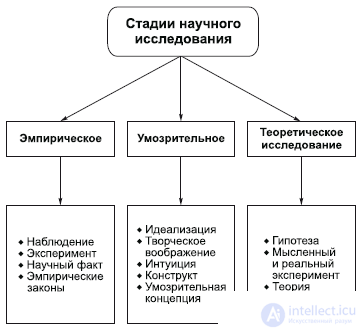
At first glance it might seem that a scientist's research activity is individual and unrepeatable; however, this point of view is mistaken. An analysis, carried out by methodologists, of the creative work of the classic figures of science, of the specifics and structure of scientific research, has shown that, despite differences in the objects studied, historical conditions, and social and national differences among researchers, a certain general regularity is revealed in their activity insofar as they strive to attain truth.
Scientific research passes successively through three stages: empirical, speculative, and theoretical research. At each of these stages, specific forms of knowledge are obtained by means of particular cognitive procedures.
This sequence of stages is due to the fact that the ultimate goal of scientific research is to uncover the essence of the class of phenomena being studied, that is, to explain these phenomena. But before one can explain these phenomena, one must first come to know them, that is, describe them. This task is accomplished by empirical research, and it is precisely with this that scientific research begins.
Once the subject area under study has been described, an attempt is usually made at first to explain it with the help of existing old theoretical knowledge. When success cannot be achieved along this path, the need for new theoretical knowledge arises. Here it turns out that fundamentally new theoretical knowledge cannot be obtained either by inductive generalization of experimental data or by deductive inference from old theoretical knowledge. One has to resort to the help of creative imagination, fantasy, and intuition, that is, to speculative research. It is speculative research that generates the new ideas on the basis of which theoretical research then unfolds, forming a new theory that explains the empirical knowledge.
The primary procedure of empirical research into a new subject area is observation. Observation – is the perception, by means of the sense organs (as well as instruments), of the phenomena under investigation, under conditions in which the researcher does not interfere with the natural course of events. The result of observation is a sensory image (sensations and perceptions). Scientific observation differs from ordinary sensory cognition in its purposiveness and organization. Scientific observation is usually connected with the solution of a particular scientific problem or task. The purposiveness of observation is connected with the presence of preliminary ideas and hypotheses that give rise to the need for observation. Scientific observations must gather data that can become the basis for subsequent developments.
In the process of observation, the qualitative and quantitative parameters of the objects under study, their spatiotemporal characteristics, and processes of change are reflected (that is, objects on the side of their appearance).
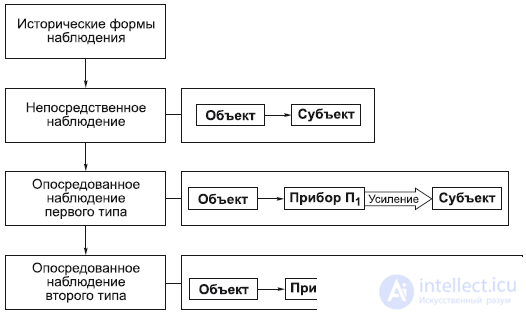
Historically, the following types of observation have taken shape.
1. Direct observation. Observation proceeds on the basis of the direct action of the object on the observer's (subject's) sense organs.
Direct observation is determined by the capacities of our sense organs. But the capacities of the sense organs are biologically limited. This biological limitation of the sense organs is overcome through the use of instruments. Here we are dealing with mediated observation, which includes two variants.
2 Mediated observation of Type I. Between the object and the subject's sense organ is placed an instrument P1, which quantitatively amplifies the action of the object on the subject.
An example of this variant of observation is the use, as an instrument, of a magnifying glass, an optical telescope, or a microscope.
3. Mediated observation of Type II. Between the object and the subject's sense organ is placed an instrument P2, which qualitatively transforms an otherwise imperceptible action of the object in such a way that it becomes observable by the subject.
An example of this variant is the use of a compass, which converts the action of the earth's magnetic field into a visually observable position of the magnetic needle.
Thanks to the use of instruments, the range of perceptible phenomena expands (both quantitatively and qualitatively), and all phenomena of the material world become in principle observable; this circumstance put an end to agnostic doubts about the knowability of the world.
The results of observations depend on the observer's sense organs, on the means of observation (instruments), and on the objective properties of the phenomena observed. Therefore, in analyzing the results of observation, a number of circumstances must be taken into account:
1) what in the results of observation depends on the object itself and what depends on the specifics of the sense organs;
2) what depends on the specifics of the instruments used and what depends on the specifics of the object itself;
3) whether the state and behavior of the object during observation differ from the state and behavior that would have occurred had there been no process of observation.
The practice of scientific research has shown that the influence of instruments on the information obtained must be taken into account. In order for the results of observations to yield more objective information, it is necessary to diversify the conditions of observation as much as possible and to apply various instruments. In doing so, the object will look different in each individual observation, but that which is common to all the observations can be regarded as objective information.
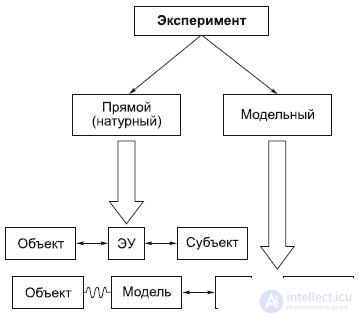
The second method of empirical research is the experiment. A distinction is drawn between direct (field/natural) and model experiments. Unlike observation, in the course of a direct (natural) experiment the subject actively acts upon the object of research by means of other material objects – experimental setups (ES) (instruments, apparatus, and so on). The reaction of the object under study to these actions is recorded by instruments with which experimental setups are usually equipped. From this it can be seen that there is a close connection between experiment and observation.
In the course of an experiment, the object is usually isolated from the influence of extraneous, inessential connections, the action of experimental means on the object is carried out, dependencies between the essential properties of the objects studied are established, and data are recorded.
The model experiment has come to be applied ever more widely since the mid-nineteenth century. The necessity of using a model experiment is explained by the fact that the object of cognition has features that make direct experiments difficult or impossible. Thus, for example, an object may be remote in space or in time, may have very large or very small dimensions, a direct experiment may be economically unprofitable, and so on. In all such cases, it is expedient to turn to experimentation on models in order to obtain the initial scientific information.
In a model experiment, in addition to those actions and operations characteristic of a natural experiment, the operation of constructing the model and of transitioning from the model to the object (the original) is added.
In a model experiment it is not the object (the «original») that is investigated, but the model; the original does not itself directly take part in the experiment. A certain object becomes a model if it satisfies the following criteria:
1) there exists a relation of similarity between the model and the original (the condition of analogy);
2) the model serves as a substitute for the object being studied (the condition of representation);
3) the study of the model makes it possible to obtain information about the original (the condition of extrapolation).
A model must not only be similar to the original but must also differ from it. It is precisely this difference that makes it possible to «get around» the obstacles present in studying the original.
The objective grounds of the model experiment lie in the existence of general regularities in the organization and functioning of various phenomena.
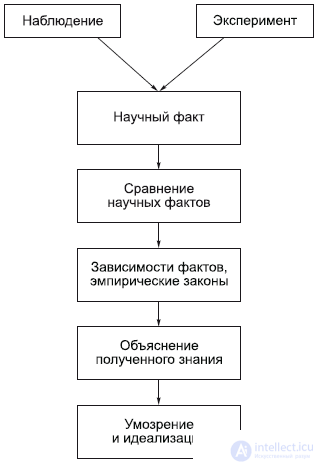
The immediate aim and result of scientific observation and various forms of experimentation is the obtaining and accumulation of facts. A scientific fact – is the first, initial form of empirical knowledge. A fact of science is reliable knowledge, reflecting the objectively existing properties of phenomena, the result of describing and generalizing empirical data.
At the next stage of empirical research, newly obtained facts are compared with one another and with those previously recorded. As a result of such comparison, dependencies among the facts – empirical laws – may be discovered.
The highest form of empirical knowledge (about the subject area under study) is a phenomenological construction, representing a deductive system built on the basis of empirical laws, from which consequences are deductively derived.
Next comes the task of explaining the empirical knowledge obtained. When this cannot be accomplished using existing theoretical knowledge, one must go beyond the bounds of the old theories. The research passes into the speculative stage.
Speculative research begins with the «idealization» of existing knowledge. The following procedure is usually applied here. A given empirical concept has features possessing quantitative characteristics. One (or several) feature is driven toward zero, while the others take on certain limiting values. For example, in the empirical concept of a solid body there are the features: mass, volume, and capacity for certain deformations. We drive the volume toward zero, and as a result we obtain an idealized object (an «ideal») – the «material point.» Naturally, a real object is not a material point; material objects without volume do not exist (whereas the «material point» has zero volume).
The question arises: what does the creation of idealized objects give us? The point is that explaining empirical data and empirical laws presupposes a transition from the level of appearance to the level of essence; from the observed phenomenon one must pass to its internal, essential characteristics. With the help of idealized objects, the researcher strives to eliminate the factors that hinder penetration into the essence. Mentally, he proceeds along the line of separating essence from appearance. By restricting the set of features in the idealized object, the researcher gains the possibility of constructing mental images of what happens to the features remaining in the idealized objects.
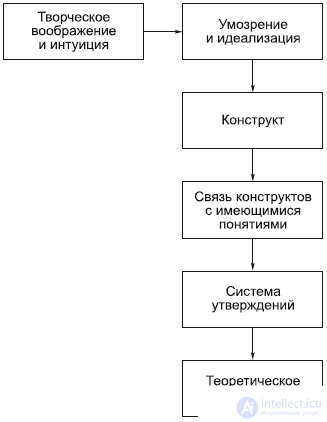
After forming idealized objects, the researcher seeks out and uses a certain structural image. The elements of this structural image are replaced by idealized objects, and as a result a speculative concept (a construct) is obtained at the end. For example, Kepler used the structural image of a magnet attracting iron for the concept of universal gravitation.
In the creation of idealized objects and speculative concepts, creative imagination and intuition play an important role. This is manifested in the choice of the mode of idealization, in finding the structural image, and in replacing its elements with ideals. In general, the process of creativity presupposes going beyond what directly and logically follows from the available data of experience and theoretical propositions.
Further, speculative research continues in the form of comparing and connecting constructs with one another and with existing concepts. Here a broad field opens up for speculative activity. Its result consists of statements containing constructs (so-called speculative principles). The history of science knows many examples of speculative activity. Thus, Galileo, imagining an ideal ball rolling along an ideally smooth, strictly horizontal plane, arrived at the conclusion that under these conditions the ball would not stop. This speculative statement (speculative principle) subsequently formed the basis of the principle of inertia formulated by Newton.
From a certain set of speculative principles, a system of assertions (a speculative conception) can be deductively constructed. In practice, one can, starting from different speculative principles, create an unlimited number of different speculative conceptions. Speculative research is completed by an analysis of the various speculative conceptions, discarding some and singling out others for subsequent work.
Theoretical research begins with certain non-contradictory, meaningful speculative principles being selected as the initial principles of a new theory. There can be very many speculative principles, so one must restrict their number as much as possible for the purposes of theoretical research. Here, besides checking them for meaningfulness and non-contradiction, the researcher's philosophical worldview plays a significant role. He will not work with those speculative principles that contradict his philosophical worldview.
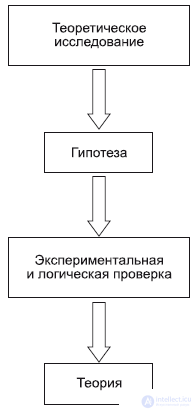
On the basis of the chosen principles, from a certain set of sign structures (contained in the researcher's informational field) a certain structure is selected for a possible theoretical law. From the assumption, accepted as a conjecture, about the structure of the possible theoretical law, a complex of deductively derived consequences unfolds. The assumption about the structure of the theoretical law and the consequences derived from it form a scientific hypothesis[14].
A hypothesis, from an epistemological point of view, represents knowledge whose truth or falsity has not yet been established. Confirmation («verification») of a hypothesis turns it into a theory, and, conversely, refutation («falsification») discards the hypothesis as a false assumption.
In the process of substantiating and testing a hypothesis, logical and practical procedures are used. First, if it turns out that the consequences within the hypothesis contradict one another, this compels one to think the initial assumption false. Second, in testing a hypothesis, the experiment plays the decisive role. First a thought experiment, in which a transition is made from constructs and new theoretical concepts to intuitive representations having quantitative parameters («interpretation»); consequences accessible to experimental verification are identified, and a plan for a real experiment is determined. In the real experiment, the hypothesis is tested. If the results of the experiments coincide with the logically derived consequences, the hypothesis is confirmed; but if the consequences derived from the supposed theoretical law do not correspond to the experimental data obtained, the hypothesis is rejected.
Confirmation of a hypothesis turns it into a theory. A theory – is a system of logically interconnected propositions reflecting the essential, internal connections of a given subject area. The logical structure of a theory has a deductive character: from certain initial true propositions, all others are logically derived.
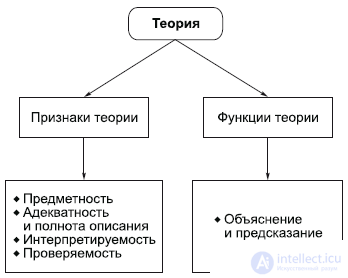
A theory, as a system of knowledge, is characterized by a number of features.
Objectivity of subject matter. The entire body of concepts and judgments of a particular theory must relate to a definite subject area. The laws of a theory delimit the subject area to which the given theory applies. They also formulate a kind of prohibition, indicating which situations, properties, relations, and processes are forbidden to be considered within the framework of the given theory.
Adequacy and completeness of description. The propositions of a theory may describe all the situations existing within the theory's subject area.
Interpretability. All the concepts of a theory must be interpretable, and their objective content revealed.
Verifiability. It must be possible to establish the correspondence of the theory to the properties and relations of the objects in its subject area.
Sometimes the feature of simplicity is also proposed: the absence of superfluous artificial constructions in the theory.
A theory performs two basic functions: explanation and prediction. Prediction consists in deriving from the theory consequences that allow for the possibility of facts and laws that exist but are as yet unknown, or of events that may occur in the future. Scientific prediction, forecasting, and foresight are of great importance for people's practical activity, for the effective management of complex systems in the sphere of material production and social development, and for control over them.
Prediction can carry scientific research beyond the bounds of the subject area with respect to which the theory was established. Then the broader subject area becomes the field of a new empirical investigation; this domain of objects must likewise be described and explained. The above-described cycle of scientific research is repeated. With respect to the broader subject area, a new theory is established. The relation of this new theory to the preceding one is characterized by the correspondence principle: in forming a new theory relating to a broader subject area, it must not come into contradiction with the previously established theory. The preceding theory becomes a particular case of the new one within the limits of the initial, narrower subject area.

Comments