
Lecture
The interconnection of phenomena is one of the basic forms of the existence of matter. The emergence, changes, and transition into a new state of any material object are possible not in an isolated and separate condition, but in interconnection with other objects. Beginning with Galileo, the laws of science became the most important hallmark of scientific knowledge.
The concept of law as a philosophical category was adopted later than a number of other philosophical categories. This is explained by the fact that law, as an attribute of essence, began to manifest itself in human activity later than the categories reflecting phenomena.
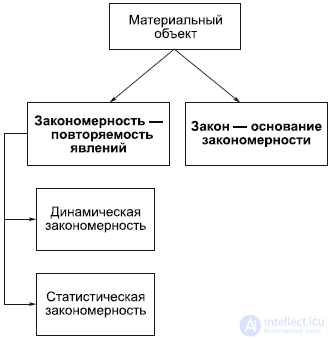
Historically, it turned out that at first human activity relied on a notion of certain recurrences. Seasonal weather changes recur, objects deprived of support fall, and so on. Stable, recurring relations (connections) between phenomena are usually called regularities.
There exist two types of regularity: dynamic and statistical. A dynamic regularity is such a form of connection between phenomena in which the preceding state of an object unambiguously determines the subsequent one. A statistical regularity, on the other hand, is a certain recurrence in the behavior not of each individual object, but of their collective, an ensemble of homogeneous phenomena. Regularity, as a recurring relation between phenomena, belongs to the attribute of the phenomenon, not of the essence. The transition to essence, to the concept of law, occurs when the question is raised about the basis, the cause, of the regularity.
A law is an objective, essential, necessary, recurring connection (relation) that determines a regularity (recurrence, regularity) in the sphere of phenomena. By essential here is understood such a relation as internally determines that which recurs in the sphere of phenomena. The necessity of a law consists in the fact that, given certain conditions, it determines the order, structure, and connection of phenomena, the constancy of processes, the regularity of their course, and their recurrence under relatively identical conditions.
The history of science reveals that if a certain multitude of phenomena is grounded in a law (a law of the first order), then behind this law lies a deeper law (of the second order), and so on. A material object in fact obeys not one but many laws. No single law manifests itself «in pure form». The combined action of several laws creates the impression of a certain indeterminacy. This is especially visible in such a complex system as society, where laws are realized only as the general direction of diverse processes.

Comments