
Lecture 8 min.
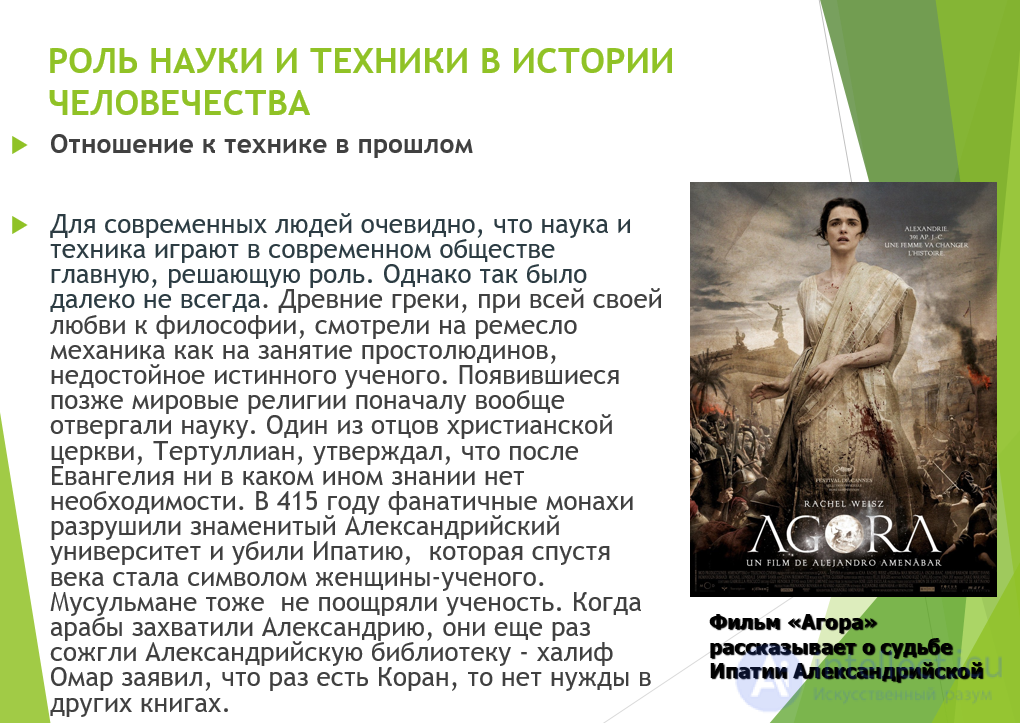
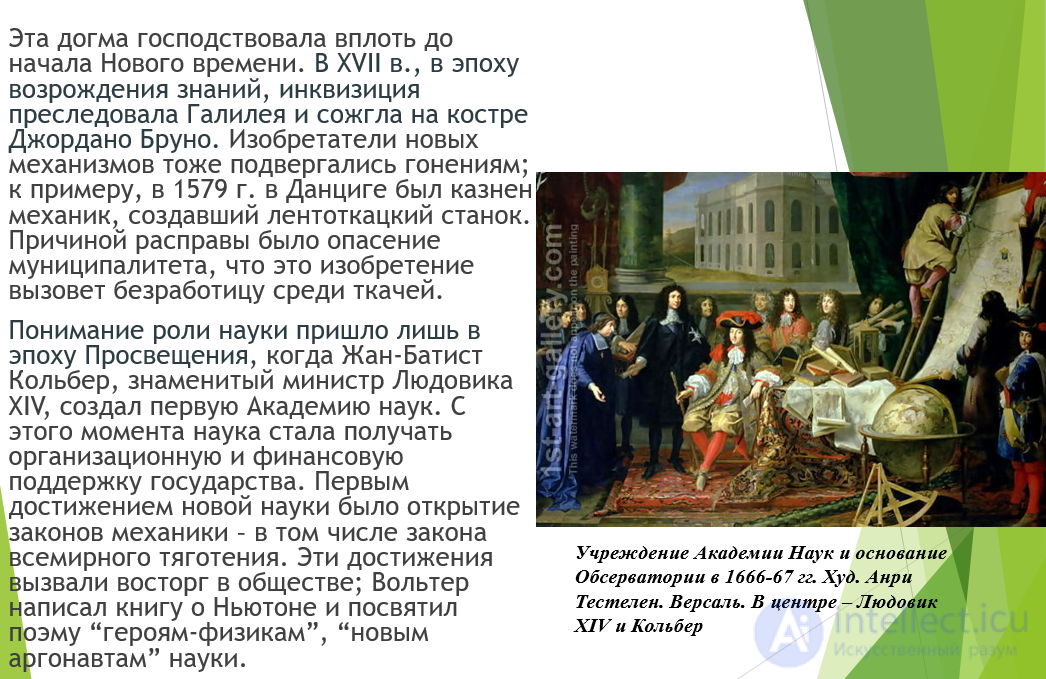
For people of our time, it is obvious that science and technology play the main, decisive role in modern society. However, this was not always the case. The ancient Greeks, for all their love of philosophy, regarded the craft of the mechanic as an occupation for commoners, unworthy of a true scholar. The world religions that emerged later initially rejected science altogether. One of the fathers of the Christian Church, Tertullian, claimed that after the Gospel there was no need for any other knowledge. Muslims reasoned in a similar way. When the Arabs conquered Alexandria, they burned the famous Library of Alexandria — Caliph Omar declared that since the Quran existed, there was no need for other books. This dogma prevailed right up to the beginning of the Modern Age. In the 17th century, during the revival of learning, the Inquisition persecuted Galileo and burned Giordano Bruno at the stake. Inventors of new mechanisms were also persecuted; for example, in 1579 a mechanic who had built a ribbon loom was executed in Danzig. The reason for this reprisal was the municipality's fear that the invention would cause unemployment among weavers. Understanding of the role of science came only in the Age of Enlightenment, when Jean-Baptiste Colbert, the famous minister of Louis XIV, created the first Academy. From that moment on, science began to receive organizational and financial support from the state.
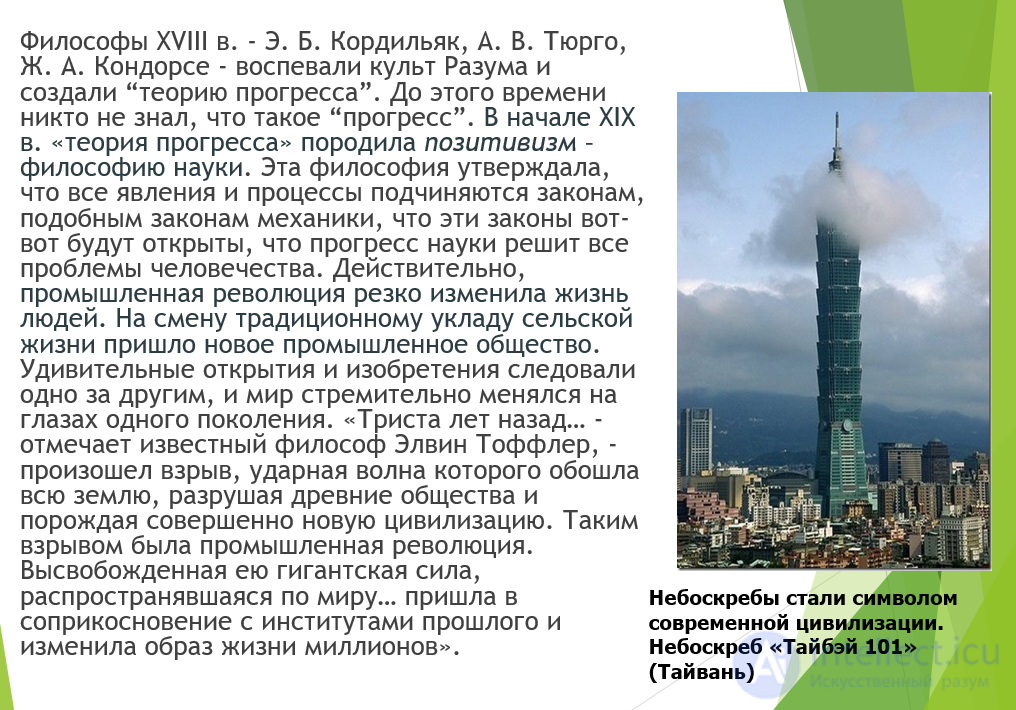
The first achievement of the new science was the discovery of the laws of mechanics, including the law of universal gravitation. These achievements aroused great enthusiasm in society; Voltaire wrote a book about Newton and dedicated a poem to the "hero-physicists," the "new Argonauts" of science. Eighteenth-century philosophers – Etienne Bonnot de Condillac, Anne Robert Jacques Turgot, and Jean Antoine de Condorcet – glorified the cult of Reason and created the "theory of progress"; before that time, no one knew what "progress" meant. In the early 19th century, the "theory of progress" gave rise to positivism, a philosophy of science; this philosophy held that all phenomena and processes obey laws similar to the laws of mechanics, that these laws were about to be discovered, and that the progress of science would solve all of humanity's problems. Indeed, the Industrial Revolution drastically changed people's lives: the traditional way of rural life gave way to a new industrial society; astonishing discoveries and inventions followed one after another, and the world changed rapidly within the span of a single generation. Following "industrial society" came "post-industrial society," and then "technotronic society" – and now it is hard even to imagine where technical progress will lead humanity and what awaits us in the foreseeable future.
Thus, the history of humankind is divided into two unequal periods: the first period is the society before the Industrial Revolution, "traditional society." The second period is the period after the Industrial Revolution, "industrial society." In "industrial society" the role of science and technology is more obvious than in traditional society; in reality, however, the development of traditional society was also ultimately determined by the development of technology.
The role of technology in the history of humankind is studied within a group of sociological theories collectively known as diffusionism. The most popular of these is the so-called "theory of cultural circles." The creator of this theory was the German historian and ethnographer Fritz Graebner, who systematized the elements of his scholarly approach in 1911 in the book "Method in Ethnology." Graebner believed that similar phenomena in the cultures of different peoples are explained by the origin of these phenomena from a single center. Graebner's followers hold that the most important elements of human culture appear only once, and only in one place, as the result of great, fundamental discoveries. In a general sense, fundamental discoveries are discoveries that make it possible to expand an ethnic group's ecological niche. These may be discoveries in food production, such as the domestication of plants, which can increase population density tenfold or even a hundredfold. They may be a new weapon that allows a people to push back its neighbors and expand its territory. The effect of such discoveries is so great that they give the discovering people a decisive advantage over other peoples. Using these advantages, the chosen people begins to spread out from its original homeland, seizing and settling new territories. The previous inhabitants of these territories are either exterminated, driven out by the newcomers, or subjugated and made to adopt their culture. The peoples standing in the path of the advance, in turn, strive to adopt the newcomers' weapons – a diffusion of fundamental cultural elements takes place, spreading in all directions and outlining a cultural circle, the area over which a given fundamental discovery has spread.
Nowadays the theory of cultural circles serves as a working tool for ethnographers and archaeologists; it makes it possible to reconstruct the realities of the past and to trace the origins of cultural connections. For historians, it offers a method of philosophical interpretation of events, a method that allows one to grasp the essence of what is happening. For example, the causes of the mass migrations of the Aryan peoples in the 18th–16th centuries BC remained a mystery for a long time – during this period the Aryans occupied part of India and Iran, broke through into the Middle East, and, in the opinion of some researchers, even reached China. It was only relatively recently, thanks to the discoveries of Russian archaeologists, that it became clear that the root cause of this grand wave of invasions was the invention of the war chariot – more precisely, the development of horse harnessing and the mastery of chariot warfare tactics. The war chariot was the Aryans' fundamental discovery, and their migrations from the Great Steppe represented the spread of a cultural circle, archaeologically identifiable as an area of burials containing horses and chariots. Another example of a fundamental discovery is the mastery of iron metallurgy. As is well known, methods of cold-forging iron were mastered by the highlanders of Asia Minor in the 14th century BC – yet for a long time this discovery had no effect on the life of ancient Near Eastern societies. Only in the mid-8th century BC did the Assyrian king Tiglath-Pileser III devise a tactic for using iron for military purposes – he created a "royal regiment" armed with iron swords. This was a fundamental discovery, followed by a wave of Assyrian conquests and the creation of the great Assyrian Empire – a new cultural circle whose components included not only iron swords and a standing army but the whole of Assyrian tradition, including the autocratic power of its kings. The Assyrian Empire perished at the end of the 7th century BC as a result of the invasion of the Medes and Scythians. The Scythians were the first people to learn to shoot a bow from horseback, and they passed this cavalry tactic on to the Medes and Persians. The emergence of cavalry was a new fundamental discovery that triggered a wave of conquests, resulting in the birth of the Persian World Empire. The Persians were succeeded by the Macedonians, who created the Macedonian phalanx – a new weapon against which the Persian cavalry proved powerless. The phalanx vividly demonstrated what a fundamental discovery really means – until then a small people, known to almost no one, suddenly burst onto the stage of history and conquered half of Asia. The conquests of Alexander the Great gave rise to the cultural circle known as Hellenistic civilization – on the points of their sarissas, the Macedonians carried Greek culture across the entire Middle East. In the early 2nd century BC, the Macedonian phalanx was crushed by the Roman legions – the Romans had developed a maneuverable tactic of field battle; this was a new fundamental discovery that made Rome master of the Mediterranean. The victories of the legions ultimately gave rise to a new cultural circle – the world known as Pax Romana.
Thus, the cultural-historical school presents history as a dynamic picture of the spread of cultural circles generated by fundamental discoveries occurring in different countries. In essence, this amounts to a technological interpretation of the historical process – the idea that historical events are determined by nothing other than the development of technology and technique, and especially military technology.
• "War is a great matter for the state," wrote the great Chinese philosopher and military strategist Sun Tzu. – "War is the root of life and death, the path of survival and destruction. This must be understood."

Comments