
Lecture
Manipulation in communication is a form of influence on other people using various techniques and tactics, often aimed at achieving personal gain or satisfying one's own needs. Manipulators of a given personality type may apply different methods, and their motives can be diverse.
Throughout their life, a person is compelled to use speech in order to ensure the coexistence of society within the communicative relations they themselves have built. Speech is the primary signaling system, which above all distinguishes a human being from all other animal organisms inhabiting our planet. In the course of the development and formation of society, various types of communication arose, which people have learned to control and even use to achieve certain goals.
Manipulation is difficult to prove. A manipulator can always say that they acted with the best of intentions and had no malicious intent, and so on. This is the main difficulty in combating this phenomenon. But manipulation can be resisted, it can be neutralized, and, most importantly, it is possible and necessary to fight the causes that give rise to manipulation. My task is to show the mechanisms and techniques of manipulation and the ways of recognizing manipulative tactics.
Of course, in the process of communication it is very important to be able to argue one's thoughts and not succumb to provocations from the manipulator. In this respect, it is enough to be able to listen rather than merely hear, and to act within clearly established limits for oneself. To do this, before starting negotiations it is enough to set boundaries for yourself, within which it is difficult to reach an agreement – or even write these boundaries down on a piece of paper, and each time the other side tries to steer the negotiations in its own direction, politely stop the course of events and return to the boundaries of the desired outcome. In this case, the opponents, as a rule, act as disputants, so it is very
useful to have good dialectics to support one's arguments. Dialectics is not only the art of correctly arranging one's arguments in a dispute, but also the art of conducting a conversation, because negotiations are not always based on «resolving» conflicts – they can also be a constructive conversation that can end in benefits for all parties. Dialectics itself is
very multifaceted and can rely both on the sensory method and on the empirical one. Depending on the type of negotiation process, dialectics allows the goal of the negotiations to be examined from different sides – both from one's own side and from the opponent's side, from the positive and the negative, from the practical and the theoretical. Dialectics is, above all, an art, the essence of which lies in possessing a multiplicity of approaches and solutions to one and the same situation. «Dialectics is able to make one feel the difference between the actual and the possible, to allow one to hypothetically imagine what
may never come to be. Dialectics, undoubtedly, in any type of negotiation is capable of directing the process toward positive decision-making. If only because it allows the subject of the communication process to be considered from radically opposite points of view. Within the framework of dialectics, theories and projects, and probabilities for the development of one or another action and decision, may be put forward.
It can be said that within the framework of speech communication there exists speech manipulation, which can be defined as a type of psychological influence in the negotiation process, carried out through a synthesis of emotional, psychological and personal factors.
So, from everything listed above, the conclusion builds up that, in general terms, manipulation is a type of psychological influence, the skillful execution of which leads to the covert arousal in another person of intentions that do not coincide with their actually existing desires. Thus, manipulation can become a rather strong asset of the manipulating person and can ensure them victory in practically any relationship. The degree of success of manipulation largely depends on
how wide the arsenal of psychological influence tools used by the manipulator is, and how flexible the manipulator is in using them. There are very many such tools. Let us note some of them:
Purposeful transformation of information – may consist in the deliberate concealment or distortion of information. In this case, the way information is presented changes, which often plays a decisive role in ensuring that the reported content is perceived the way its sender needs it to be. The timing of the presentation of information also plays a considerable role, for example, presenting it at an inconvenient time or in an inconvenient setting.
.
Concealment of influence – a means of manipulation, a rather complex manipulative tool aimed at the most thorough concealment of the manipulator's intentions. Sometimes this can happen naturally – imperceptibly even to the manipulator themselves.
Much more often, the method of partial disclosure or selective presentation of material is used. In this case, information is presented so
incompletely that in fact there is only the appearance of information being conveyed, while it is not conveyed at all. An example – answers to questions, when a multitude
of spoken words merely illustrate the well-known thesis: «Language is given to a diplomat to conceal his thoughts».
Means of coercion – suggestion or persuasion are those psychological means which, through various paths, convince the interlocutor to take the manipulator's side.
Manipulative techniques are understood as all sorts of distracting deceptive tricks and methods of influence (for example, the technique of «starting» a rumor), which prompt the interlocutor to actions and statements that damage their interests and which they would not have committed had they not been misled by the other side.
The manipulator's oratorical skill, their facial expressions, timbre of voice, intonation, the placement of emotional accents within a sentence, speech tempo, as well as gestures – all of this in combination can increase or decrease the degree of significance of certain words for the opponent. Humor and jokes are often used to lighten the atmosphere and thereby weaken the tension and attentiveness of the person being manipulated. Accompanying objects – for example, tea or coffee – can also work largely in the manipulator's favor, especially when negotiations are held on their territory. In the case where some detail important from the manipulator's point of view escapes the opponent's notice, this is the very goal the manipulator wanted to achieve. In case of questions, etiquette in such cases calls for keeping minutes that are recorded without regard to the emotions of the negotiation participants. The art of argument includes not only the ability to convince others that one is right, but also the ability to influence the emotional state of the person one is negotiating with. The main thing is to be able to select strong arguments in favor of one's own theory of the solution, to be persuasive, while not treating the opponent with contempt – they should be respected, and one should under no circumstances resort to personal attacks or a raised tone. In addition, such traits of manipulation are mentioned as the complexity of manipulative techniques and the manipulator's skill in carrying them out. For the most part, manipulation is traditionally
defined by psychological science as suggestion or persuasion toward some action. It is worth noting that suggestion and persuasion, in turn, are not identical and are different mechanisms of manipulation. It is obvious that suggestion and persuasion are the two main forms of influence of one person on another. Most often they even act simultaneously, which allows the manipulator to more effectively achieve the desired goal.
Thus, the specificity of manipulative speech influence bears not only a qualitative but also a quantitative character. Owing to their biological nature, a person is susceptible to suggestion, imitation and contagion. Some psychologists claim that susceptibility to suggestion is a permanent fate of the human being. But the mechanisms of suggestion do not always work in the same way. Repeatedly reiterated suggestion is the most effective method of «zombifying» the opponent. Suggestion, as a rule, is very dependent on the emotional state of the opponent. A manipulator, knowing their interlocutor, can deliberately bring them into a state of maximum psychic excitement and, once they are ready, begin effective suggestion. The same applies to society as a whole. At various stages of its development, society can be more or less inclined toward suggestion. There is an opinion that in a society developing according to the laws of democracy, the mechanisms of logical persuasion
work more effectively, whereas under conditions of tyranny, dictatorship, or monarchy, a people unaccustomed to intellectual activity is most susceptible to suggestion. In this case, mass suggestion achieved through the media is effective.
E. Shostrom, in his book «Anti-Carnegie, or Man the Manipulator», described what constitutes the type of social character called the «manipulator». The Manipulator. Watch this person closely. He needs to be in control of the situation no matter what: he is capable of imposing his will on everything, tries to manipulate any phrase, any situation. Keep a calm and friendly tone, for you have seen through his tactics. A person is not born a Manipulator. He develops the ability to manipulate other people in order to avoid trouble and achieve what he wants, and he develops this ability unconsciously.
The modern Manipulator, Shostrom believes, developed out of a market orientation, in which a person is a thing about which one needs to know a great deal and which one needs to be able to manage.
Concealing one's true emotions – such is the lot of the Manipulator. The Manipulator sees his main task as producing a certain «proper impression». Here, for example, is the reaction of a Manipulator who has failed to get a promotion or a pay raise so dear to his heart. Coming home, he manages to shift half the blame onto his long-dead parent who tyrannized him, onto his wife who made him a poor breakfast that very morning, or onto someone else. He may get drunk or fall ill, turn into a fawning pest, become gloomy, continue a passive strike against himself, against humanity, against his foolish boss. He may even slam the door and, dropping out of the game, leave to a friend
his place. Alongside the need to control, the Manipulator also feels a need for guidance from above.
Manipulation is not a necessary attitude toward life and brings no real benefit. All too often the Manipulator uses psychological concepts as rational explanations for his own dysfunctional behavior, justifying his current misfortunes by references to past experience and past failures.
A Manipulator is a personality that has embarked on the path of self-destruction, one who uses or controls himself and other people as «things». Since the Manipulator lives to some extent in each of us, let us see whether we can distinguish him more clearly. There are several basic types of Manipulator.
1. The Dictator. Exaggerates his strength. He dominates, gives orders,
cites authorities, and does everything to control his victims. Varieties of the Dictator: the Mother Superior, the Abbot, the Boss, the Chief,
junior Bosses.
2. The Doormat (weakling) – usually a victim of the Dictator, his polar opposite. The Doormat develops great skill in interacting with the Dictator.
He exaggerates his sensitivity, he forgets, he does not hear, he passively
remains silent. Varieties of the Doormat: the Suspicious One, the Foolish One, the «Chameleon», the Conformist, the Shy One, the Compliant One.
3. The Calculator exaggerates his control. He deceives, exaggerates, lies, tries to outwit and test other people. Variations of the Calculator: the Wheeler-Dealer, the Swindler, the Gambler, the Advertiser, the Blackmailer, the One Who Calculates Everything in Advance.
4. The Clinging Vine. Is the polar opposite of the Calculator. He
exaggerates his dependency. He is a personality craving to be led, fooled, made the object of care. He lets others do the work for him. Varieties: the Parasite, the Whiner, the Eternal Child, the Hypochondriac, the Dependent, the Helpless One.
5. The Bully. Exaggerates his aggressiveness, cruelty, malevolence. He is the Insulter, the Hater, the Gangster, the Threatener. The female
variation – the Nagging Woman (the «Nag»).
6. The Nice Guy. Exaggerates his caring, his love, kills
with his kindness. In a sense, a clash with him is more harmful than with the
Bully. The Nice Guy almost always wins. Varieties: the Obliging One, the Benevolent One, the Moralist, the Organization Man.
7. The Judge. Exaggerates his critical attitude. He trusts no one, is full of accusations and indignation, forgives with difficulty. Varieties: the Know-It-All, the Exposer, the Collector of Evidence, the Bailiff, the Shamer, the Assessor,
the Avenger, the One Who Forces a Confession of Guilt.
8. The Protector. The opposite of the Judge. He excessively emphasizes
his support and leniency toward mistakes. He spoils others by sympathizing with them beyond all measure and not letting his wards stand on their own feet and
grow independently. Instead of attending to his own business, he is ready to look after the needs of others. Variants of the Protector: the Mother Hen, the Comforter, the Patron, the Disciple, the Helper, the Self-Sacrificing One.
It is important to be able to recognize manipulation and defend against it. Here are the main aspects of this topic:
Types of manipulators by personality:
Aggressive manipulator: He uses threats, shouting, a raised tone, to get his way. The goal is to subordinate another person through fear.
Unsubstantiated manipulator: He uses promises and assurances, but often does not keep them. The goal is to create false confidence in another person.
The one playing the victim: This manipulator presents himself as a victim of circumstances in order to evoke sympathy and receive help. The goal is to exploit others' kindness and compassion.
The manipulator's manipulator: He skillfully uses manipulations and tactics to achieve his own gain. The goal is control over other people.
The covert manipulator: This type of manipulator acts covertly, often through manipulative remarks, jibes, or passive-aggressive behavior. The goal is to create conflict and discontent.
In the Manipulator, one of these types, or a combination of them, is
hypertrophied. If we ourselves represent one of the types of Manipulator in its most
pronounced degree, we project its opposite onto the people
around us and make them our targets. For example, a Doormat wife often chooses a Dictator husband, and then manages him by means of all sorts of subversive methods.
The main cause of manipulation, Frederick Perls believes, lies in a person's eternal conflict with himself, which is why a person never trusts himself completely, yet he distrusts others even more. «That is why he embarks on the
path of manipulation, so that «others» are always kept on a leash by him, so that he
can control them, and under such a condition trust them more».
Erich Fromm puts forward a second cause of manipulation: wishing to receive love, the manipulator strives to obtain complete power over another person: a power that makes the other person do what HE wants; think what HE wants; feel what HE wants.
The third cause of manipulation: since risk and uncertainty surround people on all sides, a person often feels helpless, so the passive manipulator says: «I cannot control everything that may happen to me, so I will not control anything. I give up,
do with me what you will!» – and in doing so, ultimately achieves his goals by using his outward helplessness. The active manipulator actively takes advantage of other people's powerlessness, delights in wielding power over people, striving to make them as dependent on himself as possible.
The fourth cause of manipulation: a manipulator is a personality who strives to avoid intimacy in relationships and difficult situations,
and therefore relates to people ritualistically (E. Berne, W. Glasser).
The fifth cause of manipulation: a person strives to gain everyone's approval, and is therefore forced to pretend, to hide his feelings, thoughts, and
desires, cannot be truthful and honest with those around him, but instead tries by every means, fair or foul, to please everyone (A. Ellis).
Manipulation is a way of life, it is a life script that governs the entire system of interaction with the world, aimed at controlling both oneself and others. For example, a Doormat wife has devoted her entire existence to an inconspicuous campaign to make her Dictator husband responsible for all her life's misfortunes. This is not just a separate, chance
game, it is the script for their entire life together.
Other possible causes of manipulation:
The motives of manipulators may include:
Selfishness: The desire to get something for oneself without regard for the interests of others.
Control: An attempt to establish control over other people.
Insecurity: Some people manipulate because of their insecurity and need for validation.
Fear: Fear of losing something important can make people manipulate in order to preserve it.
Thirst for power: The desire to dominate others
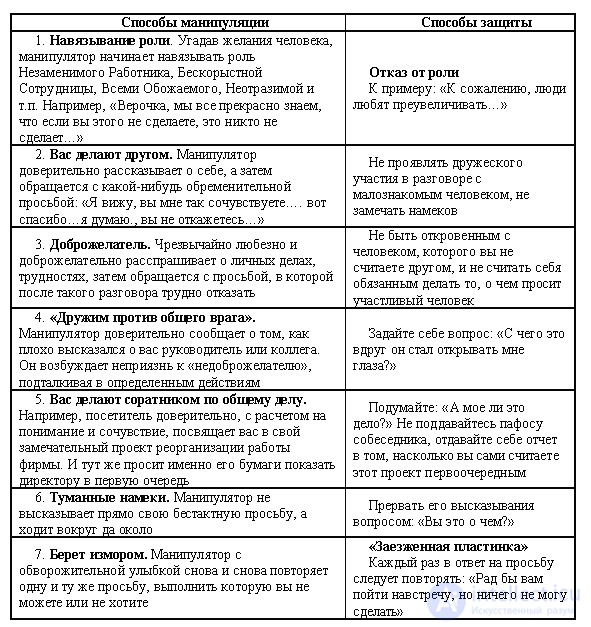
Fig. methods of manipulation and methods of defense against it
Recognizing manipulation: Recognizing manipulation requires attentiveness and communication skills. Signs of manipulation may include:
Frequent changes in behavior or mood.
Use of guilt or accusations.
Use of threats and pressure.
Lies and deception.
Exploiting others' kindness and compassion.
Attempts to isolate you from other people.
What signs allow you to determine whether your partner is manipulating you for selfish purposes or simply does not know how to communicate?
In the latter case, a person may display irritability, aggressiveness, emotional instability, preoccupation with their own problems,
indifference to the interlocutor's state. All this may be a result of a narrowing of their consciousness, yet at the same time a certain spiritual potential of the person is noticeable – hidden kindness or childlike defenselessness masked
by aggression or outward coldness. Then your task will not simply be
to withstand the partner's pressure or attack, but also to help them discover
their stereotypes of behavior and consciousness, benevolently overcoming the psychological defenses they have created.
How can you recognize a «professional» manipulator? A trait invariably present in every manipulator is the striving to gain control of the partner's will.
The manipulator will always strive to put you in a subordinate, dependent
position. He will draw this dependency from your weaknesses, fears, from
any desires from which you are not free (the desire for money, power, fame,
recognition, love).
The second distinguishing feature of a manipulator is deception, hypocrisy in his
behavior: an embarrassing sugary flattery, an eagerness to please, or
persistent clinginess, or a sense that he is holding something back
and being evasive.
You will always find the third distinguishing feature of a manipulator in his judgments, where
there will sound a call not for union, but for separation. He will try to convince
you of the necessity of fighting «for a place in the sun» («the number of places is very
limited»), of the necessity of a position of strength – «the greater your strength and ability to control others, the higher you rise as master of the situation», «people should not be befriended, but set against one another, so as to win faster».
Intrigue is the manipulator's favorite trick. The other person is always merely a means of achieving his own goals.
Of course, a skillfully executed manipulation is very
hard to recognize at once, but if you rely on your own intuition, it will always tell you
that «something is not right here». You need first of all to listen to your own feelings.
If you have a feeling that you are acting against your own will and contrary to
your own rules, that the partner is holding something back and so on, then proceed
to defend yourself against manipulative influence.
It should also be remembered that flight, aggression, crying and hysterics are childish methods of psychological defense and most often are also
destructive in nature.
More effective will be actions such as:
When dealing with a manipulator, the following should prevail:
For example, in a conversation with a sales agent: «I've heard that these days it's very
fashionable and healthy not to lose weight, but to eat everything you want, as long as it
is prepared by yourself and from fresh products. Would you like me to tell you
one simple recipe?»;
a mindset toward jointly solving the problem. One coworker to another:
«I may indeed enjoy the boss's trust, but let's tell him together
about this problem».
It should also be remembered that there is always an «emergency» way out of a situation – you can break off contact under a plausible pretext, returning to
it at the first suitable opportunity (when you are sufficiently prepared and
strong enough for confrontation).
Any negative feelings must be processed (otherwise they may destroy you), and their energy can be used to improve relationships.
This is an incomplete list of the simplest recommendations for defending against psychological attack.
According to many psychologists, the leading factor in resisting external pressure and manipulation is personal potential,
personal strength, which represents resistance to external influence and, at the same time, the power to influence people.
It presupposes individual integrity and includes the following
variables:
The higher a person's spirituality, the greater their personal strength. It turns out
that one can resist another's influence by means of one's own personal influence.
Strangely enough, a cunning, hypocritical, even if observant and
agile manipulator can most easily be resisted not by another, more
skillful manipulator with a more sophisticated arsenal of means of influence, but
by a person who is benevolent, open, sincere, free of envy and aggressiveness, but at the same time courageous, fearless, and by virtue of all
these qualities wise. It is precisely such «simple souls» that are hardest for those who seek to subordinate others to their will to deal with.
Thus, personal potential, which includes spiritual maturity
and a person's freedom from all kinds of stereotypes, is simultaneously a potential for personal influence and for resisting the influence of others.
It should be said that the acceptability of manipulation depends on whether it is used as a strategy, as a primary and constant means of influence, or as a tactic, as a situational and indirect means of influence.
In the first case, manipulation acts as a specific orientation toward
communication, although the tactics used by the person may not be manipulative at all – for example, self-disclosure in conversation (egocentric), sympathy and
attention, readiness to help, etc.
In the second case, manipulation acts as a means of indirect prompting to create additional motivation (for example, in upbringing and
teaching) or as a means of defense against someone's undesirable actions (in a situation of pressure, affective attack, coercion).
As a tactic, manipulation is used very often and by everyone without exception. Any use of metaphor, of myth (in teaching, in treatment), any
counterargumentation (for example, in a dispute, in conducting negotiations), any deliberate shifting of the partner's attention and actions is itself a kind of manipulation.
Defense against manipulation:
Set boundaries: Be clear about your boundaries and don't let manipulators cross them.
Self-assertion: Learn to say "no" and defend your interests.
Analyze the situation: Be critical of others' behavior and analyze whether it carries a manipulative character.
Communicate with others: Share your experiences and doubts with close friends or specialists.
Study communication skills: Improve your communication skills in order to better understand and manage complex situations.
Avoid emotional reactions: Strive to stay calm and think over the situation before reacting.
Defense against manipulation takes time and effort, but it can help you maintain healthy relationships and protect your interests.
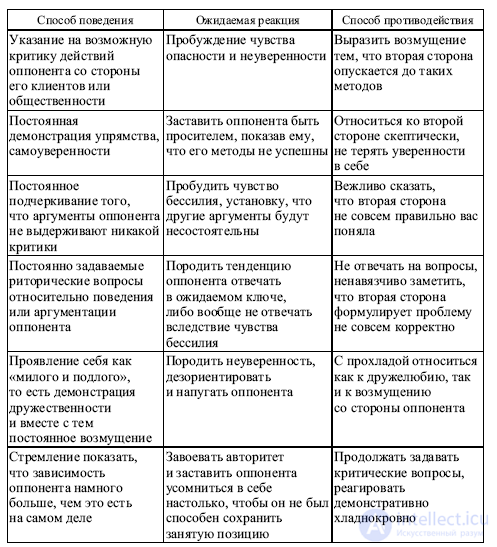
Tables 2 and 3 list typical manipulations used in the negotiation process, and ways to counteract them.
Table 2 - Manipulations based on «rules of decency» and «fairness»
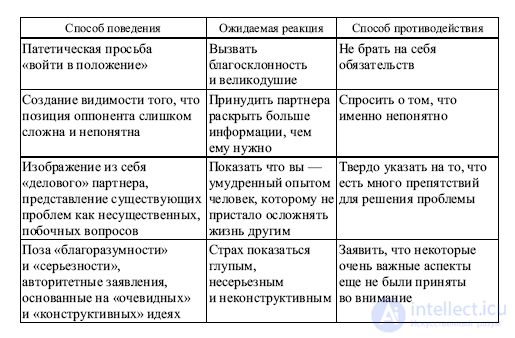
Table 3 - Manipulations aimed at humiliating the opponent

Comments