
Lecture
Emotions play an important and often key role in conflicts. They can significantly influence how conflicts arise, develop, and are resolved. Here are some of the roles emotions play in conflicts:
Initiation of conflict: Emotions can be the root cause of a conflict's emergence. For example, anger, resentment, or disappointment can lead to expressions of discontent or offensive remarks, which can mark the beginning of a conflict.
Escalation of conflict: Emotions can intensify a conflict, making it sharper and more intense. For example, if the parties feel anger and hostility, this can lead to heated verbal clashes and even physical aggression.
Serving as indicators: Emotions can indicate the importance of a conflict and the interests the parties are trying to protect. For example, fear may indicate concern about the loss of something important.
Setting priorities: Emotions help the parties determine how important the conflict is to them and what they are willing to do to resolve it. For example, a sense of justice can motivate the search for a fair solution.
Influence on communication: Emotions can affect the way people communicate during a conflict. A high degree of emotional load can make communication more aggressive, unpleasant, and less productive.
Obstacle to resolution: Sometimes strong negative emotions can be an obstacle to resolving a conflict. For example, if the parties cannot manage their anger or resentment, this can make it harder to find a constructive solution.
Need for emotional support: Conflict can cause emotional stress, and the parties may feel a need for emotional support and understanding from others.
In a conflict situation, emotions play a significant role. At times, emotions can drive people to act irrationally. The art of managing
one's own emotions lies in the ability to channel them in the right direction. Emotion-based reactions often lead to conflicts, and in a conflict
situation they lead to an escalation of opposition. Such a development of events is negative both for the opponents themselves and for the group. Let us turn to some features of emotional responding in a conflict situation.
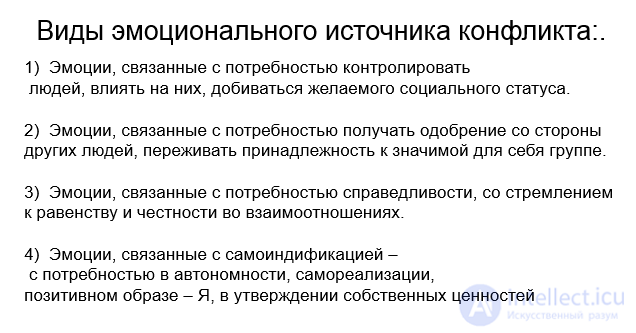
Anxiety – a mental state of unease experienced by a person
without a clear awareness of its source. This emotional state is characterized by tension and anticipation of an unfavorable turn of events. It
includes a complex of emotions: fear, grief, shame, guilt, interest, and excitement.
Anxiety proneness – an individual's tendency to experience anxiety: it can become a stable personality trait – perceiving threats to one's "self" in various situations and responding to them with heightened anxiety. In a conflict situation, such a person's anxiety proneness gives rise to certain reactions:
various attempts to escape the dangerous situation – whether in the form of verbal or physical aggression, or in the form of stupor, numbness, and an inability to analyze.
An anxious person perceives the world as carrying potential danger and strives at any cost for calm, avoiding conflicts and not
standing up for their interests. Anxiety proneness can become a cause of increased conflict-proneness in a person. An elevated level of anxiety leads to the emergence of
defense mechanisms that help get rid of the anxiety.
Emotional rigidity manifests itself as sluggishness and inflexibility of emotional responses to a changing object. The thoughts, actions, and emotions of a current conflict arise not only under the influence of what is happening at the given moment, but also under the influence of deep unconscious processes. If we restrict the expression of emotions such as fear or anger, we reduce our ability to perceive reality adequately.
Control of emotions is carried out for the most part unconsciously. People with heightened control over negative emotions and people with reduced
or normal control will express them (the emotions) differently in a conflict situation. And the outward expressions of emotion (expressions) will differ,
which does not contribute to a constructive resolution of the conflict.
The problem of regulating emotional states is one of the most complex in psychology and, at the same time, relates both to fundamental and
to applied problems.
It should be noted that there are many approaches to studying both the regulation of emotional states and the mental mechanisms that cause stress. We will consider only a few approaches. The first of these, presented in the works of F. B. Berezin, is based on the following premises:
adaptation takes place at all levels of a person's organization, including the psychic sphere; psychic adaptation is the central link in the overall
adaptation of a person, since it is precisely the nature of psychic regulation that determines the nature of adaptation as a whole. Berezin also believes that the mechanisms
of psychic adaptation, and consequently of the regulation of mental states,
lie in the intrapsychic sphere.
Among the mechanisms that determine the success of adaptation, Berezin includes mechanisms for counteracting anxiety – various forms of psychological defense and compensation. Psychological defense is a special regulatory system for stabilizing the personality, aimed at eliminating or
minimizing the feeling of anxiety associated with the awareness of some conflict. The main function of psychological defense is to "shield"
the sphere of consciousness from negative experiences that traumatize the personality. In a broad sense, this term is used to denote any behavior, including
inadequate behavior, aimed at eliminating discomfort.
Berezin identifies four types of psychological defense: those that prevent awareness of threat factors causing anxiety; those that allow anxiety to be fixed; those that reduce the level of drives; and those that eliminate anxiety. His research revealed a regular succession of mechanisms of intrapsychic adaptation and made it possible to say that different forms of psychological defense have different capacities to withstand
anxiety and other negative states. Moreover, it was found that there is a certain hierarchy of types of psychological defense. When one
form of defense proves unable to withstand anxiety, another form of defense "switches on." Berezin also found that disruption of the mechanisms of psychic adaptation or the use of an inadequate form of defense can lead to the somatization of anxiety, i.e., the channeling of anxiety
toward the formation of pre-morbid states, or to a final breakdown of adaptation. This happens because anxiety, like any other emotional state, is connected with the vegetative and humoral regulation of the organism, i.e., certain physiological changes occur when this state arises. It should also be noted that an individual's use of an inadequate form of psychological defense and the emergence of hyperanxiety are always accompanied by overstrain that is more significant in intensity than ordinary motivational strain. As a rule, in this situation a state arises that is caused by the blockage of motivational behavior, known as frustration.
Frustration is a mental state of a person caused by objectively insurmountable difficulties encountered in achieving a goal or solving a task. It should be noted that the term "frustration" is used in the modern scientific literature in different senses. Very often frustration is understood as a form of emotional stress. In some works this term denotes frustrating situations, in others – a mental state, but it always implies a mismatch between the behavioral process and the outcome, i.e., the individual's behavior does not correspond to the situation, and consequently he does not achieve the goal he is striving for, and may even arrive at a completely opposite result.
Frustrating situations that are significant for adaptation are usually linked to a wide range of needs that cannot be satisfied in
a given situation. As you already know, a need is a state of an individual created by an experienced want for something. There are various classifications of the most significant needs. P. V. Simonov, for example, distinguishes biological, social, and ideal needs. A. Maslow argues that
there is a certain hierarchy of needs, among which social needs belong to the higher ones.
The inability to satisfy one need or another causes a certain psychic tension. In the case of a reorganization of an entire complex
of needs, or their disagreement, when a person tries to solve two or more mutually exclusive tasks, psychic tension reaches
its highest limits, and as a result a state arises that causes a disruption of the adequacy of behavior, i.e., frustration. As a rule, this state arises as a result of a certain conflict, usually called an intrapsychic conflict, or a conflict of motives. The incompatibility and clash of opposing personality tendencies characteristic of an intrapsychic conflict inevitably hinder the construction of holistic, integrative behavior and increase the risk of a breakdown in adaptation.
It is precisely with the situation of intrapsychic conflict that emotional stress is directly connected. The probability of an intrapsychic
conflict arising is largely determined by features of the cognitive sphere. Numerous studies have shown the role of cognitive elements in
the development of stress, and a mismatch between cognitive elements (cognitive dissonance) entails an increase in tension, and the greater
the mismatch, the higher the tension, which leads to a disruption of the integration of behavior.
Integration of behavior is a system of interconnection between elements of a person's psychic structure, enabling tasks to be successfully solved in the interests of the individual's adaptation, and above all achieving consistency between his motives and the demands of his environment. Integration of behavior is realized through such
psychological formations as attitude, relation, and role structures.
An intrapsychic conflict of relations, which are formed on the basis of role and personal attitudes, can lead to a disorganization of behavior
and a disruption of the established structures of personality – the "self-image," the "self-concept," self-esteem. At the same time, disorganization of behavior will be accompanied by a negative emotional background, since emotions are linked to motives and ensure the implementation of certain regulatory functions, while the integration
of emotions into a single system determines the nature of the emotional state.
Building integrated behavior is an essential part of the adaptation process. A disruption of behavior at any level of integration is accompanied by a decline in the quality of psychic adaptation, an increase in frustration tension, and corresponding physiological shifts.
Depending on how integrated our behavior is, i.e., how whole, conscious, and subordinated to a definite goal, the higher our threshold of
frustration, which can be regarded as a measure of the potential
stability of psychic adaptation and the ability to withstand emerging tension.
One of the most important constituent elements of the structure of personality, affecting the level of integration of behavior and, consequently, the process of adaptation as a whole, is the "self-concept." The "self-concept" is a relatively stable, more or less consciously experienced, unique
system of an individual's ideas about himself, on the basis of which he builds his interaction with other people and relates to himself. As
follows from this definition, the "self-concept" is a system of a person's relations to himself and to the objects, people, and other phenomena around him. All the information a person receives from the external environment is perceived in the context of this system of relations, and, based on the degree of correspondence or non-correspondence to his goals, on whether the information received carries a threat or approval, a person builds his behavior. It is no coincidence that the "self-concept" is considered to form the core of a person's system of self-regulation. At the base of the "self-concept" lie self-esteem and level of aspiration, reflecting
the general orientation of the motivational sphere, oriented toward achieving success (achievement motivation) or avoiding failure (avoidance motivation). In turn, studies of motivation have shown a relationship between the nature of motivation and the choice of behavioral strategies, as well as features of adaptation to the conditions of a changing environment. When achievement motivation predominates, behavior is distinguished by the absence of visible anxiety, and conversely, avoidance-of-failure motivation is accompanied by manifestations of anxiety.
Since we have begun to speak of the system of personality relations, we cannot fail to recall V. N. Myasishchev – the author of the concept of personality relations. In
Myasishchev's view, the system of relations forms the core of the personality. This system is formed under the influence of the reflection, in a person's consciousness, of the surrounding
reality. This concept has found wide application in medical psychology, especially in the study and treatment of neuroses.
Neuroses are a group of neuropsychic disorders, psychogenic in nature, resulting from prolonged or excessively intense emotional strain. The main cause of neurosis is a disruption of the system regulating emotional connection, caused by a contradiction between a person's attitudes and views and external reality, i.e., at the root of such a disruption lies an intrapsychic conflict.
Neurosis, being a neuropsychic disorder, is accompanied by vegetative manifestations: muscle tension, tremor, disturbances
of heart function, anxiety, a feeling of depression, headaches, weakness. Moreover, these vegetative changes occur not immediately, but gradually.
First of all, sleep changes. It becomes shallow, and the person wakes easily. Gradually, the person's sensitivity to external stimuli changes. Sound, light, and conversations irritate the person unusually strongly.
Even ordinary-level noises can become unbearable. Increased sensitivity serves, on the one hand, as an adaptive mechanism in the face of
a lack of information, providing an influx of additional signals with the help of which the situation can be resolved. On the other hand, increased
sensitivity makes a person more receptive to any stimuli and manifests itself as excessive tearfulness, impatience, and irritability, as
well as in the form of painful sensations in response to weak signals from the internal environment that were previously not perceived.
However, the main feature of neurosis is conflict. Conflict is found at the root of most neuroses and is always accompanied by extremely intense experiences. These experiences can vary.
For example, a feeling of one's own guilt, one's own oversight, as a result of which the traumatic situation arose, and so on. At the same time, it should be noted that
experiences become a source of neurosis only if they are especially significant for the person. That is why most emotional, or intrapsychic, conflicts that have served as the cause of illness are social in nature. For example, a person falls ill not because he became a victim of
injustice, but because the injustice shown toward him (real or perceived) disrupted his ideas about justice, his faith in good and evil, in the meaning of human existence.
Thus, we have arrived at the conclusion that emotional stress most often turns out to be connected with social phenomena, i.e., emotional
stress is an inseparable part of a person's social adaptation. As a result of our many years of experimental research on this problem, we
have come to the conclusion that there exist personality characteristics that determine the success of a person's adaptation under the most varied conditions.
These characteristics are formed over the course of a person's entire life, and among the first to be included are the level of neuropsychic stability, self-esteem of the personality, a sense of one's own significance to others (social referentiality), level of conflict-proneness, communication experience, moral orientation, and orientation toward the demands of the immediate environment. Upon detailed study, all these characteristics turned out to be interconnected with one another. Moreover, they form a single integral characteristic, which we have named the personal adaptive potential.
This characteristic is regarded by us as a systemic property of the personality, consisting in the ability of the personality to adapt to the conditions
of the social environment. The higher the level of development of this property, the more rigid and harsh the conditions of the social environment to which a person can adapt.
In the course of experimental research, it was established that even under conditions of a real threat to life, people with a higher adaptive
potential not only have a greater chance of survival, but can successfully carry out their professional duties. It should also be noted that subsequently, individuals with a higher level of development of personal adaptive potential have a greater chance, compared with others, of restoring the functional state of the organism and returning to a normal life.
There are also other approaches to considering the problem of regulating emotional states and emotional stress. We will not examine them here, since in the course of studying other academic subjects you will become more closely acquainted with them. We will conclude this chapter by considering the practical aspects of regulating emotional states. R. M. Granovskaya divides all strategies for getting out of a stressful situation
into three groups: changing or eliminating the problem; reducing its intensity by shifting one's point of view on it; and easing its impact
with the help of a number of methods.
A key role in managing one's state is played by an awareness of one's life goals and by relating specific values to them. The faster a person defines his life values and goals, the greater his chances of avoiding the negative consequences of a sudden and excessive emotional strain, since a person who has made his main life choice has, to a significant degree, determined all his further decisions and thereby freed himself from hesitation and fears. When faced with a difficult situation, he relates its significance to his main life orientations. The timeliness
of such weighing normalizes his state. At the same time, a critical situation is viewed against the background of an overall perspective, for example, of a person's entire life, as a result of which the significance of this situation can sharply decrease. Many examples are known where people experienced accidents from
which they could have recovered within a few hours. But their reaction to them was so inadequate, so incommensurate with their personal scale of values,
that significant life crises developed. Therefore, unfavorable consequences often arise not because of the incidents themselves, but because of the reaction to them.
Thus, one of the main ways of avoiding excessive emotional strain is the harmonious development of a person's personality,
and the formation in him of an independent worldview position. Moreover, this development begins from the very first days of a person's life, and its success depends to a significant extent on how skillfully the child's parents, and later the teachers at school, conduct the upbringing process, on how much the state cares about the upbringing of the younger generation, and on much else.
The next method of regulating emotional states, in Granovskaya's view, consists in correctly choosing the moment for making a decision
or carrying out one's plan. As is known, an extreme situation leads to a narrowing of consciousness, which leads to a disruption of orientation in the surrounding environment. Anxiety and agitation change the strategy of behavior. A person overcome by confusion strives to avoid the slightest risk and is afraid to move in a direction that
threatens delusions and mistakes, and therefore tries to link every new piece of information to something similar already known to him. In this situation, a person
very often makes mistakes, arriving at the wrong decision. It is therefore necessary to learn to correctly choose the moment for carrying out one's plans
in a complex, emotionally charged situation.
Another way to reduce emotional strain consists in weakening motivation. For example, temporarily abandoning the achievement of a set goal, or reducing emotional tension through a deliberate shift of attention, concentrating it not on the significance of the outcome of the activity being performed, but on the analysis of the technical details of the task or on tactical methods.
To create an optimal emotional state, first of all a correct assessment of the significance of the event taking place is needed, since
a person is affected not so much by the intensity and duration of real events as by their individual value. When an event is viewed
as extraordinary, even a factor of low intensity can cause maladaptation. It must also be kept in mind that under strong emotional
arousal, a person's personal characteristics play a very significant role in assessing the event. Thus, a good forecast becomes even more optimistic for an optimist, while a bad one becomes even gloomier for a pessimist. However, in order to correctly assess an event, full awareness of it is necessary. The greater the amount of information a person has on a troubling matter, the lower the probability of an emotional breakdown. From this
it follows that one must make every effort to increase the amount of information about the problem that concerns you. At the same time, this awareness should be diverse in scope.
Granovskaya identifies yet another way of combating emotional stress and emotional tension. This method consists in strategies of retreat prepared
in advance. Having a fallback option of behavior in one situation or another reduces excessive arousal and makes
success in solving the task along the main line of action more likely. Without having prepared an alternative solution, a person unjustifiably assesses pessimistically the situation that may arise in the event the main option fails. Having a fallback option of action, in the event the first one fails, it is easier for a person
to come to terms with the setback and to preserve, in the process, an optimistic frame of mind. Consequently, fallback strategies reduce the fear of an unfavorable turn of events and thereby contribute to creating an optimal
background for solving the task.
In addition to the methods listed for getting out of a stressful situation, it should be kept in mind that it makes no sense to fight against something that is already an accomplished fact. In certain circumstances, when continuing one's efforts turns into fruitless attempts to "beat one's head against a wall," it is
useful for a person temporarily to abandon efforts toward the immediate achievement of the goal, to recognize the real situation and his defeat. Then he will be able to conserve his strength
for a new attempt under more favorable circumstances. In addition, in the event of defeat it does no harm to make a general reappraisal of the situation along the lines of "it
wasn't really wanted that much anyway." Lowering the subjective significance of the event helps one to fall back to previously prepared positions and to prepare for the next assault without wasting unnecessary strength. It is no coincidence that in deep antiquity, in the East, people prayed in their prayer:
"Lord, grant me the strength to cope with what I can do, grant me the courage to accept what I cannot do, and grant me the wisdom to tell the one from the other."
To effectively manage conflicts, it is important to be aware of one's own emotions, as well as to take into account the emotions of the other parties. Empathy and the ability to listen to and understand other people's emotional experiences can contribute to a more constructive and effective resolution of conflicts. It is also useful to learn to manage one's own emotions so as not to let them intensify the conflict.

Comments