
Lecture
Communication is a special and important type of activity that is present in the life of every person and has a profound effect on his or her development, psychology, and relationships with others.
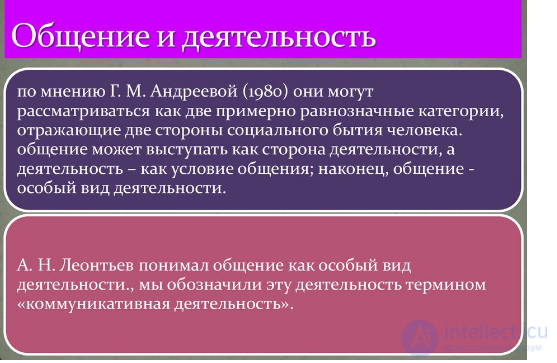
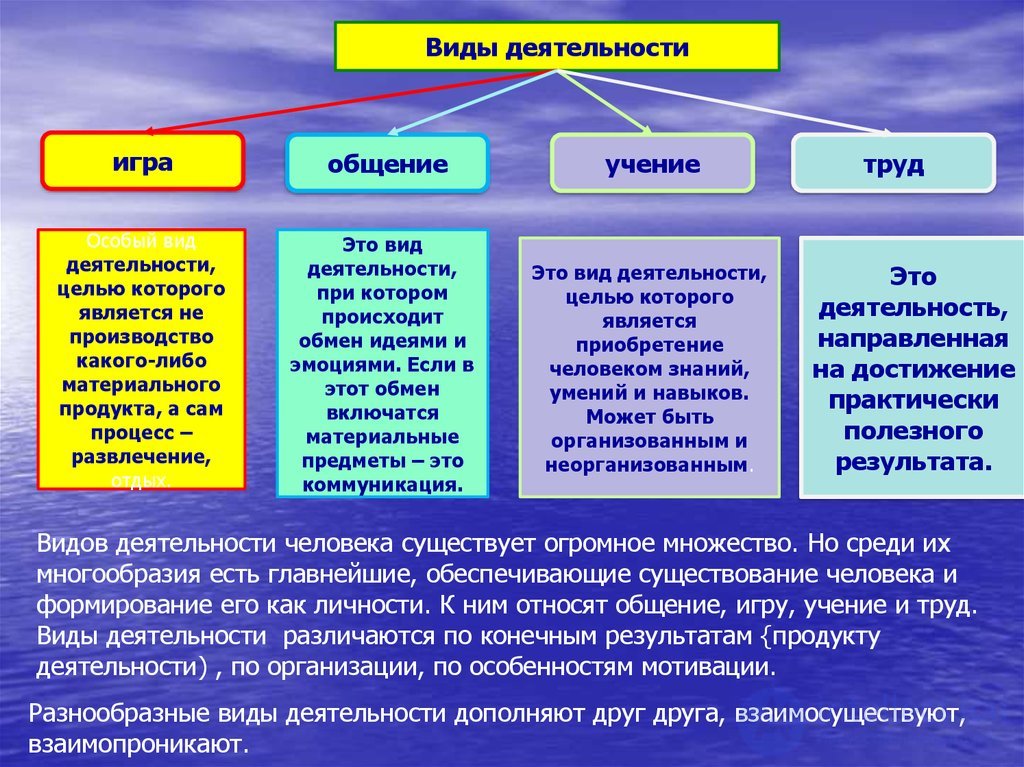
The question of the relationship between communication and activity is a complex and ambiguous one in psychology. Some researchers regard communication as one of the types of human activity (A.N. Leontiev, V.S. Merlin, B.G. Ananyev, and others). According to another point of view (B.F. Lomov and others), the category of communication has the right to relative independence. At the same time, B.F. Lomov holds that the categories of communication and activity are inseparably linked. Communication – is one of the aspects of a person's way of life, and no less essential than activity. There exists a series of transitions and transformations between these two aspects.
In the context of psychology and sociology, communication is regarded as a special form of interaction between individuals or groups of people and includes the following important aspects:
A means of transmitting information: Communication is a key way of transmitting information, ideas, knowledge, and experience from one individual to another. Through communication we learn about the world, society, other people, and ourselves.
A way of expressing emotions: Communication allows us to express and understand emotions. We share our joys, fears, concerns, and feelings with other people, which strengthens our emotional bonds.
A means of socialization: Communication plays an important role in the process of socialization, helping people enter society and internalize its values, norms, and rules. Through communication we learn the roles of son, daughter, friend, colleague, and other social roles.
Creating and maintaining relationships: Communication contributes to the formation and strengthening of interpersonal relationships. This includes building friendship, love, and partnership, as well as resolving conflicts and reconciliation.
A means of power and influence: Communication can be used for persuasion, influence, and controlling others. People use communication to express their interests, persuade others, and achieve their goals.
A means of self-expression: Communication allows us to express our thoughts, ideas, opinions, and creative concepts. This contributes to self-expression and self-identification.
A means of conflict resolution: Communication also serves as a tool for resolving conflicts and seeking compromises. Proper communication can help settle disputes and reach agreement.
Communication occupies an exceptionally important place in the life of every person and plays such a significant role in modern society that it seems legitimate to regard it as a fundamental category of methodological significance for the development of modern science, education,
and culture. Of the greatest scholarly interest are the conceptually different definitions and interpretations of the category of communication presented in
the works of I. A. Zimnyaya and A. A. Leontiev.
A. A. Leontiev developed a theoretical concept of communication in the 1970s as a development of his theory of speech activity. The concept of communication serves
for him as a system-forming concept, one of the key categories not only of contemporary psychology but of other human sciences as well. It denotes
«a system of purposeful and motivated processes ensuring the interaction of people in collective activity, realizing social and personal, psychological relations, and using specific means, above all language». A classification of types of communication is examined
according to four bases: orientation (object-oriented, socially oriented, and personally oriented communication), psychological
dynamics, semiotic specialization, and degree of mediation.
A. A. Leontiev's concept devotes considerable attention to the relationship between the categories of communication and activity. It is important to stress that his understanding
of communication as activity does not oppose the ideas about the specificity of communication as a special process not reducible to activity (G. S. Batishchev, B. F. Lomov, and
others), but rather the widespread models of interaction between people as a purely inter-individual process of information exchange, which is only one of the particular aspects of communication. He considers communication in a broader context, not reducible to the interpersonal interaction of isolated individuals, but arising from the social nature of the human being. «Communication is not only, and not so much, a relationship between people in society, as (above all!) an interaction of people as members of society». In A. A. Leontiev's view, difficulties in understanding communication as activity exist only on the condition that the subject of communication is understood as merely a separate individual
. «The social nature» of an individual's activity is not universally abstract in character: it is rooted in a historically concrete form of society. The same applies to communication, which – independently of whether, in a strictly psychological analysis, we consider it to be activity or not, – is a way, a condition, and at the same time a process of the actualization of social relations, and, like activity, has a concretely social conditioning. Communication develops historically… as a consequence and product of the historical development of society, although at a certain stage of this development it acquires relative independence – psychological (i.e., it becomes an independent activity), semiotic (it acquires its own means), and social». Elsewhere he speaks of the relationship between the individual and society by means of speech. «The social environment does not simply shape the personality through activity and in the process of activity, but the very objectivity that constitutes a property of activity itself has a social nature. The social is not «given» through activity; the problem is not one of «sociality and activity»: it is in fact a question of the social essence of the very objects of activity and of the sociality of human consciousness, which reflects these objects in the process of activity and owing to it».
A. A. Leontiev emphasized that communication is one of the types of activity; this does not mean that communication in all cases appears as an independent activity; what matters is that it can be such, although it may also appear as a component, a constituent part (and at the same time a condition) of another, non-communicative activity.
On different stages of the unfolding of the activity of communication, the realization of communicative intentions and the solution of communicative tasks relies on
systems of orientation processes, among which non-verbal components of communication occupy an important place. The activity-related status of communication «does not mean that an act of communication always functions as the highest structural unit of activity (also called by A. N. Leontiev «activity»). Communication
can enter into another activity, for example, in the capacity of an action. In this case, its activity-related nature does not change; the change concerns only its place in the
structure of activity». In other words, communication can function as an independent activity, but it can also enter into another activity in the status of its
structural components.
Communication has many forms and methods, including oral communication, written communication, non-verbal signals, mass media, and much more. Effective communication requires skills of listening, expressiveness, empathy, and adaptation to various situations and interlocutors.
Overall, communication plays an important role in the life of the individual and society. It not only facilitates the exchange of information, but also shapes our relationships, influences our psychological state, and has an impact on the sociocultural aspects of our lives.

Comments