
Lecture
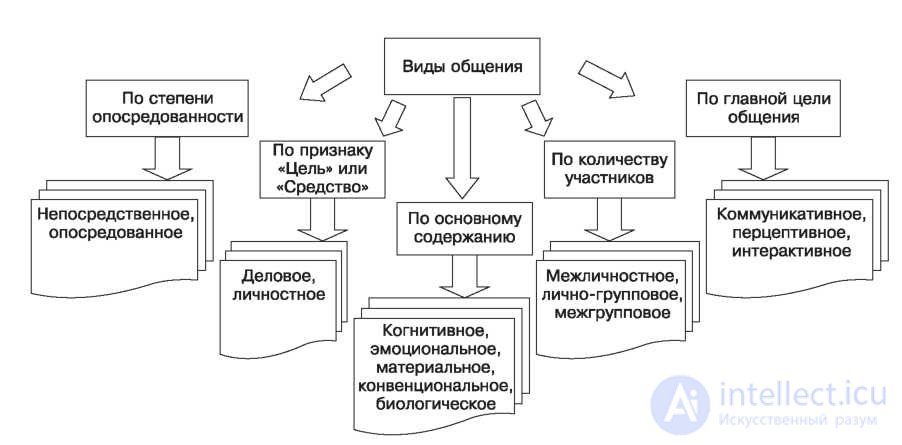
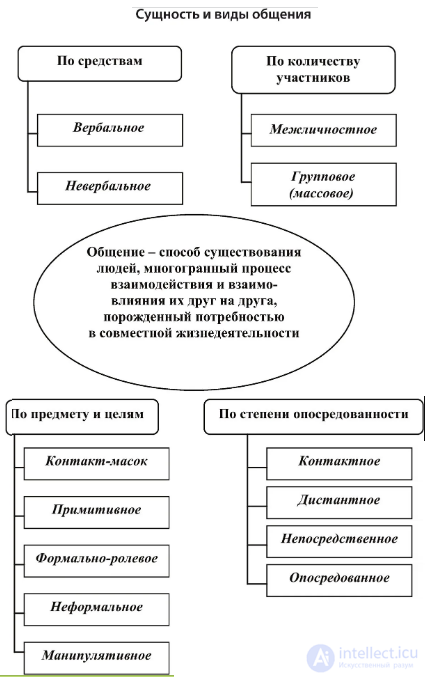
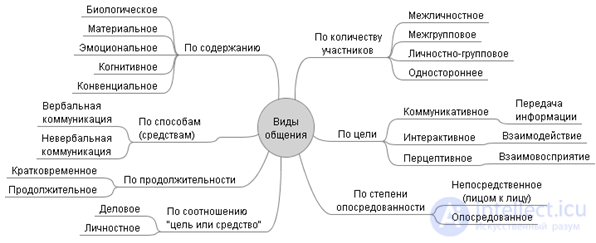
Communication is diverse and can be classified according to different criteria. Here are some of the main types of communication, their characteristics and examples:
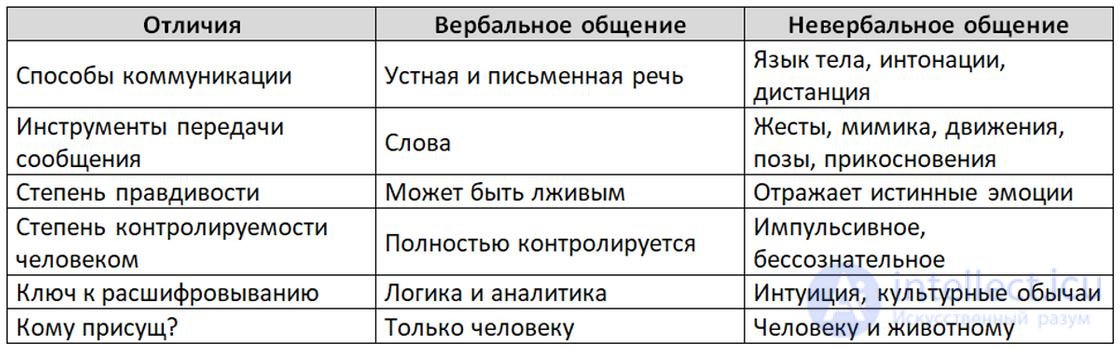
Verbal communication:
Oral communication: This is communication based on spoken speech. People talk to one another, exchanging information and ideas using words and sounds. Examples: conversations, lectures, phone calls.
Written communication: In this type of communication, information is conveyed in written form, using text and symbols. Examples: emails, text messages, letters.
Nonverbal communication:
Facial expressions and gestures: Nonverbal means of communication include facial expressions, gestures and postures that convey emotions and express messages without words.
Pauses and intonation: How and when we pause in conversation, and how the intonation of the voice changes, can convey additional information and emotions.
Indirect signs: This includes the use of symbols, colors, clothing and other elements to express information or belonging to a particular group.
Joint communication:
Group communication: Communication among three or more people. Examples: business meetings, group project discussions, family conversations.
Mass communication: Communication directed at a large audience, usually through mass media such as television, radio and social networks. Examples: news, talk shows, advertising.
Interpersonal communication:
Friendly communication: Communication between friends and close people. It often includes emotional support and entertainment.
Professional communication: Communication in a work environment or in professional contexts. Examples: business correspondence, interviews, work meetings.
Virtual communication:
Online communication: Communication over the internet and using modern technologies. Examples: chats, video conferences, social networks.
Gaming communication: Communication within video games and virtual worlds. Examples: multiplayer online games, chats in gaming applications.
Family communication:
Communication within the family: The exchange of information, feelings and experience among family members. Examples: family dinners, evening conversations, joint activities.
Parental communication: Communication between parents and children. It includes upbringing, care and education.
In interpersonal communication, verbal and nonverbal means of exchanging information, mechanisms of psychological influence, etc. are usually employed. It involves establishing direct contact between communication partners, allowing them to react to and influence the interaction process directly. This is precisely why interpersonal communication is also called direct, immediate communication, as opposed to mediated mass communication
(mass communication is anonymous in character; it is directed not at a specific individual but at large masses of people, and is carried out mostly through the mass media).
It is important to emphasize the emotional character of interpersonal communication, since in it people are oriented above all toward their own inner goals, values and needs. And although the content of such communication, and its forms, can flexibly
change and adapt to the image of the partner that takes shape in the course of interaction, it simultaneously gives its participants considerable freedom in choosing how to communicate, and in deciding on its
continuation or termination. In this situation, interpersonal communication rests on the emotional attractiveness and similarity of the partners and depends little on their social roles and statuses.
In the situation of mediated (mass) communication, there is a certain spatio-temporal distance between the participants in the interaction. Under such conditions, communication is predominantly one-sided in character: a person can only perceive information coming to
them from other generations, societies or eras, but cannot transmit any
information to them in return.
Such mediated communication, which is carried out, for example, through literature, works of art or other creations of culture,
is of great importance for enriching a person's relationship with the world; it takes the individual beyond their immediate surroundings, making the person part
of all human culture and of all the events taking place in the world. Thanks to the diverse forms of mediated communication, an individual can
become aware of their unity with the society in which they live, or with humanity as a whole, and feel themselves to be an integral part of it.
If communication is organized around properly psychological problems (establishing emotional relationships with another person, creating conditions for the development of the individual, etc.), it is called personality-oriented. When communication is limited to interaction only at the business level, it takes on a formal character and is called official (role-based).
Personality-oriented (or personal) communication involves singling out within it a purely psychological aspect, that is, the inner
world of a person. This by no means implies that only one partner in the communication is involved. It is precisely in a relationship with another person that an individual can most fully
manifest and reveal themselves as a person, as a subject of interaction.
Thus, personal communication presupposes situations of interaction in which the participants of communication engage personally. The main purpose
of this type of communication is to ensure the existence of the individual's inner world,
the perception of oneself and the other as persons, and the assertion of the right to a personal attitude toward phenomena of the external world. This is not a matter of egoistic striving, nor of defending "one's own" claims, but of asserting universal human rights and qualities of the person as an individual.
As in any other type of communication, in personal communication partners exchange information about their own experiences, feelings, external
events, etc. However, it would hardly be appropriate to reduce personal communication to an informational process alone.
The informational aspect of communication here is of rather secondary
importance, while the person's inner world comes to the fore.
M. Bobneva notes on this point that no matter how interesting and important
the information may be for the partners, it is admitted into the content of personal
communication only on the condition that its presentation allows the person's genuine properties and qualities to manifest themselves, for example altruism, the ability not only
to listen, but also to hear.
The same, in the researcher's view, can be said about the significance of joint activity for personal communication or for a world external to the person: the performance of any activity encompasses personal communication provided that the properties of the person are manifested and realized in it;
external events are likewise incorporated into personal communication provided that, in connection with their evaluation, comprehension and experiencing, the person of the
participants of communication is genuinely manifested, that is, provided that external events become meaningful to the partners' inner world and can be represented in communication.
On this basis, communication is assessed by the partners as truly personal only when kindness, as a trait of the person entering into contact, directly manifests itself in the process of communication. In this interpretation, personal communication differs from confidential communication, whose main characteristic is the disclosure of especially significant information. At the same time, trustfulness as a personality trait is an essential feature of all types of communication, including personal communication.
Official (role-based) communication involves relations mediated by social or professional roles. This type of communication may have elements of the personal, but they are actualized only to the extent that they do not conflict with the restrictions imposed by business
relations.
Role-based communication is extremely widespread in modern society. It ensures interaction in situations such as "supervisor –
subordinate," "student – teacher," "buyer – seller," "doctor – patient," and others. It is precisely the role expectations of the participants of communication that determine how a partner is perceived, how their behavior is evaluated, how an individual evaluates their own behavior, and what they are like as the performer of a role.
In a role-based communication situation, a person is not free to choose their behavioral strategy; it is deprived of a certain spontaneity of reactions, actions and feelings, and sometimes even of inner response. And although each person brings individuality and uniqueness to their social roles (there are not and cannot be two identical doctors, lecturers, or teachers), the images, actions and ideas are imposed on the person from outside, by their social position: "At present
I am a supervisor, which means…," "I am a doctor, accordingly…."
Formal (role-based) communication allows a person to realize themselves as a member of society, of a particular group, as a spokesperson for the interests of a certain social stratum, and as a creator of various social relations. Being
a participant in official communication, a person acquires a number of important values – a sense of belonging to a community, social security, and so on.
Business (role-based) communication is heterogeneous in nature. For example, role-based communication in the sphere of economics differs from communication in law-enforcement agencies, and so on. If a person fails to observe the rules of conducting official negotiations, this indicates serious problems in the professional training of specialists in the given field.
The inability to distinguish the essential in an official conversation, and to state one's thoughts concisely and competently, can result in significant losses of working
time. A variant of business communication is representative communication, which involves interaction between people as representatives of various
states, social groups or institutions.
The distinctive feature of this type of communication is that it is usually carried out in the form of negotiations. Under such conditions, relations of sympathy and antipathy are reduced to a minimum, compared with people's ability to represent their community and to organize and plan joint actions.
According to another classification, the varieties of business communication are cognitive (its purpose is to expand a partner's information base, conveying information necessary for professional activity, etc.); persuasive (arouses certain feelings in business partners,
forms value orientations and attitudes, convinces them of the legitimacy of particular interaction strategies, etc.); expressive (forms in a partner a psycho-emotional mood that prompts the necessary social actions); suggestive (aims to influence a business partner in order to
change their motivation, value orientations, behavior, etc.); and ritual (consolidates and maintains conventional relations in the business world, ensures the regulation of social psychology in large and small groups, and preserves the ritual traditions of an institution or firm; the value of individuality
in ritual communication is minimized, and the participants are equal in their right to satisfy the important social needs for the sake of which they entered into the ritual) – these are the types of communication.
According to the type of ties established between the participants of interaction, two types of communication are distinguished: monological and dialogical.
Monological communication is characterized by a one-way flow of information, that is, one of the participants in the interaction expresses their
thoughts, ideas and feelings without feeling any need to receive feedback from the partner. Such a situation can lead to positional inequality between communication partners: one participant is an influential figure endowed with agency, conscious goals and the right to realize them, while the other is regarded by the first as a passive figure who, although having goals, does not consider them as significant as their own. Under such conditions we are dealing with "subject-object" communication. Two varieties of monological communication are distinguished: imperative and manipulative.
Imperative communication is usually understood as an authoritarian, directive form of influencing a partner with the aim of compelling certain
actions or decisions, as well as exercising control over their behavior and attitudes. As a rule, imperative communication is used to establish control over a partner's external behavior, since the inner world of the participant in communication is primarily that person's own possession, and influencing it with
the aim of changing it is extremely difficult.
The final formula of the imperative is clear and unveiled:
"Do as I command!" The means of influence here are orders, demands, rewards, commands, prohibitions, intimidation, and so on. The above
does not mean that imperative communication carries only a negative charge and coloring.
There are quite a few social activities and situations in which the use of the imperative is entirely justified, both from the standpoint of the goal and from the ethical side
of the interaction. For example, the imperative type of communication is widespread in military statutory relations, especially under extreme conditions.
As for educational practice, the possibilities for applying the imperative type of communication are also limited there. Although with the help of
orders, commands and prohibitions ("don't shout," "don't run," etc.) one can achieve a child's outward compliance with certain adult requirements, however
the norms and values conveyed in this way do not become the child's own inner personal convictions and, consequently, remain external manifestations of behavior for the corresponding period of time.
Manipulative communication, being a widespread form of monological communication, involves influencing an interaction partner in order to achieve one's own hidden intentions and goals. Like the imperative, manipulation aims to achieve control over the behavior and thoughts
of the other person. However, the main difference lies in the fact that in manipulative communication a partner does not inform their interlocutor of their true goals; their real purposes are concealed, disguised or replaced with others. Manipulation can therefore also be defined as covert control of people and their behavior. Both the very fact of the influence and its goal are concealed. At the same time, the partner must retain the illusion of independence in making the decision or performing the act.
Dialogical communication helps a person discover a reality different from their own: the reality of another person, their feelings,
ideas and opinions – in short, the reality of the surrounding world as seen by the partner in interaction.
According to the tradition of domestic psychology, dialogue is considered on several levels.
Dialogue is:
1) a primary, generic form of human communication that determines the completeness of a person's mental development;
2) the leading determinant of this development, ensuring the functioning of the mechanism of interiorization, when external primary interaction
passes "inward" into the person, thereby determining their individual psychological uniqueness;
3) principles and methods of studying a person, which are realized by reconstructing the content of the internal semantic fields of the subjects of dialogical interaction;
4) a communicative process occurring according to its own laws and its own internal dynamics;
5) a particular psychophysical state unfolding in the interpersonal space between people who are communicating; this state
is akin to infantile experiences, to the state of emotional comfort during physical contact between mother and child;
6) a high level of organization of relations and communication between people,
which is most organically close to the primary nature of the human psyche, and is therefore optimal for normal mental functioning and personal development of people, and for the realization of their needs, aspirations and intentions;
7) an effective method of pedagogical, ideological, intimate, psycho-correctional and other kinds of influence; a creative process of the joint search for truth, beauty and harmony.
In the theory of dialogue as a whole, the relations that develop between specific
people are often divided into dialogical, anti-dialogical and indifferent. Here, dialogical relations are subject-subject relations, while indifferent and anti-dialogical relations are subject-object relations.
Dialogical relations arise when one participant in communication perceives the holistic image of the other as a desired partner in interaction, on the basis of recognizing that person's belonging to a certain community to which they also relate themselves.
Dialogical relations are conventionally divided into several subtypes:
It happens that one of the parties often violates the rules of humane dialogical interaction. In such a case, dialogical relations turn into anti-dialogical, inhumane relations, that is, ones in which one or both partners in the interaction perceive each other as an object, a thing,
fundamentally denying the existence of any commonality between them.
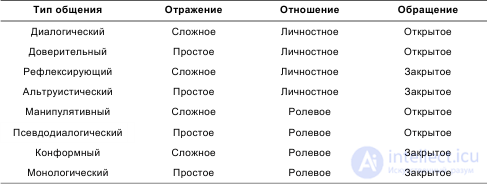
Each type of communication has its own features and requires skills in order to be effective. People often use a combination of different types of communication depending on the situation and goals.

Comments