
Lecture
In the cultural-historical approach, L. S. Vygotsky proposes to regard the social
environment not as one of the factors, but as the main source of personality development.
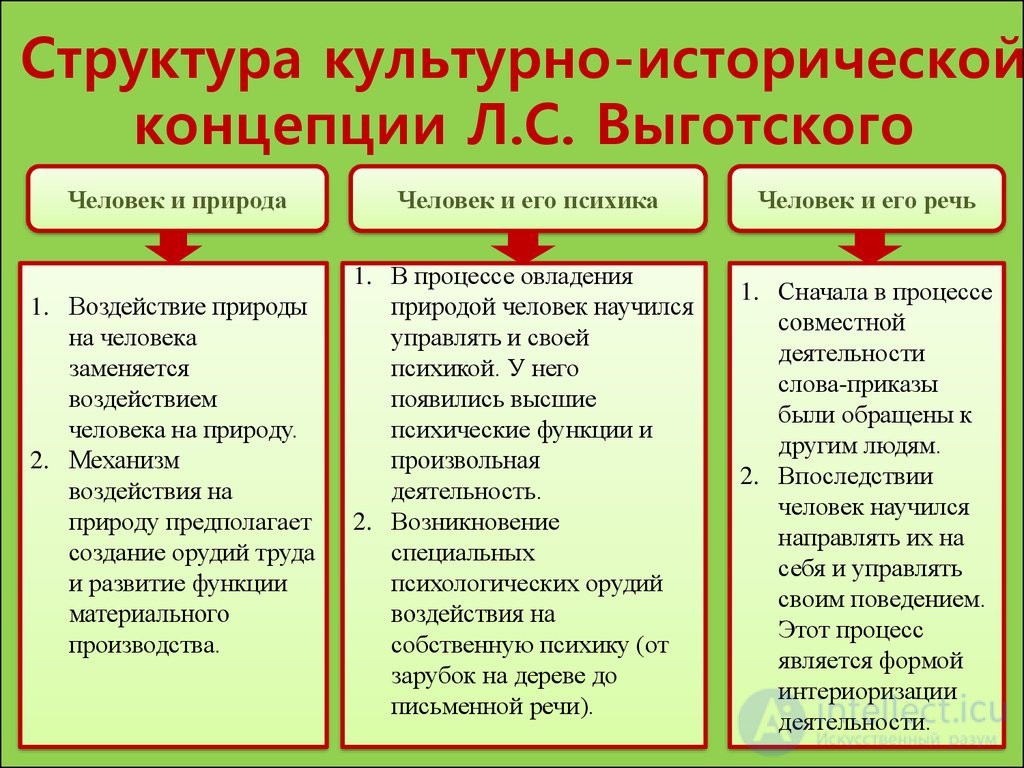
The essence of Vygotsky's cultural-historical concept lies in the fact that the scientist considers it necessary to fundamentally distinguish between lower and higher psychological functions that directly influence human behavior. Vygotsky pointed out that «consciousness determines life, but it itself arises from life».
In the child's development, he notes, there are two intertwined lines. The first follows the path of natural maturation, the second consists in mastering culture, ways of behaving and thinking. According to Vygotsky's theory, the development
of thinking and other mental functions occurs, in the first place, not through their self-development, but through the child's use of «psychological tools», by mastering a system of sign-symbols such as language, writing, and the number system.
The development of thinking, perception, memory and other mental functions
occurs through a stage (form) of external activity, in which cultural means
have a quite object-like form and mental functions operate entirely
externally, intrapsychically. Only as the process of the activity
is worked through does the activity of mental functions collapse, become interiorized, grow inward, pass from the external plane to the internal one, becoming interpsychic.
In the process of this working-through and folding inward, mental functions acquire automaticity, awareness and voluntariness. If
difficulty arises in thinking or other mental processes, exteriorization is always
possible – the carrying of the mental function outward and the clarification of its work in externally object-related activity. A plan on the internal
plane can always be worked through by actions on the external plane.
As a rule, at this first stage of external activity, everything the
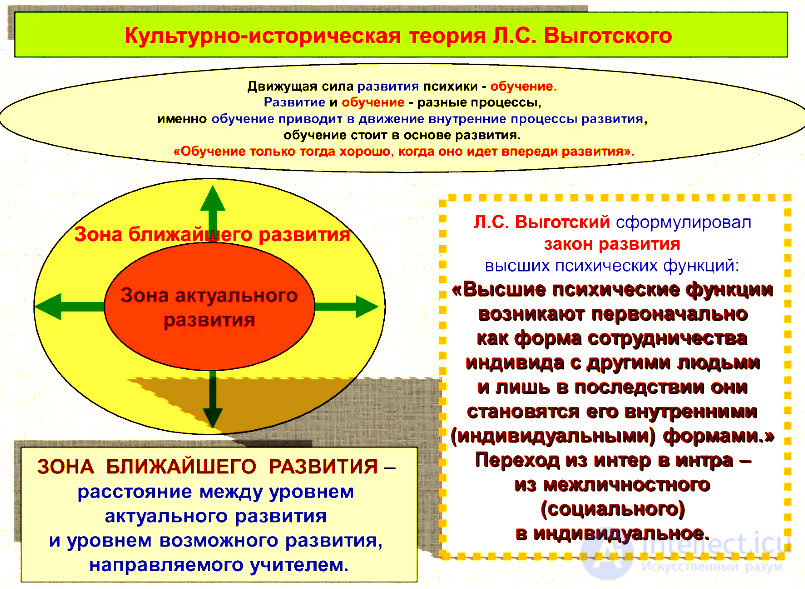
child does, he does in cooperation, together with adults. It is precisely cooperation with other people that is the main source of the child's personality development, and the most important feature of consciousness is dialogicity.
L. S. Vygotsky introduces the concept of the «zone of proximal development» – this is the
space of actions that the child cannot yet perform alone, but can carry out together with adults and thanks to them. In Vygotsky's view,
only that teaching is good which is ahead of development.
For Vygotsky, personality is a social concept, something brought into it by culture. Personality «is not innate, but arises as a result of cultural development», and «in this sense the correlate of personality will be the relation between primitive and higher reactions».
Another aspect of L. S. Vygotsky's theory – the idea that development is not
smoothly gradual but stage-like, a step-wise process, in which periods of even accumulation of new capacities are followed by stages of crisis.
A crisis, for Vygotsky, is a stormy, sometimes dramatic stage of breakdown (or
rethinking) of the old baggage and the formation of a new way of life. Crises can be painful, but in Vygotsky's view they are inevitable.
On the other hand, a child's evident distress during a crisis is by no means a rule, but merely a consequence of unskillful behavior on the part of parents and other
adults raising the child.
And another important point, where L. S. Vygotsky proved to be a pioneer, is the thesis of the child's activity. What is meant by this? Usually the child was regarded as a kind of object subjected to the activity of the adult – to the influence of suggestions, positive or negative reinforcements. And even though in the works of B. Skinner operant conditioning does seem to
speak of the activity of the one whose behavior is in one way or another reinforced, Skinner never regarded the child as someone who himself actively influences the
adult, often controlling him to a greater extent than the adult controls
the child.

Comments