
Lecture
The perception of compliments, criticism, and remarks in the process of communication plays an important role in shaping relationships and interaction between people. How a person perceives these communicative elements can significantly affect their emotional state, self-esteem, and behavior. Let us consider each of these aspects separately:
Compliments:
Criticism:
Remarks and feedback:
It should be noted that the ability to sincerely pay another person a compliment is far from available to everyone. Nor can every person
worthily accept compliments and praise from others in general. It is worth noting that there are several main reasons that prevent us from enjoying compliments. The first reason is that we sincerely believe we have not earned the praise at all. Another reason may be that we are completely indifferent to the opinion of the person who paid us the compliment. In addition, some people do not like being the center of attention because of their personal qualities and characteristics. Moreover, there are people who believe that any compliment must necessarily obligate them to something. Some people believe that a compliment is nothing other than a veiled manipulation. Psychologists maintain that compliments should not be ignored, nor should they be excessively boasted about or gloated over. For example, if you were told that you have beautiful eyes, you simply need to thank the person who said it.
One must learn to accept compliments graciously. One should always try to remind oneself that one has every right to receive compliments. As a rule, the most appropriate reaction to a compliment is gratitude for having received it. This is usually expressed in two simple phrases: "Thank you for the compliment" or "Thank you, that's very kind of you." If, in your opinion, the praise is exaggerated, then it should be perceived as the personal point of view of the person who paid you the compliment.
Very often, problems with the receptiveness of compliments are related to the low self-esteem of the person receiving them. Until you begin to love and value yourself,
you will not be able to believe in the sincerity of other people.
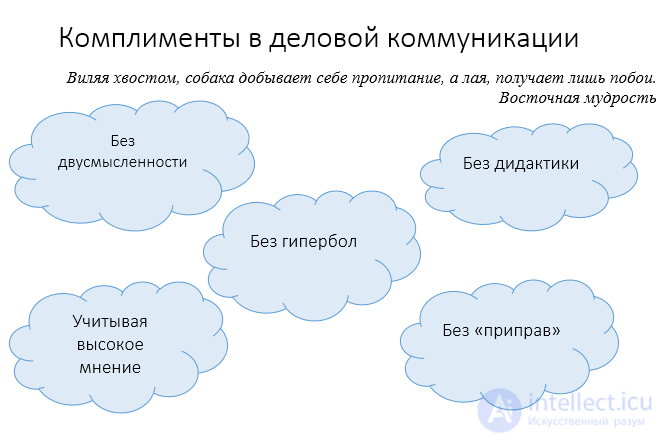
Fig. Compliments in business communication
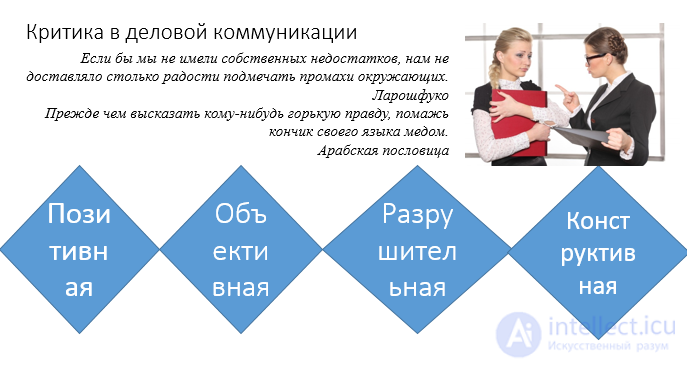
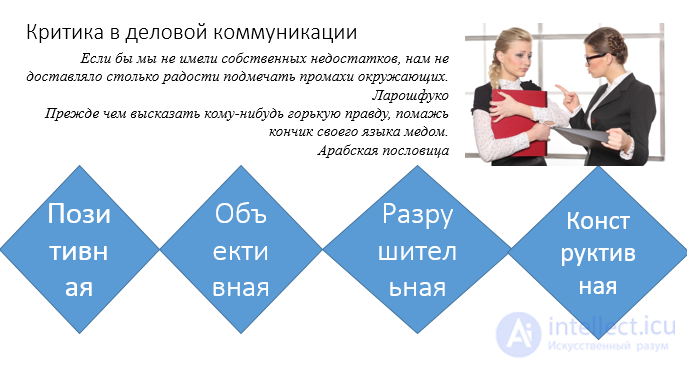
No matter how good your relationships with others are, you will nevertheless often be subjected to criticism. The ability to perceive such critical remarks plays an important role in relationships.
A person typically takes a defensive stance in response to any criticism. People often try to avoid criticism by ignoring critical remarks, refusing to discuss them, changing the subject, or simply ending the conversation.
The person who is criticizing you usually expects their words to be listened to attentively and their opinion taken into account. If you do not even want to listen to
your interlocutor, you leave the problem unresolved and aggravate it by expressing personal rejection. Instead of restoring peace, such a strategy, as a
rule, leads to an escalation of the situation and an increase in tension.
The second type of defensive reaction to criticism is complete denial. Denial can prove just as useless and harmful as avoiding
criticism.
Using the third type of behavior, you may try to excuse your
behavior, explaining the details and emphasizing its importance. An apologetic stance definitely puts you in a degraded position. Your critic does not receive confirmation that their feelings or arguments have been perceived by you. They become irritated, because each of their arguments runs into your defensive reaction.
As a result, even minor disagreements at the start of the conversation grow like a snowball, and a calmly begun conversation can turn into a serious quarrel.
The fourth type of behavior is "an eye for an eye," when the interlocutor responds to criticism with criticism. Responding with criticism is a very tempting position. Your
critic, who is not themselves perfect, criticizes you or your behavior and thereby gives you a reason to vent your irritation on them. However, while bringing temporary satisfaction, such a stance does substantial harm to the relationship. It rarely leads to the resolution of real problems or to the achievement of compromises. Moreover, a serious quarrel may result from such an approach.
As we can see, none of the models of defensive behavior is beneficial; in this case, one should use the technique of a constructive alternative. Using this tactic, you will be able to calm your critics by showing them that their opinion matters to you, that you take their remarks into account, even though you do not
always agree with them.

Fig. techniques for reducing the negative impact of remarks
Advice for the critic
It is important to remember that the perception of these communicative elements strongly depends on the emotional state, level of confidence, and personal preferences of each person. Therefore, it is important to take into account the individual characteristics of the interlocutor and to try to approach communication with respect and tolerance.
In order to ensure more effective communication, try to be sincere in expressing your thoughts and feelings, take into account the context and individual characteristics of the interlocutor, and also be ready for interaction and dialogue in the event of disagreements or misunderstandings.

Comments