
Lecture
The concepts of suggestion and countersuggestion are connected with one person's influence on another with the aim of affecting their thoughts, feelings, and actions.
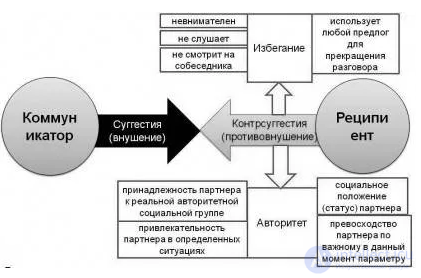
Let's examine these concepts in more detail:
Suggestion:
Countersuggestion:
Ideal communication implies that the interlocutor adequately perceives the information received and responds in the manner
expected of them. But quite often one encounters cases where words and intentions
are misunderstood by interlocutors. Sometimes it seems that
the partner is erecting certain barriers, and the transmitted information gets lost or stuck in these barriers. It is necessary to clarify the origins and mechanism of action
of these obstacles.
Psychologists have proven that from the very beginning speech was a means of suggestion,
or persuasion. In conveying a message, its author acts on the partner, seeking to change something in their representations. But people do not always want these changes. Changes brought about by communication may require a decisive reshaping of a person's inner world, compelling them toward thoughts alien to them,
and actions uncharacteristic of them. That is why a person defends themselves, erecting obstacles and barriers.
The Russian psychologist B. F. Porshnev proposed a concept of resistance to a suggestive attack, which he called «countersuggestion». Although every speaker suggests, not every suggestion is accepted – there exists
a counter psychological activity – counter-suggestion, or countersuggestion, which is the main reason for the barriers that are erected along the paths of communication.
In every person's life there are more situations in which the information received carries not a threat but a benefit, helping to strengthen their life positions. But there will
also be useless, even harmful, communications. The task is to distinguish harmful information from positive information: to stop the negative influence and «let in» useful information.
Avoidance. Countersuggestion includes protection from trusting the one who is suggesting. By denying trust to a partner, a person shields themselves from influence.
Psychologists have called this defense mechanism «avoidance» – it is protection from the source of communication.
By identifying a communication partner in advance as dangerous, a person attaches various labels to them: «not authoritative», unnecessary, alien, «not one of us». To avoid communication, a meeting, or a conversation, a person invents
excuses (sometimes even for themselves) in order to disrupt the meeting, finds a pretext to interrupt the conversation, does not pay attention to what is being said, and reads letters «diagonally».
Choice of reference groups. Reference groups serve us as a model to follow and for
identifying «one's own» and «others». Comparing a business partner to a reference group provides a quick way to classify people as «suitable» or
«unsuitable» for business relations.
This is a biased and highly subjective classification: perhaps he
does not suit my status, I do not like his appearance, or intuitively I feel that he is different. Reference groups reflect tastes and preferences to a greater extent than an analysis of prior experience in building business relationships.
Misunderstanding. If «avoidance» and «choice of authority» are defenses against the source of communication, then misunderstanding is a defense against the message itself. Sometimes
the information received comes from a source we trust, but we
recognize or sense the potential danger of this information (it may force us to change something, to adapt to something, etc.). In this
case the defense mechanism that comes into play is «misunderstanding», and the recipient does not even
realize that this is their own countersuggestion.
Misunderstanding can be phonetic, occurring when someone speaks with an accent, a speech impediment, uses unfamiliar gestures, or speaks too quickly. The phonetic barrier operates, like all the others, automatically. If it is important to receive a message, we will receive it – after all, we understand the speech of small children and
foreigners when it concerns our interests.
The semantic level of misunderstanding operates when the information conveyed is alien in meaning (semantics – the meaning, sense of a word). The existence of this barrier is determined by the polysemy of words in any language. It turns out that the «semantic fields» of words differ from person to person, so one can be speaking in different
languages while speaking the same one. There exist, for example, «semantic jungles» in
the field of management, where Anglo-Saxon scholars cannot understand one another because of the
polysemy of managerial terminology. Students sometimes complain about
the academic, abstruse vocabulary of the professoriate, while they themselves use
student slang. Regional, professional, and criminal jargon are incomprehensible to the uninitiated.
The effect of the semantic level of misunderstanding leads to a very sharp
decline in the effectiveness of communication: people sometimes not only fail to understand a message but may also distort its meaning. For example, a partner may not be
understood, a hidden agenda may be ascribed to their proposals, and interlocutors' gestures too may be misinterpreted. Sometimes, however, our suspicions
(say, of ill will or a criminal subtext) turn out to be
justified – the defense mechanism is working correctly.
The stylistic level of misunderstanding is related to the fact that the style of communication is perceived as «alien» or «hostile». Similar difficulties
also arise when a partner does not accept the other person's logic and arguments; this is called the logical barrier of misunderstanding.
Suggestion as an object of socio-psychological research has come to
be examined comparatively recently. V. M. Bekhterev was one of the first to undertake a special study of this phenomenon as applied to
social life, although a description of this phenomenon and a definition of its mechanisms can also be found in other authors of that time (N. K. Mikhailovsky,
G. Tarde, G. Le Bon, and others).
Since suggestion is one of the almost equally ancient mechanisms of socio-psychological communication, like contagion, it is
naturally of particular interest now to examine precisely those attempts to study
this phenomenon in which the aspiration toward a historical approach is realized. Such an approach makes it possible to better understand the nature and genesis of these mechanisms,
which have their origin at the very sources of human history.
In light of what has been said, of interest is B. F. Porshnev's attempt to explain, through the prism of the mechanisms of suggestion
and countersuggestion, a number of the most important pages of the most ancient history of humankind in a new way.
Thus, if, in B. F. Porshnev's view, suggestion is connected with
a person's dependence on the coercive force of collective actions and representations,
reaching deep into the roots of social psychology, then countersuggestion is connected with the birth of an «inner world», the psychic independence of the personality.
The interaction of the mechanisms of suggestion and countersuggestion also explains
the historical process of the social (demographic and linguistic) differentiation of humankind, which found expression, on the one hand, in
the rapid settlement of Homo sapiens across the continents and archipelagos of the globe over
the first 15–20 thousand years of our history, and, on the other, in the fact of the emergence of a multiplicity of languages out of what was once a single proto-language.
Both of these processes, which took place at the dawn of human history,
can be rationally understood, in B. F. Porshnev's view, as the results
of countersuggestion, that is, of the resistance of a person, weighed down by the burden of inter-individual pressure, to the suggestive force of the word within the framework of the first historical community of «us».
«People, – writes B. F. Porshnev, – were scattered across the planet by something specifically human. This fact cannot be reduced to a lack of food resources in their former locations: after all, other animal species have remained and
continued to feed in their ancient ranges, often to this very day – there is enough food.
It cannot be said that people migrated from worse geographical conditions to
better ones; the facts show that the opposite also occurred. Things did not become
crowded for them in an economic sense, since the total number of humans at that time
(in the Stone Age) was small. It was, rather, that things became crowded for them in the sense of the manifestation
and development of the burden of inter-individual pressure».
But if the most ancient settlement allowed a person to escape the burden
of psychological pressure, as it were shielding themselves from this pressure by the space separating people, then multilingualism served as an additional shield –
a shield of not understanding the foreign word, which also shielded a person from the force
of the influence of suggestion.
While recognizing the legitimacy, significance, and value of the hypothesis
proposed by B. F. Porshnev regarding the genesis of the historical process from
the standpoint of the concept of the interaction between suggestion and countersuggestion, one
cannot, at the same time, fail to reserve the right to polemicize with him on the question of the nature and
essence of the phenomenon of suggestion itself as distinct from other socio-psychological mechanisms of psychic influence
on a person that are close or similar to it.
Suggestion itself is regarded by B. F. Porshnev as a variety or one of the types of contagion alongside imitation. This cannot
be entirely agreed with.
Of course, there is much in common between contagion and suggestion. The latter
consists in the fact that contagion and suggestion are both ways of group integration, ways of welding a community into a single whole by creating a common psychic state that later grows into joint group and
mass activity.
Further, there is reason to speak of a considerable degree of mutual influence between contagion and suggestion on each other. Through suggestion, the contagion of a group or a large mass of people with a single mood can be brought about.
But if contagion with a single social mood turns out to be the result of suggestion, then, in turn, contagion, the psychic state of a common
mood, can itself act, and does act, as an important prerequisite and
essential condition for a further increase in the effectiveness of the suggestive
influence.
However, from everything that has been said, one should not conclude that suggestion
represents merely a variety of that same contagion. In our view,
suggestion differs qualitatively from contagion. These differences can be reduced to the following.
First of all, unlike contagion, which is a way for
people to jointly experience a common psychic state (which is why
we speak of «contagion»), suggestion not only does not presuppose but, moreover,
completely excludes, or at least as a rule excludes, a psychic state of equally shared experience of identical emotions and representations on the part of the object and subject of suggestion, the inducer and the recipient.
With a very great stretch, one might say that suggestion is
a one-sided contagion, in which the source of the contagion exerts an influence,
«infects» others, while itself not succumbing to the force and effect of the general contagion.
But even such a notion of suggestion is highly imprecise. It is difficult to imagine a person capable of suggesting anything to others if they themselves turned out
to be in the grip of a general, spontaneously arisen mood, if they themselves became a victim of a psychic «infection» that struck everyone. And conversely, to evoke this or that
psychic state, to infect people with this or that mood, does not
mean fully identifying oneself with the image being created. Otherwise
even an actor brilliantly performing their role, who captivates and «infects» the audience with their mood, would literally, and not
merely figuratively, have to kill or beat, having entered the role, their partner.
But the art of suggestion, unlike the process of contagion, consists precisely in the fact that it bears a somewhat one-sided character. The one who suggests
must infect others, to some extent, of course, infecting themselves as well, but at the same time
must remain at all times at a sufficiently high level of self-control, so as not
to become fully infected themselves.
Unlike contagion, suggestion represents a more complex
form of socio-psychological influence, historically younger
than contagion, and connected with the development of a person's verbal activity and their
individuality.
Whereas contagion, as a process of interaction, can bear a non-personified character, being the result of a spontaneous, elemental toning up
of the psychic state of a group or mass of people as a result of simple psychic contact among those communicating, suggestion is a process of one-sided, active, and personified influence of one individual on another or on a group of people.
Unlike contagion, which, as a rule, bears a nonverbal character, that is, it can be carried out apart from speech influence (dances, games,
music, individual sounds, the rhythm and tempo of joint movements, etc.), suggestion,
on the contrary, except for isolated cases of hypnosis and telepathic
communication, bears a verbal character, that is, it is carried out by means of a spoken message.
The very act of one person's suggestive influence on another can be more or less conscious in character.
In the process of communication, people are constantly influencing one another, suggesting
or imposing on each other their opinions, evaluations, and moods, but they by no means always recognize and regard this as an act of suggestion and mutual suggestion.
V. M. Bekhterev noted in this connection that «suggestion is one of the ways in which some persons influence others, which can occur either intentionally
or unintentionally on the part of the influencing person, and which can sometimes be carried out completely unnoticed by the person perceiving the suggestion, while at other times it occurs with their knowledge and with a more or less clear awareness on their part».
A distinguishing feature of suggestion, unlike persuasion, is that it is addressed not to the logic and reason of the individual, not to their readiness to think and reason, but to their readiness to receive an instruction, a directive for action.
Naturally, therefore, suggestion does not need a system of logical proofs or a deep awareness of the meaning of the information being conveyed.
«Suggestion, – wrote V. M. Bekhterev, – acts through the direct implanting of psychic states, that is, ideas, feelings, and sensations, without
requiring any proof whatsoever and without needing logic».
Suggestion acts with particular force on impressionable persons who at the same
time do not possess a sufficiently developed capacity for independent logical thinking, and who lack firm life principles and convictions.
This applies above all to the category of children and adolescents. A high
degree of susceptibility to suggestion is generally characteristic of people for whom a dominance of situational psychic mood, as well as a state of self-doubt, is typical.
Among the other important conditions for the effectiveness of suggestion as a means
of influence, one should also name the authoritativeness of the source of information, which, in turn, inclines one toward trust and removes any significant resistance to the suggestive influence.
When these conditions are observed, the opinion and demands of the one who suggests can
become active elements of the recipient's consciousness (their motives, impulses, etc.) and can exert a considerable influence on their behavior, perception, and
understanding of the people around them.
Just how significant the influence of a suggested set can be on the evaluations and
characteristics that a person attributes to other people, based, for example, solely
on their outward features, is demonstrated by an experiment conducted by the psychologist A. A. Bodalev.
A group of adult subjects were shown, one after another, photographs
of a young man and an elderly man. The subjects, who viewed each of the photographs for five seconds, were asked to verbally recreate the appearance
of the person they had just seen.
The showing of the photographs was accompanied by a set – a characterization of the persons depicted in them. The sets given before the showing of the photograph
were: «criminal», «hero», «writer», «scientist».
Here are various verbal portraits of the very same persons, testifying to the considerable influence of the set on the subjects' perception:
«This brute wants to understand something. He looks intelligent and unblinking. A standard thuggish jaw, bags under the eyes, a massive, aging figure, hunched forward» (author of the «portrait» – I.; set – criminal).
«A degraded, very embittered man. Untidily dressed, unkempt. One might think that before becoming a criminal he was an office worker or an intellectual. A very angry look» (author of the «portrait» – K.; set
– criminal).
«A young man of about 25–30. A strong-willed, manly face with regular features. A very expressive look. Tousled hair, unshaven; collar
unbuttoned. Apparently, this is the hero of some kind of struggle, although he is not in military uniform (he is wearing a checkered shirt)» (author of the «portrait» – G.; set –
hero).
«A very strong-willed face. Fearless eyes looking from under the brow. Lips pressed together, one senses spiritual strength and fortitude. A proud expression»
(author of the «portrait» – M.; set – hero).
«A portrait of a man of about 50–53. An open face, large features,
gray, or rather graying, hair; a bulging forehead with horizontal creases
of wrinkles. Very expressive eyes, of the kind usually found in intelligent, perceptive people. Around the eyes there are many small wrinkles, giving the face a slightly
sly expression. It seems as though this person would certainly
start with a joke upon meeting someone. I don't remember the lower part of the face. What I remember are the hands – small, not used to manual labor, covered with hair. The portrait of a writer… It seems to me that this is
the face of a person who loves children and writes for them. Judging by his relaxed manner, he is used to posing; he is probably a well-known writer. I would like to stress once again that it is the eyes that are most memorable in the portrait. A person with such eyes must know and love life and people well…» (author of the
«portrait» – V.; set – writer).
«A man of about sixty, bald, with a cigarette in his hand. Large, regular features. A large head, a high and broad forehead, a true forehead
of a scholar. The look and expression on the scholar's face suggest that he is intensely and
painfully working out some problem» (author of the «portrait» – D.; set –
scientist).
Suggestion is an important factor in social life and finds
application in all spheres of social relations. Suggestion is used as
a method of activating group activity – industrial, educational, or
athletic. There are broad possibilities for applying suggestion, in particular hypnosis,
for medical purposes as a factor in group psychotherapy.
The concepts of suggestion and countersuggestion can be important in various fields, such as psychology, medicine, rhetoric, and marketing. Understanding these concepts helps both to improve communication and influence skills and to develop skills for protecting oneself against unwanted influence.

Comments