
Lecture
Nonverbal means of communication play a huge role in conveying information, expressing emotions, and establishing connection between people. Here are some of the main nonverbal means of communication:
Facial expression: The expression of emotions through facial expression. For example, a smile, a frown, raised eyebrows, etc.
Gestures: Various movements of the hands and fingers that can supplement and reinforce verbal communication. For example, waving a hand in greeting, pointing gestures, and others.
Posture and physique: Body posture and general physique can convey information about a person's state and emotional condition. For example, an upright posture may indicate confidence, while a hunched body may indicate insecurity.
Eye contact: The level of eye contact can indicate your interest in and respect for your interlocutor. Seeking or avoiding eye contact may point to different emotional states.
Intonation and vocal modulation: The ability to change intonation, volume, and speech rate can influence how a message is perceived and can convey emotional coloring.
Distance: The distance between people during communication (spatial proximity) can indicate the degree of closeness and intimacy in the relationship.
Touch gestures: These are touches, hugs, and other physical contact that can express support, friendliness, and closeness.
Facial expressiveness: Emotional expressions on the face, such as surprise, joy, sadness, and others, can reinforce or alter the meaning of verbal messages.
Spatial relations: How people position themselves in space during communication can indicate their status, power, or intimacy in the relationship.
Time: The management of time and the pace of movement affects the effectiveness of communication. For example, waiting or rushing can create a particular mood.
Nonverbal communication is the exchange of information between interlocutors by
means of facial expressions, gestures, postures, gaze, intonation, and other means, without the use of linguistic means of expression. Nonverbal language is also called «body language.»
Nonverbal codes either supplement information and express the interlocutors' emotions, or replace speech altogether. Experts maintain that more effective communication requires the ability to recognize and interpret nonverbal signals. Sometimes we do not even realize how powerful an emotional impact we have on our interlocutor through our gestures,
glances, facial expressions, and so on.

Functions of nonverbal communication:
1. Nonverbal signals duplicate our speech and reinforce it with evidence in the form of emotion.
2. Facial expressions, gestures, and postures sometimes cannot be controlled, and they reveal a person's true face, i.e., if a person is telling you something very beautifully and persuasively, their nonverbal gestures may reveal something
entirely different.
3. Nonverbal signals sometimes replace speech. For example, a nod of the head, a shrug of the shoulders, a blink of the eyes, a wave of the hand, and so on.
4. Nonverbal communication can also supplement verbal communication. For example,
when we sympathize with or feel sorry for a person, we hug them and stroke their
back or head.
5. Nonverbal signals can place emphasis on a particular statement. For example, when expressing protest or reluctance by saying the word «No!»,
one might pound a fist on the table.
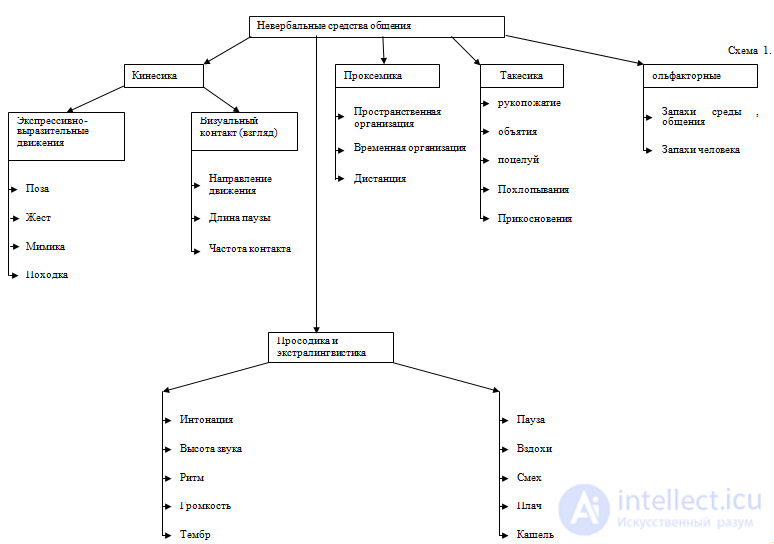
The main channels of nonverbal communication include kinesics, facial expression, eye contact, posture, gestures, haptics, and proxemics.
Kinesics (from Ancient Greek κίνησις – movement) is the set of bodily movements (gestures and facial expressions) used in the process of human communication, excluding movements of the speech apparatus.
It is important to keep in mind that the same gesture may be interpreted differently in different cultures.
Kinesics is one of the subfields of paralinguistics. It studies how human behavior is reflected in nonverbal manifestations, which include facial expression (movement of the facial muscles), pantomime (movement of the whole body), «vocal mimicry» (intonation, timbre, rhythm, and vibrato of the voice), and spatial patterning (zone, territory, possessions, and movement),
and expressiveness (the vividness and intensity of the feelings and experiences displayed), which can be decisive in interpreting what is said.
Facial expression (from Ancient Greek μῑμέομαι – to imitate) is the look on a person's face through which a person reveals their inner sensations, experiences, feelings, mood, emotions, and other states of mind.
«By exchanging glances we can confirm that our interlocutor is listening to us attentively.
But what if your interlocutor keeps avoiding your eyes?
Eye contact deserves the name only if it actually creates contact.
The point is that contact may fail to be established even if your interlocutor is looking you straight in the eye
and is eager to build a rapport.
This happens when the interlocutor's gaze rests motionlessly on a single point on your face.
Some teachers of rhetoric and communication instruct people to look firmly and resolutely at, say, the bridge of the interlocutor's nose.
In reality this cannot produce genuine, warm, sensitive contact
and is more likely to leave a repellent impression.
And since a gaze fixed on a single point has a sharply limited field of view, it can hardly be expected to notice or understand much.
A living gaze constantly wanders from pupil to pupil, and it is precisely this that we mean by eye contact.»
Posture (from French pose, via German, ultimately from Latin pono, supine positum – «to place, to put») is the position assumed by the human body, the arrangement of the body, head, and limbs relative to one another.
Posture is characterized by relative immobility.
The common human postures are orthograde (standing, sitting) and horizontal (lying down, on all fours). It is studied by biomechanics, physical education, and physiology.
Posture is, as a rule, maintained through the balance of body segments, the tonic tension of the muscles supporting the joint angles, and interaction with a supporting surface.
Gesture (from Latin gestus – movement of the body) is an action or movement of the human body or a part of it that carries a definite meaning or sense, i.e., that functions as a sign or symbol.
Widely used gestures include
gestures include pointing at something or someone (this is one of
the few gestures whose meaning varies little across countries), as well as using the hands and body in sync with the rhythm of speech to emphasize certain words or phrases. Many outwardly similar gestures carry different meanings in
different countries. The same gesture may be harmless in one country and
vulgar in another. Moreover, even gestures of the same type
may differ slightly from country to country. For example, when a Russian counts
something on their fingers, they typically curl their fingers into the palm, whereas a typical American, by contrast, extends their fingers when counting.
Haptics is the nonverbal communication of people through touch
(pats, handshakes, kisses, blows, etc.), as well as the branch of psychology that studies it.
Proxemics is the use of spatial relations in
communication, expressed in the separation of personal territory, the personalization of place and object of communication, which become the property of a person
or a group of individuals. The term was introduced by the American psychologist
E. Hall to analyze the patterns of the spatial organization of communication, as well as the influence of territories, distances, and spacing between people on the nature of interpersonal communication. Special studies have shown that these vary considerably across cultures and are quite significant
for communication.
The principle of openness/closedness is a principle of object-oriented programming that establishes the following position: «software entities (classes, modules, functions, etc.) should be open for
extension but closed for modification»; this means that such entities can allow their behavior to be changed without modifying their source code. This
is especially significant in a production environment, where changes to the source code
would require a code review, unit testing, and other similar procedures in order to earn the right to be used in the
software product. Code that follows this principle is not changed when extended and therefore does not require such labor costs.
Confidence is a person's mental state in which they consider
certain information to be true. Confidence is a psychological characteristic of a person's beliefs and convictions. Confidence can be the result either of a person's own experience or of outside influence.
For example, confidence may arise in a person regardless of (and sometimes against) their will and awareness, under the influence of suggestion. A feeling of confidence
can also be induced in oneself through self-suggestion (for example, autogenic
training).
Insecurity is a state in which a person considers
something to be untrue: information, characteristics, sensations, or any information in general. Insecurity can form at any age and
through the suggestion of other people or self-suggestion.
Honesty is one of the fundamental human virtues, a moral quality that reflects one of the most important requirements of morality. It includes truthfulness, integrity, faithfulness to commitments made, a subjective conviction in the rightness of one's cause, sincerity toward others
and toward oneself regarding the motives that guide a person, and the recognition and observance of other people's rights to what
rightfully belongs to them. The opposite of honesty is deceit, lying, theft, treachery, and hypocrisy.
A lie is a statement known to be untrue and consciously presented as such. In everyday life, a lie refers to the deliberate transmission of factual and emotional information (verbally or
nonverbally) for the purpose of creating or maintaining in another person a belief
that the person conveying it themselves considers untrue.
By analyzing nonverbal behavior, one can obtain information about the communicator's personality; about the attitude of the participants in the communication process
toward one another; and about the participants' attitude toward the topic under discussion. To understand how a person evaluates you and what reaction your words
evoke in their mind, you need to analyze the partner's actions and body movements. Interpreting your interlocutor's nonverbal behavior will let you
understand what kind of person is in front of you and whether their words can be trusted. Analyzing nonverbal behavior lets you see the interlocutor's reaction to some
irritant or pain. This state will show up in the person's posture, as well
as in their gestures and facial expressions. What deserves special attention?
1. Gesticulation. When talking with a person, it is worth remembering that gestures can be «open» or «closed.» If your interlocutor has no desire to
communicate with you and is speaking insincerely, you will see hands clasped together
or crossed on the chest, gestures covering the mouth and nose, as well as the characteristic «legs crossed» posture. If your interlocutor is nervous, their hands will
make a great many small movements. Tapping a fist or
palm on the table in time with speech should be read as an attempt at pressure.
Broad gestures and waving of the arms indicate that your interlocutor is clearly embellishing what they are saying.
2. Posture. If your interlocutor aristocratically straightens their back and squares their shoulders broadly, you are looking at a self-confident person. Such a partner
in communication will radiate calm and respect for the interlocutor. However, do not
confuse this with a person whose back is overly straight and whose chest is puffed out.
Such a person is displaying superiority over you and is inclined to
be aggressive. If your partner slouches, drops their shoulders, and hunches over, they
will inevitably reveal themselves as a compliant, insecure person.
To make a favorable impression on your interlocutor, you do not need to
constantly control your nonverbal behavior. It is enough to remember a few rules: look your interlocutor in the eye, but do not do so defiantly. Your facial expression should match what you are saying; do not laugh when talking about something sad. Sitting in front of the person,
adopt a relaxed posture, do not clench your hands or legs. Speak to your partner
clearly and loudly. Simply put – be simpler, more open, and more confident in
yourself, and people will begin to respect you.
Nonverbal communication obeys certain rules, which we follow unconsciously but react keenly to violations of. These
rules can be said to include the following:
1) the use of nonverbal signs must be definite and
recognizable;
2) we must be able to translate our feelings and intentions into nonverbal means («encode» them);
3) the observer must be able to interpret nonverbal
signs («decode» them).
The main problems in interpreting nonverbal messages (their encoding and decoding) are related to the very nature of nonverbal communication. The features of nonverbal messages (contextuality, ambiguity, spontaneity, and unintentionality) predetermine the difficulty of the process
of interpreting nonverbal behavior. It has been established that only the expressive codes of the basic emotional states of a person are stable and unambiguous: joy, fear, anger, attention, surprise, contempt, and
certain others. The remaining ways of nonverbal encoding are subject to the influence of many factors. Among them:
– the general situation of communication;
– the individual features of how states are expressed by each participant in communication;
– sex;
– age;
– the degree of significance of the partners to each other;
– cultural and ethnic norms for expressing individual personality traits.
It is obvious that taking all these factors into account in a situation of direct
interpersonal interaction, for the purpose of precisely interpreting nonverbal
messages, is practically impossible. Therefore there is a high probability of errors in
determining the content of many nonverbal messages. So, when interpreting nonverbal messages, the following points must be taken into account:
– the uniqueness of nonverbal language;
– the inevitability of contradictions between the nonverbal expression and its
psychological content;
– the changeability of ways of nonverbal expression;
– the dependence of successful encoding on a person's ability to adequately
express their experiences, on the level to which they have developed the skills of encoding nonverbal messages.
Understanding and being able to interpret the nonverbal means of communication helps one perceive and convey messages better, as well as read emotional signals during communication. The combined use of verbal and nonverbal means of communication contributes to a fuller and more precise exchange of information and emotions.

Comments