
Lecture
Written communication, including email and fax, also has its own psychological features that may differ from oral communication. Here are some of them:
Absence of nonverbal signals:
More time for reflection:
Records and documentation:
Delayed interaction:
Privacy and confidentiality:
Less emotional expression:
Cultural differences and language barriers:
Control over the message:
Multitasking:
Understanding these psychological features helps in making effective use of written communication and minimizing possible problems, such as misunderstanding or conflicts.
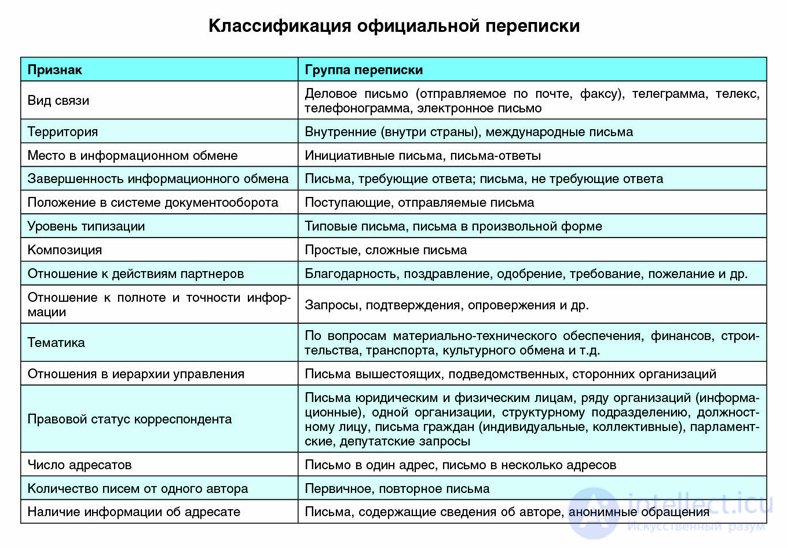
Fig. features of business correspondence
An important part of business etiquette is — business correspondence. Of course, every business letter must be strictly individual. It is shaped above all by the addressee, the specific situation, and the personality and position of the writer. The approach to deciding what a business letter should be like calls for a certain degree of creativity, but nevertheless there are also general rules of business correspondence.
Correspondence — is communication in miniature; mastering it is both a labor, at times not an easy one, and an art. Skillful business correspondence contributes to increasing a firm's or enterprise's turnover, improving the interconnection of various departments, raising qualifications, and establishing solid ties with customers.
One of the main requirements for a letter — is that it should not be long. If you want your letter to be read, try to keep it within a page and a half of typed text, or better still — on one page. A good letter, like a speech, should be clear and lucid. This is the second requirement for a letter. Try to avoid polysyllabic, obscure (foreign, highly specialized) words and expressions in a business letter. This is the third rule of writing a business letter. This same rule also implies composing letters in short sentences in which the author's main ideas are clearly and lucidly formulated. Laconic letters, written in plain words, characterize their writers as good conversationalists who have mastered the art of communication. A letter should not contain superfluous adjectives and adverbs, which often make the style excessively "flowery". This kind of style is most often used in the countries of the East.
A letter should reflect the individuality of its author, of the department or company where they work. From the letter it should be clear what kind of company it is, what it does, whether it is firmly on its feet, and so on. This is yet another requirement for a business letter.
But even with such a seemingly standard approach, there remains great scope for creativity. Above all, think about the addressee, try to learn their interests, and in turn make an effort to interest them, to convey the essence of the matter to them in such a way that your letter will be remembered.
There are established templates for business letters or memoranda.
The main requirements for a business letter:
In international practice, a generally accepted «standard» for formatting a business letter has developed, which provides for the following:
A letter, as a rule, should include the following elements:
In business correspondence one must remember that the impression a letter makes on the addressee depends on such "small things" as the envelope, the company letterhead, and the content of the letter. Do not begrudge the time — even if it seems to you that the letter is written flawlessly, delay sending it for a while longer and reread it once more. As a rule, you will find inaccuracies and overly emotional expressions. Correct them, and only then send it. Observing this rule is especially important when responding to customer complaints. Do not try to fob off or get rid of the customer — that is an unforgivable mistake. A customer's dissatisfaction with a firm's work spreads 100 times faster than a good reputation about it.
Try to begin the letter in a friendly manner — this evokes kind feelings toward the author in the recipient. Personal touches will lend your message greater significance. A conversational style of writing also contributes to this.
Correspondence specialists divide correspondence into six types:
- Trade agreements, deals, and other similar correspondence.
- Reply letters of thanks.
-Congratulations.
-Apologies.
- Demands and requests.
-Condolences.
These six types of letters are in turn divided into two categories: formal and informal.
Memoranda are likewise divided into types:
- orders on personnel matters, the institution's internal regulations, work rules;
- expressions of thanks and congratulations;
-reminders, requests, holding of events.
Informal business correspondence often uses abbreviations, one-syllable words, and adjectives: they create an impression of close acquaintance, warmth, and mutual sympathy. Adjectives such as warm-hearted, capable, responsive, wonderful, splendid, and the like bring the author of the letter and its addressee closer together. They convey emotional state and show how objective or subjective the author of the letter is; perhaps they wrote it guided only by emotions.
There are many ways to prepare correspondence, but let us single out the most general questions:
What does the prospective client need? What are their main concerns? What doubts trouble them? What are their financial considerations? Have they had any problems in the past that still worry them? What are their goals?
And one more point of no small significance: a letter should be structured according to the following scheme: attention — interest — request — action.
You need only remember that, when formulating a request, offer the addressee a limited choice of options. The fewer the options, the greater the likelihood of success.
The culture of telephone communication. Modern business life cannot be imagined without the telephone. Thanks to it, the speed of resolving numerous issues and problems increases many times over, and there is no longer any need to send letters or telegrams, or to travel to another institution or city to clarify the circumstances of some matter. A great deal can be accomplished by telephone: negotiations can be conducted, instructions given, a request stated, and so on. Very often the first step toward concluding a business agreement is a telephone conversation.
Compared with a letter, a telephone conversation has one important advantage: it provides a continuous two-way exchange of information regardless of distance. But a business telephone conversation also requires careful preparation. Poor preparation and an inability to highlight the main point, to express one's thoughts concisely, cogently, and correctly, lead to significant losses of working time (up to 20—30%).
The art of conducting telephone conversations consists in briefly conveying everything that needs to be said and getting a response. At a Japanese firm, an employee who cannot resolve a business matter by telephone within three minutes will not be kept for long.
The basis for the successful conduct of a business telephone conversation is competence, tact, goodwill, command of conversational techniques, and a striving to resolve the problem promptly and effectively or to help in resolving it. It is important that a work-related, business telephone conversation be conducted in a calm, polite tone and evoke positive emotions. The effectiveness of business telephone communication depends on a person's emotional state and mood.
Voice, tone, timbre, and intonation tell an attentive listener a great deal; tone and intonation can carry up to 40% of the information. One need only pay attention to such «small things» during a telephone conversation. As for yourself — try to speak evenly, restrain your emotions, and not try to interrupt the speech of your interlocutor.
Try to state your arguments briefly and clearly. Your reasoning should be sound in substance and correctly expressed in form. In conversation, try to avoid expressions such as: «sure», «okay», «fine», «bye», and the like. In a telephone conversation it is also better not to use specific, professional expressions that may be unclear to the interlocutor.
It should be remembered that the telephone aggravates defects of speech; speaking too fast or too slowly makes words harder to perceive. Pay particular attention to the pronunciation of numbers, proper names, and consonant letters. If the conversation involves the names of cities, towns, proper names, surnames, and the like, which are poorly perceived by ear, they should be pronounced syllable by syllable or even spelled out letter by letter.
The etiquette of a business telephone conversation has in its arsenal a whole range of remarks for adjusting communication. For example: «How well can you hear me?», «Could you repeat that... ?», «Sorry, it's very hard to hear», «Excuse me, I didn't catch what you said», and so on.
Before calling someone, remember: prolonged exposure to telephone calls has a negative effect on the nervous system (which is why you yourself should try to pick up the receiver as soon as you hear it ring), and unnecessary telephone conversations disrupt one's work rhythm and interfere with the resolution of complex issues that require deep analysis and discussion under calm conditions — that is, they interfere with the work of those nearby.
A call to a business partner's or colleague's home telephone for a work-related conversation can be justified only by a serious reason, whoever you may be calling — a superior or a subordinate. A well-mannered person will not call after 10 p.m. unless there is an urgent necessity for it or prior consent to the call has been obtained.
As analysis shows, 30—40% of a telephone conversation consists of repetitions of words and phrases, unnecessary pauses, and superfluous words. Consequently, one must prepare carefully for a telephone conversation: gather all materials and documents in advance, have on hand the necessary telephone numbers, addresses of organizations or of the people needed, a calendar, a pen, paper, and so on.
Before you decide to dial the number, you should determine precisely the purpose of the conversation and your tactics for conducting it. Draw up a plan for the conversation, write down the questions you want to resolve, or the information (data) you want to obtain, and think through the order in which to raise the questions. Formulate them clearly, so that your interlocutor cannot interpret them in more than one way. If you are discussing several matters, finish the discussion of one matter before moving on to the next. Use standard phrases to help separate one matter from another. For example:
«So, are we agreed on this matter?!», «May I take it that we have reached an agreement on this matter?», «As I understand you (on this matter), can we count on your support?».
The conversation on each topic should end with a question requiring an unambiguous answer.
When preparing for a business conversation by telephone, try to answer the following questions for yourself:
1) what main goal you are setting for yourself in the upcoming telephone conversation;
2) whether you can do without this conversation at all;
3) whether the interlocutor is ready to discuss the proposed topic;
4) whether you are confident of a favorable outcome to the conversation;
5) what questions you should ask;
6) what questions the interlocutor might ask you;
7) what outcome of the negotiations will suit (or not suit) you and them;
8) what techniques of influencing the interlocutor you can use during the conversation;
9) how you will behave if your interlocutor: firmly objects, raises their voice, does not react to your arguments, shows distrust of your words or information.
To prepare for a business telephone conversation, especially a long-distance or international one, it is better to prepare a special form on which the upcoming conversation is recorded together with the anticipated answers.
For example, one like this:
P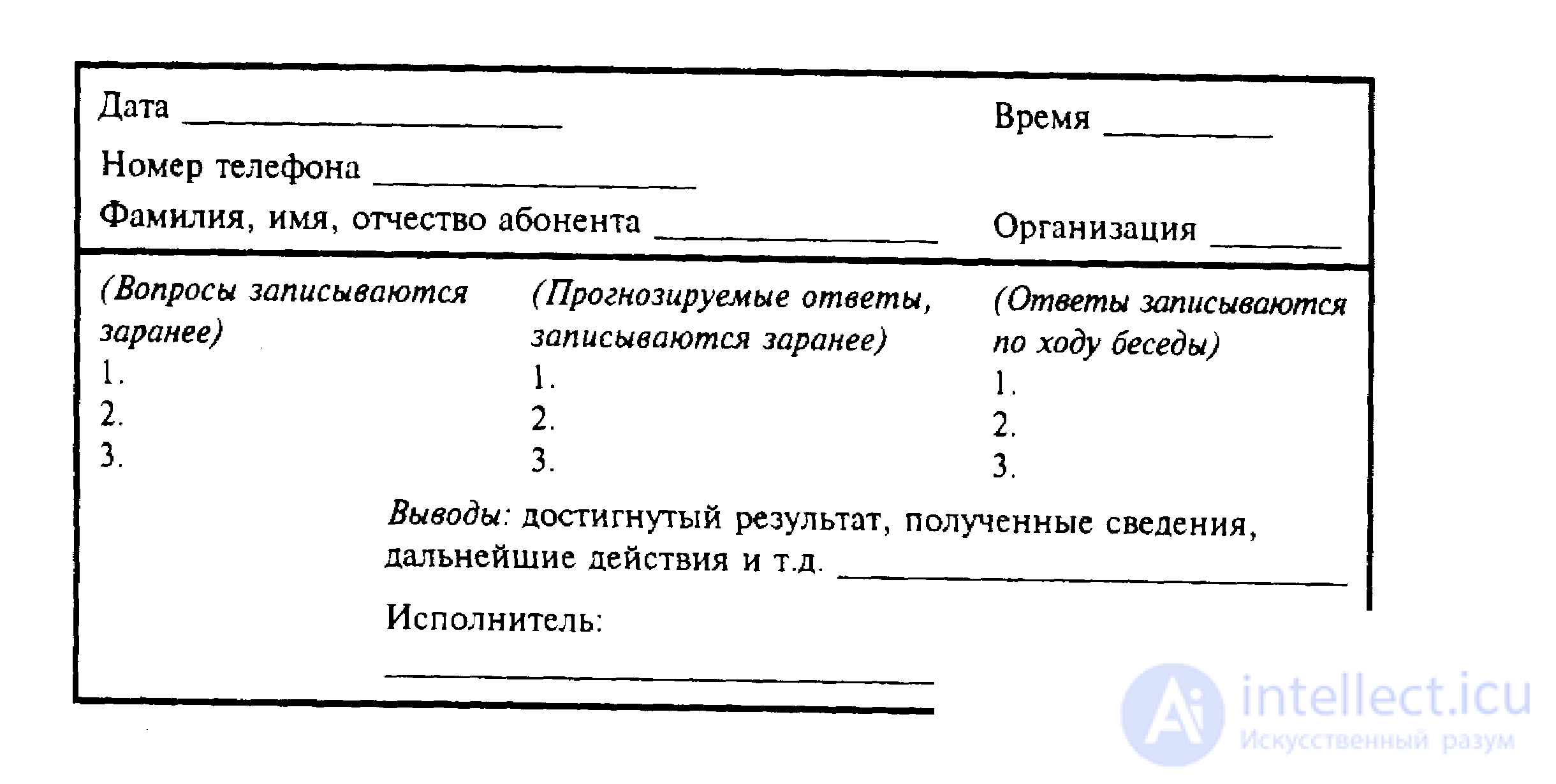 on completion of a business telephone conversation, spend 3—5 minutes analyzing its content and style. Reflect on your impressions. Identify the weak points of the conversation. Try to understand the reason for your mistakes.
Working with business correspondence. The share of working time spent on processing business correspondence, as some studies have shown, is from 5 to 10%.
It is necessary to review each incoming document, assess the situation that has arisen, make a decision, and formalize the decision in the form of a resolution.
A resolution — is an administrative action in the form of a notation on a management document, determining the course of the work to be carried out and organizing the activity of those responsible for its execution. A resolution, as a rule, establishes priorities in the work. It is important that it fit within the existing management system and not introduce disorganizing elements into it.
The first and necessary condition for working with business correspondence is the sorting and distribution of correspondence according to the time of its arrival at the department or organization. It is necessary to achieve such an organization of record-keeping that only genuinely important documents reach the desk. Documents concerning routine matters, on the other hand, should be sent directly to the person responsible without a resolution from their supervisor.
The mandatory requirements for a management resolution are: proper addressing, clarity in formulating the content of the management actions, indication of possible ways of resolving the matter, and consistency with other management decisions previously made in the given area.
Let us list the basic rules for preparing a resolution:
1) the resolution must indicate to whom the document is sent for execution; a resolution with no addressee is considered incorrectly drawn up;
2) the document should be sent to a single person responsible for its execution. If the letter is addressed to several people responsible, individual tasks should be set for each of them;
3) the form of address to the person responsible in the resolution must be correct and consistent with professional ethics;
4) the method of solving the task is chosen depending on the position and qualifications of the person responsible. If the person responsible can be trusted to choose the method of solution independently, it need not be specified in the resolution. If independent choice of the method of solving the task by the person responsible themselves is undesirable, it should be specified precisely what and how they must do;
5) the deadlines for completing the assignment need not necessarily be indicated in the resolution if they are indicated in the document itself. If the deadlines are not indicated in the document itself, then a resolution without an indication of the completion deadline is considered incorrectly drawn up;
6) control over the execution of the decision may be indicated or provided for by the existing system of decision execution. The methods and forms of monitoring the execution of the decision should be indicated, and personal responsibility for the monitoring should be assigned;
7) the resolution must exclude the possibility of differing interpretations, and consequently of imprecise execution of the decision;
8) the resolution must have the required particulars — a date and a signature.
The receipt and processing of business correspondence, in turn, involve the preparation and sending of letters and replies. These two types of work are mutually connected.
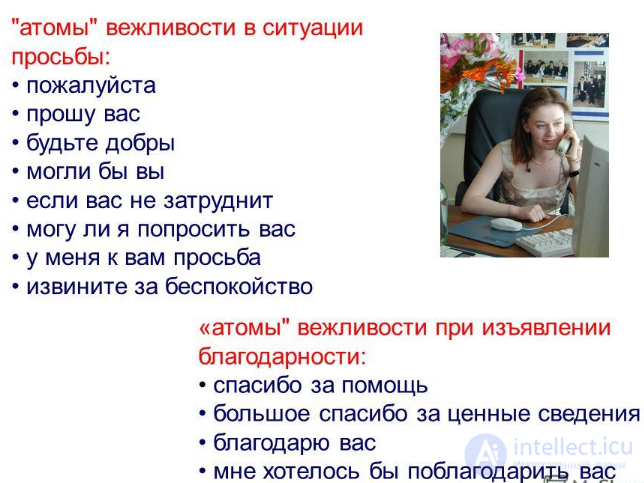
fig. atoms of courtesy
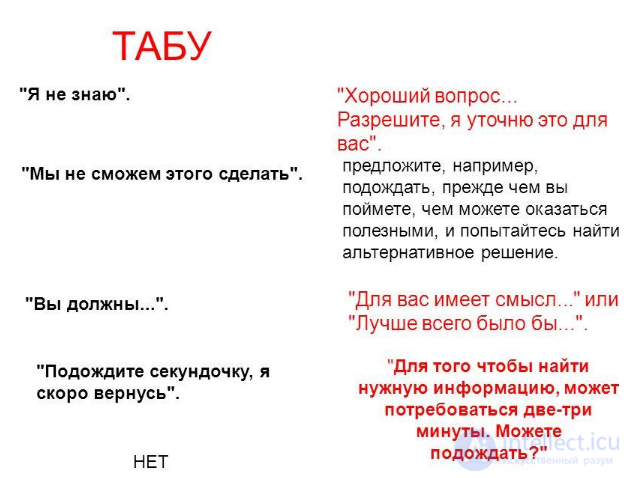
fig. what should not be said on the phone
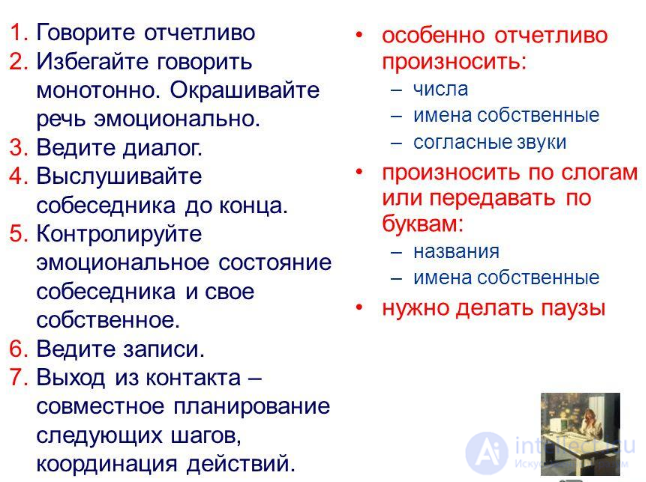
fig. features of phone and video calls
Communication via video online services, such as Skype, Viber, Discord, and others, has its own psychological features that may differ from communication in live presence or even through text messages. Here are some of them:
Sense of physical distance:
Visual information:
Features of perception:
Comfort and confidentiality:
Fatigue and attention:
Technical problems:
Self-esteem and appearance:
Multitasking:
Absence of physical contact:
Because of these psychological features, it is important to take into account how the conditions of video communication affect you and your interlocutors, and to try to create comfortable conditions for effective and pleasant communication.

Comments