
Lecture
Manipulation of mass consciousness (cf. “manipulation of public opinion”) — one of the ways of controlling a large number of people (collectives, communities, and so on) by creating illusions and conditions for controlling their behavior.
This influence is directed at a person's psychological structures, is carried out covertly, and aims to establish control over behavior, to deprive the object of manipulation of freedom of choice by changing people's notions, opinions, motivations, and goals in the direction needed by some group. Manipulation of mass consciousness serves as a key element of psychological operations and information warfare. As indicated in the monograph by S. G. Kara-Murza, the symptoms and signs of manipulation can include: language, emotions, sensationalism and urgency, repetition, fragmentation (parceling), removal from context, totalitarianism of the message source, totalitarianism of the decision, blending of information and opinion, cover by authority, activation of stereotypes, decoherence of statements, and so on . Manipulation is the oppression of the individual, and since a person wants to believe in what they want to obtain (knowledge, experience, material goods, psychological comfort), this oppression can be achieved through “a lie one wants to believe”.
The Oxford English Dictionary defines manipulation as “the act of influencing or controlling people cleverly, especially with a disparaging connotation, as covert control and processing”. It was in this sense that the word “manipulation” replaced the previously used term “Machiavellianism” in the political vocabulary .
In the 20th century, the range of phenomena to which the term “manipulation” came to be applied, with a political content added to its original definition (in tech., med.: “handling objects with a special intention, a particular purpose, as manual control”), expanded. “It came to be used in reference to the media and political events aimed at programming the opinions or aspirations of the masses, the psychological state of the population, and so on. The ultimate goal of such efforts is control over the population, its manageability and obedience” :44,45.
Accordingly, the understanding of the term “manipulation” in psychological literature was also adjusted. In addition to the two previously known meanings (the first borrowed from engineering and used by engineering psychology and the psychology of labor; the second from ethology, where manipulation is contrasted with locomotion ), from the 1960s psychologists began to use it — within the framework of analyzing interpersonal relations — also in a third sense, drawn from political science works.
In political science, in the 1950s–70s, the concept of “manipulation” was actively used simultaneously by both main adversaries in the “Cold War”. Socialist literature focused on “exposing the manipulative essence of bourgeois (imperialist) media”, while the latter accused the USSR and the PRC of “brainwashing” Americans taken prisoner during the Korean and Vietnam wars :45.
The “Modern Dictionary of Sociology”, published in 1969 in New York, defined manipulation as “a type of exercise of power in which the one who possesses it influences the behavior of others without revealing the nature of the behavior he expects from them”. A person, in interacting with those around them, interacts with the consciousness of other people, in one way or another influencing their behavior, but conscious manipulation begins from the moment the manipulator sets a goal for himself for the manipulation.
Today the concept of “manipulation” is largely identical to control over people's behavior through the introduction into consciousness of ideas, thoughts, and notions, the formation of a cognitive image of the world (Schank, 1991) with the help of the massed dissemination of information specially prepared in form and content.In this connection, in the work “The Information and Communication Space of Contemporary Russia”, published in Germany, Nobel Prize nominee V. V. Tepikin writes: “A person in the contemporary information society continues to be actively shaped and directed, so to speak "informed". And manipulation makes it possible to immerse the audience in a state of illusoriness, for the very active information field has the ability to shape people's consciousness, subordinating them to those who control the process”.
Manipulation is based on a property of consciousness which, as researchers believe, often involuntarily perceives information one-sidedly, relying on internal patterns, taking an illusion or external form for the essence of a given phenomenon (Mamardashvili, M., 1990) .
On the other hand, researchers claim that mass consciousness contains deep archetypal structures that promote the rejection of manipulative schemes and the regeneration of mass consciousness, which significantly limits the impact of manipulations (Kolin Yu., 1997)
There are quite a few methods of manipulating consciousness used in the mass media. Among them are both crude, primitive forms of manipulation and subtle ones, based on a good knowledge of individual human psychology and social mechanisms. The most common and obvious are:
It should be noted that in contemporary society, manipulation of the masses by means of the mass media proves most effective through suggestive influence on the audience. This is connected with at least several factors, the main ones being the almost total coverage of the territory of influence, as well as a historical predisposition to trust the mass media, which comes to us from the Soviet past, and, for those born later, by a phylogenetic path (the evolutionary interaction of generations).
Sergei Alekseevich Zelinsky, author of the textbook “Manipulation of the Masses and Psychoanalysis”, proposes the following methods of suggestive (Eng. suggestive - hint, suggestion) influence on the masses:
The essence of this method is based solely on the specifics of our psyche, which is arranged in such a way that it tends to take on faith the information that entered our consciousness's processing first.
Even the fact that later we may receive more reliable information often does not rule out either subconscious distrust of it, or the circumstance that our unconscious will send “favorable” impulses to consciousness regarding the information received first.
This principle is used quite successfully in political technologies, when some incriminating material (compromising information) is sent (via the media) against a competitor, thereby: a) forming a negative opinion of him among voters; b) forcing him to justify himself. Moreover, even in this case there is an effect on the masses through the stereotypes widespread in society that if someone is justifying themselves — it means they are guilty (and, note, apparently these stereotypes are quite false, but nevertheless they leave a negative trace regarding the given individual).
A fairly common deception, used with the aim of influencing the audience for purposes needed by the manipulators, when so-called eyewitnesses of events are found, who with the necessary sincerity report information passed to them in advance by the manipulators, presenting it as their own.
The name of such “eyewitnesses” is often concealed, supposedly for reasons of secrecy, or a false name is given, which, together with the falsified information, nevertheless often achieves an effect on the audience, since it acts on the individual's unconscious, arousing in them an intensity of feelings and emotions, as a result of which the psyche's censorship is weakened and is able to let through information without determining its false essence.
This method of manipulation is often the most successful, because in this case, through the artificial creation of a threat and the resulting intensity of passions, the masses are already, as it were, initially immersed in a state resembling an ASC (altered state of consciousness).
As a result of which they are easier to control, since the necessity of carrying out orders is dictated by the individuals' own safety; along the way, a positive image of representatives of the authorities is also formed. This, again, practically contributes to the acceptability, on the part of the authorities, of any actions, unconsciously interpreted by the masses as “care” for them.
In Soviet times, a falsely formed image of the enemy made it possible to spend a significant portion of the GDP (gross domestic product) on the defense department, artificially creating a shortage of certain goods for the population in the country.
In this case, the manner of presenting material may seem quite curious. That is, there occurs a certain conscious shift of emphasis in the material presented to the audience, when a shift of emphasis occurs, and something not entirely desirable for the manipulators is presented in the background, while what is necessary for them is most clearly highlighted.
In this case, manipulations of mass consciousness of any kind proceed from the belief, widespread among manipulators, that when performing any actions of a purchasing or imitative nature, individuals orient themselves toward so-called opinion leaders. Various figures who have become cult figures or sufficiently authoritative for a certain category of the population can act as opinion leaders.
Moreover, most often the situation is such that individual sectors of the media-mass-audience have their own opinion leaders. For example, for someone a famous athlete may become an authority, for someone a pop singer or rock musician, for someone a writer.
It is known that this form of manipulation is quite actively used both in the media and in ordinary life. And during the election period this form becomes most desirable for manipulators, when well-known actors, writers, and musicians, hastily accepted into one party or another, recommend voting exclusively for it (that is, for themselves, which already means also for it, and for all those who, besides these well-known figures of show business and various bohemian institutions, belong to the given party).
In this case, it becomes possible to present material of practically any degree of emotional intensity without evoking the expected storm of passions. And this becomes possible based on the rule of reorientation of attention, when the information that needs to be concealed, as it were, recedes into the shadow of events pushed forward as if by chance, serving to distract attention.
In this case, it becomes possible to present practically almost any material without fear of its undesirable (negative) component.
Such an effect on the emotional component of the mass-media audience occurs during the television appearances of a number of politicians, impulsively shouting out their ways of getting out of crisis situations in which, in their opinion, the country is constantly located. Such a method has been and is used by certain television announcers, who, thanks to this method of manipulation, affect the feelings of individuals, and an emotional charging of the audience occurs, meaning that such manipulators gain the ability to force attention to the material presented.
Depending on how the same materials are presented, various, sometimes opposite, opinions can be achieved in the audience. That is, some event can be artificially “not noticed”, while something else, on the contrary, is given increased attention, moreover on different television channels.
At the same time, of course, the truth itself, as it were, recedes into the background. And it depends on the desire (or lack of desire) to bring it to light.
This becomes possible when a certain portion of information, undesirable for the manipulators — is deliberately not allowed on air.
The March 26 rallies. The truckers' protests
A type of manipulation based on the advance release of information negative for the main category of people, or compromising material against a competing group in the sphere of political elections, when this information causes maximum resonance, so that, by the time subsequent information arrives and an unpopular decision needs to be made, the audience is already tired of protesting and no longer reacts the same way. The people, in this case, have already grown tired of reacting.
Active work in the media on the negative image of Mikhail Prokhorov before the 2012 elections.
A method of manipulating the mass-media audience, when a false intensity of passions is used through the presentation of supposedly sensational material, as a result of which the individual's psyche does not have time to react properly, unnecessary hype is created, and the information presented by the manipulators ends up being favored in the individual's assessment of it. That is, in this case there is a noticeable decrease in the critical faculty put forward by the psyche's censorship, which means the manipulators achieve the expected result.
In this case, the basis for possible manipulation consists of a known component of the individual's psyche, when he is inclined to believe information that does not contradict his inner “self”. That is, in other words, if through the media (television, radio, press) we encounter information with which we internally disagree (this somehow contradicts information already present in our unconscious), then we consciously shut off such a channel of receiving information.
Amid a flow of unnecessary and useless information, the truth gets lost.
In this case, such a quantity of negative information occurs regarding some figure that this information achieves the exact opposite effect, and instead of the expected condemnation, such a figure begins to arouse pity.
The type of mass manipulation we are examining becomes possible when information that could produce an undesirable effect is delivered in a quite ordinary tone, as if nothing strange, let alone frightening, is happening. As a result of this manner of presenting information, certain critical information, upon penetrating the listeners' consciousness, as it were loses its relevance.
When covering rallies or demonstrations suppressed by the authorities with a large number of victims and casualties, the effect of such information is noticeably reduced when the material is presented by announcers in an ordinary, even voice, as if they were talking about some ordinary and quite unremarkable story. At the same time, the atrocities may in fact be the exact opposite of the manner in which the material is presented.
In this case the manipulativeness of the technique applied is aimed at one-sidedness in the coverage of events, when only one side of the process is given the chance to speak, which achieves a false (hidden, manipulative) effect regarding a possible interpretation of the events presented in the material, in fact ruling out such an interpretation altogether.
This type of manipulation becomes possible when the necessary information is presented against a backdrop of other information that is initially negative and perceived negatively by the majority of the audience.
That is, against a black background something white will always stand out. And against a background of bribe-takers and bureaucrats — in the right context one can present a person with deliberately constructive actions, even if he does not expose the profiteers, but, for example, merely has information about this person's positive qualities put across.
This method of manipulation is also used on television (when, in some talk show, the audience starts clapping and wildly expressing their delight at something), and at the appearances of various public figures before an audience, when an initially paid “support group” periodically starts showing every kind of approval for the speaker.
When put into practice, this principle is meant to produce an effect of psychological shock, whereby the manipulators achieve the desired effect through the deliberate broadcasting of the horrors of contemporary life for individuals, which provokes an initial reaction of protest (owing to a sharp rise in the emotional component of the psyche), and a desire to punish the guilty at any cost.
Analogue of Chomsky's method: Placing emphasis on emotions to a far greater degree than on reflection, only in a more categorical form.
This manipulation is quite dangerous, since it in fact eliminates the true cause of some issue, replacing it with a false analogy. For example, some well-known athlete is elected as a deputy, and political strategists vigorously push the idea (by creating an associative chain) that if he was able to achieve significant results in sport, then he will also be able to achieve something similar in the struggle for the cause of the working masses.
In this situation, in order to solve some task the manipulators throw a great deal of various information onto the market, thereby tracking public interest, and the information that fails to gain traction is subsequently discarded, while what remains is presented with the help of numerous manipulative techniques so that the manipulators can fully achieve their programmed success.
Any event undesirable to the manipulators can, when this kind of technique is used, often take on the opposite coloring. As they say, everything depends solely on how you present this or that material, and with what commentary.
The eyewitness is always right. People trust those who are in the thick of events.
This principle is based, at times, on an almost radical change in an individual's previous opinion as a result of that individual being admitted to the presence of certain representatives of power (even ones once condemned), famous performers of musical compositions (even in a genre unacceptable to that individual), and so on.
This method of manipulation is in some ways fairly simple and unique. All that is needed is the repeated repetition of some piece of information, so that it lodges itself in the audience's memory and is later put to use by it.
This method of manipulation has been known for quite a long time, and consists in the public being presented with only part of the reliable information, while the other part, which explains the possibility of the first part's existing, is withheld by the manipulators.
Since I am trying to understand how these manipulations work, I have had to introduce a few concepts and examine a few patterns.
AAPR = Absolutely Adequate Perception of Reality
This is a hypothetical state that represents an infinite approximation of adequacy. The concept is introduced for the sake of illustrating certain patterns and relationships. A sufficient condition for AAPR is absolute IML.
Note
It is not clear how precisely you would be able to predict the future even while possessing AAPR. Thus, if we assume that freedom of choice does nonetheless exist, then we cannot precisely predict events. The question of whether we can, even so (given the presence of free choice), precisely predict the probability of possible events also has no answer, because the probabilistic characteristics of “freedom of choice” have not been studied. But still it seems obvious that the closer one's perception of reality is to AAPR, the more precisely one can predict the future.
Absolute IML (IML = Information, Mental abilities, Logic)
APR = Adequate Perception of Reality
Note
In reality it is often mathematically impossible to compare the adequacy of two pictures of the world precisely. For example, if one picture of the world predicts events A, B, and another picture of the world predicts C, D, while in reality A, C occur, then which picture of the world is more adequate? Mathematically it would be correct to rely on the amount of information contained in the predictions A, B, C, D, which is related to the probability of these events, but the problem is that in real life it is often impossible to find the exact value of these probabilities. But still, sometimes this is fairly obvious. Let us compare, for example, the perception of a child and of parents. Parents predict the development of events far better.
Picture of the world — our interpretation of reality.
Small regeneration cycle — a cycle that, on the one hand, makes it possible to build a correct picture of the world out of true facts, and on the other hand, a correct picture of the world makes it possible to filter out false facts, correct erroneous ones and add missing ones. In this way self-tuning to the truth takes place.
Note
Small cycle means that this is “internal” work.
The word regeneration means that this work is aimed at reproducing the picture of the world.
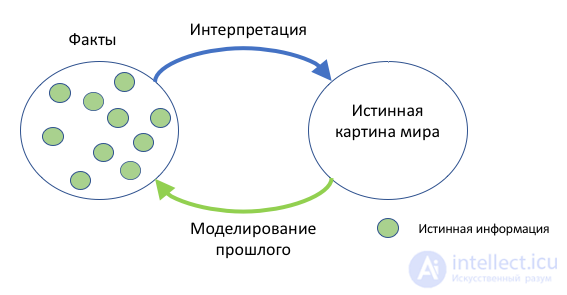
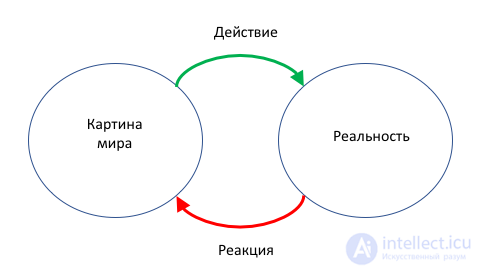
Large regeneration cycle (experience cycle) — a cycle that, on the one hand, makes it possible, on the basis of a true picture of the world, to forecast the development of events and to act accordingly, and on the other hand, by analyzing the result of these actions, to correct the picture of the world. In this way self-tuning to the truth takes place.
Note
Large cycle means that this is an ''external'' activity, consisting in the relationship between the individual and reality.
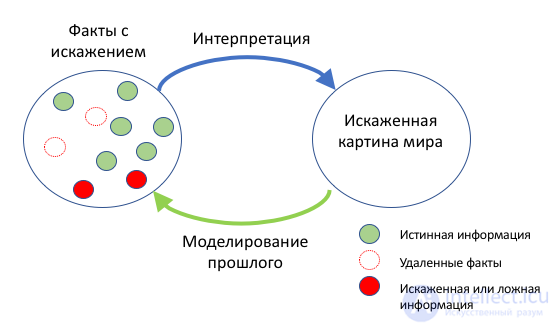
False small regeneration cycle — in the case of a weak IML, a false picture of the world can start to filter facts incorrectly, retaining or adding false ones and ignoring true ones, while this set of facts (together with the erroneous data) will support this false picture of the world. In this way the illusion is maintained.
False large regeneration cycle (false experience cycle) — in the case of a weak IML, on the basis of a false picture of the world an individual makes incorrect predictions and performs corresponding actions, while the result of these actions (which is not positive) is interpreted incorrectly (as positive), which supports this false picture of the world. In this way the illusion is maintained.
Compensatory mechanisms
The principal mechanisms that lend adequacy to the picture of the world and ensure “self-cleaning” from errors are the large and small regeneration cycles. But a person, owing among other things to the weakness of his IML, is forced to resort to certain compensatory techniques that place a limit on the effectiveness of these cycles. Four such mechanisms can be singled out: generalization, emotional charge, the opinion of those around us, and meaning. Each of them possesses a “cementing” property, depriving our perception of the world of flexibility and “preserving” it.
Note
I do not understand where the precise boundary between feelings and emotions lies, or whether there even is one. So although in this article I nowhere speak of feelings, I allow that in places the terminology is not quite correct and one should rather speak of feelings.
Note 1
In the case of authoritarian regimes this factor is used together with an emotion, usually fear. A typical situation — people try to ''think like everyone else''.
Note 2
In the modern world, a world of social networks and the ability to shape one's surroundings in accordance with one's own view of life, the power of this factor is intensified. We can hold differing points of view and select for ourselves a milieu with a similar worldview. This gives rise, for example, to such strange phenomena as the community of followers of the flat-earth theory.
Remark 1
An imposed purpose is not always false. For example, the whole process of raising small children — these are usually imposed purposes. The task of parents and educators is to understand what is truly important and interesting (meaningful) for the child.
Example
If you are forced by brute force to do something, with no explanation at all (no myth), and in the end you are compelled to somehow live with it and “accept” this picture of the world (you resign yourself to it), then you yourself will create a myth to explain why this must be done. “Stockholm syndrome” can be cited as an example.
This diagram shows the concepts introduced above in their interrelation:
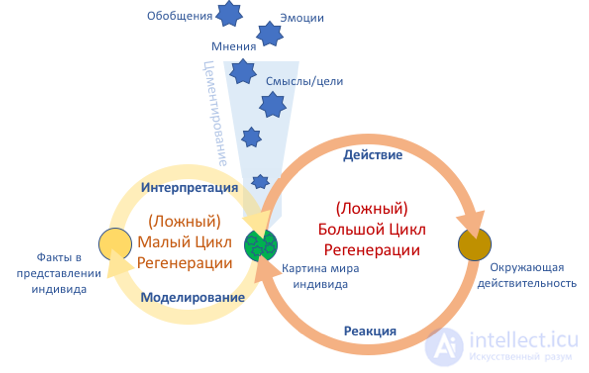
Now we have a sufficient set of tools for analysis.
The cause of a decrease in the degree of adequacy is a weakness of the IML, namely:
All of this is a field for attacks on our relationship to reality with the aim of manipulating consciousness. Let us examine each of these aspects.
This is the most obvious cause of distortion in perception. It is quite natural. It is clear that if you do not possess sufficient information, it is hard for you to form an idea of the situation.
This is also one of the most widespread methods of manipulation. Essentially, when we speak of distorted or false information, we are talking about deception. In the case of simple deception, the picture of the world can easily be restored by supplying true facts. But modern reality shows that with some kinds of manipulation, a false picture of the world possesses surprising stability, and “truthful data”, even when available, often cannot win in the competitive struggle for the status of truth against outright lies and fakes. This effect can be called “brainwashing”, and all our examples will concern precisely such situations.
This is a manipulation aimed at a specific person, taking into account the particulars of his character and perception, with the goal of discrediting another person or of influencing his attitude toward a particular situation.
Let us examine the famous story of the relationship between Othello and Desdemona from the point of view of the new concepts introduced and the patterns described.
Then, using the dry language of analysis, Othello's attitude toward Desdemona was changed by means of false information. This information was presented in such a way as to form in Othello a particular view of the situation. His jealous character gave this new picture of the world a strong negative emotional charge, which created a kind of potential minimum for such an interpretation and deprived Othello (a strong negative emotion) of the ability to think logically. Once the false picture of the world had formed, a false small regeneration cycle began to operate, which displaced the true facts, ceasing to take them into account. A cycle of false experience was also launched. A false goal appeared — revenge, which then governed his actions.
An interesting (and unexpectedly effective) device is the creation of a cycle of fake news. Each such news item, moving in the wake of a certain (false) point of view, fits into the small cycle of false regeneration and “feeds” the negative emotion associated with this suggested picture of the world. And despite the fact that this news item is refuted after some time, it serves as fuel for this emotion, which in turn “cements” the false picture. This leads to the result that even while understanding that this news item was false, a person who has fallen under the influence of this manipulation continues to retain this false picture of the world. Also, as already mentioned, negative emotion strikes at the second and third elements of the IML, narrowing the individual's analytical abilities.
The next common, unsophisticated but very effective device — blackening.
Essentially similar to the two previous ones. A (falsely) negative image of a person is created. The information may contain a large percentage of lies. It does not matter that after some time it turns out to be a lie. The main thing is that an emotion will be “glued” to this person. Then this image can be “worked on”, this “reality” can be elaborated with a sequence of fake news items that will serve as “fuel” for this emotion. The difference from the Othello example is that here, alongside emotion, the ''opinion of the people around'' is used to give stability to the false picture of the world. The media are employed for this.
''A bald-faced lie'' means that a person knowingly lies, while skillfully creating the impression that he is telling the truth. The essence of this manipulation is that the attacker, through his behavior, tries to win people over and thereby increase the degree of trust in this information. When the media is used, with good acting skill or training, this attack on minds is highly likely to succeed, at least for a certain target group, which can then quickly “unite” via social networks, thereby creating a “fixation” of the picture of the world in accordance with the “opinion of the people around” factor.
This is an aggressive, persistent, and prolonged distortion of the picture of the world. This is a direct, massed attack on minds. The greater the power used, the more effective it is.
In fact, a certain myth is created, and this myth is instilled in those around. In doing so, the emotion of fear is often used. To this end it is demonstrated that if someone actively disagrees with this picture of the world, then that person will have problems — ranging from inconvenience to real danger to life (intimidation). This is a favorite device of totalitarian regimes, but it can also be a less bloodthirsty situation, for example in the case of sects, or of certain companies (which sometimes resemble sects) or certain groups. This attack, using fear, first strikes at the second and third elements of the IML of the target group (respectively, for whichever is the weak link). Further, as this group grows, the “opinion of the people around” factor acquires ever greater significance.
In the case of sectarianism and certain ideologies, it may not be fear but “bright feelings” associated with a sense of brotherhood, of meaningfulness of existence, or it may be the result of various psychophysical techniques elevated to the rank of a cult. But still, the dichotomy of good/evil underlying these myths always has fear as the flip side of the coin.
This attack is built on the dichotomy — cruel/kind, evil to enemies but kind to friends. It resembles the previous attack. Fear and myth (see the next chapter) are also used, in the form of a peculiar notion of good and evil (which may even be formalized as a code of ethics). Here, unlike the previous attack, the media are not used, and the action is limited to a narrow circle of “one's own”. In principle, this largely resembles the previous two cases (right down to elements of sectarianism).
All four compensatory mechanisms described earlier are a consequence, among other things, of a weak second element of the IML, which means that any “brainwashing” using “cementing” is also an attack based, among other things, on the limitation of thinking capacity. It is easy to see that all the previous examples belong to this category.
But a group of special manipulations can be singled out that are aimed specifically at attacking this element.
In reality this is a primitive form of blackening.
This is a very widespread type of manipulation. An insult or name-calling is a kind of generalization, a sort of little box into which a certain set of negative characteristics (and, correspondingly, emotions) has been carefully placed in advance. But not only that — an instruction is also included on what to expect from this person, on how he will behave. This is a way of “erasing” a personality by classifying it. After that one no longer has to pay attention to it. If you compare an insult with an ordinary classification, the difference lies in the presence of negative emotion. The stronger this emotion, the more strongly the perception is “cemented”.
The essence of this manipulation is that a person is made a beneficiary of a false cycle of experience based on a false picture of the world (myth). There are two possible variants
We are considering precisely the second variant. In this case, the very fact that the person is a beneficiary “cements” the false picture of the world. Thus, for example, in caste societies, the higher castes sincerely consider themselves an elite, despise common people, and believe that they possess a deserved right to violence and exploitation. They are unquestionably beneficiaries of this system of relations, and their false small regeneration cycle carefully shields them from all doubts.
It is interesting to observe, and I think everyone knows of such examples, how some people change their views to the exact opposite, having become beneficiaries of a myth they had fought against some time before.
We have already discussed the significance of myth in the chapter “The picture of the world and its stability”. The use of the media, playing on already-formed emotions (for example, resentment, hatred), and the use of authorities can indeed turn a myth into a powerful weapon. In fact this is the direct implantation of a false picture of the world into consciousness.
The danger also lies in the fact that these myths are often imposed in childhood and youth, when we are almost defenseless against attacks of this kind. Later on, the myth may “die”, or you may independently come to recognize the falseness of this worldview. But this worldview does not disappear without a trace; its fragments, like shards of a broken mirror, continue to live within us. Some of them fit harmoniously into a new myth that carefully picks them up, others are stored in an inactivated state, thereby creating a “backdoor” into our consciousness.
The essence of this manipulation lies in the fact that you emphasize events confirming the myth, giving them great significance, and downplay or try not to mention, reducing their weight to zero, other events that do not fit into the proposed picture of the world.
In this way, even without openly lying, this attack allows one to implant and sustain a false small regeneration cycle.
Reality usually contains an entire spectrum of events. For example, a person may sometimes be kind, sometimes aggressive, sometimes depressed. In some situations he may look at his best, in others he may feel like a dolt… This applies to almost everything. There is always a spectrum. And if the weights of the phenomena in this spectrum are set incorrectly, this forms a false picture of perception.
So, for example, when it comes to discrediting a person, the public's attention is focused on those situations in which the person did not look his best. These may, for example, be not the finest deeds of his life, or simply unflattering photographs obtained by paparazzi.
Let us start with the fact that the lower a person's IQ, the more easily he succumbs to this kind of manipulation. A slow-witted person is easy to befuddle. But what was a discovery for me is that people with excellently developed logic and an IQ substantially above average still fall for these errors and themselves use these manipulations during arguments. Such is the strength of the desire to defend one's own “picture of the world”, such is the strength of the small and large regeneration cycles.
The most primitive and yet one of the most effective attacks is direct insults or even physical assault on the opponent. This throws a person off emotional balance and disrupts the process of logical thinking, which requires a certain degree of calm and comfort.
A variant of the previous attack is trolling. This is a more sophisticated attack. There may be no direct insults. It is more a form of mockery, but the essence and goal remain the same — to throw someone off balance.
The effectiveness of this attack can be strengthened by forming a group of trolls.
Remark
Both direct attack and trolling differ somewhat from the other attacks given here. At first glance it seems that these manipulations are not of the “brainwashing” kind. It is unlikely that the victim, after such behavior from the opponent, will become more interested in his ideas. But let us recall the “propaganda” attack and the factor of intimidating dissenters. Trolling usually takes place in public space and is aimed not at the opponent but at the spectators. They see how easily, cheerfully, and sometimes cruelly the victim is “trampled”. For at least some psychological types this is undoubtedly a powerful cementing factor and a manipulation of the “brainwashing” kind.
A very frequently encountered manipulation. Similar to the “emphasis” manipulation. The essence is that in a chain of cause-and-effect relations, some particular moment favorable to the attacker is taken and then considered as the original cause. The entire preceding chain is ignored. A device often used in the criminal world, when the victim's natural reaction to a provocation, in an attempt to defend himself and his dignity, is presented as the cause of the conflict, thereby demoralizing the victim and instilling in him the belief that he is guilty and must “answer for …”
— Why did you call Marya Ivanovna names?
— But Vasya did it too.
After this the usual question follows:
— And if Vasya had jumped out of the window, would you have jumped too?
This question is meant to explain to the child that one must answer for one's own actions and not follow the herd instinct.
I can understand why a child with an as-yet unformed mind answers this way, but why do I constantly encounter similar arguments among adult, intelligent people?
They probably want to say something more. I can even suppose that they have simply shortened their logical chain in this way. But please, unfold it. Explain to me, what do all these examples and comparisons have to do with it? The question was why YOU did this, not Vasya (or why THIS is happening HERE, and not THERE).
In reality this too is a manipulation. In doing so, our weak points connected with our past may be exploited (for example, fragments of old myths that once afflicted us).
Now let us look at a few non-trivial (unlike, say, low IQ, susceptibility to influence) typical misconceptions
Unshakeable confidence in one's own rightness most likely speaks of a fixation of the picture of the world and of false small and large regeneration cycles. The essence is that our IML is severely limited. We cannot say which information is true and
продолжение следует...
Часть 1 Methods of Mind Manipulation: Psychotechnologies of Hypnotic Manipulation, Sergei Alekseevich Zelinsky's Classification
Часть 2 CONCLUSION - Methods of Mind Manipulation: Psychotechnologies of Hypnotic Manipulation,

Comments