
Lecture
Ontogenetic research on communication is the study of the development and evolution of a person's communicative skills and motives for communication throughout the entire course of his or her life, from the moment of birth to old age. This line of research makes it possible to gain a deeper understanding of what changes occur in the process of communication over time and how interaction with the surrounding world shapes the psychological, social, and cognitive aspects of personality.
Ontogenetic research on communication may include the following aspects:
The development of communicative skills: Studies may focus on how the abilities to listen, speak, analyze information, and express oneself develop at different periods of life. This may include an analysis of infants' first words and gestures, the development of language and grammar, as well as the assimilation of sociocultural norms and rules of communication.
Motives and goals of communication: Studies may examine how the motives and goals of communication change at different stages of life. For example, a child's motives for communication may be directed toward receiving attention and care, whereas in adults the dominant motives may be exchanging information, establishing relationships, and achieving goals.
Social and cultural influences: Studies may analyze how the sociocultural environment, including the family, school, community, and media, influences the development of communicative skills and motives for communication. This includes examining the influence of language, cultural norms, and values on communication.
Specific stages of development: Studies may identify key stages in the development of communication, such as early childhood, adolescence, adulthood, and old age, and analyze which characteristic features of communicative behavior are observed at each of these stages.
Interaction with other aspects of development: Ontogenetic research may also take into account the relationship between the development of communication and other aspects of personality development, such as cognitive development, social adaptation, emotional state, and psychological well-being.
The study of the ontogenesis of communication is presented in the works of M. I. Lisina, L. I. Bozhovich, and A. V. Mudrik.
In preschool age, four forms of the child's communication with adults successively replace one another: situational-personal, situational-business, extra-situational-cognitive, and extra-situational-personal.
In M. I. Lisina's research it was repeatedly pointed out that the first means of communication to arise in ontogenesis are expressive-mimic means:
smiling, laughter, expressive vocalizations, and facial movements.
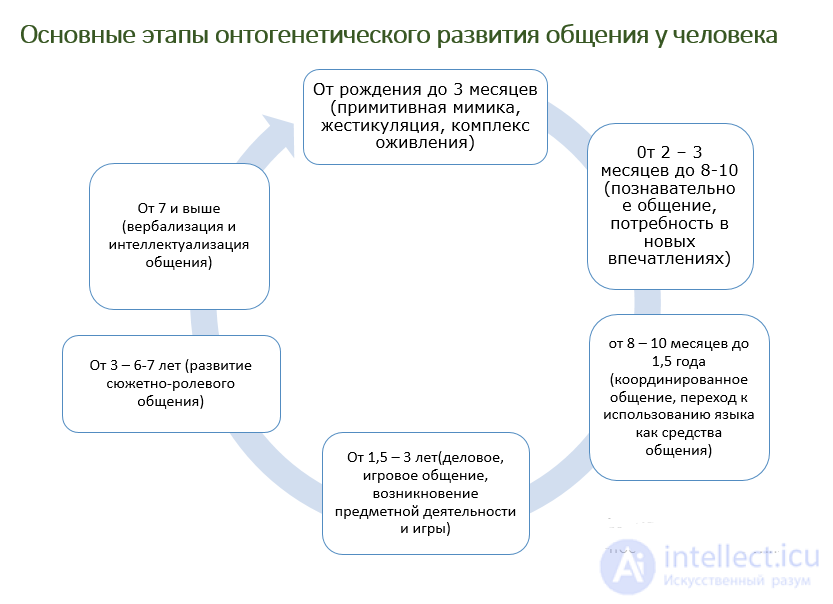
These are expressive means of communication. Their function is that they serve as indicators of one person's attitude toward another.
Object-related active means of communication arise later in ontogenesis. These are not expressive but pictorial means. They include postures,
turns, pointing gestures, pulling and handing over objects, manipulating objects, acting with objects, etc. Pictorial means
express a partner's readiness for communication and, in a distinctive form, show precisely what kind of interaction he is inviting.
Situational-personal communication (directly emotional
communication). The first form of the child's communication with adults to appear in ontogenesis. It begins to take shape in the 2nd month of life as the revival complex
develops. This form of communication satisfies the child's need for attention and goodwill from the adult; it is prompted by personal motives;
it is realized by means of expressive-mimic means; the content of situational-personal communication is the exchange of positive emotions between the child and the adult. In the first half-year of life it is the leading activity,
exerting a powerful influence on the development of all aspects of the child's psyche.
Situational-business communication with adults appears second in ontogenesis and exists from 6 months to 3 years of age.
Communication with adults becomes woven into the new leading activity (object-manipulative activity), assisting and serving it. Among other motives for communication, the central place
is taken by the business motive, since the main occasions for the child's contacts with adults are connected with their joint activity – practical cooperation. In the situational-business form of communication, the leading position
is occupied by communicative operations of the object-related active kind
(locomotor and object-related movements; postures used for the purposes of communication).
Situational-business communication is of paramount importance in the lives of
young children. During this time children move from non-specific, primitive manipulations of objects to increasingly specific and then culturally fixed actions with them. In this transition, communication plays a decisive role.
Extra-situational-cognitive communication arises in the middle of preschool age and is characteristic of children aged 4–5.
Like the second form of communication (situational-business), it is mediated and
woven into joint cognitive activity («theoretical» cooperation). The leading motive becomes the cognitive motive. The situational-cognitive form of communication is characterized by the child's striving for the adult's respect.
Cognitive communication is closely interwoven with children's play, which is the leading type of activity throughout the whole of preschool childhood.
Extra-situational-personal communication is the highest form of communication
(according to M. I. Lisina) and arises at the age of 6–7 years. This communication is directed toward
the cognition of the social world and is not included in any other activity.
It proceeds in the form of independent episodes. Its main motives are personal ones, which prompt the child to communicate. The adult
attracts the child as an independent personality. The main component of communication is the need for mutual understanding and empathy from the adult. Among
the various means of extra-situational-personal communication, the main place
is occupied by speech means.
Communication is of enormous importance in the formation of the human psyche, in its development, and in the establishment of rational, cultured behavior. Through communication with psychologically developed people, thanks to broad opportunities for
learning, a person acquires all his or her higher cognitive abilities
and qualities. Through active communication with developed personalities, he himself becomes a personality.
Communication is the most important factor in the formation of personality, one of the main
types of human activity, directed toward the cognition and evaluation of oneself
through other people. As L. S. Vygotsky believed, the development of the human psyche
occurs only in joint activity.
From the very earliest stages of ontogenesis, communication acquires a personal character and presupposes the possibility of close interaction of the child
with the adult. Communication plays a special role in the child's mental development,
the development of the child's psyche – being a process that occurs through the child's assimilation of humanity's socio-historical experience by means of real communication with adults.
Most scientific studies and psychological-pedagogical recommendations on the formation of communication skills in cases of impaired intellectual development are devoted to childhood. This is natural and understandable, since the earlier in life corrective-developmental work with a «special» child begins, the more effective the results of his or her social rehabilitation.
In communication, first through direct imitation (vicarious learning), and then through verbal instructions (verbal learning), the child's basic life experience is acquired. The people with whom he communicates are for
the child the bearers of this experience, and this experience cannot be acquired in any other way except through communication with
them. The intensity of communication, and the diversity of its content, goals, and means, are the most important factors determining the child's own development.
Communication serves the development of various aspects of a person's psychology and
behavior. Thus, business communication forms and develops his abilities and serves as a means of acquiring knowledge and skills.
Personal communication forms the person as a personality, giving him the opportunity to acquire certain character traits, interests, habits,
and inclinations, to assimilate norms and forms of moral behavior, to determine life goals, and to choose the means of achieving them. Diverse in content,
goals, and means, communication also performs a specific function in the mental development of the individual.
Thanks to non-verbal communication, a person gains the opportunity to develop psychologically even before he has mastered and learned to use
speech (at around 2–3 years of age). Moreover, non-verbal communication itself promotes the development and improvement of a person's communicative capacities, as a result of which he becomes more capable of interpersonal contacts and opens up broader opportunities for development. Verbal communication is connected with the acquisition of speech, which, as is well known, underlies
the entire development of the individual.
In infancy, the need for communication with parents, especially with the mother, is strongly expressed. A deficit of such communication over a period of 5–6
months therefore leads to irreversible negative shifts in the child's psyche,
disrupts emotional, mental, and physical development, and leads to
neuroses.
As M. I. Lisina notes, the content of the need for communication (or, more precisely,
it would be the motive for communication) may differ at different stages of ontogenesis.
In children aged 2–6 months from birth, a need for benevolent attention appears, while in children from 6 months to 3 years of age it is a need for cooperation. For children under 6
months of age, the adult is a source of affection and attention, and communication itself has a personal meaning for the child. For toddlers, the adult is
a playmate, a model for imitation, an appraiser of the child's knowledge and skills;
communication with him has a business meaning.
By the end of the first year of life, children develop a fairly stable
striving for communication with peers: they like being among other children,
although they do not yet play with them. From the second year on, communication with peers expands. However, one cannot yet speak of stability in the choice of a communication partner among young children.
In 4-year-old children, communication with peers becomes one of the leading
needs. However, the need for communication with adults does not disappear either. For
a child aged 3 to 5, the adult is an object of respectful attitude, and communication with him has a cognitive meaning. For children aged 5–7, the adult is
an older friend from whom children expect mutual understanding and shared experience.
Thus, with age, the content of the need for communication (or, more precisely,
it would be more accurate to say – the content of the motive for communication) becomes richer and more diverse.
At the same time, the significance of the adult as an object of communication also changes.
Stages have been identified through which the communication of preschoolers passes in its development (M. I. Lisina). These stages are connected with children's use of various
forms of communication.
The emotional-practical form of communication (years 2–4 of life).
In early preschool age, the child expects a peer to participate in his games and craves self-expression. In a peer, he perceives only the peer's attitude toward himself, while the peer as such (his desires, actions, mood), as a rule,
goes unnoticed. This communication is situational and depends entirely on the concrete setting and on the partner's practical actions. The main means of communication are locomotor or expressive-mimic movements. After age 3, children's communication
becomes increasingly mediated by speech, although it is still extremely situational and is used only in the presence of eye contact and expressive movements.
The situational-business form of communication (years 4–6 of life). After age 4,
the peer becomes more attractive to the child than the adult. At this
time, role-play becomes collective – children prefer
to play together rather than alone. The main content of communication among children of this
age becomes business cooperation. A need for recognition
and respect from peers begins to manifest itself distinctly. The child strives to attract others' attention, keenly catching in their glances and facial expressions signs
of their attitude toward him, and shows resentment in response to inattention or reproaches from partners. At the age of 4–5, children often show adults their advantages over their peers, and try to hide their mistakes and
failures from peers. This means that competitive, rivalrous relations appear at this age.
The extra-situational-business form of communication (years 6–7 of life). In children
of this age, about half of speech addresses to a peer are of an extra-situational nature. Children tell each other where they have been, what
they have seen, share their plans, and give assessments of the qualities and actions of others.
However, such communication takes place against the background of a shared activity (a common game or
productive activity). At the same time, preparing for the game, planning it, and
discussing its rules take up a significantly larger place than at the previous stage. A competitive element persists in the communication of children of this age.
But this does not prevent them from perceiving in their partner his extra-situational manifestations – desires,
preferences, and mood.
In the lower grades, communication with peers becomes the leading activity, and
a stable circle of close communication is formed. The need for the emotional support of peers can be so great that children do not always think about the fundamental basis of these relationships. Hence cases of «false comradeship» and «mutual covering-up».
Communication influences the development of the child's psyche in childhood chiefly through the real process of interaction with the adult.
Primary school age is a special one among the ages of childhood. Its
study has always been connected not only with identifying children's psychological characteristics, but even more so with studying the conditions of their schooling. This
social peculiarity of primary school age makes the task of differentiating age-related and psychological-pedagogical approaches almost impossible to resolve. This position was most consistently implemented in research on the formation of learning activity (D. B. Elkonin, V. V. Davydov, and others), but it also, as a rule, manifested itself in other studies as well.
An analysis and synthesis of L. I. Bozhovich's studies makes it possible to present the teacher's influence on pupils in the form of a certain ideal model.
Given the general atmosphere of unconditional acceptance, empathy, and goodwill
created by the teacher, in primary school age the regulation of
pupils' behavior comes to the fore. The teacher's influence is exercised by including himself in the sphere of the pupil's life activity; the factor of inclusion at this
stage is the teacher's monological authority. The teacher acts for the lower-grade pupil as a model in the new position of pupil that is unfamiliar to him. At
this stage, communication that is dialogical in content is carried out by the teacher
mainly in the form of direct (instruction, command, prohibition) and indirect (advice) subjective demands, as well as a system of objective demands. The mechanism by which these influences are carried out is suggestion, with
elements of explanation, persuasion, and request. At the same time, the teacher differentiates pupils by degree of suggestibility. It has been noted that children with a higher
level of cognitive activity are less suggestible. Pupils
of the lower grades are active participants in the «teacher-pupil» interaction; they identify themselves with the teacher as the performer of the role and imitate him. The process of interaction, in which new forms of activity, new relationships, and new experiences arise, is called the process of induction.
The teacher, as it were, inducts the pupil into a new object of his activity and consciousness, passing on to the child not only the means of mastering his own behavior, but
also the motives for new activity and creative development, ensuring the child's forward movement through the stages of the educational system. The role of the
primary school teacher in the development of the child's personality, in his education and upbringing through induction into cultural values, is so great that in the best educational systems in the world, primary school teachers are trained at national universities.
Communication with peers reaches its maximum at age 11–13. At the same time,
the desire to help a friend is a fairly common basis for communication.
When choosing a communication partner, adolescents take into account the partner's
qualities: «strong-willed», «honest», «brave», and so on; his practical qualities are also mentioned: plays football well, plays the guitar well, and so on.
In sixth-graders, motives for choice appear that are connected with the need for inner (spiritual) communication: «dreaming together», «making
various plans for life together». This may be why, with age, as shown by
A. V. Mudrik (1981), stability in the choice of a communication partner increases, in
particular among schoolchildren – up to the 7th grade.
In adolescence, communication between adults and children is often difficult,
because the child is convinced that he will not be understood anyway. For more successful communication between the adult and children, some transformation of the adult's position
toward the child's position is necessary. Sometimes the psychological barrier can be overcome with the help of a story told by the parent or teacher about his own
behavior in childhood in similar situations, giving an assessment of his actions from
the child's point of view and from the adult's point of view. If the adolescent takes a dismissive position in communication with
the adult, the latter must show great tact,
patience, and attention to the child's interests and inclinations. In some adolescents the striving for communication with adults does not disappear, and in the 7th–8th grade
this motive acquires a new quality: a quarter of schoolchildren develop a need for confidential communication with adults (A. V. Mudrik, 1981).
Adolescence is characterized by an alternation of periods of «closedness» and «openness» in communication. «Closedness» is noted in the 6th and 8th grades (although there may be shifts in the timing of the onset of this period), while «openness» is noted in the 7th and 9th grades. «Closedness» manifests itself in the adolescent's striving
to protect his inner world, to shield from outside pressure his still-
unformed conceptions of himself, his self-image. During this period even
neutral questions can provoke an inadequate reaction in adolescents.
For example, one boy, in response to his mother's question, «Did you have lunch today?», suddenly
became angry: «You're always prying into my soul! Leave me alone!»
During periods of «openness», the adolescent, on the contrary, needs to talk about himself,
about his problems, experiences, and the changes taking place within him. Moreover,
while both peers and
adults can satisfy this need in a seventh-grader, ninth-graders have an acute need to communicate specifically with adults
(though only with those they trust), because they face the task of determining their path in life, choosing a profession, and a path for further education.
Here a teacher who enjoys authority among pupils can provide considerable help.
Features of Communication in Youth
In youth there occurs a substantial renewal of the motives
of communication. The circle of communication expands, as do its goals. Intra-group communication with peers breaks down, contacts with persons of the opposite sex intensify, as do contacts with adults when complex everyday
situations arise (I. S. Kon, 1989). The need for mutual understanding with other people noticeably increases: in young men, from 16% in the seventh grade to 40% in the ninth, and in young women, from 25% to 50% respectively, which is connected with the formation of
self-awareness.
Features of Communication in Maturity and Old Age
In maturity and old age, the spheres of communication often narrow. Further, in
connection with retirement, business communication disappears. Grown-up children often leave their parents, and therefore the latter experience a decrease in the intensity
of family communication, which is most often carried out by telephone conversations and on the initiative of the parents rather than the children. Many elderly people
become widowers, or, more often, widows, as a result of which they lose their constant family communication and experience loneliness. In this case, a great
role is acquired by communication with friends or acquaintances, with neighbors in the same building or (in rural areas) on the same street
This type of research plays an important role in understanding how communicative skills and motives for communication are formed and change over the course of a person's entire life. It makes it possible to identify key moments in the development of communication and to identify factors that contribute to successful communicative interaction at different periods of life.

Comments