Business communication is the process of exchanging information, ideas, and opinions among people in a work environment with the aim of achieving certain work-related goals and objectives. Effective business communication plays a key role in an organization's success and in the interaction among colleagues, partners, clients, and other stakeholders. Here are some of the main aspects of business communication:
-
Written communication: Includes emails, documentation, notes, reports, and other text messages. It is important to be clear, concise, and precise in written communication.
-
Oral communication: Includes conversations, presentations, video conferences, and phone calls. It is important to listen attentively and express one's thoughts clearly and precisely.
-
Non-verbal communication: This is how you look and what you do while communicating. It includes gestures, facial expressions, posture, and tone of voice. Non-verbal communication can convey a great deal of information.
-
Intercultural communication: Different cultures and languages are often encountered in the global business environment. Understanding cultural differences and adapting to them are important for successful business communication.
-
Emotional intelligence: The ability to understand and manage one's own emotions and the emotions of others plays an important role in interpersonal communication in the workplace.
-
Ethics and professionalism: Business communication requires compliance with ethical norms and the demonstration of professional conduct.
-
Communication technologies: The use of modern means of communication, such as email, messengers, social networks, and video conferencing, plays an important role in modern business communication.
-
Feedback: It is important to give and receive feedback from colleagues in order to improve productivity and the quality of work.
As already noted, communication does not always proceed smoothly and successfully. In the process of communication we encounter various obstacles connected with a failure to understand the interlocutor. Obstacles arise due to semantic barriers, differing readings of non-verbal symbols by different people, a lack of attention and interest on the part of the communication partner, and also poor feedback, which does not allow one to determine whether one's message has really been interpreted in the sense one intended.
Business communication strategies:
Business communication strategies are the planning and methods used to achieve certain goals and objectives in a work environment. These strategies may include:
-
Target audience: Identifying the target audience and adapting your message to its needs and expectations.
-
Communication goals: Defining the specific goals you want to achieve through your communication, such as informing, persuading, or inspiring.
-
Choice of communication channels: Selecting appropriate means of communication, such as email, meetings, or video conferencing, to ensure the best effectiveness in a given situation.
-
Feedback plan: Planning feedback mechanisms to assess the effectiveness of your communication and the possibility of making adjustments to your strategy.
-
Time and priority management: Strategies may also include planning time and priorities in order to optimize productivity in the communication process.
Business communication skills:
Business communication skills are the skills necessary for the successful application of strategies and for effective communication in the workplace. They include:
-
Clarity and specificity: The ability to express one's thoughts and ideas clearly and specifically, avoiding vagueness and ambiguity.
-
Listening: Active and attentive listening to the interlocutor, understanding their point of view and needs.
-
Empathy: The ability to put oneself in another person's place and understand their emotions and perspective.
-
Feedback skills: The ability to provide constructive feedback and to accept it.
-
Conflict management: Skills for resolving conflicts and communicating in difficult situations.
-
Intercultural communication skills: Understanding and respecting cultural differences when interacting with colleagues and partners from different cultures.
-
Stress management: Effective management of stress and emotions in the work environment.
-
Ability to give presentations and conduct negotiations: Skills necessary for the successful conduct of presentations and negotiations.
Effective business communication includes not only knowledge of these strategies and skills, but also their practical application in real work situations, in order to achieve better results and improve cooperation with colleagues and partners.
The success of business communication depends largely on the ability to listen to the interlocutor. Unfortunately, when listening, people often do not hear one another. The ancient Greek writer and historian Plutarch (c. 45 —c. 127) observed that one must learn to listen, and then benefit can be drawn even from those who speak poorly. Despite its apparent simplicity (many think «listen — and know how to keep silent»), listening is a complex process requiring skills of a culture of communication. Specialists speak of effective and ineffective listening. Ineffective listening does not ensure a correct understanding of the interlocutor's words and feelings and of the problem under discussion, nor does it help to establish trusting relations between communication partners.
Effective listening, by contrast, promotes an understanding of the problem under discussion and leads to its resolution. Two kinds of effective listening are distinguished: non-reflective and reflective.
Non-reflective listening — is the ability to remain attentively silent, without interrupting the interlocutor's speech with one's own remarks and comments. Attentive silence implies listening with the use of non-verbal means — nods, facial reactions, and eye contact. In addition, verbal devices are used: «Uh-huh», «Yes, yes», «Yes — I agree», «Yes — I understand», and the like. This kind of listening is useful when your interlocutor is displaying some feeling (for example, anger), wants to discuss a question that concerns them, or wishes to express their point of view.
Reflective listening — is the process of decoding the meaning of messages and establishing active feedback with the speaker. It allows one to remove obstacles and distortions in the process of communication and helps one understand the meaning and content of the interlocutor's statements.
In psychology, four basic techniques of reflective listening are distinguished.
1. Clarification. This consists of a direct appeal to the speaker for clarification by means of phrases such as: «I did not understand», «Please clarify this», and the like, which promotes better understanding.
2. Reflection of feelings. In this case particular attention is paid to the listener's reflecting the speaker's emotional state by means of phrases such as: «You seem a little upset», «Apparently, you feel...», and the like. By reflecting the interlocutor's feelings, we show them that we understand their state. This technique presupposes the use of the perceptual mechanism of empathy (see sec. 2.4).
3. Paraphrasing, i.e. one's own formulation of the speaker's message in order to check the accuracy of one's understanding. Phrases used here include: «If I have understood you correctly...», «In other words, you believe...», «In your opinion...», and the like, which show the speaker that they are being listened to and understood. In the case of a misunderstanding, this technique helps to correct the misunderstanding in time.
4. Summarizing, i.e. the summing-up of the speaker's main ideas and feelings. This technique is appropriate in lengthy conversations, when concluding a conversation. Phrases of the following type are used: «So, you believe that...», «If we sum up what has been said, then...», and the like.
Moreover, it is always necessary to remember the mistakes that lie in wait for us on the path of listening, and to try to avoid them. Therefore, one must not:
- · interrupt the interlocutor;
- · focus attention on the conversational peculiarities of the communication partner;
- · draw hasty conclusions, thereby erecting obstacles to communication;
- · object hastily, without hearing the interlocutor out to the end;
- · give unsolicited advice.
In psychology there exist many techniques for increasing the effectiveness of communication, which are usually called communication techniques. Let us consider some of them.
1. The technique of «the proper name» is based on frequently pronouncing the communication partner's first name and patronymic aloud. This technique evokes positive emotions, removes the interlocutor's resistance, and demonstrates the employee's goodwill toward the client or partner.
2. The technique of «golden words», or the art of paying compliments, which makes it possible to attune the interlocutor to cooperation, evoke positive emotions, and create an atmosphere of trust and mutual respect.
3. The technique of «the mirror of relations» involves a smile and a benevolent facial expression, which promotes a positive mood, demonstrates respect for the client or communication partner, and creates in them a feeling of confidence.
4. The technique of «the patient listener» means patiently and attentively hearing out the client's problems. As a result, the most important need for self-affirmation is satisfied, which leads to the formation of positive emotions and creates a trusting disposition on the part of the client.
Success in business communication, according to specialists, depends largely on how well we are able to take into account the interests of the people we encounter in everyday life, and above all, of colleagues at school or at work. We come to work or to study, and we are surrounded by people who have a great many problems: someone is worried about their own health or the health of a loved one, another is troubled by a quarrel with someone close, someone else has been upset by the result of a hockey (football) match, and a car enthusiast has been annoyed by the lack of necessary spare parts. In other words, every person has their own informal, personal theme. One need only find it, and the person will respond with warmth toward you. D. Carnegie observed that one must talk about what interests one's interlocutor. However, it is not enough simply to talk about what interests the communication partner. According to the same D. Carnegie, there exists a most important law of human behavior, the essence of which is as follows: always instill in the interlocutor a sense of their own significance. At the same time, in showing the interlocutor one's attitude toward them as toward a respected person, one should not flatter, still less at the expense of demeaning one's own dignity. The age-old experience of psychology and pedagogy tells us that one must rely on what is positive in a person, and then in response one will receive a humane attitude.
Stages of business communication
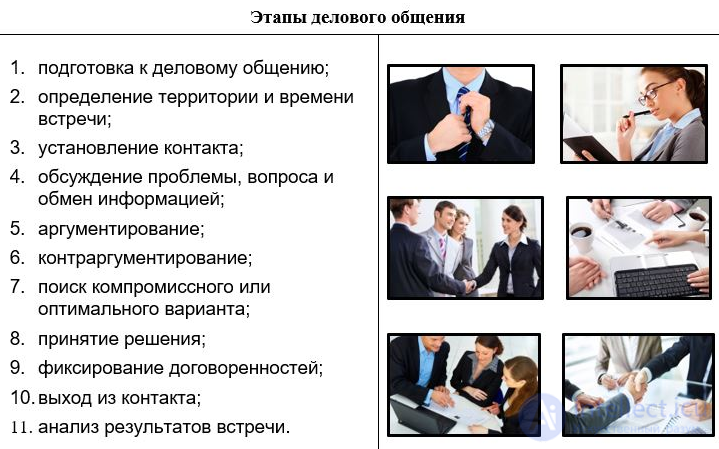

Features of business communication
- A partner in business communication always acts as a person of significance to the subject.
- People communicating are distinguished by good mutual understanding in matters of business.
- The main task of business communication — is productive cooperation.
Depending on various features, business communication is divided into:
from the point of view of the one-way/two-way direction of speech between speaker and listener:
from the point of view of the number of participants:
from the point of view of the absence/presence of a mediating apparatus:
from the point of view of the communicants' position in space:
Forms of business communication
Business conversation — interpersonal verbal communication among several interlocutors with the aim of resolving certain business problems or establishing business relations. The most widespread and most frequently used form of business communication.
Business telephone conversation — a means of prompt communication, significantly limited in time, requiring both parties to know the rules of telephone etiquette (greeting, mutual introduction, statement and discussion of the subject of the call, summing up, expression of gratitude, leave-taking).
Business negotiations — an exchange of opinions in order to achieve some goal, to work out an agreement between the parties.
Work meeting — one of the effective ways of involving employees in the decision-making process, a tool for managing employees' sense of involvement in the affairs of their department or of the organization as a whole.
Business discussion — an exchange of opinions on a business question in accordance with more or less definite procedural rules and with the participation of all or individual participants.
Press conference — a meeting of officials (executives, political figures, representatives of state authority, public relations specialists, businessmen, etc.) with representatives of the press, television, and radio, for the purpose of informing the public on topical questions.
Public speech — a monological oratorical speech addressed to a particular audience, delivered with the purpose of informing the listeners and exerting the desired effect upon them (persuasion, suggestion, inspiration, a call to action, etc.) .
Business correspondence — a written form of interaction with partners, consisting in the exchange of business letters by mail or by e-mail. A business letter is a brief document performing several functions and concerning one or several interrelated questions. It is used for communication with external structures, as well as within an organization for conveying information between natural and legal persons at a distance .
Interview — a form of business conversation intended for publication in the press, in electronic-digital sources, or for broadcast on television or radio .
Press conference — a meeting with journalists for the purpose of bringing important political, economic, or social information to the wider public, and reporting on the actions of organizations of great significance to the public .
Presentation — is a form of business communication carried out to convey information and ideas, to persuade of the necessity of certain actions, and to draw attention to an organization or a person.
Also forms of business communication are public auctions and presentations.
The technology of business communication
- Verbal communication — the oral, verbal transmission of information.
- Non-verbal communication — information conveyed by means of non-verbal means of communication (gestures, facial expressions, intonation, body posture, etc.).
- Remote communication — the transmission of information using various kinds of technical means (telephone, facsimile method, mail, internet communications, e-mail, television and radio broadcasting systems).
Principles of business communication.
Business communication – is a complex, multifaceted process of developing contexts between people in the work sphere. Its participants act in official capacities
and are oriented toward achieving a goal, specific objectives.
A specific feature of this process is regulatedness, i.e. subordination to established restrictions, which are determined by national and cultural traditions, and by professional and ethical principles.
Business communication can be direct (in immediate contact) or indirect (when there is a spatial – temporal distance).
Practice shows that it is effective to use the following methods at the start of a conversation:
- the tension-relief method (warm words, a joke);
- the «hook» method (describe events, tell an anecdote on the topic of the conversation);
- the direct approach method (an immediate move to the matter at hand, without introductions).
After the introductions comes the next stage of the conversation – informing the partners, and arguing the points being put forward.
Six basic principles of business communication are distinguished.
- 1. Punctuality (do everything on time). Only the behavior of a person who does everything on time is normative.
- 2. Confidentiality. The secrets of an institution, corporation, or a specific deal must be kept just as carefully as secrets of a personal nature.
- 3. Courtesy, benevolence, and friendliness. In any situation, one must behave toward clients, customers, and colleagues politely, amiably, and with goodwill.
- 4. Attention to others. One must show attention to both superiors and subordinates, respect the opinions of others, understand their point of view, and listen to criticism.
- 5. Appearance. One must fit into one's surroundings, into the contingent of employees of one's level.
- 6. Literacy. Documents and letters sent outside the institution must be composed and expressed literately, in good language. In conversation, use only normative vocabulary.
Information and argumentation arise through the use of questions.
By classification, questions are distinguished as:
- closed, which can be answered with «yes» or «no»;
- open, beginning with the words «what», «how», «in what way», «why», «where», and the like;
- rhetorical, not giving a direct answer, used to provoke a new question or to point to variable problems;
- turning-point questions are asked when sufficient information has been obtained on one problem and it is necessary to move on to another;
questions for reflection contain remarks that should be calm and correct.
Arguing the points being put forward - the main stage of a business conversation – is the substantiation of the points being put forward. At
this stage a preliminary opinion is formed, the position taken by the interlocutors. With the help of argument, one can fully
or partially change the interlocutor's position and opinion, soften contradictions, and critically examine the position and
facts presented by both interlocutors.
In argumentation, two basic constructions are distinguished:
evidentiary argumentation, when the interlocutor wants to prove or substantiate something, and counter-argumentative, by means of which the interlocutor refutes the assertions of the negotiating partners.
To build both constructions, the following basic methods of argumentation are used:
The functional method – a direct appeal to the interlocutor, who is presented with facts and information. Numerical examples play an important role.
The method of contradiction – based on identifying contradictions in the opponent's argumentation (a defensive method).
The method of drawing conclusions based on precise argumentation.
The method of questioning – questions are prepared for people in advance.
The method of comparison – in this method of argumentation, one fact is compared with another similar fact.
Ethics of business communication
The ethics of business communication is a professional ethics regulating the system of relations among people in the sphere of business. Business communication must proceed in accordance with professional-ethical norms and standards. These can be combined into two groups:
- the first group — a complex of ethical notions, norms, and assessments that a person possesses from birth, a notion of what is good and what is evil — that is, one's own ethical code, with which a person lives and works, whatever position they may hold and whatever work they may perform;
- the second group — those norms and standards brought in from outside: the internal regulations of the organization, the firm's code of ethics, the oral instructions of management, a professional code of ethics
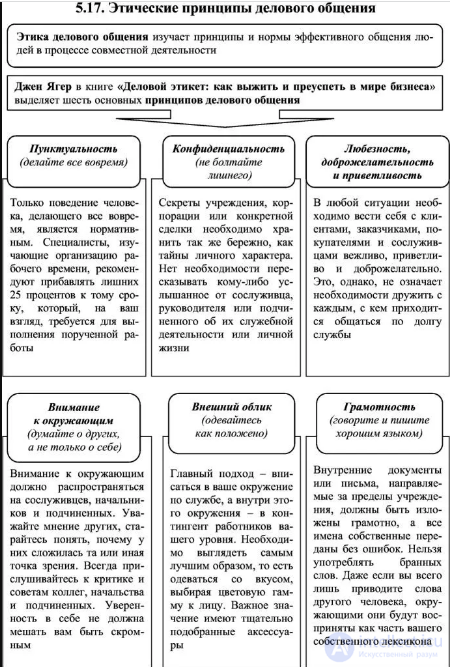
fig. Ethical principles of business communication
It must be remembered that in the process of communication one should not monopolize the conversation, i.e. turn a conversation into a monologue. J. de La Bruyère noted that the talent of a conversationalist belongs not to the one who readily talks himself, but to the one with whom others readily talk; if, after a conversation with you, a person is pleased with themselves, then they are quite pleased with you as well.
The effectiveness of communication is also influenced by the choice of linguistic means of communication. In doing so, one must be guided by the interlocutor, the situation, and the formality or informality of the setting. Speak with your partner in their language — then you will understand one another.
Try to emphasize that you and your interlocutor have something in common — this will make your relations warmer and more trusting. Common interests, positions, even common problems and difficulties help to win over a communication partner. Emphasizing commonality is an ancient technique of communication. Joseph Rudyard Kipling (1865—1936), the English writer, formulated the rule of commonality in the novel «The Jungle Book»: «We be of one blood, thou and I». In communication, your own «I» should not be at the center of attention. Specialists recommend being modest in self-assessments and not imposing your position on the interlocutor in a categorical form. One must learn to take the partner's point of view.
Remember that in business communication everything matters: what we say and how. The effectiveness of communication depends on how we formulate our «vision». For example, instead of the formulation: «This seems interesting to me», use: «This could interest you». Instead of: «Now I will prove it to you» — «Now you can be convinced that...» and the like.
Furthermore, it should not be forgotten that no advice or rules will help if you do not show sincerity and goodwill in communication.
Business communication is an integral part of working life, and its quality can significantly affect success in one's career and the achievement of organizational goals.
Questions for review:
1. The Russian poetess Marina Tsvetaeva (1892-1941) said: «It is one thing to listen, and another to hear». What do you understand by this statement?
2. Reveal the essence of reflective listening.
3. How often, in conversation with friends, do you use techniques of reflective listening? Reveal the content of each technique.
4. What are «communication techniques» needed for?


Comments