
Lecture
The specifics of communication under conflict conditions can be complex and require special attention and approach. Here are some key aspects that characterize communication in conflict situations:
Emotional tension:
Negative communication:
Decreased communication effectiveness:
Ambiguity and misunderstanding:
The need for conflict-management skills:
The importance of mediation:
Culture and context:
Three main models of behavior in conflict and the corresponding types of subjects can be identified.
1. The destructive type is characterized by a constant readiness to trigger conflict, is not inclined toward compromise, and is set on the complete suppression of the opponent. In everyday life — this is an egoist, an instigator of quarrels and scandals; in an institution — a chronic complainer; in a crowd — an initiator of unrest and destructive actions; at the interstate level, similar subjects of conflict action are militaristic powers and various extremist organizations.
2. Subjects of the conformist type are passive; they would rather yield than continue the struggle. This type is dangerous because it objectively contributes to, or more precisely provokes and abets, the aggressive aspirations of others. But it can also play a positive role if the contradictions between the subjects are trivial in nature, in which case compromise is the best way to prevent and resolve the conflict.
3. The constructive type seeks to extinguish the conflict, find a solution acceptable to both sides, and looks for ways to satisfy mutual interests.
Just as no single style of leadership can be effective in absolutely every situation, so too can none of the conflict-resolution styles examined be singled out as the best. One must learn to use each of them effectively and consciously make one choice or another, taking the specific circumstances into account.
Conflicts in the personal-emotional sphere. A manager has to resolve conflicts not only in the business sphere but also in the personal-emotional sphere. Different methods are applied in resolving them, since as a rule it is difficult to identify the object of disagreement in them, and there is no clash of interests.
So how should one behave with a difficult person?
1. It must be kept in mind that such people have certain hidden needs, which as a rule are connected with past losses and disappointments, and they satisfy them in this way. For example, an overly aggressive person tries to suppress cowardice and timidity through his aggressiveness.
2. You should bring your own emotions under control and let this person's emotions find an outlet, if you intend to continue communicating with him.
3. Do not take the words and behavior of this person personally, knowing that in order to satisfy his own interests, a difficult person behaves this way with everyone.
4. When choosing a suitable style of action in a conflict situation, you should take into account which type of person he belongs to. In the book "Coping with Difficult People," Robert Bramson identifies the following types of difficult people he had to work with in various firms:
• the hostile-aggressive — who speaks rude and unceremonious, needling remarks toward others and becomes irritated if not listened to. As a rule, behind his aggressiveness lies a fear of his incompetence being exposed;
• the complainer — a person consumed by some idea and blaming others (someone specific or the whole world in general) for all sins, but doing nothing himself to solve the problem;
• the "angry child" — a person of this type is not evil by nature, and the outburst of emotion reflects his desire to take control of the situation. For example, a boss may fly into a rage, sensing that his subordinates have lost respect for him;
• the maximalist — a person who wants something without delay, even when there is no need for it;
• the silent type — keeps everything inside, does not speak about his grievances, and then suddenly vents his anger on someone;
• the "secret avenger" — a person who causes trouble through some kind of scheming, believing that someone has acted wrongly and that he is restoring justice;
• the "false altruist" -- who supposedly does you a good turn, but deep down regrets it, which may manifest itself in the form of sabotage, demands for compensation, and so on;
• the "chronic accuser" — who is always searching out other people's mistakes, believing that he is always right, and that by accusing, one can solve the problem.
Other types of difficult people can be identified, but the rules of behavior with them are generally the same.
5. If you consider it necessary to continue communicating with a difficult person, you must insist that the person tell the truth, no matter what it is. You must convince him that your attitude toward him will be determined by how truthful he is with you and how consistently he behaves in the future, rather than by whether he agrees with you on everything.
Rules of behavior under conflict conditions. Since conflicts often give rise to an emotional state in which it is difficult to think, draw conclusions, or approach the resolution of a problem creatively, adhere to the following rules when resolving a conflict situation.
1. Remember that in conflict, a person is dominated not by reason but by emotions, which leads to an affect, when consciousness simply switches off and a person is not responsible for his words and actions.
2. Adhere to a multi-alternative approach, and while insisting on your own proposal, do not reject your partner's proposal; ask yourself the question: "Am I never wrong?" Try to take both proposals and see what sum of gains and losses they will bring in the near term and later.
3. Recognize the significance of resolving the conflict for yourself by asking: "What will happen if a way out is not found?" This will allow you to shift the center of gravity from the relationship to the problem.
4. If you and your interlocutor are irritated and aggressive, it is necessary to reduce internal tension, to "let off steam". But venting on those around you — is not a solution but an outburst. But if it has already happened that you lost control of yourself, try to do the one thing you can: fall silent yourself, rather than demanding this of your partner. Avoid stating your partner's negative emotional states.
5. Focus on the positive, the best in a person. Then you oblige him to be better as well.
6. Invite your interlocutor to put himself in your place and ask: "If you were in my place, what would you do?" This removes the critical mindset and shifts your interlocutor from emotions to reflecting on the situation.
7. Do not exaggerate your own merits and do not display signs of superiority.
8. Do not blame or attribute responsibility for the situation that has arisen solely to your partner.
9. Regardless of the results of resolving the disagreements, try not to destroy the relationship.
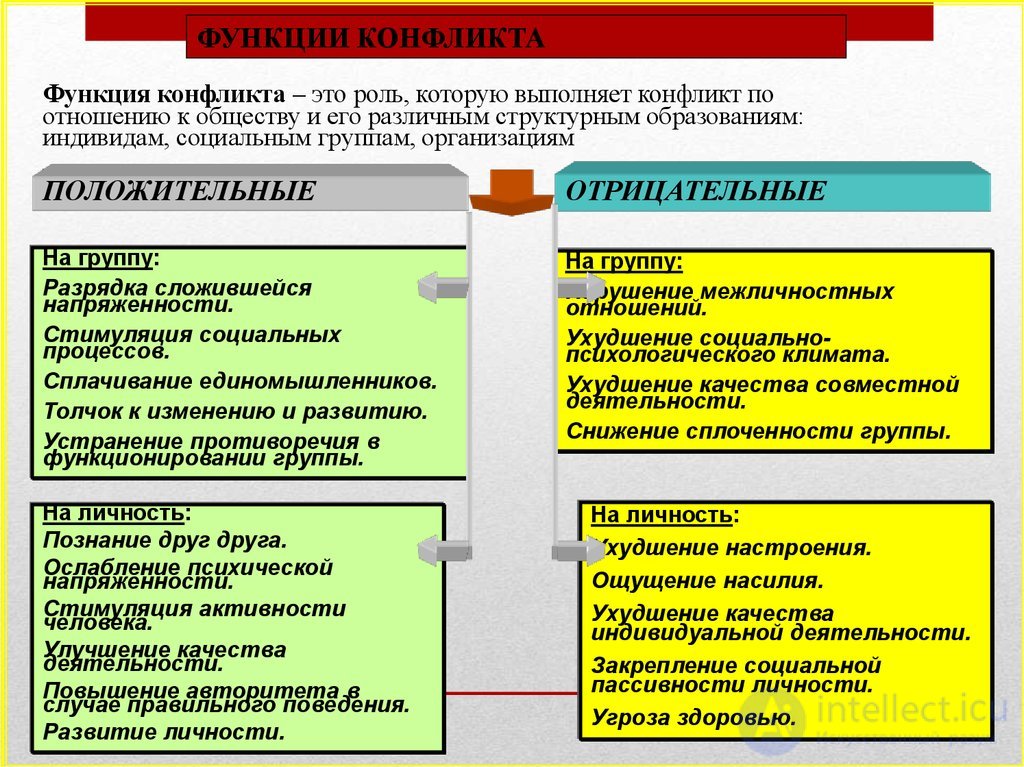
fig. Positive and negative functions of conflict
Since conflicts are inevitable in human interaction, they can perform a positive constructive function:
— conflict promotes a certain forward movement and prevents stagnation;
— in the process of conflict, the source of disagreement becomes objectified and its resolution, its «removal», becomes possible, and means of preventing future conflicts are found;
— conflict — is a certain negation of old, «obsolete» relationships, which leads to the formation of new relationships and the correction of interaction;
— in conflict, internal tension is «worked off», aggressive feelings are «released», and frustrations and neuroses are «discharged»;
— conflict — is a way for a personality to assert itself, especially in adolescents; conflict — is a necessary form of behavior for maintaining status within a group;
— intragroup conflict in scientific activity creates the level of tension needed for creative activity; thus, research has shown that the productivity of creative scientific activity is higher among conflict-prone individuals;
— intergroup conflicts can promote group integration and the growth of group cohesion and solidarity;
— the necessity of resolving the conflict leads to cooperation, to the concentration of participants' efforts on resolving the conflict situation, and to the involvement of group members in the group's common life.
An important point in studying the problem of conflicts and their nature is identifying their causes. Analysis of sociological and socio-psychological research allows the following main causes of conflicts to be identified:
— socio-economic — conflicts in modern society are the product and manifestation of objectively existing socio-economic contradictions;
— socio-psychological — the needs, motives, and goals of the activity and behavior of various people;
— socio-demographic — differences in attitudes, behavioral motives, goals, and aspirations of people, determined by their sex, age, and affiliation with various national groups.
The main dysfunctional (negative) consequences of conflicts:
1. Unproductive, competitive relationships between people.
2. Lack of striving for cooperation and good relations.
3. Viewing the opposing side as an «enemy», one's own position as exclusively positive, and the opponent's position as only negative.
4.Curtailing or completely ceasing interaction with the opposing side, hindering the solution of work-related tasks.
5.The conviction that «victory» in the conflict is more important than solving the real problem.
6. Feelings of resentment, dissatisfaction, bad mood, staff turnover.
Let us examine the structural methods of conflict management.
1. Clear formulation of requirements. One of the best management methods for preventing dysfunctional conflicts is clarifying the requirements for the work results of each individual employee and of the department as a whole; the existence of clearly and unambiguously formulated rights and duties and rules for carrying out work.
2. Use of coordinating mechanisms. Strict observance of the principle of unity of command eases the management of a large group of conflict situations, since a subordinate knows whose orders he must carry out. If employees have disagreements on some work-related issue, they can turn to an «arbiter» — their common superior. In some complex organizations, special integration services are created, whose task is to align the goals of various departments.
3. Establishing common goals, forming shared values. This is facilitated by informing all employees about the organization's policy, strategy, and prospects, as well as their awareness of the state of affairs in various departments. Having common goals allows people to understand how they should behave in conflict situations.
4. The system of incentives. Establishing such criteria for work effectiveness that exclude a clash of interests among different departments and employees.
With rational behavior on the part of the participants, a conflict, passing through all the stages of its development, can remain functional. Resolving a conflict in the full sense means eliminating the problem that gave rise to the conflict situation and restoring normal relations between people.
11 taboos in a conflict situation. One must not:
1. Critically evaluate your partner.
2. Attribute base or bad intentions to him.
3. Display signs of superiority.
4. Blame and attribute responsibility solely to the client.
5. Ignore his interests.
6. See everything only from your own position.
7. Diminish your partner's merits and contribution.
8. Exaggerate your own merits.
9. Get irritated, shout, or attack.
10. Touch on your partner's «sore points» and vulnerable spots. Heap a multitude of grievances on your partner.
Ten typical mistakes of a person in conflict:
1. Defends his own point of view and does not think about how to solve the problem.
2. Behaves inflexibly, unable to change tactics or switch to something else.
3. Intolerant of dissent, unable to shift to another position or make a compromise.
4. Thinks in stereotypes, tries to squeeze the solution into the framework of existing norms, traditions, and rules.
5. Gets distracted from the main goal by other, secondary ones, and strays from the main problem.
6. Sees only one way to solve the problem or a single alternative, rather than a range of options.
7. Works only within the subject area, unable to reflectively analyze and move toward interaction.
8. Creates obstacles to free creative debate and the generation of ideas, criticizes excessively, instills fear, and so on.
9. Agrees unnecessarily with others' opinions if they yield, adapt, or avoid solving the problem.
10. Is afraid of risk.
Indirect methods of extinguishing conflict have found expression in principles such as:
1) the principle of «venting feelings». It means that if a person is allowed to express his negative emotions without hindrance, they will gradually be replaced «on their own» by positive ones. Implementing this principle requires professional patience and the ability to give the interlocutor emotional support;
2) the principle of «emotional compensation». A person who comes to you with complaints about his adversary should be regarded as a person who is suffering. The internal picture of the situation that has formed in your interlocutor's mind casts precisely him as the sufferer.
Suffering should be taken into account, even if it is «unrighteous». By showing that you take this into account, you are already «emotionally compensating» your interlocutor's dejected state of mind. He is especially warmed by a well-placed word of praise dropped appropriately into the conversation. One only needs to know what his genuinely good qualities actually are;
3) the principle of the «authoritative third party». A state of conflict sharply distorts the mutual perception of the warring parties and makes their role expectations of one another highly biased.
A conciliatory, kind opinion of one opponent about the other can now be conveyed only through a third party who is authoritative for both. The third party should devote 99% of their communication to topics of mutual interest to both parties, and only one percent – to the «decisive» remark.
For an offended person, a positive judgment about him from the offender is a push for his own thoughts in the direction of seeking an interpersonal compromise;
4) the principle of «exposing aggression». The warring parties are deliberately given the opportunity to express their hostility toward one another: the conflicting partners can be «pitted» against each other in an athletic contest, a debate, a game, or a work competition.
An effective means of developing people's skills in competent communication in conflict situations is socio-psychological training. The main forms of SPT in this case are role-playing, heuristic, and business games.
The proposed heuristic game is designed for 2-3 hours. Within the framework of this game, a conflict situation is artificially created, the resolution of which is directed and regulated by the facilitator, who also guides the overall course of the game.
Goal of the game. Developing the ability to get out of a conflict situation on the basis of constructive conflict resolution.
The essence of the conflict situation. Imagine a hospital that specializes in donor heart transplants. Unexpectedly, a donor heart arrives at the hospital. Five people are in line to receive it: an elderly professor working on developing a vaccine against cancer, whose work is nearing completion; a sixteen-year-old pregnant girl, an orphan, who has a bad heart; a young, attractive woman who is held in exceptional affection by the staff; a doctor from the same hospital where the donor heart transplant operations are performed; a schoolteacher, a mother of two children, who has just buried her husband, killed in a car accident. All of them are in a critical situation. Each of them has no more than a month left to live.
The problem: whom to give preference to for the donor heart transplant.
Stages of the heuristic game.
1. The facilitator divides the game's participants into three or four small groups and gives each the opportunity to propose and defend, at all costs, its own version, its own proposal: to whom the donor heart should be transplanted. In addition, a small group of experts is formed. The experts' duties include the task of providing an analysis and assessment of:
a) who was the leader in each of the small groups and why?
b) which of the small groups found a more weighty argument, the most correct approach to solving the problem of the donor heart transplant?
c) which of the small groups prevailed in the conflict situation and why?
2. The stage of the heuristic game itself. Within this stage, each of the groups widely uses heuristic methods (brainstorming, empathy, inversion, methods of random associations, key questions, and others) to generate new, original ideas.
In practice, 30-40 minutes are allotted to each group for developing ideas and working out strategies and tactics for negotiating with each of the other three groups. At first, each of the four groups meets with another, for which 15 minutes are allotted.
3. A session of all four groups is held and negotiations begin on resolving the conflict. It is very important that the facilitator not dominate the participants of the heuristic game, but only periodically steer its course in the right direction.
4. Summing up. At this stage, the group of experts (as a rule, consisting of three people) gives, independently of one another, characterizations and assessments, according to previously established criteria, of each group individually, both regarding the course and the results of the conflict resolution.
5. And in conclusion, the game's facilitator can make a sensational announcement that, in heart transplant clinics, in order to avoid conflicts over the question of who is next in line, the only criterion most often used is the order in which patients were admitted to the clinic, which is strictly documented.
Communication in conflict situations requires tolerance, empathy, and the ability to build dialogue on a basis of trust and respect. This can be a difficult process, but resolving conflict through constructive communication can lead to more harmonious and productive relationships.

Comments