
Lecture
Means of communication comprise various tools, methods, and technologies that are used to convey information and exchange messages between people or groups. In the era of modern technology, means of communication are diverse and include both traditional and modern methods of communication. Here are some of the main means of communication:
Verbal communication:
Written communication:
Visual communication:
Electronic means of communication:
Mass media:
Modern technologies:
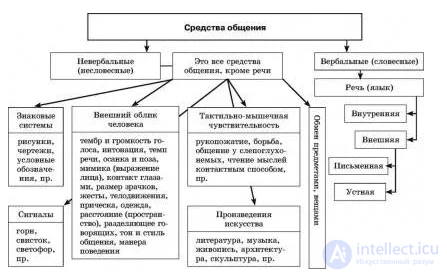
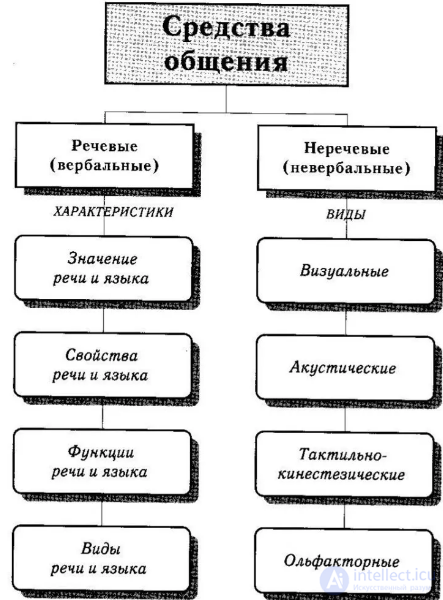
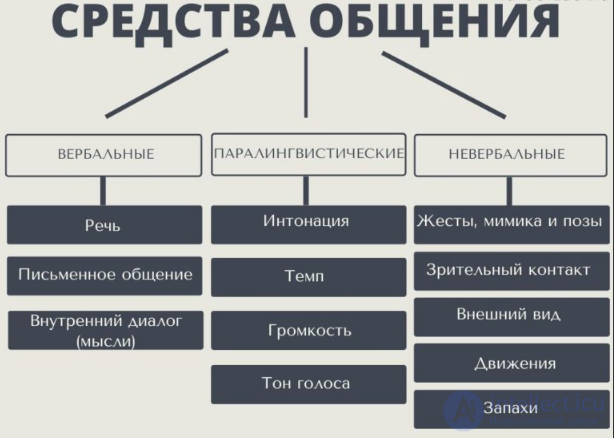
All means of communication fall into two large groups: verbal (word-based) and non-verbal. At first glance it may seem that non-verbal
means are not as important as verbal ones. But this is far from the case. A. Pease, in his
book "Body Language," cites data obtained by A. Mehrabian,
according to which the transmission of information occurs through verbal
means (words alone) at 7%, through vocal means (including tone of voice and intonation
of sound) at 38%, and through non-verbal means at 55%.
Professor Birdwhistell arrived at similar conclusions, having established
that verbal communication in conversation accounts for less than 35%, while more than 65% of information is conveyed by non-verbal means. Between verbal and non-verbal means of communication there is a varied division of functions: pure information is conveyed through the verbal channel, while
attitude toward the communication partner is conveyed through the non-verbal one.
Let us briefly consider the main non-verbal means of communication.
Kinesic means. Kinesic means are the most significant. These are
visually perceived movements of another person that perform an expressive-regulatory function in communication. Kinesics includes expressive movements manifested in facial expressions, posture, gesture, and gaze.
A special role in conveying information is given to facial expression — the movements
of the facial muscles, not for nothing called the mirror of the soul. Studies, for instance, have shown that with a motionless or invisible lecturer's face, up to
10–15% of information is lost. The main characteristics of facial expression are its integrity and
dynamism. This means that in the facial expression of the six basic
emotional states (anger, joy, fear, suffering, surprise, and contempt), all the facial muscle movements are coordinated.
Studies by psychologists have shown that all people, regardless of the nationality and culture in which they were raised, interpret these facial configurations with sufficient accuracy and consistency as expressions
of the corresponding emotions. And although each expression is a manifestation of the configuration of the whole face, the main informational load is nevertheless carried by the eyebrows and the area around the mouth (lips).
Closely connected with facial expression is gaze, or visual contact, which constitutes an extremely important part of communication. In communicating, people strive
for mutuality and feel discomfort if it is absent.
American psychologists R. Exline and L. Winters established that gaze is connected with the process of forming an utterance and with the difficulty of that process. When a person is only forming a thought, they most often look away ("into space"); when the thought is fully ready — at the interlocutor.
If the matter concerns complex things, one looks less at the interlocutor; when the difficulty is overcome — more. In general, whoever is speaking at a given moment looks less at the partner — only to check their reaction and interest. The listener, on the other hand, looks more toward the speaker and
"sends" them feedback signals.
Visual contact indicates a disposition toward communication. One could say that if we are looked at little, we have every reason to believe
that we, or what we are saying and doing, are regarded poorly, while if we are looked at too much, it is either a challenge or a sign of a good attitude toward us.
The eyes convey the most accurate signals about a person's state, since the dilation or constriction of the pupils cannot be consciously
controlled. Under constant lighting, the pupils may dilate or constrict depending on mood. If a person is excited or interested in something, or is in an elevated mood, their pupils dilate up to four times their normal state. Conversely, an angry, gloomy mood
causes the pupils to constrict. Thus, it is not only facial expression that carries information about a person, but also their gaze.
Although the face, by general opinion, is the main source of information about a person's psychological states, in many situations it is far
less informative than the body, since facial expressions are consciously controlled far better than body movements. Under certain circumstances, when a person, for example, wants to hide their feelings or conveys deliberately false information, the face becomes uninformative and the body becomes the main source of information for the partner. Therefore, in communication it is important to know what information can be obtained by shifting the focus of observation from a person's face to their body and movements, since gestures, postures, and the style of expressive behavior carry a great deal of information. Information is carried by such body movements as posture, gesture, and gait.
Posture is the position of the human body typical for a given culture, the elementary unit of a person's spatial behavior. The total number of different stable positions the human body is capable of assuming is about 1,000. Of these, due to the cultural tradition of each people,
some postures are prohibited while others become established. Posture clearly shows how a given person perceives their status in relation to the status
of other people present. Persons of higher status adopt more relaxed postures than their subordinates.
Psychologist A. Scheflen was one of the first to point out the role of a person's posture as one of the non-verbal means of communication. Further research conducted by W. Schubtz revealed that the main semantic content of posture consists in how an individual positions their body in relation to their interlocutor.
This positioning indicates either closedness or a disposition toward communication.
It has been shown that "closed" postures (when a person somehow tries to cover the front of the body and take up as little space as possible; the "Napoleon" posture while standing: arms crossed on the chest, and while sitting: both hands resting on the chin, etc.) are perceived as postures of distrust, disagreement, opposition, and criticism. "Open" postures (standing: arms open with palms up; sitting: arms spread, legs extended), on the other hand, are perceived as postures of trust, agreement, goodwill, and psychological comfort.
There are clearly readable postures of reflection (the pose of Rodin's Thinker), postures of critical evaluation (hand under the chin, index finger extended toward
the temple). It is known that if a person is interested in communication, they will orient themselves toward the interlocutor and lean in that direction; if not very interested, they will, on the contrary, orient themselves away and lean back. A person wishing to assert themselves, to "make a statement," will stand upright, in a tense state, with shoulders squared, sometimes with hands on hips; a person who does not need to emphasize their status and position will be relaxed, calm, in a free and unconstrained posture. Practically all people are good at "reading" postures, although, of course, far from everyone understands how they do it.
Gestures — the various movements of the hands and head whose meaning is clear to the communicating parties — can be understood just as easily as posture.
A great deal is known about the information carried by gesticulation. Above all, the amount of gesticulation matters. However much cultures
may differ, everywhere, as a person's emotional arousal and agitation increase, the intensity of gesticulation grows, as it does with the desire to achieve fuller understanding between partners, especially when that understanding is for some reason difficult to attain. The concrete meaning of individual gestures differs across cultures.
However, in all cultures there are similar gestures, among which one can distinguish:
1) communicative (gestures of greeting, farewell, attracting attention, prohibition, satisfaction, negation, questioning, etc.);
2) modal, i.e., expressing evaluation and attitude (gestures of approval, dissatisfaction, trust and distrust, confusion, etc.);
3) descriptive gestures, which have meaning only in the context of a speech utterance.
In the process of communication, one must not forget about congruence, i.e., the correspondence between gestures and speech utterances. Speech utterances and the gestures accompanying them must coincide. A contradiction between gestures and the meaning of utterances is a signal of lying.
Finally, a person's gait, i.e., their style of movement, makes it fairly easy to recognize their emotional state. Thus, in studies
by psychologists, subjects were able to identify emotions such as anger, suffering, pride, and happiness from gait with great accuracy. Moreover, it turned out that the heaviest gait occurs with anger, the lightest with joy, a sluggish and depressed gait with suffering, and the greatest stride length with pride.
Attempts to find a connection between gait and personality traits are more complicated. Conclusions about what gait can express are drawn on the basis of comparing the physical characteristics of gait with personality traits identified through tests.
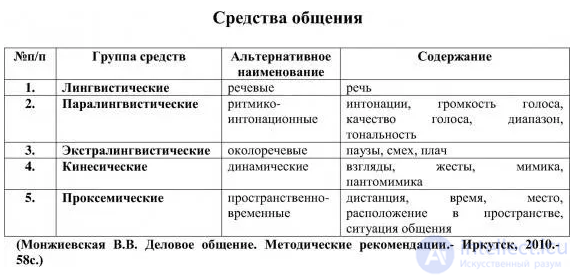
Prosodic and extralinguistic means. Prosodic and extralinguistic means of communication are connected with the voice, whose characteristics
create an image of a person, contribute to recognizing their states, and reveal their psychological individuality.
Prosody is the general name for such rhythmic-intonational aspects of speech as pitch, loudness of voice tone, timbre of voice, and force of stress.
The extralinguistic system is the inclusion in speech of pauses, as well as various kinds of psychophysical manifestations of a person: crying, coughing, laughing, sighing, etc. Prosodic and extralinguistic means regulate the flow of speech and economize the linguistic means of communication; they supplement, substitute for, and anticipate speech utterances, and express emotional states.
Enthusiasm, joy, and distrust are usually conveyed with a high voice; anger and fear also with a fairly high voice, but in a broader range
of tonality, strength, and pitch of sound. Grief, sorrow, and fatigue are usually conveyed with a soft, muffled voice, with a lowering of intonation toward the end of the phrase.
The tempo of speech also reflects feelings: fast speech indicates agitation or anxiety; slow speech indicates a depressed state, grief, arrogance, or fatigue.
So, one must be able not only to listen but also to hear the intonational structure of speech, to assess the strength and tone of voice, and the speed of speech, which practically
allow us to express our feelings, thoughts, and volitional impulses not only alongside words but also apart from them, and sometimes even contrary to them. Moreover, a well-trained person can determine from the voice what movement is being made at the moment a given phrase is uttered, and conversely, by observing gestures during speech, one can determine what kind of voice a person is speaking with. Therefore, one must not forget that gestures and movements can sometimes contradict what the voice communicates. Consequently, it is necessary to control this process and synchronize it.
Tactile (haptic) means of communication. Tactile means of communication include dynamic touches in the form of a handshake, a pat,
a kiss. It has been proven that dynamic touches are a biologically necessary form of stimulation, and not merely a sentimental detail
of human communication. A person's use of dynamic touches in communication is determined by many factors. Among these, the status of the partner, age, sex, and degree of acquaintance are especially significant. Handshakes, for example, are divided into three types: dominant (the hand on top, palm turned down), submissive (the hand underneath, palm turned up), and equal. Such a tactile element as a pat on the shoulder is possible under conditions of close relations and equal social standing between those communicating.
Tactile means of communication, more than other non-verbal means, perform in communication the function of an indicator of status-role
relations and a symbol of the degree of closeness between those communicating. Inadequate use of tactile means by a person can lead to conflicts in communication.
Proxemic means. Communication is always spatially organized. One of the first to study the spatial structure of communication
was the American anthropologist E. Hall, who introduced the term "proxemics" itself, the literal translation of which means "closeness." Proxemic characteristics include the orientation of partners at the moment of communication and the distance between them. Proxemic characteristics of communication are directly influenced by cultural and national factors.
E. Hall described the norms of a person's approach to another person — the distances characteristic of North American culture. These norms are defined by four distances:
It should be noted that the non-verbal behavior of a person is polyfunctional; it:
Verbal means of communication form the logico-semantic line that determines its content. This line may appropriately be called "verbal action."
The leading stylistic feature of modern public communication is conversational style, i.e., simplicity and liveliness in constructing a phrase, and the use of colloquial vocabulary and phraseology.
The stylistic distinctiveness of verbal action is manifested in the features of its syntactic structure, i.e., in how phrases and word combinations are constructed. But along with this, the distinctiveness of the conversational style of verbal action is created by a number of psychotechnical devices:
a) imaginary dialogization (the syntactic structure of the verbal action imitates an imagined dialogue setting);
b) the question-and-answer device (the subject of communication asks themselves a question and answers it themselves);
c) the rhetorical question (which, as is known, contains an assertion or negation and stirs the thoughts and emotions of communication partners);
d) emotional exclamations (which allow attention to the topic of communication to be heightened and stimulate the conversational quality of communication);
e) inversion (i.e., the deliberate disruption of word order).
The quality and effectiveness of verbal action, its communicative effectiveness, depend on how well the subject commands the psychotechnics of speech
(precisely psychotechnics, and not technique, as some authors believe).
The psychotechnics of speech is a system of individual psychological control of the voice, diction, intonation, and logic in accordance with the socio-psychological conditions of communication.
Verbal action, as is evident from its characteristics, accumulates paralinguistic and extralinguistic means of communication. In this sense, the psychotechnics of speech is a branch of the psychotechnics of communication that reveals the methods of effective use of the linguistic, paralinguistic, and extralinguistic means of human interaction. If linguistic means determine the substantive content of verbal action, then paralinguistic and extralinguistic means determine its expressiveness.
Intonation and tonality affect not only consciousness but also the sphere of feelings, giving emotional coloring to words and phrases.
The tempo of verbal action is the speed of its execution; a fast tempo makes it difficult to concentrate attention on the logic and content
of the verbal action, while a slow one is tiring. The most optimal variant of tempo organization of verbal action is psychologically appropriate
management.
The merging of verbal and optical-kinetic actions forms the process of one communication subject influencing another and vice versa. But this influence is effective only if mechanisms of mutual understanding are woven into it.
Means of communication are diverse, and the choice of means depends on the goals, context, and preferences of the participants in communication. It is important to be able to effectively use different means in accordance with specific communication tasks.

Comments