
Lecture
There are several methods of conflict resolution that can be applied in various situations depending on the nature of the conflict and the goals each party sets for itself. Here are some of the main methods:
Compromise: A compromise approach assumes that both parties are willing to make concessions in order to reach an agreement. This method is often used in situations where both sides have important interests, and the goal is to find a middle ground.
Cooperation (collaboration): Cooperation implies the active collaboration of the parties to develop a joint solution that satisfies everyone's interests. This method usually requires time and effort, but can lead to more stable and satisfactory outcomes.
Avoidance (evasion): Sometimes the best way to resolve a conflict is to avoid it. This can be useful when the conflict is minor or when there is no time to resolve it. However, it can also lead to an accumulation of problems if the conflict remains unresolved.
Resistance (confrontation): Resistance implies defending one's own interests and positions in the conflict, without a readiness to make concessions. This method can be useful when it is important to protect one's rights and interests, but it can also aggravate the conflict if the parties are not ready for dialogue.
Active listening and empathy: Effective conflict resolution often begins with actively listening to the other side and showing empathy. This helps the parties better understand each other's point of view and find common ground.
Mediation: A mediator — a third, neutral party who helps the parties in the conflict engage in dialogue and find a solution. Mediation is often used in professional and family conflicts.
Arbitration: An arbiter — a neutral person who makes a decision on the conflict after hearing the arguments of both sides. This method is often used in legal disputes.
Command management: In some situations, for example in the workplace, resolving a conflict may require the intervention of higher management or administration.
The formal-explanatory method: through orders, instructions, directives, etc.
The method of “separating” the parties to a conflict: by resources, goals, means of labor, structural units, etc.
The method of “insuring” against conflict: by creating reserve stocks of financial and material resources. (a special case — «buying off» the parties to the conflict).
The method of uniting the parties to a conflict by setting common goals and objectives.
The method of introducing integration mechanisms: conciliation commissions, anti-crisis committees, deputies for specific areas, curators, coordinators, etc.
fear of losing one's functions;
fear of losing income;
fear of new problems arising.
education, retraining, and further training of employees;
involving employees in the process of organizing change, creating motivation for change among those who resist;
emotional and psychological support;
«buying off» employees through material incentives;
negotiation (justifying the need to seek a compromise);
co-optation (giving the resisting person a leading role in introducing innovations);
maneuvering (selective use of information for one's own benefit);
coercion (threatening dismissal, blocked promotion, reduced pay, etc.);
dismissal of the employee.
Resolving a conflict begins with establishing its causes. The difficulty here is that the true causes are often disguised, since they may portray the initiator of the conflict in an unfavorable light.
Moreover, a protracted conflict draws more and more new
participants into its orbit, widening the list of conflicting interests, which objectively makes it harder to find the main causes.
A conflict situation is the accumulated contradictions that contain the true cause of the conflict. An incident is a coincidence of circumstances that serves as the occasion for the conflict. A conflict is an open confrontation resulting
from mutually exclusive interests and positions.
To resolve a conflict means:
1) to eliminate the conflict situation,
2) to exhaust the incident.
A conflict between people can be compared to a weed in a garden: the conflict situation is the root of the weed, and the incident is the part above the surface. It is clear that if we cut off the weed's top growth without touching the root, we will only strengthen its ability to draw from the soil the nutrients so necessary for cultivated plants. It is also harder to find the root afterward. The same is true of
a conflict: without eliminating the conflict situation, we create conditions for
the conflict to deepen.
Each of the conflict situations, through its manifestation, plays the role of an incident for another. To resolve the conflict means to eliminate each of the conflict situations.
The key role in resolving a conflict is played by the correct formulation of the conflict situation. A conflict situation is the diagnosis of the disease
called «conflict». Only a correct diagnosis gives hope for a cure.
Conflict management is a purposeful influence on the process
of the conflict, ensuring the solution of significant tasks.
Conflict management is the transfer of the conflict into a rational channel of human activity, a deliberate influence on the conflict behavior of the subjects with
the aim of achieving the desired results; it is the confinement of confrontation
within the bounds of constructive influence on the process. Conflict management includes: forecasting conflicts; preventing some while at the same
time stimulating others; stopping and suppressing conflicts; regulating and resolving. Each of these named types of action represents
an act of conscious activity by the subjects: one of the conflicting parties, or both,
or a third party not included in the conflict action.
Objectivity of understanding – is the primary prerequisite for managing conflicts, and at the same time a methodological problem.
An objective understanding of a conflict is an adequate description of it, i.e. one that corresponds to reality. The subject of management has as its object not
the conflict directly, but its description, image, mental reflection, verbal (speech) interpretation. It is clear that such a description
includes a particular approach acceptable to one side of the conflict or the other, or to a third, neutral party acting as mediator. After all, each
side strives to present the collision as it sees it from its own positions, as it understands the situation that has developed, in other words, as it finds it in its interest to explain the conflict, and therefore the very fact of one explanation or another of the
conflict becomes part of the subject of the contradiction.
An objective explanation of a conflict is possible if the following requirements are met:
– the analysis of the conflict takes into account only those facts that are relevant to
the present situation;
– the explanatory context includes an account of the prior state of
the conflict situation and its subsequent development;
– the explanation of the conflict is subordinated to its successful resolution in the interests of the whole – the progress of society, the individual, etc.
Recognizing the possibility of actively influencing a conflict is also an essential condition for managing it. This rules out treating
conflicts as fatally inevitable, arising spontaneously and developing just as
spontaneously, and instead encourages the search for ways and methods of consciously
influencing a conflict situation, whether emerging or already existing.
One of the principles of conflict management – is openness. Any attempt to
conceal the existence of a conflict, to mask it with an outward appearance of well-being, leads
only to a deepening of the confrontation. Conversely, timely and correct
disclosure of the conflict, its causes and conditions, creates favorable
preconditions for settling it and successfully overcoming it. Openness presupposes the availability of information about the conflict situation, bringing
it to the attention of interested parties and forming an appropriately objective
attitude toward it.
The constructive model of conflict behavior is characterized by
a striving to settle the conflict. It is aimed at finding an acceptable solution. It is distinguished by self-control and composure, a benevolent attitude toward the opponent, openness and sincerity in communication, brevity and reticence.
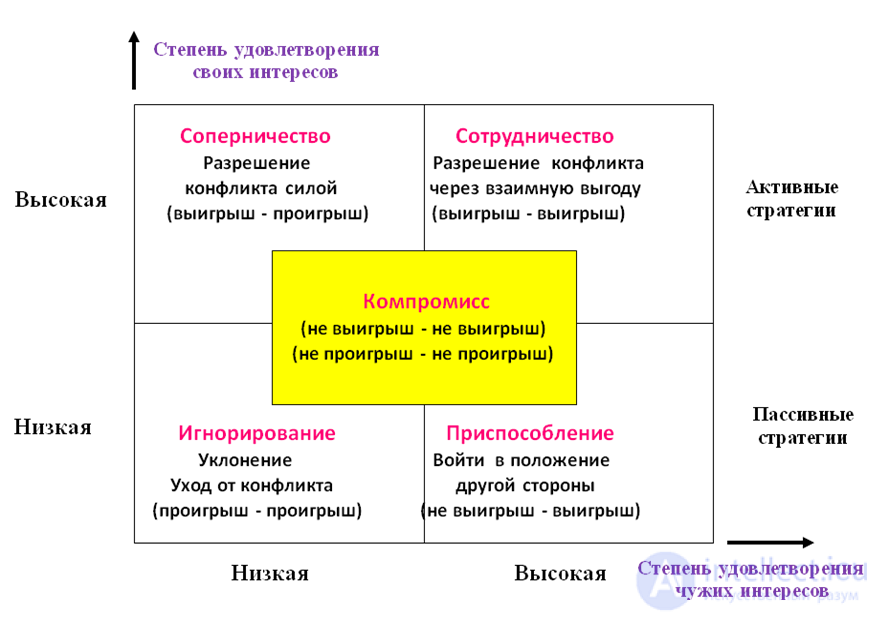
An example of a constructive model of an individual's behavior in conflict is the two-dimensional model of behavioral strategies in conflict interaction
developed by K. Thomas and R. Kilmann. This model is based
on the orientation of the parties to the conflict toward their own interests and the interests
of the opponent.
Regulation of a conflict is an action by the managing
subject aimed at softening, weakening, or redirecting it into another channel and to
another level of relations. A regulated conflict is a conflict that is controlled and, consequently, predictable.
Resolution of a conflict – is its final stage. Various forms of conflict termination are realized in all their diversity: the ending
of the conflict through the destruction of one of the sides or the complete subordination of the other; the transformation of both conflicting sides in the direction of reconciling their interests and positions on a new basis; the mutual reconciliation of the opposing agents; the mutual destruction of the opposites. When the first and last of these possibilities are realized, the ending of the conflict is accompanied by an intensification of the struggle. When the other forms are realized,
a gradual fading of the conflict occurs.
A distinction is made between complete and incomplete resolution of a conflict. If there is
a transformation or elimination of the basis of the conflict (its causes, its subject), then the conflict is resolved completely. Incomplete resolution occurs when
only some structural elements of the conflict are eliminated or transformed — in particular, the content of the confrontation, its field, the motivational basis
of the participants' conflict behavior, etc.
A situation of incomplete conflict resolution gives rise to its renewal on the same or a new basis. The permanent revival of one and the
same conflict in a transformed form at a different level.
Resolution of a conflict must be distinguished from its suppression, i.e. the forcible elimination of one or both sides without eliminating the causes and the subject of the confrontation. Nor does it lead to resolution when a conflict is so-called cancelled – this is an attempt to get rid of the conflict through reconciliation or glossing over it, rather than overcoming the opposites underlying it.
The process of resolving any conflict consists of at least
three stages. The first – the preparatory stage – is the diagnosis of the conflict. The second
– the development of a resolution strategy and technology. The third – the direct
practical activity of resolving the conflict – the implementation of a set of
methods and means.
Diagnosis of the conflict includes:
Conflicts in which the opponents are separated by irreconcilable contradictions, and whose resolution can be achieved only through the victory of one side
over the other, differ substantially from conflicts of the «debate» type, where argument and maneuvering are possible, but where, in principle, both sides can reach
a compromise. Conflicts of the «game» type are specific, where the parties act within
the framework of the same rules, and resolving the problem here does not lead to the elimination of the entire structure of the relations binding them.
The competing style is used when the subject is quite active and intends to move toward resolving the conflict, striving above all to satisfy their own interests at the expense of others' interests, forcing other people to accept their solution to the problem.
The avoidance (evasion) style is applied in a situation where the subject is not
confident of a favorable outcome to the conflict, or does not want
to spend effort on resolving it, or in cases when they feel they are in the wrong.
The accommodating style is characterized by the fact that the subject acts jointly with others, without seeking to defend their own interests. Consequently, they
yield to their opponent and resign themselves to the opponent's dominance. This style should be used in a case where you feel that, by yielding on something, you
lose little. Some situations in which the accommodating style is particularly recommended are as follows: the subject seeks to preserve peace and good relations with others; they understand that the truth is not on their side; they have little
chance of winning; they understand that the outcome of the conflict resolution matters far more to the other subject than to them.
Thus, when applying the accommodating style, the subject
seeks to work out a solution that satisfies both sides.
The cooperating style. In using it, the subject actively takes part in resolving the conflict, defending their own interests while at the same time trying together
with the other subject to find ways of achieving a mutually beneficial result.
Some typical situations in which this style is used: both conflicting subjects have equal resources and opportunities for solving the problem; resolving the conflict is very important to both sides, and neither wants to withdraw from it; there is a long-standing and interdependent
relationship between the subjects involved in the conflict; both subjects are able to state the essence of their interests and listen to each other, both know how to explain
their wishes, express their thoughts, and work out alternative options
for solving the problem.
The compromising style. It means that both sides of the conflict seek a solution to the problem based on mutual concessions. This style is most effective in situations where both opposing subjects want the same thing but are convinced that they cannot have it simultaneously. Some cases in which the compromising style is most appropriate: both sides have identical resources and mutually exclusive interests; both sides can be satisfied with a temporary solution; both sides can take advantage of a short-term benefit.
The choice of a method for resolving a conflict depends on the specific situation, as well as on the degree of importance and emotional intensity of the conflict. It is important to remember that there is no universal method suitable for all cases, and sometimes effective conflict resolution requires a combination of different approaches.

Comments