
Lecture
The influence of the group on a person's views and behavior is an important research topic in the field of social psychology. Group influence can have a significant effect on the individual and includes several important mechanisms:
Social comparison: People often compare themselves with others in order to determine how they look, what they think, and how they act. If an individual sees that most members of the group are doing something in a particular way, this can influence his or her decisions and actions.
Compliance with group norms: Groups usually develop norms - rules and expectations that define acceptable behavior for their members. Individuals may feel pressure to comply with these norms and adapt to the group culture.
Informational influence: The group can provide information and opinions that can influence the individual's views and beliefs. If the group possesses expertise or authority, this influence can be especially strong.
Pressure from the group: Individuals may be subjected to pressure from the group to conform to its expectations and stereotypes. This can manifest itself in the form of group dynamics, where members of the group put pressure on those who disagree with the majority opinion.
Social identification: People can identify themselves with particular groups and perceive their values and ideology as their own. This can lead to a change in the individual's views and values in line with those of the group.
Conformity — a change in a person's behavior or opinion under the influence of real or imagined pressure from another person or a group of people
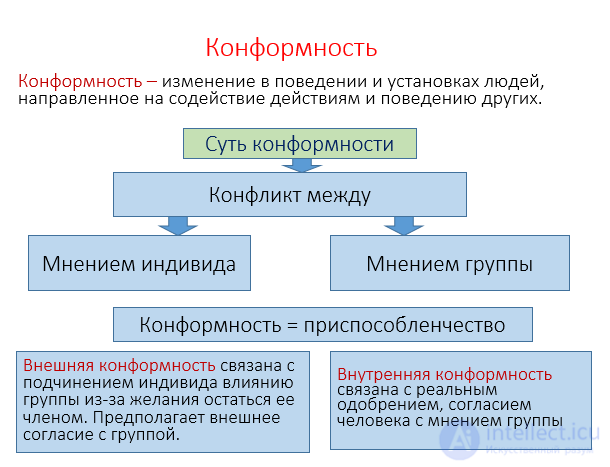
The word «conformism» (from Late Latin conformis — «similar; congruent») is also often used as a synonym. But the latter, in everyday language, means opportunism, acquiring a negative connotation, while in politics conformism is a symbol of appeasement and reconciliation. Therefore, social psychology distinguishes between these two concepts, defining conformity as a purely psychological characteristic of an individual's position relative to the position of the group — the acceptance or rejection of a particular standard or opinion characteristic of the group, the degree of the individual's submission to group pressure. Moreover, the pressure may come either from a specific person or a small group, or from society as a whole. Conformity is a personality trait expressed in a tendency toward conformism, that is, a change by the individual of attitudes, opinions, perception, and behavior — in line with those that, in the individual's view, prevail in a given society or group. In this case, the prevailing position need not be expressed explicitly, or even actually exist in reality.
It is wrong to think that the group changes a person however it pleases.
Often a person resists many of the group's influences for a long time; many influences he perceives only partially, and some he
rejects completely. The processes of a person's adaptation to the group and of the group's
adjustment to the person are ambiguous, complex, and often quite lengthy. On entering a group and interacting with the group
environment, a person not only changes himself but also exerts an influence on
the group, on its other members.
While interacting with the group, a person tries in various
ways to influence it, to introduce changes into its functioning so
that this would be acceptable to him, convenient for him, and would allow him to cope with his responsibilities. Naturally, both the form of influence and the degree
of a person's influence on the group depend significantly both on his personal characteristics, his ability to exert influence, and on the characteristics of the group.
A person usually expresses his attitude toward the group from the standpoint of what he considers most important for himself. At the same time, his reasoning always depends
on the position he occupies in the group, on the role
he performs, on the task assigned to him, and accordingly on what goals
and interests he personally pursues.
A person's interaction with the group may take the form of cooperation, merger, or conflict. Each form of interaction may occur to its own degree. In other words, for example, one can
speak of a hidden conflict, a weak conflict, or an unresolvable
conflict.
In the case of cooperation, trusting and benevolent relations are established between the group member and the
group. The person views the group's goals
as not contradicting his own, he is ready to look for ways to improve
interaction, and, positively, though with some rethinking of his own positions, he accepts the group's decisions and is ready to look for ways of maintaining relations with the group on a mutually beneficial basis.
In the case of merger between a person and a group, relations are established between the person and the rest of the group such that each side
regards the other as an organically unified component of the whole.
The person builds his goals based on the goals of the group, largely subordinates his interests to its interests, and identifies himself with the group. The group, in
turn, also tries to view the individual not as the performer of
a particular role, but as a person fully devoted to it. In this case
the group takes upon itself care for the person, treating his problems and difficulties as its own, and tries to assist him not only in solving work-related tasks but also in solving his personal problems.
In the case of conflict, there is an opposition of the interests of the person and the group and a struggle between them to resolve this contradiction in their own
favor. Conflicts can be generated by two groups of factors:
The first group of factors is related to differences in views on goals, structure, relationships, the distribution of roles within the group, and so on. If a conflict
is generated by these factors, it is relatively easy to resolve. The second
group of conflicts includes factors such as distrust of a person, a feeling
of threat, fear, envy, hatred, malice, and so on. Conflicts generated by these
factors are poorly amenable to complete elimination.
A conflict between a group member and the group should not be regarded merely as an unfavorable, negative state within the group. The assessment of a conflict
depends fundamentally on what consequences for the person and the group
it leads to.
But very often conflict in relations within a group has a positive
character. This is because conflict can lead to favorable
consequences. First, conflict can increase motivation to achieve goals. It can generate additional energy for action, bringing
the group out of a stable, passive state. Second, conflict can lead to a better understanding of the relationships and positions within the group, to members gaining clarity about their role and place in the group, to a clearer understanding of the nature of tasks
and actions.
But the group not only helps a person survive and improve
his professional qualities. It changes his behavior, often making the person substantially different from what he was when he was outside the
group. These influences of the group on a person have many manifestations. Let us point out some significant changes in a person's behavior that occur under the influence of the group.
First, under social influence, changes occur in such
characteristics of a person as perception, motivation, the scope of attention, the system
of evaluations, and so on. A person broadens the scope of attention and the system of evaluations by paying closer attention to the interests of other members of the group. His life
comes to depend on the actions of his colleagues, and this substantially changes
his view of himself, of his place in his surroundings, and of others.
Second, within the group a person acquires a certain relative
«weight». The group not only distributes tasks and roles, but also determines the relative position of each member. Members of the group may do exactly the same work, yet have a different «weight» within the group. And this will be an additional significant characteristic for the individual, one that he did not have and
could not have had while outside the group. For many members of the group, this characteristic may be no less important than their formal position.
Third, the group helps the individual acquire a new vision of his own «self».
The person begins to identify himself with the group, and this leads to significant changes in his worldview, in his understanding of his place in the world
and of his purpose.
Fourth, being in a group and taking part in discussions and the working out
of decisions, a person may also come up with suggestions and ideas that he would never have produced had he pondered the problem alone. The effect of «brainstorming» on a person significantly increases his creative potential.
Fifth, it has been noted that within a group a person is far more inclined to accept risk than in a situation where he acts alone. In a number of cases
this feature of the change in a person's behavior is the source of more
effective and active behavior by people within a group setting than if
they had acted alone.
Conformity (English: conformity). The process of change in an individual's attitudes, opinions, perception, and behavior in the direction of agreement with the group in response to
real or imagined group pressure in situations where there is no direct
requirement to agree with the group. «Pressure» on the individual is usually expressed in the very fact of the manifestation of the consolidated position of other members
of the group and the resulting need to publicly express one's own position. Conformity has been closely studied in social psychology, beginning with
the classic studies of Muzafer Sherif (Sherif, 1936) and Solomon Asch
(Asch, 1951). A personality trait expressed in a tendency toward conformity
in the sense given above. Often used synonymously with «conformism»
Traditionally, two types of conformity are distinguished:

Fig. External and internal conformity
There are other classifications of types of conformity as well. Herbert Kelman identified three levels of conformist behavior that are qualitatively distinct from one another: compliance, identification, internalization:
Another attempt to distinguish different types belongs to Guangdong Song and colleagues. They divide conformity into rational and irrational:
The neo-Freudian philosopher Erich Fromm paid great attention to what he called the «automatizing role of conformism» (English: automaton conformity). Conformism, in his view, is a widespread protective form of behavior in modern society — a person who resorts to conformism ceases to be himself, fully assimilates the type of personality offered to him by the models of culture, and becomes completely like others and the way they expect to see him. Fromm believes that this allows a person to avoid feelings of loneliness and anxiety, but he has to pay for this with the loss of his own «self»
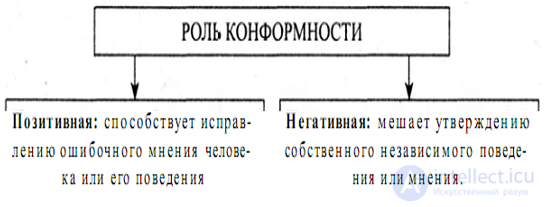
Fig. The positive and negative role of conformity
The manifestation of conformity is determined by numerous factors. Some of them have been studied experimentally, for example by Solomon Asch . The following factors are identified:
The following experimental studies of conformism are most widely known :
Intuitively, conformism (as the behavioral level at which conformity manifests itself) is often contrasted with the reaction of nonconformism or negativism; however, on closer examination, much in common is found between these types of behavior. The nonconformist reaction, like the conformist one, is conditioned and determined by group pressure and is dependent on it, even though it operates according to the logic of «no». Behavioral negativism is often related to the fact that a particular individual finds himself at the stage of entering a group, when the primary personal task for him is the task of «being and, above all, appearing not to be like everyone else». To a considerably greater degree, it is the phenomenon of an individual's self-determination within a group that is opposed to both conformist and nonconformist reactions .
The phenomenon of collectivist self-determination of the personality was studied by A. V. Petrovsky. His research showed that the alternative to conformism is not nonconformism (its distorted form), but collectivism, that is, behavior based not on an unconscious submission to another's influence, but on a person's self-determination, on a kind of filtering of the collective's influence. In exercising collectivist self-determination of the personality, a person rejects influences that do not suit him and accepts the opinion or behavior of other members of the collective that he considers appropriate, depending on a variety of factors (his own assessments, convictions, ideals).
It is also noted that both conformist and nonconformist behavior are encountered more often in groups with a low level of socio-psychological development, and, as a rule, are not characteristic of members of highly developed prosocial communities .
The influence of a group can be both positive and negative. A group can promote socialization, the exchange of information, and support, but it can also lead to conformism, pressure on members, and even the adoption of harmful norms or behavior.
Understanding these mechanisms is important for explaining how people make decisions and how social views and values are formed.

Comments