
Lecture
Competence in communication is the ability to interact effectively and successfully with other people through various means of communication, including spoken language, writing, nonverbal signals, and modern means of communication. This ability includes a variety of skills and knowledge necessary for understanding, expressing, and interpreting information, as well as for creating positive interpersonal relationships.
The main components of communicative competence
The components of competence in communication also include:
Linguistic competence: This is knowledge and understanding of language, including grammar, vocabulary, and the rules of linguistic communication. Linguistic competence makes it possible to construct correct sentences and messages.
Sociocultural competence: This is an understanding of the sociocultural norms and features of communication in various cultures and social contexts. This competence helps avoid misunderstandings and conflicts related to differences in cultural expectations.
Discursive competence: This is the ability to organize and structure information into texts and utterances, taking into account the purpose and context of communication. Discursive competence includes skills of argumentation, explanation, and storytelling.
Active listening skills: This is the ability to listen attentively to an interlocutor, ask questions, and give feedback. Active listening skills contribute to a deep understanding of the interlocutor and to building trusting relationships.
Nonverbal communication: This is the ability to read and interpret nonverbal signals such as gestures, facial expressions, intonation, and body language. Nonverbal communication can convey emotions and additional information that supplements verbal communication.
The ability to resolve conflicts: This is the ability to effectively manage conflicts and find constructive solutions. The ability to resolve conflicts helps maintain healthy interpersonal relationships.
The ability to adapt: This is the ability to adapt one's communication style depending on the situation and audience. Flexibility and adaptation help one interact with different people and in different contexts.
Psychologists, like representatives of other professions who work primarily with people, have their own professional characteristics.
A psychologist always bears in mind the subjectivity of any opinion, except in cases confirmed by statistics and conclusions following from them with
logical necessity. One of the main rules of the practicing psychologist – not to project one's own problems onto the interlocutor, which is why any opinion about
another person is presented with the requisite qualifying phrases "it seems to me", "I think", "in my opinion", etc.
A psychologist necessarily has a more developed capacity for reflection than representatives of other professions, and therefore rather rarely confuses their own attitude
with their own goals, for which reason they may sometimes appear to be a cynical phlegmatic.
A psychologist is very well acquainted with how often people are mistaken. Hence a psychologist is more critical of the sense of their own being right,
believing that this is merely a feeling, and shows greater respect for the possible rightness of the interlocutor.
One of the psychologist's tools is working with perceptual positions. Therefore a psychologist rarely says to another what they themselves would not want to hear. For
the same reason they will not say something that could be turned back on them.
In this connection, in a conversation they evaluate not only their own position but also
how others perceive it. If a person does not do this, they are not entirely a psychologist.
A psychologist avoids the use of nominalizations and tries to be careful with logical connectives – they know that this leads to errors. A psychologist
knows well that conflict is an extreme means of resolving issues, and moreover
a largely ineffective one. Therefore they provoke it only when it is clearly necessary. For the same reason a psychologist never accuses anyone of
bad intentions, even if a similar thought has occurred to them.
A psychologist knows well that no one, with the exception of severe pathologies,
wishes evil; only conceptions of good differ. Therefore psychologists generally do not speak sharply negatively of anyone.
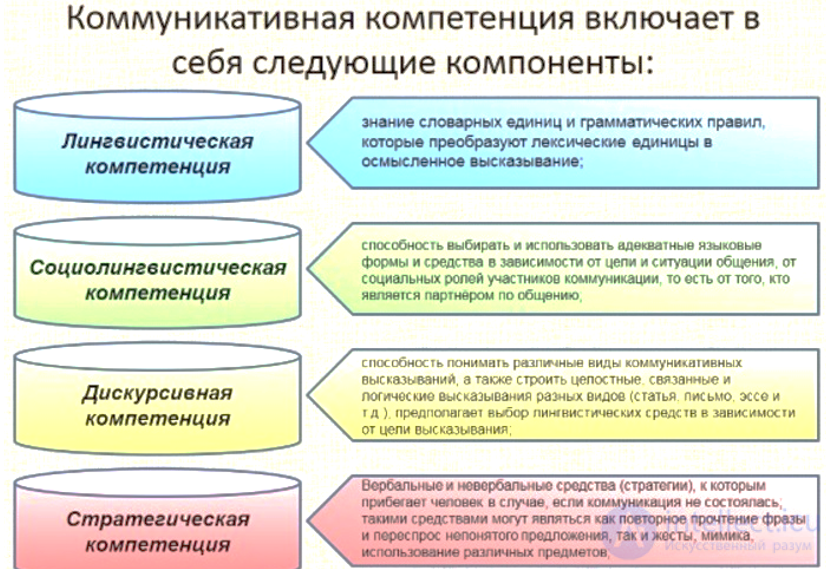
The concept of "communicative competence" by its origin denotes a certain system of requirements placed on a person in connection with the process of communication: literate speech, knowledge of oratorical devices, the ability to demonstrate an individual approach to the interlocutor, etc. When speaking of the abilities of a particular
person, it is said that such-and-such a person has demonstrated communicative competence [kompetentnost'].
There is thus a widespread view that communicative competence [kompetentsiya] (like any other competence) is a certain system of requirements, while communicative competence [kompetentnost'] is the degree to which a person corresponds to that system of requirements. Indeed, one can much more often hear that someone "has demonstrated their communicative competence [kompetentnost']" rather than "has demonstrated communicative competence [kompetentsiya]".
E. A. Klimov identified the main features of the communicative competence of the educational psychologist:
Among the professional communicative skills and abilities of the psychologist
are counted the skills of active listening, building feedback, describing behavior, the ability to attract people to oneself; the ability to keep a client at a distance and avoid emotional closeness; empathy as a skill; the ability to use strategies that promote changes in the client's behavior, the ability
to concentrate attention on given objects and phenomena, reflecting them fairly objectively and adequately.
Among the important communicative qualities of the psychologist the following are named: a propensity for communicating with people, sociability, the ability to effectively
resolve conflicts, free command of verbal and nonverbal
means of communication, ease of manner, logical and clear speech, politeness,
tact, a sense of humor, and others. The main sources of acquiring communicative competence are: knowledge of the languages of communication, experience of interpersonal communication in business, everyday, and festive settings; knowledge, general erudition, and scientific methods of teaching communication. From these sources a complex set of communicative knowledge and skills is formed, constituting the communicative competence of a personality.
The effectiveness of developing communicative competence in the learning process depends largely on correctly chosen teaching methods, i.e., on
the way in which the teacher influences the learner in order to achieve the set learning goals.
The teaching methods that are advisable to use for developing
communicative competence in the educational process include traditional methods, active learning methods, trainings, and distance
learning methods.
Traditional teaching methods are useful in conveying information about
the psychology of people, and about the methods and techniques used in communication. Traditional methods include lectures, seminars, viewing educational films, independent work with educational texts, and written assignments. These methods
make it possible to reduce the cost of training, provide an opportunity to demonstrate
a model of monological and dialogical speech, and allow the development of the oral and
written speech and language culture of learners. However, for developing communicative competence, traditional methods are the least effective.
Great opportunities for developing communicative competence lie in active learning methods. Such methods include seminars, discussions, debates, round tables, business and role-playing games. These methods make it possible to model real communicative situations, to find
a solution to a specific communicative task, and to feel the consequences of the decisions made. Active learning methods are highly effective, since they allow learners to practice interpersonal communication skills in typical situations, receive feedback, adjust their behavior, and find
alternative ways of solving communicative problems.
Distance learning, which is being introduced everywhere, or, as it is also often
called, e-learning, is distinguished by a high degree of structuring of the material studied and a step-by-step assessment of its assimilation. Distance learning is especially important for learners with limited abilities, studying at home.
Depending on the means of transmitting information, distance learning can be divided into:
Each of the teaching methods considered has its own features,
which must be taken into account when applying them. For developing the communicative competence of learners, an integrated approach is the most acceptable and rational. This is a combination of teaching methods.
Each method has its own area of application and limitations. If teaching methods are selected and combined competently, communicative skills can be developed more effectively. Traditional methods and distance learning will help learners master the necessary knowledge and skills
in the field of communication. Active methods and trainings will make it possible to master
skills of situational communication and to work on the personal qualities relevant to communicative competence.
Methods for developing communicative competence (using the example of a Russian language lesson)
The level of students' communicative culture is raised by the use of such methods of organizing a lesson as:
Competence in communication plays an important role both in personal and in professional life. It contributes to successful communication, the establishment of relationships, the solving of problems, and the achievement of goals. This ability is constantly developed and improved in the process of learning and practice.

Comments