
Lecture
Mass communication is the process of producing and reproducing messages intended for the mass consciousness, by means of mass communication (MMC), and of transmitting them through corresponding technical means — the periodical press, radio, television, and other means of electronic communication.
Mass communication is the process of transmitting information, messages, and ideas from one sender to a large audience by means of various mass communication channels, such as television, radio, newspapers, magazines, the internet, and social media. Mass communication plays an important role in shaping public opinion, disseminating news, advertising, and influencing people's behavior.
Means of mass communication are the instruments for producing, storing, and disseminating all kinds of information intended for mass perception.
Mass communication is an integral part of modern society, with its economy, politics, and culture. Of revolutionary significance for mass communication is the emergence of the Internet, with its capacity for feedback and its growing impact on the productive, socio-political, and cultural-ideological spheres of human life. Mass communication is not only directly related to all these processes, but, in this connection, also appears as one of the most important global problems, on whose resolution the development of the whole of human civilization depends.
The concept of «mass communication» (where communication is understood as connection and interaction) emerged in the 1920s in the United States, largely reflecting the experience of the press — above all newspapers and magazines — operating under conditions of market competition in accordance with the principle «The customer is always right,» which was reformulated into the rule «Give the public what it wants.»
Under these conditions, newspaper and magazine publishers needed to know their audience's preferences fairly promptly and accurately, which led them to understand their publications as a means of mass communication — that is, as a means of influencing the masses, a specific multitude of people who, as a rule, were not directly connected with one another but who shared common interests that prompted them to turn to the periodical press. Cinema and radio, and later television and other electronic means of communication acting upon the mass consciousness, also came to be understood as means of mass communication.
In the Russian Empire, the most widely circulated magazine at the beginning of the 20th century, intended for all estates of the empire, was called «Niva.» A significant part of each issue contained advertising. A striking example of the dissemination of information commissioned by the ruling elite was the celebration of the centenary of the Patriotic War of 1812 — the full run of issues for 1912 illustrates this fully.
In the Soviet Union, the concepts of «mass communication» and, accordingly, «means of mass communication» were introduced by researchers in the 1960s.
The concept of «means of mass information» is a calque of the French term «moyens d’information de masse.» It began to be introduced into the Russian language from the 1970s by the Propaganda and Agitation Department of the CPSU Central Committee, on the basis of a memorandum submitted by the Faculty of Journalism of Moscow State University.
By that time, France had already switched to the term «média de masse,» that is, a translation of the English «mass media» (a contraction of «media of mass communication,» that is, «means of mass information»), abandoning «means of mass communication» as a concept that was too limited, since it represented the impact of mass communication as a predominantly one-way process (from communicators to the mass audience), thereby diminishing the significance of feedback.
Thus, what appeared as an innovation in the Russian language had, by that time, already become an anachronism in French.
The author (or authors) of the memorandum to the CPSU Central Committee apparently did not know that the term «média de masse» (means of mass information) had practically fallen out of use in France, and thereby misinformed the higher authorities. As a result, the concepts of «mass communication» and «means of mass communication» began to be displaced in the Russian language by the concept of «mass media (MM)» with its conservative, protective connotations. Thus a situation arose in which, for many people (including journalists) and especially for the rising generations, the designation «mass media» became something taken for granted, while the concepts of «mass communication» and «means of mass communication» became, as it were, a terminological nuisance.
If one asks where the concept of «mass media» is used today, the answer would be: «In the Russian Federation and in countries that have not yet overcome the understanding of the means of communication as “means of information,” which isolates them from a full understanding of the impact of the electronic infocommunication environment with its rapidly growing resources of instant feedback.» Accordingly, overcoming the use of the concept of «mass media» in these countries is becoming increasingly necessary to ensure their conformity with the development of the modern world as a whole.
When analyzing the perception of mass communication, the following should be kept in mind:
One of the most important socio-psychological features of mass communication is its ability to shape public opinion.
In the modern conditions of human life, whose optimization requires the exercise of the right to information and the right to communication, the potential of mass communication can be most effectively realized by taking into account the socio-psychological features of its impact.
The diversity of the impact of mass communication presupposes the transmission of information from a source (a communicator) to recipients who, most often, are not directly connected with one another. At the same time, feedback is realized to one degree or another, as, for example, when television viewers call the studio to express their attitude toward the position of the participants in a broadcast.
Recipients, who play a passive role in receiving information, themselves become communicators when they disseminate the information they have received, guided in doing so by their own interests, imitation, fashion, and so on.
In the West, mass communication (including as applied to the formation of everyday experience of mass communication and taking into account the socio-psychological aspects of its impact on the individual and society) has been studied since the end of the nineteenth century.
Mass communication, as a field of research, studies the entire diversity of the impact of mass communication on the MMC audience, on the individual, and on society, including the socio-psychological aspects of this impact.
Understanding mass communication requires the study of a large complex of questions of social development, which is precisely what determines the interdisciplinary character of research into mass communication.
The foundation of the theory of mass communication is the very concept of «mass communication», but this concept is not reduced solely to this definition (as connection and communication) and, in relation to the needs of social development, is interpreted more broadly, including with regard to the democratization of public life.
The system-forming concept of the theory of mass communication became the concept of the «public», introduced in the works of G. Tarde, C. Cooley, and W. Lippmann (and later developed by H. Blumer and H. Lasswell) in the era when the means of mass communication first emerged. By the public they understood a body of people who, unlike the mass, adequately recognize their interests, are actively involved in the process of realizing them, and accordingly possess their own publicly expressed opinion (which, in turn, links the actions of the public with the public form of the exercise of state power).
Of considerable interest are studies of public perception in the formation of collective representations that promote the integration of people as members of mass audiences, through the strengthening of their sense of solidarity with one another. At the same time, contemporary scientific research also reveals intensifying disintegrative processes characteristic of mass consciousness under conditions of globalization.
As a special field of research, the ecology of the means of communication, which also exerts a form-shaping influence, is becoming increasingly significant.
Any model, as a path of cognition, represents an attempt to reflect phenomena of the real world in the concepts
of an abstract theory. Since a model must reflect certain aspects of the original, the construction of models is naturally subordinated to the task of the most accurate representation of its properties.
The construction and study of models of really existing phenomena is carried out on an object-based, sign-based, structural, or behavioral
basis.
1950s–60s — the information approach (cybernetics, informatics): communication is viewed as a one-way informational process in which particular attention is paid to methods of formalizing the message, its encoding and decoding, and most definitions of communication are reduced to the idea of transmitting information from an author to an addressee, which is reflected in the Shannon–Weaver model developed within the mathematical theory of communication.
1960s–70s – the psychological approach, in which communication is defined as business or friendly relations, an exchange of thoughts by means of linguistic signs. Researchers' interest is focused on the psychological characteristics of the participants, the features of speech activity, the rules of speech behavior, and their role in the formation of the implicit meanings of an utterance. These ideas are embodied in the circular (cyclical) model of communication proposed in the works of W. Schramm and C. Osgood.
In the 1980s - the sociological direction, in which communication – is a social phenomenon, and consequently the social roles of the communicants and the context (situation) of interaction come to the fore. Increasing importance is attached to the personal (social and psychic) qualities of the communicants and to their relationships.
Since the 1990s, a surge of interest in questions of communication has been observed on the part of practically all the sciences. This is explained by the growing role of information processes in society and the development of Internet technologies. Problems of cultural differences acquire particular importance, and alongside national cultures, the bearers of gender, age, and corporate cultures increasingly become objects of researchers' attention.
There are several models of mass communication that help to understand the processes and the interaction between the sender, the message, and the audience:
«Speech is composed of three elements: the speaker himself, the subject he speaks about, and the person to whom he addresses himself; and it is this last that is the final goal of everything (I mean the listener)». (Aristotle. Poetics. Rhetoric. St. Petersburg, 2000. P. 99)
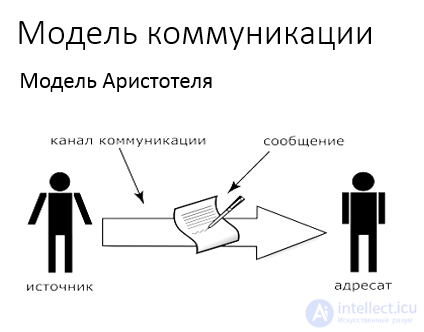
He regarded the linear chain «SPEAKER – SPEECH – AUDIENCE» as the basic elements of the act of communication.
Object models presuppose the reproduction of certain functional characteristics of an object. In particular, in analog
models, the original is described by certain relations.
In sign models, built on the basis of a natural or artificial language, what matters most is the transformation of sign constructs and their
understanding. What is modeled is either the object itself, or its behavior, or its structure.
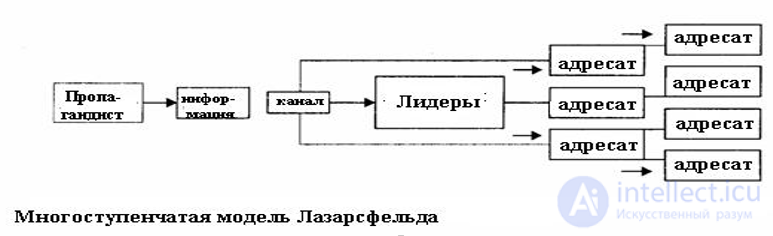
One of the most important stages in the study of the impact of the mass media on the audience was the discovery, by the American P. Lazarsfeld at the end of the 1940s, of the two-step model of communication. The impetus for this was provided by the results of surveys showing that the reach of the population upon becoming acquainted with a message two weeks after its broadcast turned out to be higher than immediately after the broadcast itself. Further analysis showed that the increase in reach was a consequence of the discussion of these messages with those who came to be called «opinion leaders». Moreover, it was not only the reach that increased, but also the degree of the message's influence on the audience.
Thus the one-step model became a two-step model, with the first step characterized mainly by the transmission of information, and the second step — by the transmission of influence. Three main propositions can be identified within this theory. First, each subgroup has its own opinion leaders, as does each topic. Second, opinion leaders come from all strata of society, and consequently media messages may be interpreted and used differently in different social groups. Third, it is clear that messages on their way to the mass audience pass through
various filters, and therefore, in order for the media to reach different audiences, the source of the messages must modify it to take specific groups into account.
The German communication researcher Elisabeth Noelle-Neumann proposed the model of the
«spiral of silence», which establishes a direct link between the processes of mass and
interpersonal communication. In this scheme, mass communication appears
as a means of forming a climate of opinion; in turn, the climate of opinion
determines people's readiness to enter into interpersonal communication.
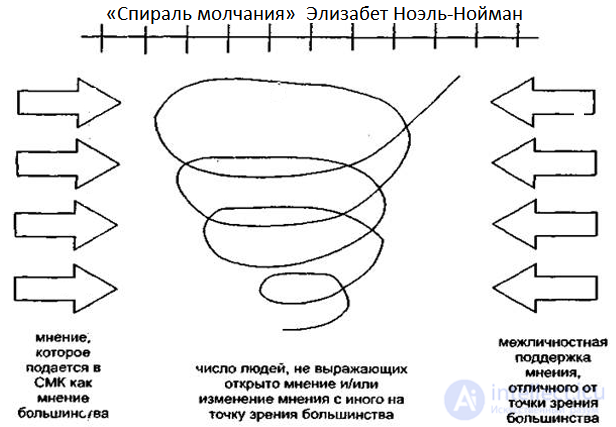
The «spiral of silence» model considers a situation in which the mass media, by manipulating
public opinion, give voice not to the majority but to a minority. Moreover,
this minority speaks on behalf of the majority. As an example of the
«spiral of silence» model at work, many researchers cite the case of totalitarian
communication. In it, the right to speak for some often turns into a «regime of
silence» for others. One's own opinion becomes not merely inconvenient but, in
certain situations, dangerous.
During the Second World War, the author
of the model noticed that when the
population was being reoriented toward
cheaper cuts of meat, the decisive
opinion belonged not to the producers
of the product, nor to the sellers, but
to the so-called «gatekeepers». This referred to
people who made the purchasing decision and
disseminated their point of view in
society. Even now, the classic example of a «gatekeeper» is
the housewife choosing groceries for
the home. As White, a researcher
of group communication, wrote, a «gatekeeper»
can be recognized as someone capable of
controlling the flow of news by sorting,
measuring, expanding, repeating, and withholding
information. Applying, in the practice of
communication, the «gatekeeper» model
makes it possible to navigate more clearly among
different systems of values, to select
messages of interest to the audience,
and to predict how they will be perceived.
K. Lewin hoped that one day «psychological theory will become so well developed that, as in modern physics, a few very general formulas will make it possible to derive most psychological phenomena. However, science cannot reach this state without first uncovering more specific laws, each of which reflects the essence of particular types of processes.» The author of these words tried to bring us closer to a bright scientific future, setting out in his articles and books a picture of the behavior of social structures in the form of a large number of formulas. But what proved to be in demand were his methods and models for describing group dynamics.
«The practical task of social management, just like the scientific task of explaining the dynamics of group life, requires an understanding of the drive toward a specific change and the resistance to it.» «It begins with an analysis of the people involved in the situation in order to predict their actual next step.» It is necessary to «take into account the cultural and psychological properties of the organization».
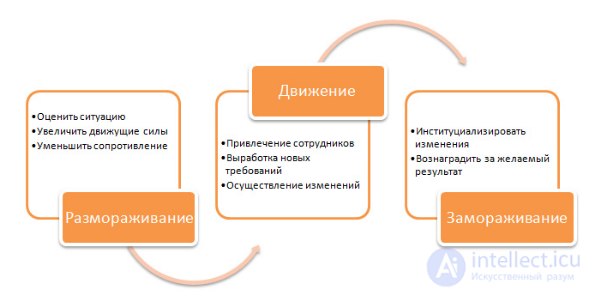
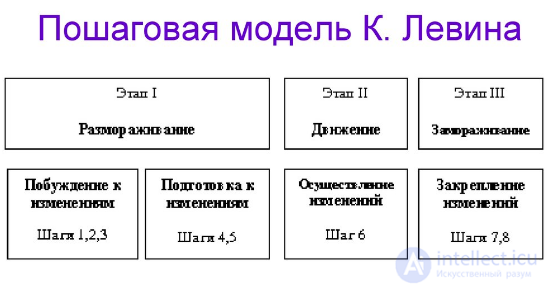
The model includes three stages:
1. Unfreezing;
2. Moving;
3. Refreezing.
Stage 1: The unfreezing stage involves making sense of the current situation, identifying the driving forces, and describing the desired end state. At this stage, the organization rethinks its views and business processes and abandons some of them. During this period, the organization must become less stable, as if temporarily unfrozen. As an effective tool for unfreezing, it is proposed to use «Force Field Analysis». This model, taking into account the picture of the force field, will look as follows:
Stage 2: The moving stage marks the process of transition from one state (AS IS) to another (AS IT SHOULD BE). K. Lewin compared this stage to movement, to a journey undertaken to overcome problems. This stage involves the participation and engagement of the organization's personnel. Management needs to maintain employees' belief in success and a clear picture of the desired future.
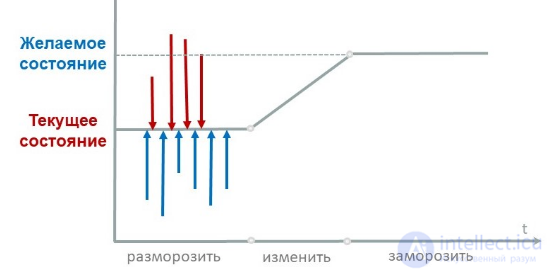
Stage 3: The refreezing stage consists in stabilizing the organization and cementing the new state. The point is that the process of introducing something new is not always the same as change. Indeed, very often, some time after a project is completed, the organization abandons its results and stops using the new practice. K. Lewin's model takes into account the concept of homeostasis (the tendency of a system to strive to restore itself).
At the third stage, it is proposed to use such tools as the institutionalization of new approaches (through structure, new standards, norms, etc.), and the definition of policies and reward systems.
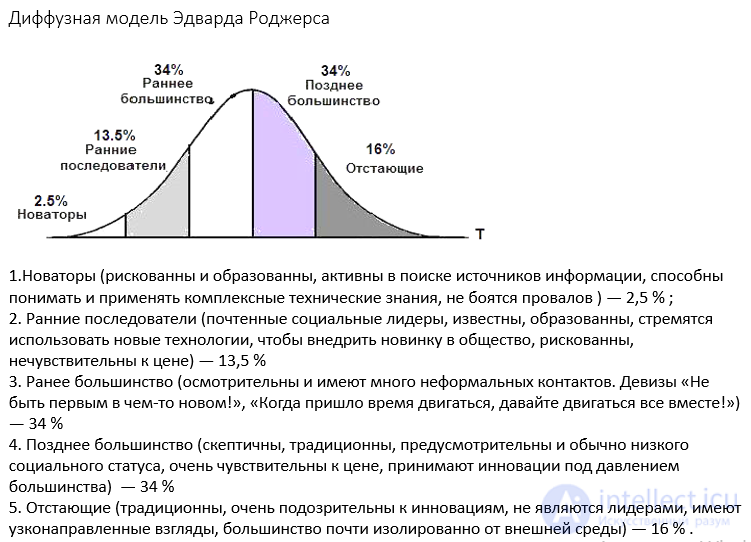
This model is associated with the name of the American
researcher E. Rogers. He analyzed
the spread of new ideas, products, and so on, and
observed differing degrees of receptiveness
to novelty among different segments of society. Some of
us are fairly conservative, while others,
on the contrary, readily embrace new processes.
One should not, therefore, try to influence everyone, but
should first try to persuade
the critical five percent. To convince
them, one still needs to reach 50% of the population.
Once an idea has captured the minds of 20%,
it becomes impossible to stop it.
E. Rogers identified six stages in the process of
adopting a new idea:
1. Attention.
2. Interest.
3. Evaluation.
4. Trial.
5. Adoption.
6. Confirmation.
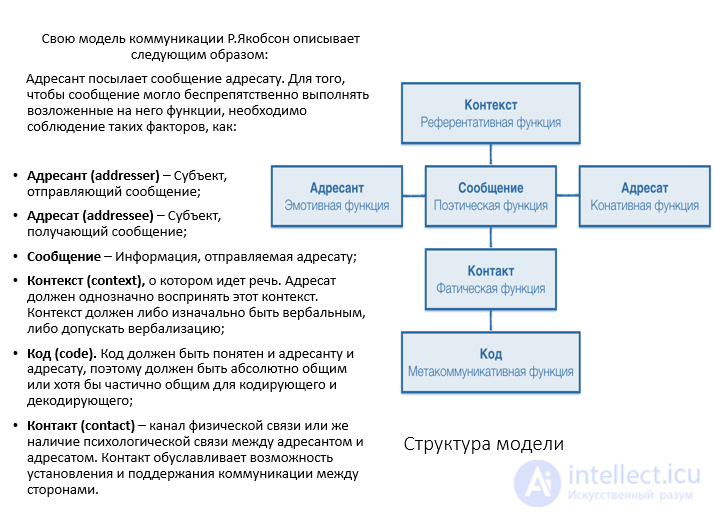
Jakobson identifies the following functions in the communicative act:
The emotive (expressive) function: in language, as a rule, we can shape one and the same content, even through intonation alone, so that
our approval, disapproval, and so on becomes clear. R. Jakobson gives the example of an actor from the Moscow Art
Theatre who, as an experiment, pronounced the phrase "This evening" using forty different intonations. And, most
importantly, these intonations were unambiguously read by the audience.
The conative function: the function of assimilation is oriented toward the addressee. It is expressed in the vocative form and the imperative
mood.
The phatic function: it is oriented toward contact; what matters for it is not the transmission of information but the maintenance of contact. These
are conversations about the weather, conversations during a birthday celebration, where what matters most is not the novelty
of the information but the process of maintaining contact. We often check contact with the words "Are you listening?"
The metalingual function (of interpretation): it is connected with the code — if we do not know a word, we can ask about its meaning and get an answer.
The answer may be given descriptively, by means of other words, or simply by pointing to the object.
The poetic function: it is directed at the message. This is the central function for verbal art, which is
characterized by greater attention to form than to the content of the message. Our everyday speech is oriented more toward
content.
The referential (denotative, cognitive) function: it is oriented toward the context and represents a reference to the
object being spoken about in the message.
Jakobson's model, in its various versions, is used in linguistics both for the analysis of the functions of language as a whole and for
the analysis of the functioning of its individual units, of speech production, and of text. This model shows the purpose,
the functions of language. Contemporary sociolinguistics, communication theory, and the sociology of communication have also borrowed
Jakobson's model for describing communicative processes.
Yu. Lotman considered the model of communication proposed by R. Jakobson
to be too abstract, emphasizing that in reality the speaker and the listener cannot have absolutely
identical codes, just as they cannot have an identical volume of memory. «Language is a code plus its
history», Yu. Lotman asserted. With complete similarity between speaker and listener, the very need
for communication disappears: they would have nothing to say to each other. The only thing that remains —
is the transmission of commands. That is, communication inherently requires a non-equivalence between
the speaker and the listener.
Thus, in one of the first Moscow editions of his works, he discussed ambiguity as a
defining characteristic of the literary text. It is precisely this characteristic that makes
possible the constant return to a literary text, its repeated reading, since
in this case it becomes possible to gain new knowledge when reading an already familiar
text.
He identifies no less significant characteristics within his analysis of folklore
communication, singling out the folklore audience there. Comparing a sculpture and a doll, he
expresses a remarkable idea, directly applicable to advertising and PR. A sculpture
must be looked at, while a doll must be played with — it must be turned about in one's hands, touched, seated or
stood up, spoken to, and answered for. The same holds for the public, which is
heterogeneous in its composition. With some, communication is like dealing with a sculpture; with others, it is like dealing with
a doll.
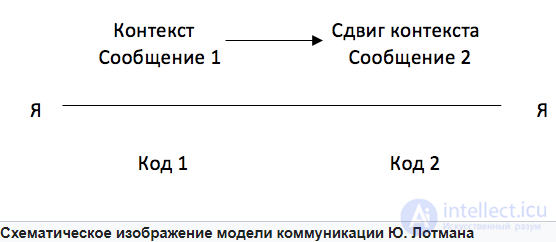
The theory of Yuri Lotman's semiotic model of communication is based on several founding principles:
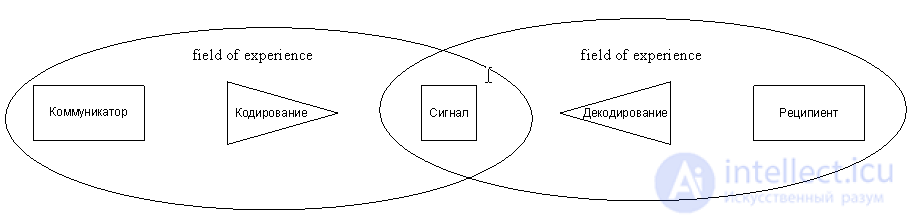
First, Lotman agreed with the model of communication put forward by Jakobson, but considered it too abstract. In Lotman's view, the code of the addresser and that of the addressee cannot be identical. Moreover, behind communication lies history, since language is not merely a code. This is precisely why communicators must take into account the codes that their partner already possesses.
Second, Yuri Lotman maintained that any communication is a translation from the language of my «I» into the language of your «you». "The very possibility of such a translation is due to the fact that the codes of both participants in the communication, although not identical, form intersecting sets" — Lotman believed.
Third, he distinguished two communicative models, "I - HE" and "I - I". Autocommunication, "I - I", imparts new meaning to the message by recoding it through the introduction of a second, additional code. Moreover, the transmission of a message to oneself can be interpreted as a restructuring of the personality. Thus, "I - I" communication can be considered internal and based on the receipt of a code, while "I - HE" communication is external, based on the receipt of a message.
In the “I — HE” system, the framing elements of the model turn out to be the variables (the addresser is replaced by the addressee), while the code and the message remain constant. The message and the information it contains are constant, while the carrier of the information changes. In the “I — I” system, the carrier of the information remains the same, but the message is reformulated in the course of communication and acquires new meaning. This happens because an additional — second — code is introduced, and the original message is recoded in terms of the units of its structure, acquiring the features of a new message.
In addition, he defined and created a model of literary communication. The core idea is that the author of a message must embed a new perspective on some idea, that is, propose a new deautomatization. In other words, at the moment when a person becomes accustomed to a particular narrative form, the author needs to provide a new idea in order to regain attention. Thus, the structure of the message itself must consist of a series of chains.
In order for the overall structure of a text to retain its informativeness, it must constantly be drawn out of the state of automatism that is characteristic of non-literary structures. At the same time, however, an opposite tendency is also at work: only elements placed in certain predictable sequences can perform the role of communicative systems. Thus, within the structure of a literary text, two opposing mechanisms operate simultaneously: one strives to subordinate all the elements of the text to a system, to turn them into an automatized grammar, without which an act of communication is impossible, while the other — seeks to destroy this automatization and to make the very structure itself the carrier of information.
According to Yuri Lotman, culture is a generator of various codes. Thus, all cultural phenomena can be interpreted as different communicative mechanisms, and therefore as different languages. This entails the priority of linguistic methods of analysis. The importance of such mechanisms is also related to the appeal to primary and secondary modeling systems. The primary system is language; the secondary system is literature, theater, cinema. The secondary system incorporated a large number of linguistic characteristics, since it is nevertheless based on language. It can thus be concluded that linguistic tools are of particular importance. Lotman, on the whole, laid the foundations for the communicative analysis of culture, analyzing it as a communicative mechanism
This is a standard applied model, reinforced by the concept of secondary codes, by which U. Eco means various kinds of additional connotative meanings known not to everyone, but only to part of the audience.
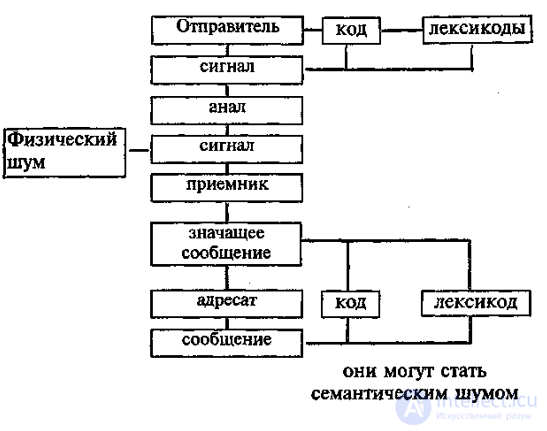
Analyzing early Christianity, U. Eco pointed out that exerting influence required inventing parables and symbols, something pure theory could not do — for example, Jesus was symbolized through the image of a fish.
Professor Umberto Eco devoted a separate study to communication within
mass culture.
U. Eco proposed general models essential for modeling communication,
as well as specific models of visual communication and communication within
mass culture
Neuro-linguistic programming (hereinafter — NLP),
separates itself from psychoanalysis and group psychotherapy for
the following reason: within NLP, clearer
theoretical foundations of a specifically communicative kind are laid,
which as a result made it possible to build just as clearly
its own methodology of influence.
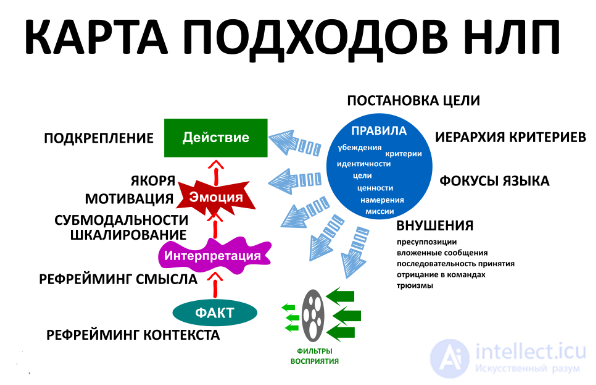
However, those who work within the field of NLP
promote it quite actively. Let us cite, for example, the opinion of A.
Sitnikov, president of the company "Image-Contact":
"Just as language is a means of communication, so NLP is a means of
effective influence. NLP is used everywhere
communication skills are needed: in advertising, business, the media.
I have been engaged in NLP for a long time and am personally acquainted with many of its
authors.).
Why is NLP of interest for public relations and other varieties
of applied communication? NLP is built on the following
basis: a person receives information through a number of
communicative channels (audio, visual, etc.), but for
each of us only one of them is dominant,
leading. We are, as it were, oriented toward it and even
habitually describe situations, often without paying
attention to this, using words from a single set.
Freud's basic postulate can be stated as follows: our behavior does not always rely on what consciousness presents to us as the motives of our actions, which in reality may be quite different.
The focus on finding sexual motives in Freud's model should be recognized as somewhat exaggerated. The essence of psychoanalysis, however, lies in the search for these hidden motives, translating them from the realm of the unconscious into consciousness, which in a number of cases has a therapeutic effect.
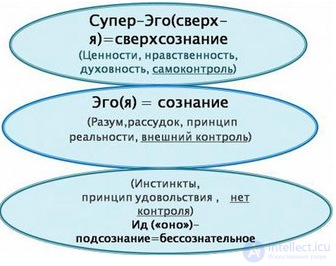
Sigmund Freud's psychoanalytic theory demonstrates that in the process of human interaction, people's childhood experience is reproduced, and people unwittingly apply the concepts they acquired in early childhood. If subordination, obedience, and compliance dominated a child's upbringing, then later in life such a person will tend to prefer submission and to avoid taking responsibility for making important decisions. Freud believed that people form social groups and remain in them partly because they experience a sense of devotion and submission toward the group's leaders, unwittingly identifying them with the powerful figures that fathers personified in childhood. In such situations, people, as it were, regress, returning to an earlier stage of development. If people's interaction is initially unorganized and they have no clear plan of action, this contributes to the strengthening of the group leader's power. The ways a person interacts with a group depend on defense mechanisms — adaptation, aggression, transference, sublimation, and so on.
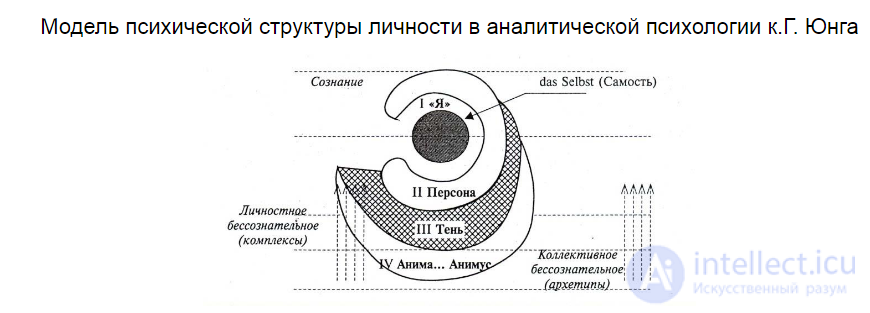
Carl Jung departed from an exclusively
sexual interpretation of the libido
(energy, drive), which was championed by
Freud. He also wrote a remark important for
public relations: "People
want to love in god only their own ideas,
precisely those notions which they
project onto god. In this way they want
to love their own
unconscious, that is, those remnants
of ancient humanity and of the age-old
past equally preserved in every
person». Hence this constant
recourse to symbolism, traceable
in every direction of psychoanalysis,
of particular value for public
relations. It is precisely symbols that facilitate
access to a person in any type of
communication; psychoanalysis attempts
to fit the explanation of symbolism into
the framework of its own hypothesis.
J. Lacan analyzed the unconscious. He believed that it
was structured like a language.
A significant component of
J. Lacan's communicative account is feedback. He says that speech,
when it has a listener, does not remain unanswered, even when
the listener is silent. He writes: "The function of speech is not
to inform, but to evoke representations. What I seek in
speech is the other's answer. That which constitutes me as a
subject is my question".
A second important characteristic of communication, according to Lacan,
is the significance of what is erroneous: misunderstanding,
slips of the tongue, forgetfulness. Although the unconscious passes
through censorship, truth can be found elsewhere.
Hence arises the unusual task of "analyzing
the subject's behavior in order to discover exactly what the subject
does not say. As a result, it is not single-channel
communication that begins to work, but multichannel. A person may
express or fail to express something in any way whatsoever, not only
through words.
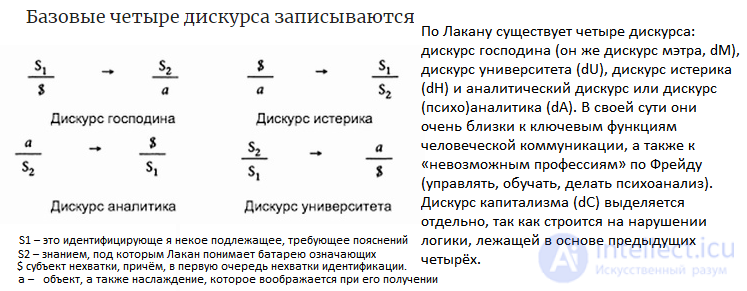
In Lacan's model, it is not only verbal
communication that is significant. Here an appeal to the nonverbal
component of communication appears. And the analysis of nonverbal components
acquires an importance no less, and in some cases even more,
significant than the analysis of the speaker's words.
Argumentation is a social, intellectual, verbal activity serving to justify or
refute an opinion, consisting of a set of statements and aimed at gaining the approval of the audience." Thus
arguments are defined as statements put forward to justify or refute an opinion.
F. van Eemeren and R. Grootendorst also allow for the presence of hidden or indirect
speech acts in argumentative discourse.
The resolution of a dispute in argumentation theory appears as consisting of four stages:
1. The confrontation stage.
2. The opening stage of the discussion.
3. The argumentation stage.
4. The concluding stage, where it is established who resolved the dispute.
Overall a complex structure is formed, which the authors characterize as follows: "Live argumentative
speech often contains several discussions simultaneously, which may become intertwined. Even if the original dispute
is simple, any number of smaller disputes may arise from the argumentation aimed at resolving it, and this, in
turn, may lead to a new discussion and accordingly to the advancing of new arguments. A dispute that
was not originally mixed can easily turn into a mixed dispute or sub-dispute; a single dispute can
lead to a multiple dispute".
The authors also identify multiple argumentation, for example: "Mail delivery in Holland is far from perfect.
One cannot be sure whether a letter will be delivered the next day, whether it will be delivered to the correct address, and
whether it will be delivered in the morning". Multiple argumentation is used for rhetorical purposes, since the defense
then appears stronger. The analysis of argumentative communication should include the following operations:
Today, hundreds of researchers work in the field of analyzing argumentative communication. In doing so,
interesting facts come to light. M. Scriven, for example, noted the asymmetry of positive and negative evaluations.
To reject the purchase of a car, one remark about the unsafety of its brakes is enough, whereas for
a positive decision a whole list of merits must be cited. This indicates that the work is easier in the case of
negative argumentation.
Probably one of the first works in this field in the military
sphere can be considered K. Lemin's monograph "Propaganda
of War in Japan and Germany". It was published by
the state military publishing house under the imprint
of the Institute of World Economy and World Politics
of the Communist Academy. And although it is entirely permeated with journalistic
rhetoric, it contains a great many concrete analyses
of the information structures of the two states under
consideration.
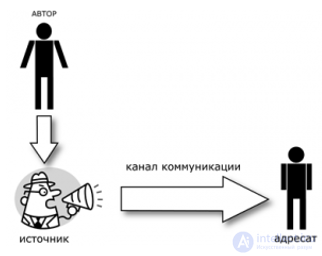
America was caught off guard by the Japanese attack
on Pearl Harbor because of a serious
disinformation campaign on the part of Japan.
Japanese propaganda, which they called
"the war of the mind", was conducted by a large number of organizations.
While within the country the listening of foreign
radio broadcasts was banned, Japan itself broadcast in twenty-
two languages. Radio was the main instrument of Japanese
"war of the mind", as F. Taylor believes. In the case of Japan,
as in the case of Hitler's Germany, the role of propaganda
inside the country was so high that people were not
swayed by the American nuclear bombs.
Already R. Nixon believed that a dollar invested in propaganda
was worth more than ten dollars invested in armaments,
since it begins to work immediately. This was emphasized in
his book "Information-Analytical Work in
Foreign Institutions" by Prof. N. Leonov
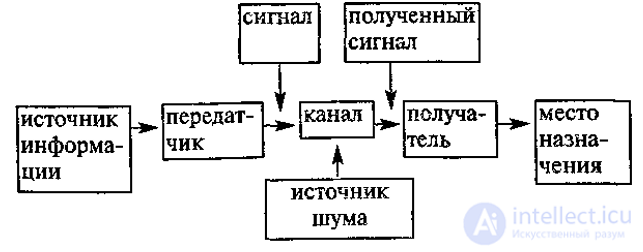
Claude Shannon identified three levels of communication:
technical, semantic, and the level of effectiveness.
Technical problems relate to the accuracy of transmitting
information from sender to receiver. Semantic
problems relate to the interpretation of the message by the receiver
as compared with the meaning that was sent
by the sender. The problem of effectiveness reflects
the success with which it is possible to change behavior in connection with
the transmitted message. The central problem for him
becomes the question of the transmission of information, but here
what matters most is not what was said, but what could have
been said: "Information is the degree of your freedom
of choice when you select a message. When you are
in a very elementary situation, where you have a choice between two
alternative messages, then one can conventionally say
that information equals one unit. Information (or entropy)
in this model appears from the standpoint of freedom of choice.
One can calculate the maximum entropy that
this source is capable of having with the same set of symbols.
Natural language is redundant in this respect: thus for
the English language this figure amounts to 50%. Such high
redundancy is what allows errors arising
during transmission to be corrected. The higher the noise level, the more
necessary redundancy becomes.
We will take only one aspect of N. Wiener's model — feedback. He
gives the example of a thermostat, which maintains a temperature
approximately at a constant level. Any system works
effectively when it receives information about the state of that system.
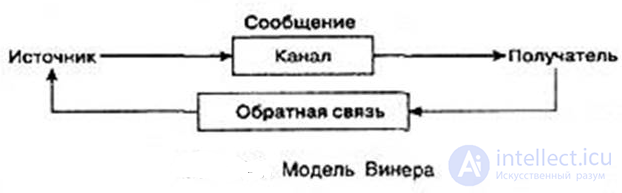
And on this basis it modernizes its control signals.
"Information fed back into the control center tends to
counteract the deviation of the controlled quantity from
the controlling one". In a separate chapter, N. Wiener examines
the functioning of social information. A group of non-social
animals has little information, since its members do not share it. In
the case of an effective organization — there is more information than
each of its individual members possesses.
T. Newcomb proposed taking into account
the relations that are established
between the agents of communication and between them
and the object of speech. Schematically, such a
minimal system has the following
form:
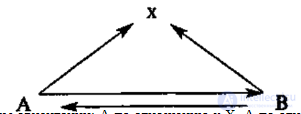
The following types of
orientation arise: A in relation to X, A in
relation to B, B to X, and B to A. The general
tendency of communication is
a striving toward symmetry. If A and B
are oriented positively toward each other,
they will tend toward
convergence of their attitude toward X. When
attitudes toward each other diverge,
the attitude toward X will diverge as well.
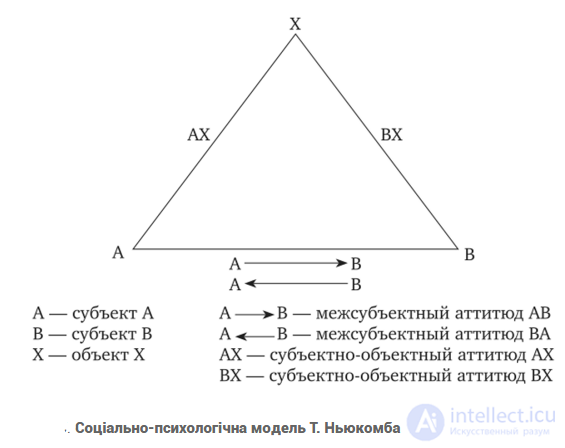
Convergence of attitudes toward X when
attitudes toward each other diverge,
this will be perceived as abnormal.
Incidentally, in the domain of these relations lies
the well-known saying "The enemies of my
enemies are my friends". This model
sets the dynamics of change toward which
communication will strive — toward
the creation of symmetrical relations,
with an equal evaluation of objects,
given an equal evaluation of each other.
V. Platt introduces a fundamental distinction between an intelligence
information document and a scholarly work: "It must be useful
for securing state interests at the given moment".
The average rates of decline in the value of information, according to V. Platt,
look as follows. Operational-tactical
intelligence information loses 10 percent of its value per
day. Strategic intelligence information during wartime loses
10 percent of its value per month. In peacetime, strategic
intelligence information loses 20 percent of its value per year.
The main stages of intelligence work take the following
form:
Stage 1. General familiarization with the problem.
Stage 2. Definition of the terms and concepts used. Stage 3.
Collection of facts.
Stage 4. Interpretation of the facts.
Stage 5. Formulation of a hypothesis.
Stage 6. Conclusions.
Stage 7. Presentation.
The information forecast deserves separate consideration.
When considering the forecasting of the capabilities of a foreign
state, V. Platt emphasizes the importance of such points as: a)
a consistent description of favorable and unfavorable
factors with an assessment of the overall outcome of their interaction; b)
comparison of the situation in the foreign state with a known
analogous situation; c) determination of the upper and lower
limits of the development of the given phenomenon. The forecast must also
include an indication of its degree of reliability.
Lasswell's model is the first in the series of other models of communication. It reflects researchers' interest, above all, in the outcome of communication — namely, how the message conveyed by the communicator affects the recipient. Naturally, in this case communication is viewed as a one-way process. The model takes into account neither the external environment nor the internal attitudes of the communicants. The researcher's main attention is focused on the effect of communication: message -> result.

Lasswell's Model of Communication
Developing and refining G. Lasswell's model, R. Braddock introduced into the model elements that are significant, namely: the goal pursued by the communicator and the factors influencing the process of persuasion. At the same time, the main focus likewise remained on the process of persuasion, and the process of communication was still viewed as a one-way process: goal -> result.
This model was used mainly for structuring and summarizing various
studies of mass communications:
• who? – studies of the communicator;
• says what? – studies of the message;
• through which channel? – studies of the channels, or means, of mass communication (MMC);
• to whom? – the study of recipient characteristics that facilitate or hinder the acceptance
of mass communication messages;
• with what effect? – studies of the factors of effectiveness and the effects of mass communications.
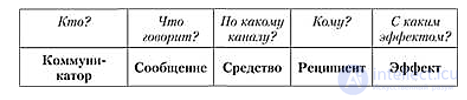
This model has not lost its relevance even today and is successfully used for
planning empirical research. Later, R. Braddock added two more elements to it: the conditions under
which communication takes place, and the communicator's goal. Nevertheless, this formula is a striking
example of models within the "media-centered" paradigm, since it describes the communication process as
linear, without taking into account the activity of the recipient (audience) and its influence on the communicator.
The cyclical nature of mass communications is most vividly
described in the Osgood–Schramm model. According to W. Schramm,
the communicative process is infinite and continuous. The main
tasks of the communicator and the recipient are encoding,
decoding, and interpreting the message, errors in the course of
which can lead to significant distortions of the original
message.
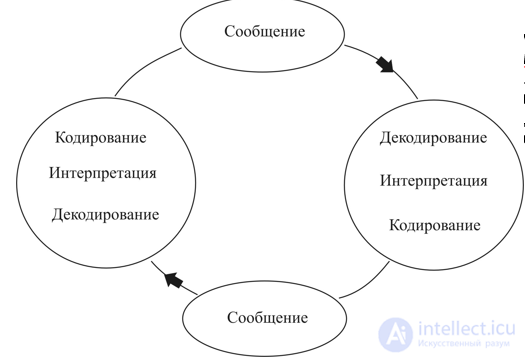
W. Schramm's model, unlike the models that existed before him, focused attention on establishing the relationship between communicants. Moreover, he was the first to include in his model the experience that communicants have and which influences the outcomes of the communication process. A logical development of the model was the transition to a model of communication as a circular process. Unlike all previous models, Schramm and Osgood drew attention in their model to the fact that communication is a circular process, and attention was focused on the interaction of two subjects of communication: communicator -> recipient.
G. Gerbner's model focuses attention on how information about an event is transformed into a message. This model, above all, treats an event as information that is of interest to the subject perceiving it. At the same time, this model draws on Schramm's approaches, which regard the process of encoding information as an important stage of the communication process. Unlike previous models, it does not devote sufficient attention to the decoding of the message, limiting itself to its creation. Thus, the emphasis of the model can be expressed as the pair: event -> message.
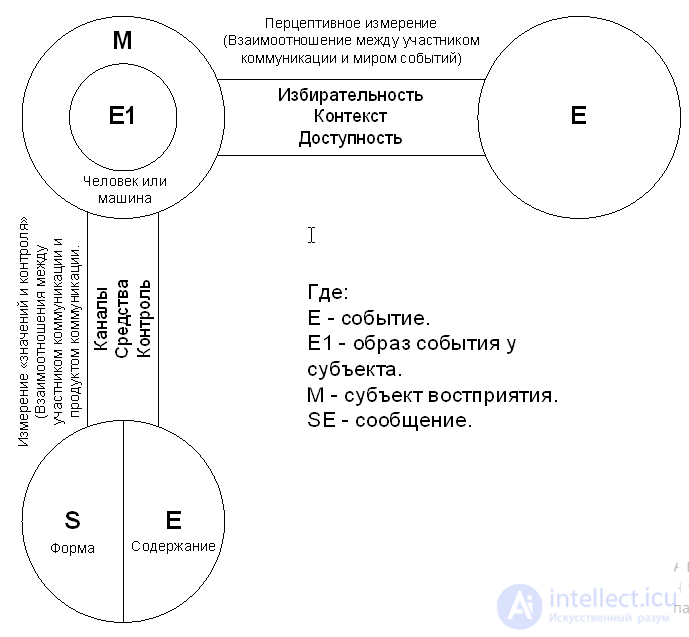
Gerbner's Model of Communication
The Westley and MacLean model generalized practically all the main models that had been proposed by researchers up to the time of its creation. Above all, it is distinguished by its adoption of the Newcomb model as a model of the relationship between two subjects in relation to an external object. The model also shows the influence of Gerbner's model regarding the formation of a message on the basis of the perception of an event. Finally, the model takes into account the cyclical nature of the interaction between communicants. Unlike previous models, it treats the audience as the recipient and, accordingly, can represent communication at any level. Thus, the Westley and MacLean model can be regarded as a universal model of communication, emphasizing the pair: event -> audience.
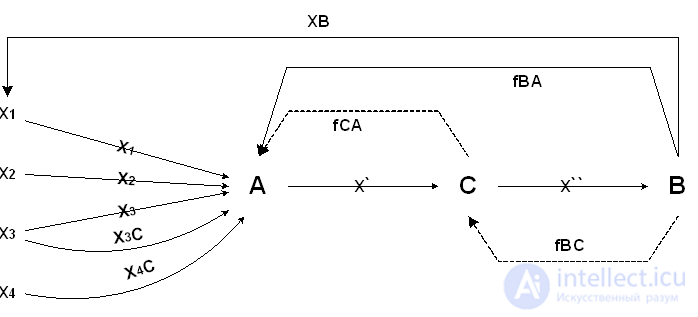
Westley and MacLean's Model of Communication
D. Berlo's model focuses attention on the details of the communication system, examining various characteristics of the communicants, the message, and the channel of communication. Thus, the merit of this model can be said to be that it shows that any of the communication subsystems can be examined with any desired degree of detail, and the essence of the model can be represented as the pair: element of communication à characteristics of the element.
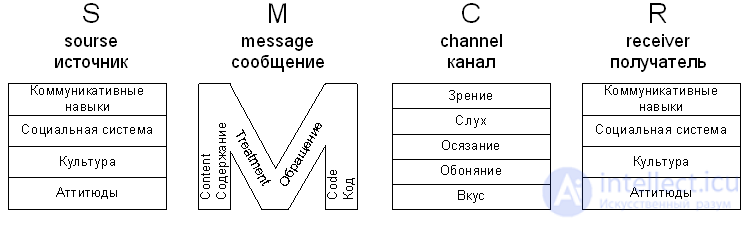
Berlo's Model of Communication
Taking into account the accumulated experience, DeFleur proposed, in his model, to refine the Shannon-Weaver model by introducing into it a feedback channel identical to the forward one. Thus, he combined in his model the Shannon-Weaver and Schramm-Osgood models. He devoted his attention, first and foremost, to the correspondence of identical perception of information conveyed by means of messages between communicants. At the same time, the essence of the model corresponds to Shannon's model, though somewhat modified, namely – the correctness of the perception not of the message, but of the information conveyed by means of that message: (information) communicator -> recipient (information).
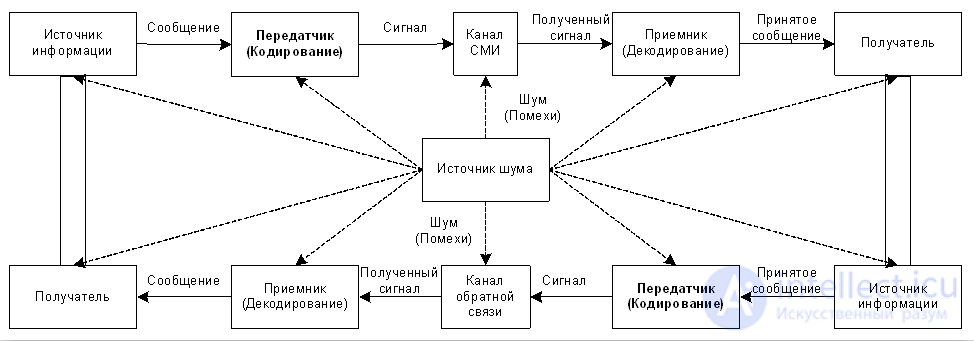
DeFleur's Model of Communication
Maletzke's model, in fact, generalizes the accumulated experience and offers a systemic model of communication in the field of mass communication. If one looks at the model proposed by Maletzke, it is evident that the process of communication is viewed from the standpoint of the interaction of the communicator's and the recipient's systems. At the same time, within the framework of either system, any elements that the researcher deems it necessary to consider within the analysis of communication may be included. Thus, this model can be reflected in the pair: communicator system -> recipient system.
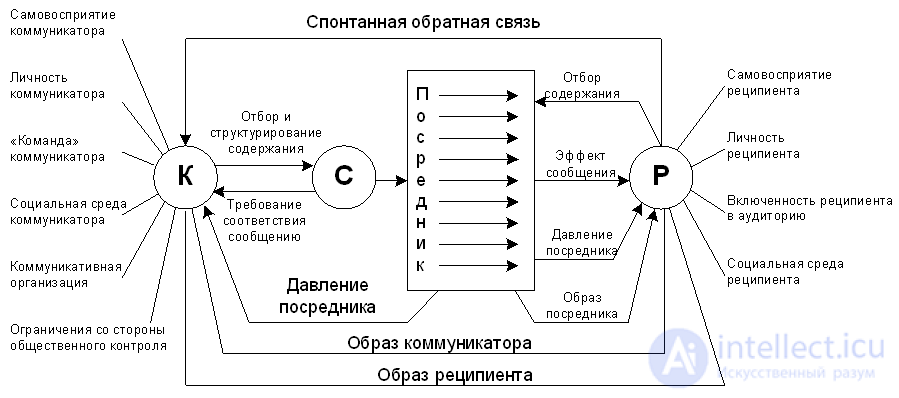
Maletzke's Model of Communication
McLuhan's Model: Herbert McLuhan developed a model asserting that mass media, such as television and radio, have a major impact on culture and society. He introduced the concept of "the medium as the message" (The Medium is the Message), emphasizing that the very means of transmitting information is more important than its content.
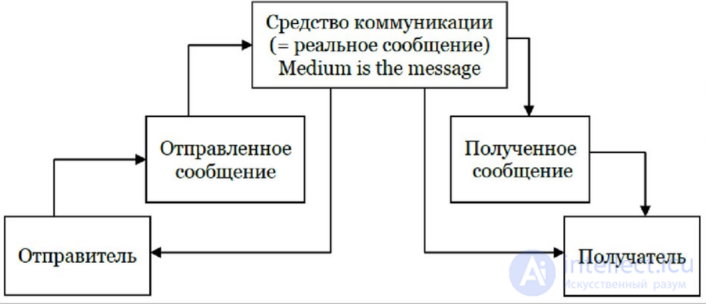
Foucault's Model. The large-scale social, cultural, and political transformations of the 1960s could not but influence theoretical thought. During this period, a whole galaxy of unique, unrepeatable conceptions of society and, in particular, of communication emerged, which influenced the further development of social and humanities research.
Michel Foucault, a French philosopher, belonged, perhaps, to the most radical segment of humanities scholars who critically reconsidered European intellectual culture of the last several centuries. Foucault was interested in such questions as the social and cultural conditioning of the development of systems of knowledge in various historical epochs; the interrelationship between power and knowledge;
the construction of subjectivity, sexuality, and power relations within various discursive systems. And despite the fact that Foucault did not deal with communication issues as such, his conception nevertheless had a very strong influence on communication studies in recent decades.
Foucault develops one of the key ideas of some of the newest scientific paradigms (in particular, poststructuralism): the content and truth of our knowledge of the world are determined not by their correspondence to objective facts, nor by the logic and methodological rigor of the process of cognition, but by the operation of epistemic norms and standards adopted in a given historical epoch and under given social conditions. The very notion of truth, logic, and rigor of knowledge, as well as the content of the knowledge itself, is dictated by the discursive system within which cognition takes place.
All processes of cognition are set by discursive schemes, cultural codes, and language, which assign to various facts the status of true, correct, acceptable, natural, or, conversely, untrue, false, unacceptable, and unnatural. Foucault writes: «Every society has its own regime of truth, its own “general politics” of truth: namely, the types of discourse it accepts and makes function as true; the mechanisms and requirements that make it possible to distinguish true statements from false ones; the techniques and procedures accorded value in the acquisition of truth; the status of those who are granted the right to say what counts as true» .
Thus, Foucault considers discourse to be the basic element of both cognition and communication — as a set of statements and the rules for their creation, possible under certain historical, ideological, and social conditions («discursive formations»); as a set of linguistic practices that determine the representation of those objects that serve as their referents (that which the statement is about). As A. R. Usmanova explains, in discourse Foucault sees «a specific power of utterance, endowed with the force to assert something. To speak — means to possess the power to speak» .
Different discursive formations presuppose different cognitive schemes: whereas in the 16th century systems of knowledge about the world were built on the principle of resemblance («to seek the law of signs means to discover things that are similar»; to learn something new means to find analogies with already known facts), in the 17th—18th centuries the epistemic norm becomes not the search for analogies but the formation of representations (the truth of a statement is determined not by its «order», but by the position of the speaker).
Finally, the modern discursive formation, whose beginning Foucault locates in the 19th century, acquires total autonomy — words ceased to be tied either to reality or to subjectivity; they began to shape both a certain type of reality and subjectivity itself. Language now functions in such a way that both reality and personhood become the result of its functioning. Here one observes the generative, constructive character of discourse in the age of rationalism and late capitalism.
Under such conditions, communication becomes not a means of understanding the surrounding world or of expressing the speaker's personality, but a condition for the construction of reality.
In the most general form, Michel Foucault's model of communication can be represented as follows .
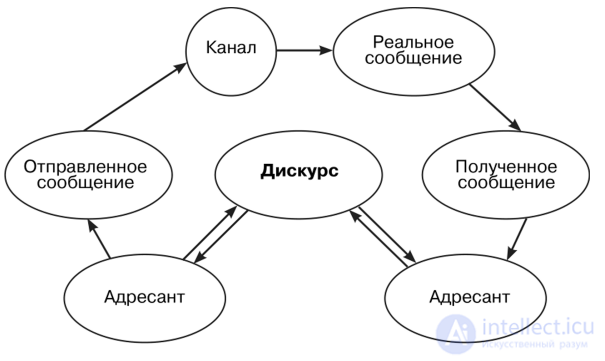
Fig. . Foucault's Model of Communication
Burt's Model. Robert Burt — an American sociologist engaged in the micro-sociological analysis of social ties and relations, i.e., the study of communicative interactions at the elementary (lowest, everyday) level of social life. His conception is built on a view of society not as a hierarchized structure with vertical, multilevel information-communication flows, but as a network consisting of elementary ties between people. His conceptual propositions on the nature and regularities of communicative processes in society are set out primarily in the work «Social Capital and Structural Holes»
For Burt, communication is, first and foremost, people and the contacts they establish, and only then the complex system of functions, channels, means, codes, and contexts for transmitting messages. Any network in which people are included presupposes not a static «placement» of individuals in social space, but a constant, living, changing interaction between people.
Fig. 2.7 schematically shows the social (communicative) ties within and between three groups of people (organizations). Points denote individuals, and the lines connecting them — the ties between individuals. Bold lines denote «strong» (stable, significant, information-rich) relations, while dotted lines denote — «weak» (unstable, insignificant, information-poor) relations.
Burt denotes the absent ties between representatives of different groups by the term «structural holes», and in Fig. 2.7 they are represented by empty spaces that could have been filled with lines of interpersonal and intergroup connection. In fact, «structural holes» — are not evidence of a lack of information about other groups or individuals; rather, they are evidence that the communication processes in communities divided by «holes» are organized around information that is too local and closed. At the same time, the possibility of joint activity (both cooperation and rivalry) is directly related to filling these structural gaps with communicative ties.
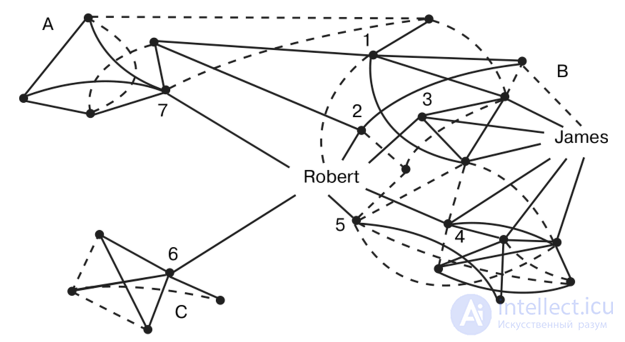
Fig. 2.7. Robert Burt's model
The diagram shows that both individuals — Robert and James — have the same number of ties (six «strong» and one «weak» tie each), yet Robert is connected to representatives of different groups (A, B, C), whereas James is connected only to one (B). This means that, unlike James, Robert has access to information about events in other communities (organizations). From Burt's point of view, this is an extremely important feature for the development of intergroup communication, and he denotes this feature by the term «social brokerage».
«Social broker» (in Fig. 2.7 this is Robert) effectively establishes or facilitates the exchange of information between groups, cooperation, and the openness of communities. In this, Burt sees the functions of intergroup communication, the foundations of which, in his view, lie in the «linking mechanism» (brokerage). At the same time, «airtight networks», i.e. those «in which no one can act without being noticed by others» , also have their merits. A. V. Nazarchuk explains that such a network guarantees access to information that is most important to individuals, as well as reducing the risks associated with cooperation, and increases intragroup trust .
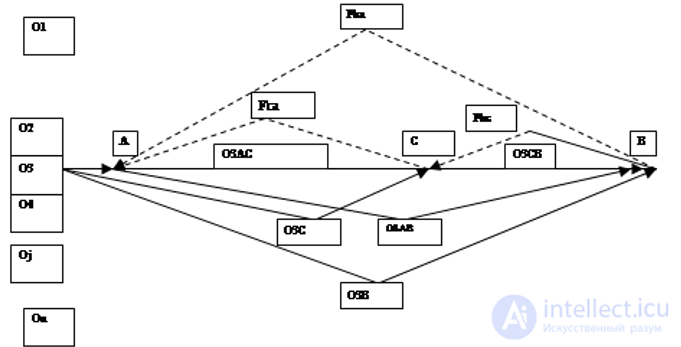
O1,O2,O3…On – objects in the space of information choices
A – eyewitness
C – information intermediary/gatekeeper (mass media)
B – receiver, audience
F – feedback
This model describes both interpersonal and mass communication, and it reveals the functional role of the mass media in meeting the recipient's (audience's) need for information. It also explains the mechanism of both direct and mediated communication.
The Westley and MacLean model provides for the possibility of feedback – communication directed from the receiver to the source, for example in order to ask a question, evaluate the message, agree, object, or offer additional information. This can take the form of readers' letters to a newspaper's editorial office (the Fbc arc), calls from TV viewers (also Fbc), an editor's demand that a reporter rewrite an article (report) because the material is uninteresting (the Fca arc). Feedback helps the source, or gatekeeper, correct their errors or missteps.
The model does not account for the influence of noise during encoding/decoding or message transmission, and it does not show the effect of the message.
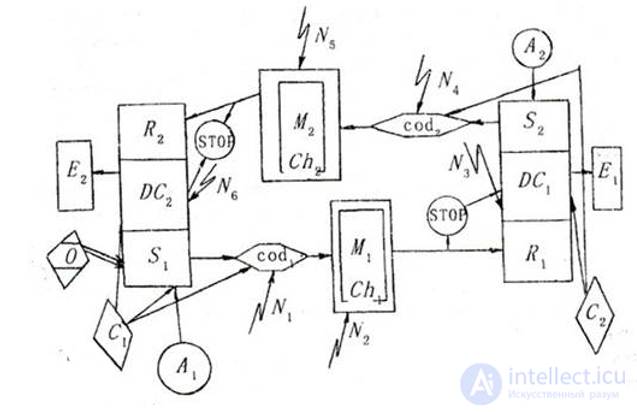
O – the object that is selected as the subject of communication
S1 – subject 1, performing the functions of the source in direct communicative interaction
S2 – subject 2, performing the functions of the source in reverse communicative interaction
C1, C2 – respectively, the culture of subject 1 and subject 2
A1 and A2 – respectively, the goals of subjects 1 and 2
Cod1 and Cod2 – the processes of encoding the message in direct and reverse comm. interaction
M1 and M2 – the messages of direct and reverse interaction
Ch1 and Ch2 – the channels of direct and reverse interaction
DC1 and DC2 – the processes of decoding the message in direct and reverse comm. interaction
R1 – the subject performing the functions of the receiver in direct comm. interaction
R2 – the subject performing the functions of the receiver in reverse comm. interaction
E1 and E2 – the effects of direct and reverse comm. interaction
N1,N4 – semantic noise of the source in direct and reverse comm. interaction
N2,N5 – mechanical noise of the channel in direct and reverse comm. interaction
N3,N6 – semantic noise of the receiver in direct and reverse comm. interaction
STOP – the symbol for the termination of communication.
The transactional model – a model that describes the ideology of the interaction of social subjects who are equally capable of acting as source and receiver. Proposed by Alexis Tan.
- Communication begins when an individual or a social organization (S1 in the model) responds to stimulus O in their surrounding environment.
- The selection of stimuli is purposeful in nature and is determined by the objective goals of S1 – A1.
- The perception of objects is mediated by the subject's culture, understood in the broad sense (C1)
=>
- If the message reaches R1, the latter must decode it (DC1)
Decoding refers to the perceptual and cognitive processes that lead to becoming acquainted with the message, understanding it, and interpreting it.
- As with the source (S1), the culture of R1 – C2 will significantly affect the process and outcome of decoding.
- Communication will not take place (STOP) in two cases:
First, when channel ch1, due to its physical parameters, is not capable of transmitting message M1.
Second, when receiver R1, due to their cultural and linguistic characteristics, is unable to decode (DC1) message M1.
- After decoding the message, R1 has at least two alternatives:
First, in connection with the message, he may in some way change the parameters of his consciousness and/or behavior. This change is precisely the effect of communication (E1)
Second, it is also possible that R1 will respond to the message.
- From S1's standpoint, communication succeeded to the extent that R1's observed response corresponds to the goals that S1 was pursuing in initiating the communicative act (A1)
An alternative is possible for R1 after decoding M1 – to encode his own message and send it to the source of the original outgoing message.
- At the second stage of the process, R1 becomes the source or communicator S2.
In the model under consideration, noise is defined as any source of distortion of the volume and meaning of the message. (Noise can be semiotic or mechanical)
In the structure of the source there are two most important sources of noise – correct or incorrect use of language and selective perception conditioned by cultural factors.
Receiver noise – a particular danger. Factors:
- Selective attention
- Selective perception
-Selective retention
(!) The selective exposure hypothesis (selective exposure) – people avoid information that contradicts their own values, beliefs, attitudes, etc. – i.e., they avoid dissonance and, on the contrary, seek out resonant information.
«Attention to any given message is determined by the size of the expected reward, the expectation of punishment, and the amount of effort required,» - Wilbur Schramm.
Selective perception and selective retention represent other types of receiver noise (audience noise). Perception is determined to a greater extent by cultural factors. The way in which we perceive or understand the objects around us, including communication messages, depends on prior experience, values, and group affiliation. Similarly, in a number of cases selective retention reinforces existing attitudes and behavioral patterns. Thus, even if a message has reached the audience, receiver noise can distort its content.
The concept of cognitive dissonance
Every person strives for consistency between what they know, what they believe, what they feel, and what they do. When there is inconsistency between knowledge, beliefs, and behavior, a person attempts to logically and cognitively justify this inconsistency and resolve it. If it is not possible to suppress or compensate for this inconsistency, the person begins to experience psychological tension, a discomfort that is called cognitive dissonance.
(!) Dissonance is always a motivating factor for the psyche – it motivates a person's activity toward reducing it. The presence of dissonance leads a person to strive to get rid of it, and the stronger the dissonance, the stronger the motive to get rid of it.
The concept of the fundamental attribution error
(Attribution is the ascribing of causes, a connection, or some significant factor that determines a significant function)
F.A.E. is a property of the human psyche associated with the fact that, in the case of a positive outcome of social interaction, a person tends to attribute the causes of this outcome, with respect to themselves, to their own positive personal qualities, and with respect to other people, to circumstances. And conversely: in the case of a negative outcome, a person attributes, with respect to themselves, the causes of this outcome to negative circumstances, and with respect to other people, to their negative personal qualities.
The bias of «playing in one's own favor»
When evaluating other people, a person tends to judge them by parameters in which they themselves are better. (This is also a type of cultural noise)
The most important characteristics of the Transactional model:
- In this model, communication is purposeful interaction. It has a certain goal (A1), and it is precisely this goal that communication pursues.
- This model is systemic in nature. It contains many factors that affect the character of communication (culture, goals, noise) => Any change (even in the smallest factor) changes the entire communicative process, the entire system.
- Communication is transactional in nature. Both individuals are actively involved in the transaction process. The original sender of the message can influence the receiver, but the latter is also often able to influence the source.
- The factor of information loss. This model clearly demonstrates that the combination of risks of deteriorating communication quality in transactional interaction, amid the mutual, constant change of source and receiver, creates a critical situation for ensuring the effect of communication => Communicators (especially in mass communication) must ensure message redundancy, some tools that increase the likelihood of overcoming noise and interference.
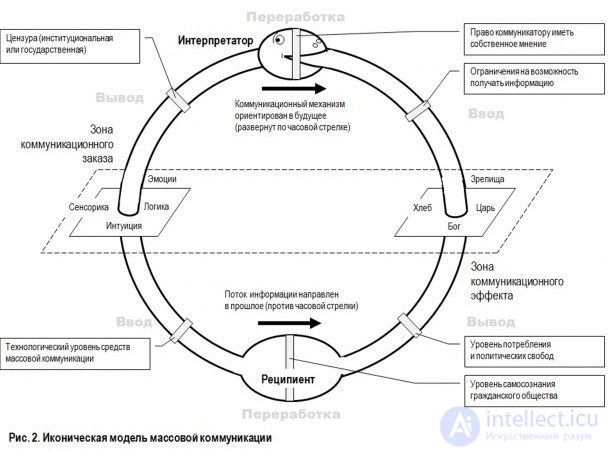
The theory proposes an ontological model of mass communication (MC) that combines the traditional structural-functional information approach with a metaphorical modeling method. The study substantiates the selection of archetypal psychological structures that can be used as the basis for a representative communicative model. The model establishes the equality of the values of the communicator and the recipient in the communicative process and the resulting structural symmetry of the mental and activity cycles of communication; in particular, it balances the communicative effect with the obligatory nature of the communicative order, which makes it possible to clarify the meaning of the term "free press". The model identifies six key positions for assessing the objective state of the MC system in society. The analysis of these positions is carried out taking into account the distribution of the information flow in MC not by technological features (press, radio, TV, etc.), as is usually done, but in accordance with the four psychological modes of C. G. Jung, which is methodologically predetermined by the ontological view of communication.
Looking at the years when communication models were created, it can be said that the main period of model creation fell in the fifties of the last century, as the most active initial period in the development of communication theory.
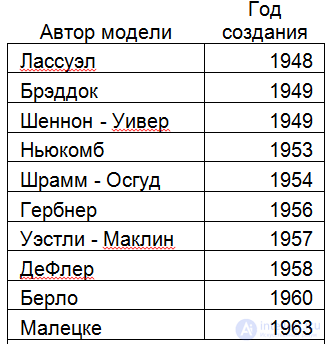
Models of communication — author and year of creation
In subsequent years, communication models continued to be created by various authors, for example, the systems model of communication (1972), Brown's holographic model (1987), the fractal model of communication, and others, references to which can be found in the literature. This speaks to the relevance of this method for studying the communication process.
These models help analyze and understand various aspects of mass communication, from their structure to their impact on the audience and cultural change. They also help researchers and practitioners in the field of mass communication develop more effective strategies for conveying information and influencing the audience.

Comments