Personality and the group play an important role in the context of communication and social interaction. Let us examine them in more detail:
-
Personality:
- Definition: Personality is a unique combination of individual characteristics, traits, beliefs, values, motivations, and behavioral patterns that determine who we are as individuals.
- Role in Communication: Personality influences how we perceive and interpret information, as well as how we express our thoughts and feelings in the process of communication. Personality can determine communication style, the level of empathy, the ability to adapt to different interlocutors, and many other aspects of communication.
-
Group:
- Definition: A group is a collection of individuals united by a common goal, interests, values, or task. Groups can be small (for example, a family) or large (for example, a work team, a community, or a nation).
- Role in Communication: Groups play a key role in social dynamics. Communication within a group includes establishing relationships, exchanging information, resolving conflicts, and making decisions. Members of a group may share common norms, customs, and communicative patterns, which affects their ability to interact with other groups and individuals.
-
Interaction between the Individual and the Group:
- The personality of each member of a group influences the group's dynamics and the overall perception by its members. Each participant brings their own individual traits, experience, and point of view to the communication.
- Group dynamics, in turn, can affect the personalities of group members through communication, shaping their beliefs, values, and behavioral standards in accordance with what is considered "normal" within the group.
- Effective communication within a group requires understanding and respecting the diversity of personalities, as well as the ability to find common ground and resolve conflicts.
In addition, it is important to note that in the context of communication various roles can arise, both within a group and for each individual. For example, leader, initiator, listener, and so on. These roles also affect how interaction takes place and which roles individuals and groups assume in the process of communication.
Communication between the Individual and the Group
Communication between the individual and the group is the process of an individual interacting with the members of a group or with the group as a whole. This process can occur in various contexts, such as family, work, education, communities, and so on. The direct forms of communication that develop within a group form social bonds, shaping the character of each person. And just as each individual bears the imprint of their group, so each group bears the imprint of the members who make it up: while being a formative force for individuals, it is itself formed by them.
Joint activity is one of the main forms of human communication.
It is impossible without contact between subordinates, without the exchange of information for the purpose of successfully solving tasks. Joint activity is therefore the most important factor in organizing life and the socialization of the individual.
The specific forms of joint activity can be: play in preschool age, learning in school age, and work in adulthood. But this does not mean that each age is necessarily characterized by one particular style of communication during joint activity rather than another. Rational processes of communication, and thus the development of the personality, are possible only given a harmonious combination of all three types of joint activity; they draw all forms of communication into activity, and it is these that enrich the personality.
Within joint activity as a form of human communication, informational communication is possible; it involves the transmission and exchange of information not only as an aspect of the activity but also outside it. Such communication presupposes the presence of a sender (communicator) and a receiver (recipient) of information.
In the act of communication, the following elements must be clearly distinguished: a) the tasks of communication; b) its content; c) the means of communication; d) the socio-psychological product of communication. If even one element of this whole is missing, communication turns into a meaningless conversation.
Genuine informational communication always performs the following main functions:
1) the informational function, whose main property is the originality of the message;
2) the command function - in the form of a verbal order to act in one way or another, an instruction that formulates the content of a task or indicates the way to solve it;
3) the integrative function, which ensures the integrity of the organization of a given process;
4) the persuasive function, which allows the recipient to dispel doubts, become finally convinced of the correctness of the proposed action, and acquire firm confidence in success.
Communication in collective action can take various forms. These include: notification, proposal, request, demand, order, and instruction. All of this can be carried out either in oral, verbal form or in sign form of conveying information - by means of gestures, facial expressions, conventional movements, and other codes for conveying information for use during the performance of the task.
The exchange of information during communication illustrates the recipient's varying attitude toward the message they receive.
In a positive sense, this is a manifestation of compassion, agreement, solidarity, trust, sympathy, friendship, and help, when the recipient perceives the information received as guiding or integrative and incorporates it into the regulation of their own actions.
In a negative sense, indifference, disagreement, hostility, antipathy, and resistance to the wishes of others arise, leading to conflict situations within the collective, which may then break up into several groups.
The model of the group. This is an emotional-psychological formation. However, it is not an object of sociometric research, since it does not lend itself to a proper analysis of people's relationships on the basis of social norms, value orientations, and evaluations.
The importance of correctly finding the key to understanding the collective is difficult to overestimate, since it makes it possible to purposefully direct and precisely regulate such psychological phenomena as the relationships and interaction of the collective's members, cohesion, psychological climate and compatibility, the well-being and self-respect of the individual, and their prospects connected with the collective.
These phenomena make the collective a link that connects the individual and society.
Psychology has accumulated experience in understanding and forming the collective and its best examples. This experience follows from the ideas and regularities identified by A. S. Makarenko, who viewed the collective as a group of people united by a socially recognized purpose of activity, in which relationships are built on mutual understanding and mutual support.
The stratometric concept of intragroup activity proposed by A. V. Petrovsky makes it possible to view its problems differently in a historical context. At the heart of this view is the idea that the mental properties of the personality are mediated in character. The function of mediation is performed by signs, by means of which a person masters their own behavior and actions, socially determining them. The use of signs and sign systems radically restructures and activates human activity.
Human mental functions first take shape on the social plane, in the process of interaction between people, and only afterward are they transferred to the internal plane.
This is where the importance of primary groups arises, into which every person is first drawn from childhood. Higher mental functions are expressed within these groups as relations between children, and later, once the children have mastered them, they take the form of personality traits that become part of the system regulating behavior and activity.
Relations among subordinates within a collective influence the formation of personal qualities. Mastering signs and sign systems allows subordinates to apply social experience and knowledge and to become acquainted with humanity's cultural values. Mental functions formed during communication and group action become an internal determinant of the individual's activity.
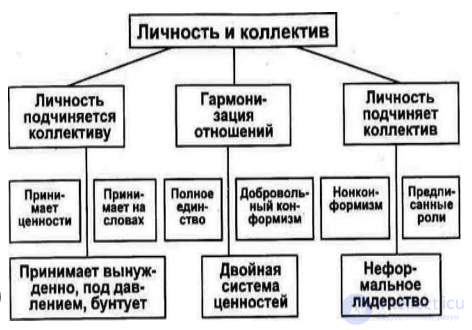
The formation of the personality takes place in one direction - from the collective to the individual. The opposite process runs in the other direction - from the individual to the collective. In doing so, each individual contributes something of their own, influencing others, the course of interpersonal relations, and the nature of group action.
Such a view of how the determinants of personal activity manifest themselves allows a leader to analyze how their manifestation depends on the level of development of the group or collective and on its values. This approach takes on particular importance when collectives are formed from people of different specialties, who need not only professional development but also the cultivation of the best personal and cultural traits.
So what fundamentally distinguishes a collective from less developed groups of people?
In a collective, the defining principles are interaction and relationships mediated by the goal, tasks, and values of the joint activity, which make up its content.
Among the most important properties of a collective's joint activity are the advantage the collective provides for a person's self-determination and the noticeable decrease (compared with a group, an association, or a diffuse group) in conformist reactions in situations important to the collective.
Therefore, by drawing a person into the system of social relations, the collective shapes them as a person.
A distinctive feature of a collective is that it is created by a leader, and interpersonal relations characteristic of a democratic society actively arise within it. A collective can be seen as a special social environment that shapes and develops the spiritual and professional abilities of the younger generation. Properly building and organizing interaction among subordinates within a collective is one of the tasks of upbringing.
The Individual and the Group.
Personality – is, first of all, an abstract concept that unites many aspects characterizing a person: emotions, motivation, thoughts, experiences, perception, and actions. Personality can be viewed as the individual expression and subject of social ideals, values, social relations, activity, and human communication.
Social personality develops through people's communication, beginning with the primary forms of communication between mother and child. In essence, it represents a system of a person's social roles within the various groups whose opinion they value. All forms of self-assertion in one's profession, in rivalry, and so on shape the social structure of the personality. Psychologists note that satisfaction or dissatisfaction with oneself is entirely determined by a fraction in which the numerator expresses our actual success and the denominator our aspirations.
Merton defines a group as a set of people who interact with one another in a certain way, are aware of their membership in the given group, and are regarded as its members by other people. L. I. Friedman and I. Yu. Kulagina give the following definition: «A group is a certain set of people considered from the point of view of social, production, economic, everyday, professional, age, and similar commonality. It should immediately be noted that in the social sciences, in principle, there can be a twofold use of the concept of “group”». The main characteristics of a group include: its composition, structure, group processes, norms, values, and system of sanctions. But the biggest problem in studying groups is their classification. Researchers have proposed an enormous number of solutions to this problem, but have never arrived at a common opinion. Nevertheless, the trait uniting all the proposed classifications is the group's form of life activity.
Regardless of the administration's wishes, small informal groups of three to seven people form within every collective. If such a group exercises a substantial influence on the collective's public opinion, it is called a reference group,or a benchmark group. A reference group may include people of different ages who are not necessarily employed, for example, in the same department, i.e., it can be "cross-cutting." The main psychological prerequisite for the formation of such a group is the need for informal communication and interaction with other people. Interaction and interdependence serve to satisfy both particular (situational) and general needs, for example, for respect, prestige, belonging to a group, and power. In addition, activity as part of a group gives rise to new needs, for example, to preserving the group's stability.
The most important feature of an informal group is the presence of a common goal, which, firstly, is not always recognized by the group's members and, secondly, is not necessarily connected with solving production tasks. The need for communication may arise in connection with shared study, a common hobby, and so on. The goals of a small group can be positive, i.e., conducive to the cohesion of the collective, neutral, or negative.
The need for goal-setting, for formulating a goal, and for organizing activity aimed at achieving it leads to the emergence ofleaders. This phenomenon can be observed in all informal groups numbering more than three people.
Any informal leader possesses personal magnetism, which manifests itself in various forms. Three types of leaders are distinguished: the chieftain, the leader (in the narrow sense of the word), and the situational leader.
The chieftain — is the most authoritative member of the group, possessing a gift for suggestion and persuasion. He influences other members of the group through words, gestures, and looks. The Greeks in Homer's time believed that a chieftain should possess the wisdom of Nestor, the fairness of Agamemnon, the cunning of Odysseus, and the energy of Achilles. Throughout the 20th century, numerous studies were conducted on the individual qualities of successful leaders. Thus, the American researcher R. Stogdill proposed the following list of qualities of a leader — a chieftain:
1) physical qualities — active, energetic, healthy, strong;
2) personal qualities — adaptability, self-confidence, authority, striving for success;
3) intellectual qualities - intelligence, the ability to make the right decision, intuition, a creative streak;
4) abilities — sociability, ease in communication, tact, diplomacy.
Of course, an extremely small number of people satisfy all of the requirements listed. This, however, does not mean that "leaders are born" and that good leadership can practically not be taught. Indeed, studies have shown a direct link between the combination of five factors — intelligence, authority, self-confidence, energy, and knowledge, on the one hand, and the capacity for leadership, on the other. However, this combination does not yet guarantee success, since the dependence accounts for only 25—35%. In the remaining cases, the decisive role in effective leadership is played not by personal qualities but by the leader's style of behavior.
The leader is far less authoritative than the chieftain. Along with suggestion and persuasion, he often has to prompt action by personal example ("do as I do'"). As a rule, his influence extends to only part of the members of the informal group.
The situational leader possesses personal qualities that matter only in some quite specific situation: a ceremonial event in the collective, a sporting event, a hiking trip, and so on.
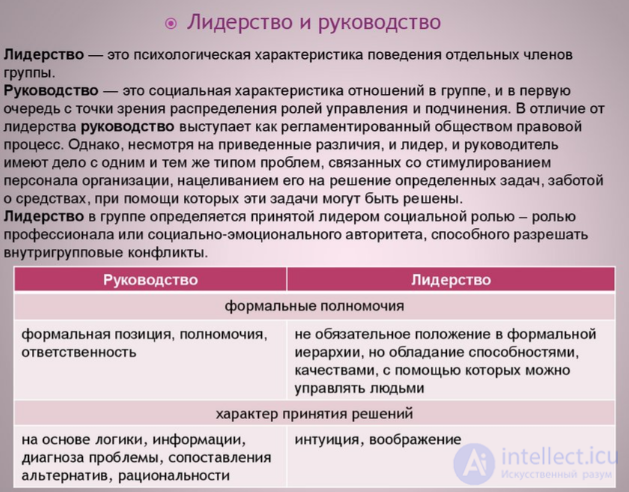
Leaders exist in every collective and deserve special attention, since it is precisely they who actively influence the moral-psychological climate in the collective and can become a source of conflicts, but it is also precisely they who make up the reserve for the promotion of personnel. Among informal leaders one can distinguish business, emotional, authoritarian, and democratic leaders, and, finally, most importantly, positive and negative leaders. A manager, as a formal leader, is obliged to have a sufficiently complete picture of the informal structure of his collective in order to prevent conflict situations in time, to clearly understand who shapes public opinion in a given work group, and to have an idea of the degree of authority of his deputy and other employees.
The methodology for measuring the informal structure of a group, otherwise known as the sociometric procedure, has by now been worked out in fairly great detail.
The Role of the Leader in the Formation of a Collective
So, the effectiveness of a collective's work and its ability to accomplish the tasks set largely depend on the moral-psychological climate, as well as on the prevailing "mood" of the staff within the group, which, other things being equal, is determined, firstly, by the qualitative composition of the personnel and, secondly, by the particular features of the informal relations between the manager and the subordinate.
Let us dwell on these problems in more detail. Scientific research and the generalization of practical experience show that the most productive work groups are those made up of people of different ages, sexes, and temperaments. Younger employees take in new things better and are more energetic, but are sometimes overconfident and unwilling to compromise. Older employees, by contrast, are fairly conservative but possess life experience, are not prone to taking risks, are able to make more considered decisions, and, as a rule, avoid conflict situations. Furthermore, purely female and purely male collectives have their own specific drawbacks: in female collectives petty squabbles occur more often, and more working time is lost through the systematic discussion of everyday problems and so on, whereas in some male collectives foul language and "bad habits" flourish during working hours. In other words, joint work between people of different sexes tends to pull employees together and raises self-discipline and self-demand. It is no less important to have individuals of different temperaments within a group, since each of them, as we have already established, has their own strengths and weaknesses.
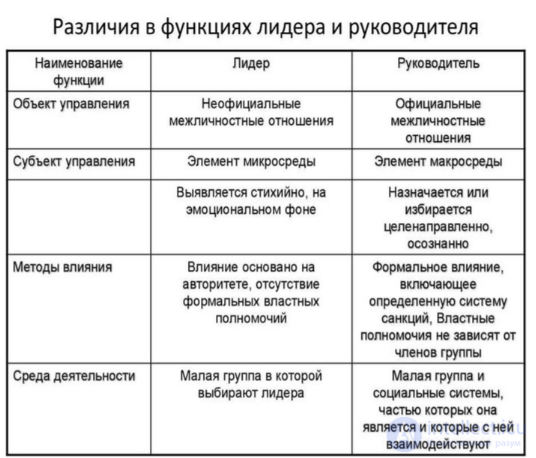
Informal relations between the manager and subordinates deserve the most serious attention. Along with the ability to choose the optimal leadership style for a given situation, a manager must above all know the typical mistakes characteristic of people of his status and be able to build interpersonal relations with staff correctly.
Among the typical mistakes are cases when:
- the manager gives no specific assignments, but constantly pesters subordinates with a large number of questions of a general nature;
- is "fixated" on a single topic in communicating with staff, for example, labor discipline;
- formulates new ideas for completing a task every day;
- constantly preaches his own plans;
- does not trust his employees and abuses petty control;
- is overly fond of paperwork;
- is hard to reach, both physically and in terms of time;
- has no ready-made solutions to production problems to offer the staff.
The success of informal relations with subordinates, without which the formation of a feeling of respect for one's manager is impossible, depends on observing a whole range of principles and rules of business communication.
Of fundamental importance is respect for another person's dignity. The moral-psychological basis of this principle is an axiom of social psychology, according to which no person feels sufficiently comfortable without a positive self-assessment. Consequently, a manager must see in every subordinate not a position but a person, must show goodwill and tolerance, treat their personal life with respect, while at the same time avoiding giving advice in that area. It is worth always remembering that "the strong never humiliate," and, consequently, it is unacceptable to raise one's voice at an employee or to attach labels such as "lazybones," "loafer," "dimwit," and so on.
If a subordinate makes a mistake or commits a misdeed, they usually understand their fault and accept the punishment appropriately, but if the manager, in doing so, wounds their self-esteem, they will not forgive it. Consequently, when analyzing a situation, it is necessary to separate the person from the act: criticize specific actions, not the personality of the person at fault.
It is important to remember that only those managers are respected who praise in front of everyone but reprimand in private; who never complain about their employees and, if necessary, take the blame upon themselves; and who acknowledge their mistakes promptly and openly.
Regardless of personal likes and dislikes, a manager is obliged to make the same demands on all subordinates, to treat everyone evenly, to single no one out; in the presence of others, to address employees by their first name and patronymic, regardless of their age.
It is unacceptable to lecture and moralize to staff if the manager does not observe this requirement themselves: only the manager's personal example has educational value.
A typical mistake of young managers is the desire to become "one of the crowd" among subordinates. It is better to keep a distance, to separate the personal from the professional, and not to allow familiarity. Otherwise, an order as a form of instruction will be ineffective.
A manager has no moral right to withhold important information from their employees. At the same time, they are obliged to suppress gossip and denunciations.
Every boss encounters complaints from their employees about working conditions, relations within the team, or with other departments. Even if the manager is not able to solve the problem themselves, they are obliged to listen carefully to the subordinate. It is unacceptable to ignore the appeals of subordinates, since, as the American sociologist Diane Tracy rightly noted, complainers are not traitors. It may well be that the complainer is doing you a great service by reporting on a situation from which others suffer but stay silent. In this sense, complaints deserve your gratitude, not punishment.
Components of leadership
Leadership begins with oneself. To have a clearer idea of your capabilities, start with self-analysis. Self-analysis – is a kind of internal compass. A clear definition of one's own values helps to achieve a set task despite the difficulties that arise. Words must not diverge from deeds. One must be able to make decisions quickly.
Leadership implies the participation of all members of the organization. In other words, it is necessary to know and understand the members of the team, to involve them in the work of setting goals, planning projects and distributing the workload.
Leadership presupposes positive interaction. The atmosphere in your organization depends on the level of your relationships, on how well you treat each other. The higher the regard you give each other, the higher your chances of achieving success as a group.
Leadership relies on organization. It is precisely good organization of production that supports the active positive interaction of all group members and allows them to solve the tasks set.
Leadership is directed toward the future. Much more can be accomplished when people united by common goals work together. All members of the organization must have a clear idea of the future of their organization.
Leadership – is the ability to influence individuals and groups of people in order to induce them to work toward achieving goals. There are many means by which one can exert influence on others and lead people.
There are three main theories of leadership:
- The trait approach. The best leaders possess a set of personal qualities common to all of them (level of intelligence and knowledge, an impressive appearance, honesty, common sense, initiative, socio-economic education and a high degree of self-confidence). But in different situations, effective leaders display different personal qualities.
- The behavioral approach created a basis for classifying leadership styles, or styles of behavior (authoritarian, democratic, liberal).
- The situational approach studies the needs and personal qualities of subordinates, the nature of the task, the demands and influences of the environment, and also the information available to the leader.
Leadership styles
Collectivist. Their credo is as follows: “Let's all do it together”. Such leaders value harmony and cohesion of the group and try to make sure things go smoothly. They are flexible and easily adapt to circumstances, always oriented toward other people. Such leaders can be relied on to find compromises. They prefer working in a group, are receptive to new ideas, and are not inclined toward traditional thinking.
Action-oriented. Credo: “If it needs to be done, it should be done right now”. For such leaders, the result matters; they are oriented toward solving tasks rather than toward people. They prefer a competitive environment. Control is important for such leaders.
Deliberate. Credo: “Let's not rush, so as to be sure that we are doing the right thing”. They value precision and observance of formalities. They ask many questions, most often: “How?”, “How much?”.
Quality-oriented. Credo: “If it is worth doing, it should be done properly”. And if it cannot be done well, then it is better not to undertake it at all. Such leaders strive for perfection in everything. They are caring, inclined toward cooperation and receptive to the new; idealists, dreamers, visionaries. Typical questions: “Why?”, “What is the best way?”.
Thus, the efficiency of the "team," its ability to successfully solve the tasks set, depends significantly on the moral-psychological climate and on the mood of the employees prevailing in the group, which is determined by: a) the qualitative composition of the staff; b) the characteristics of the relations between the manager and subordinates. The most productive are working groups consisting of people of different ages, genders and temperaments.
It is necessary to take into account the informal relations between the manager and subordinates. A manager must know the typical mistakes inherent in people of their status; and build relationships with staff correctly.
Typical mistakes of a manager:
- the manager does not give specific assignments, but constantly bothers subordinates with a large number of general questions;
- is "fixated" on one topic in communication with staff, for example on labor discipline;
- formulates new ideas for carrying out a task every day;
- constantly preaches their own plans;
- does not trust their employees, abuses petty control;
- gets carried away with paperwork;
- is hard to reach, both territorially and in terms of time;
- has no ready-made solutions to the tasks offered to staff.
The success of informal relations with subordinates, without which respect for the manager is impossible, depends on a whole series of principles and rules of business communication.
- Respect others' dignity.
- Praise in front of everyone, but reprimand in private; do not complain about subordinates. Take their blame upon yourself if necessary; acknowledge your own mistakes promptly and openly.
- Make the same demands of everyone, educate only by personal example, i.e. fulfill all requirements yourself.
- Keep a distance, separate the personal from the professional, do not allow familiarity. Do not withhold important information from subordinates, suppressing gossip and denunciations.
- When faced with a complaint, listen carefully and, if possible, take measures. A complainer is not an informer, not a traitor.
Dependence of self-esteem of the individual on the influence of the group
The self-esteem of an individual is connected not only with one's self-image, but also with the expected evaluation, as well as the real evaluation from others, and finally with the individual's evaluation of the group. The real evaluation is higher, the higher the individual's evaluation of others. Most people place themselves slightly above the middle, which speaks to everyone's need for self-respect. Self-respect, even more than self-esteem, depends on the level of aspiration of the individual – this is the desired level of self-esteem of the individual, manifested in the degree of difficulty of the goal that the individual sets for themselves. The striving to raise self-esteem, in the case where a person has the opportunity to freely choose the degree of difficulty of the next action, gives rise to a conflict of two tendencies. On the one hand, the striving to raise one's aspirations in order to experience maximum success, and on the other – to lower them in order to avoid failure. Therefore, the exclusion of an individual from the group provokes significant psychological changes in that individual – self-respect falls considerably, the sense of self-worth decreases, a feeling of resentment is present, and vital tone declines.
A few steps to building self-confidence
Self-esteem – is a comparison, so it is important with whom a person compares themselves, who their ideal is. It should be noted that not everyone is suitable for comparison, since some are endowed by nature with talent or outstanding abilities. One cannot simultaneously think like Einstein; write like Dostoevsky; speak like Cicero; look like Schwarzenegger. Ideals can be admired, but they should not be turned into a measure of success. As a measure, it is better to have someone who is just one step ahead!
You may not know the price that must be paid for the coveted success. This price may, for you, be unacceptable. Thus, a businessperson does not have time to communicate with their children, a good homemaker does not have time to read, and so on. Perhaps you are not inclined to pay such a price?
To normalize low self-esteem it is useful to learn to:
- think well of yourself more often;
- reward yourself for the slightest achievements:
- not speak badly about yourself (people who are aware of their own worth spread an aura of satisfaction around them);
- forgive yourself past mistakes and sins, bury heavy memories;
- look for the causes of failures outside yourself – in the situation, not in the shortcomings of your own personality. If the source of the problems is outside you, it is easier to find ways to deal with them and easier to come to terms with failures;
- regard the reasons for refusal as a consequence of the fact that more effort should have been made, but not go head-on; the request was excessive, ill-timed, and in general the person who refused is suffering from some problems and needs sympathy and understanding. The reasons for the refusal are not in you, but outside you! They need to be analyzed and new attempts made;
- narrow the zone of failure. Do not keep repeating: “I am a shy person”. Limit your difficulties: “I get nervous when I speak in public”. Local problems exist for all successful people. Accept compliments with gratitude.
Effects of interpersonal perception in a group
In the process of interpersonal perception, a number of "effects" arise: first impression, "halo," stereotyping, prejudice, the primacy effect, set (attitude), the factor of superiority, the factor of attractiveness, the factor of relation, and others. They manifest themselves to a particular degree in the formation of a first impression, where the role of set (attitude) is great.
Let us examine each of them in more detail.
In the perception and cognition of another person, an important role is played by the emotional regulation of this process, which gives rise to the phenomenon of attraction – the emergence of the appeal of a communication partner.
First impression – is one of the phenomena of social perception, i.e. the perception of one person by another. The first impression we make on other people has a key influence on the development of our further relations with them. It is fairly resistant to change. People form their judgment of another person very quickly and are not inclined to change it. There is a so-called "15-second rule": the first impression of a person is formed within the first fifteen seconds of communication. It is created on the basis of characteristics of external appearance. The depth of the orienting reflex with respect to a person increases intensively during the period up to 9 weeks of communication. The most correct understanding of a person is formed among people communicating with a not-too-lengthy, and most importantly, not-too-close acquaintance.
The most important factors that influence the formation of a first impression: the source of information – information from a source we trust is assessed as more important; the positive and negative character of the information – we usually assess negative information about people as more important; information about peculiarities and oddities of a person's behavior and character – the more unusual the data, the greater the significance we attach to this information.
The process of social stereotyping is connected with the formation of a social stereotype — a relatively stable and simplified image of a social object (a group, a person, an event, a phenomenon, etc.).A social stereotype forms under conditions of a lack of information as a result of the generalization of personal experience and of ideas accepted in society (often biased). The existence of a social stereotype, although it does not always meet the subject's requirement for accuracy, plays a significant role in the assessment of the world, since it allows a sharp reduction of reaction time to changing reality and speeds up the process of cognition. However, arising under conditions of limited information about the object, a social stereotype may turn out to be false and play a conservative or even reactionary role, forming erroneous knowledge of people and seriously distorting interpersonal interaction.
The halo effect — the spreading of a general evaluative impression of a person onto the perception of their actions and personal qualities (under conditions of a lack of information). In other words, the first impression of a person determines their subsequent perception and evaluation, allowing into the perceiver's consciousness only that which corresponds to the first impression, and screening out that which contradicts it. In the formation and development of a first impression of a person, the halo effect can appear: 1) in the form of positive evaluative bias — a "positive halo": if the first impression of a person is, on the whole, favorable, then afterward all their behavior, traits and actions begin to be overrated in a positive direction; mainly the positive moments are singled out and exaggerated, while the negative ones are, as it were, underrated or unnoticed; 2) in the form of negative evaluative bias — a "negative halo": if the overall first impression of a person turned out to be negative, then even their positive qualities and actions are later either not noticed at all or underrated against the background of hypertrophied attention to shortcomings. At the basis of the halo effect (as of many other phenomena of social perception) lie mechanisms that ensure the categorization, simplification and selection of information about social objects when it is lacking.
The primacy effect — the higher probability of recalling several of the first elements of material arranged in a series compared with the middle elements (the edge effect).
The perception of people is also influenced by prejudices – the emotional evaluation of certain people as good or bad, without even knowing them, their motives, or their actions, as well as by social attitudes – a person's unconscious readiness to perceive and evaluate certain people in a certain habitual way and to react in a certain manner without a full analysis of the specific situation.
Attitudes are formed: 1) under the influence of other people (parents, the media) and "crystallize" by the age of between 20 and 30 years, and then change with difficulty; 2) on the basis of personal experience in repeatedly recurring situations.
Psychologists distinguish three types of set (attitude) toward the perception of another person: positive, negative and adequate. Positive set: we overrate a person's positive qualities and give them a large advance, which appears as unconscious trustfulness. Negative set: leads to the fact that mainly the negative qualities of another person are perceived, which is expressed in distrustfulness, suspicion. Adequate set: every person has both positive and negative qualities. What matters is how they are balanced and evaluated by the person themselves.
People entering into communication are not equal: they differ in their social status, life experience, intellectual potential, etc. Given inequality between partners, the perception scheme most often applied is one that leads to errors of inequality. In psychology these errors have received the name the superiority factor. When meeting a person who surpasses us in some parameter important to us, we evaluate them somewhat more positively than would be the case if they were our equal. If, on the other hand, we are dealing with a person whom we surpass in some way, we underrate them. Moreover, superiority is fixed with respect to a single parameter, while overrating (or underrating) occurs across many parameters.
The action of the attractiveness factor in the perception of a person consists in the fact that, under its influence, certain qualities are overrated or underrated by other people. The error here is that if a person is likeable (in appearance), then at the same time we tend to consider them smarter, better, more interesting, etc., i.e. again many personal characteristics are overrated. Thus, the more externally attractive a person is to us, the better they seem to us in all other respects; if, on the other hand, they are unattractive, their other qualities are underrated.
The relation factor toward us operates in such a way that people who treat us well are rated higher than those who treat us badly. A sign of the attitude toward us, which triggers the corresponding perception scheme, is everything that testifies to a partner's agreement or disagreement with us.
Questions for self-check:
1. Show how temperament and business qualities of individuals are connected.
2. Explain the problem of leadership, describe the types of leaders.
3. What structure of a work group can be considered optimal?
4. Reveal the role of the manager in the establishment of informal relations in a "team."


Comments