
Lecture
By strategy of interaction is meant the general scheme of actions of the participants in a communicative process, the general plan for achieving the goal that
the interlocutors are striving for. Interaction – is the process of direct or
indirect influence of people on one another, giving rise to their mutual conditioning and connection.
Strategy and styles of interaction play an important role in effective communication. They determine how a person interacts with other people, how they express their thoughts and feelings, and how they respond to communication from others. Here are some key aspects of interaction strategies and styles:
Interaction strategy:
Communicative strategy: This is the general plan or approach a person chooses to achieve their goals in communication. For example, the strategy may be oriented toward persuasion, cooperation, conflict resolution, or obtaining information.
Adaptation strategy: A person may adapt their style of interaction depending on the situation and the interlocutor. This allows them to be more flexible and interact successfully with different types of personalities.
Conflict management strategy: When a conflict arises, a person may choose a strategy aimed at resolving the conflict, easing tension, or protecting their own interests.
Styles of interaction:
Aggressive style: This style is characterized by the active assertion of one's own interests, often at the expense of infringing on the interests of others. Aggressive interaction may include loudly expressing opinions, criticism, and dominating the conversation.
Passive style: People with a passive style of interaction often avoid conflicts but may fail to express their needs and opinions. They may be reserved, unsure of themselves, and unable to say "no", even if this does not correspond to their true wishes.
Assertive style: Assertive interaction presupposes the ability to express one's opinions and needs clearly and respectfully. People with this style of interaction are usually able to set boundaries and respect the boundaries of others.
Passive-aggressive style: This style combines elements of passivity and aggression. People may criticize or express their resentment indirectly or covertly, avoiding direct conflicts.
Manipulative style: People with a manipulative style of interaction may use tactics of manipulation and control to achieve their goals. This may include deception, inducing guilt, or attempts to control others.
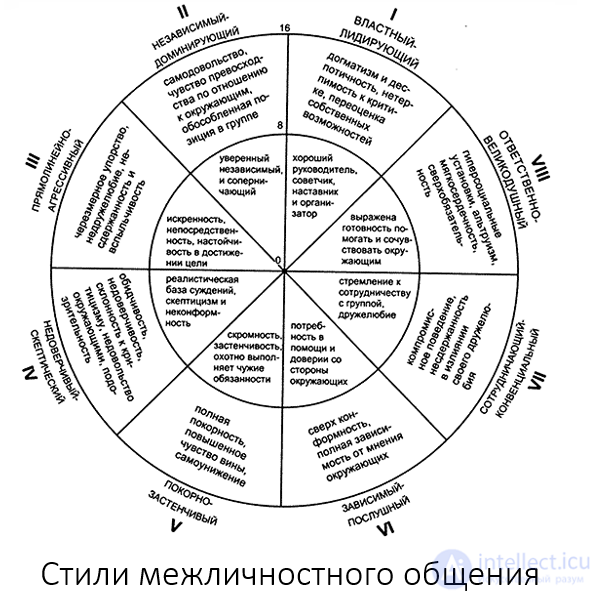
Leading strategies of behavior in interaction:
1. Cooperation is aimed at the full satisfaction by the participants of
interaction of their own needs without infringing on the interests of the other (the motives of cooperation or of competition are realized).
2. Rivalry (opposition) presupposes an orientation exclusively toward one's own goals without regard for the goals of one's partners in communication (individualism).
3. Compromise is realized through the partial achievement of the partners' goals for the sake of
conditional equality.
4. Accommodation (adaptation) presupposes sacrificing one's own goals in order to achieve the partner's goals (altruism).
5. Avoidance represents a withdrawal from contact, a loss of one's own
goals in order to preclude a gain for the other.
Each situation dictates its own style of behavior and action; in each situation a person «presents» themselves differently. And if this self-presentation is not adequate, this
hinders communication.
Styles of interaction are divided into the following types: ritual, manipulative, and humanistic.
Ritual style. This style is usually set by the culture in which
a person lives. Ritual, for example, may be the style of greetings and questions asked upon meeting, and the answers to them. Thus, in American culture it is customary
to answer the question «How are you?» with «Great», however things actually stand in reality. Our culture tends to answer «to the point», not
shy about listing negative characteristics of one's own existence. A person accustomed to a different ritual will be puzzled upon receiving such an answer.
Manipulative style. If the goal of imperative communication is in no way
disguised, then when a manipulative style is used, influence on the interlocutor is exerted covertly. The goal remains the same: to gain control over
the behavior and thoughts of another person. In manipulative communication the interlocutor is perceived not as a whole personality, but as a bearer of certain qualities needed by the manipulator. Therefore, a person who has chosen a manipulative style as their main style of communication, over time, begins to perceive even themselves fragmentarily, shifting to stereotyped forms of behavior.
Moreover, the use of manipulative skills in one sphere (for example, in
business) usually ends with the transfer of these skills to all other spheres of a person's life.
Humanistic style. This style includes all varieties of dialogical communication: this is equal interaction, the goal of which is
mutual knowledge, self-knowledge. A humanistic style of communication is devoid of imperative and allows one to achieve deep mutual understanding.
The choice of a particular strategy and style of interaction depends on the situation and personal preferences. It is important to develop assertive skills, which allow one to clearly express one's thoughts and needs, respect the opinions of others, and resolve conflicts constructively. Adapting one's style of interaction depending on the situation can also improve the quality of communication and relationships with others.
1. Match the strategies of interpersonal interaction with their characteristics
2. A productive style of interaction includes the following attitudes of those communicating
3. Influence that leads to the covert arousal in another person of intentions that do not coincide with their actual wishes is called
4. Influence on a partner becomes manipulation if it has the following situational features
5. A partnership strategy of interaction presupposes mastery of the following mechanisms of mutual understanding
6. Match the mechanisms of mutual understanding with their characteristics
7. Sincerity in communication is expressed by means of the following elements of behavior
8. Style of interpersonal communication – is a …………… manner of behavior inherent in a given person
9. The substantive characteristics of communication style include
10. The concept of lifestyle was introduced into psychology by
11. According to A. Adler, a lifestyle is formed in a child
12. Match the types of life attitudes according to Adler with their characteristics
13. According to K. Horney, the choice of a person's behavioral strategies is based on
14. Match the personality types according to K. Horney with the features of their behavior
15. V. Satir distinguishes communication styles depending on
16. Match the personality types with their inner attitudes
17. Match the personality types according to V. Satir with their characteristics
e) never expresses disagreement; apologizes when thanking
18. The use of the behavior patterns of the placater, blamer, computer, and distracter reinforces in a person
19. Match the names of temperament types with the typical behavioral features of people in a communication situation
20. Match the communication styles according to T. E. Argentova with their manifestations
21. Partner-oriented and non-partner-oriented styles of communication are the result of general ……….. toward the partner
22. Match the communication styles with the features of how contact is organized
22. The «Johari window» makes it possible to identify individual styles of people's behavior depending on their …………..
23. The «Johari window» includes the following zones
24. Match the zones with the characteristics of the communication style

Comments