
Lecture
In the process of communication there are many effects and factors that influence how one person perceives another. These effects and factors can exert a variety of influences on how we perceive others and how others perceive us. Here are some of them:
First impression effect: The first impression we create or form of another person can strongly influence our perception of and interaction with them. This effect can be long-lasting and can influence all subsequent encounters.
Stereotypes and bias: Stereotypes and bias are based on preformed ideas about members of certain groups or categories. They can lead to distorted perception and influence our behavior and reactions in communication.
Non-verbal communication: A great deal of information is conveyed through non-verbal signals, such as facial expressions, gestures, intonation, and body language. These signals can reinforce or alter the perception of messages and personalities.
Attribution: In the process of communication, we often try to understand why other people act the way they do. This process is called attribution. Attribution involves determining whether another person's behavior is the result of internal characteristics or external circumstances.
Confirmation effect: The confirmation effect consists in the fact that we tend to seek out and interpret information in a way that matches our ideas and beliefs about other people. This can lead to the confirmation of stereotypes and the reinforcement of bias.
Expectation effect: If we have certain expectations regarding another person's behavior or character, we may seek out and interpret information so that it matches these expectations.
Feedback: The feedback we receive from our interlocutors can influence our perception and behavior. Positive feedback can strengthen a positive perception, while negative feedback can trigger negative reactions.
Cultural and social factors: Cultural and social norms and values can strongly influence perception and communication. Different cultures may have different standards of communication and perception.
Personal characteristics: Personal traits, such as character, experience, level of education, and personal values, can also influence perception and interaction.
Stereotyping is the perception and evaluation of social objects on the basis of certain ideas (stereotypes). Stereotyping manifests itself in the attribution of similar characteristics to all members of a social group without sufficient awareness of the possible differences between them.
A stereotype (from ancient Greek στερεός “solid, spatial” + τύπος “imprint”) is a mental evaluation of something preformed by a person, which may be reflected in stereotypical behavior. A stereotype can be either negative or positive, which is why it is necessary to distinguish between stereotypes and prejudices, which are always negative.
Stereotype is a simplified, often distorted, idea characteristic of the sphere of everyday consciousness, about some social group
or an individual person belonging to one or another social community. A stereotype arises on the basis of limited past experience as a result of the tendency to draw conclusions from insufficient information. Most often
stereotypes arise in relation to a person's group membership.
Stereotyping is one of the most important characteristics of intergroup and interpersonal perception and is accompanied by manifestations of social attitudes and the halo, primacy, and recency effects.
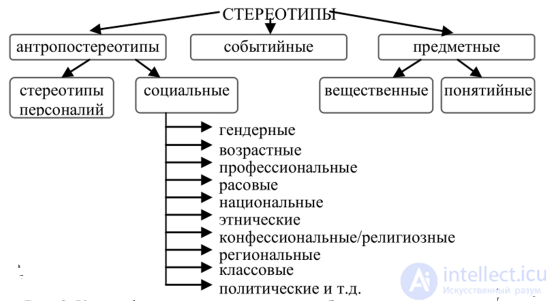
Fig. Types of stereotypes
In interpersonal perception, stereotyping performs two main functions:
1) maintaining identification,
2) justifying possible negative attitudes toward other groups.
An individual makes judgments by means of a stereotype more quickly than by means of rational inference. The immediate impression (from a stimulus) and the previously formed opinion (the stereotype) appear in consciousness simultaneously. Stereotypes resist transformation and criticism. In cases where experience comes into conflict with a stereotype, one of two outcomes is possible: if the individual has already lost a certain degree of flexibility, or if, owing to some significant vested interest, it is extremely inconvenient for them to change their stereotypes, they may ignore the contradiction or find some error in it, and then forget about the event. But if they have not lost their curiosity or their capacity to think, then the new information is integrated into the already existing picture of the world and changes it.
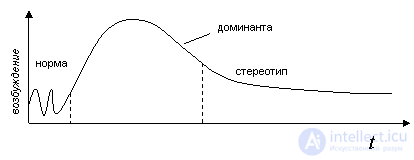
Fig. Diagram of a stereotype
So-called ethnic stereotypes have become especially widespread, whereby prejudiced conclusions about an entire group are built on the basis of limited information about individual representatives of one or another ethnic group. Stereotyping in the process of people getting to know one another can lead to two different consequences. On the one hand, to a certain simplification of the process of getting to know another person, and then this simplification leads to the replacement of a person's image with a cliché, for example “all accountants are pedants,”
“all teachers are moralizers.” On the other hand, it leads to prejudices,
if a judgment about a social object is built on the basis of limited past experience, which most often may turn out to be negative.
The halo effect is the formation of an evaluative impression of a person under conditions of a lack of time to perceive their actions and
personal qualities. The halo effect manifests itself either in the form of positive
evaluative bias (a positive halo), or in negative evaluative bias (a negative halo).
Thus, if the first impression of a person is generally favorable, then
subsequently all of their behavior, traits, and actions begin to be overvalued in a
positive direction. Mainly only the positive aspects are singled out and exaggerated in
them, while the negative ones are undervalued or go unnoticed. If, however, the overall first impression of a person, owing to the circumstances that arose,
turned out to be negative, then even their positive qualities and
actions are subsequently either not noticed at all, or are undervalued against the
backdrop of hypertrophied attention to their shortcomings.
Causal attribution. In getting to know one another, people are not limited to
obtaining information through observation. They seek to clarify the reasons for
their communication partners' behavior and to ascertain their personal qualities. But since the information about a person obtained through observation is most
often insufficient for reliable conclusions, the observer begins to attribute
probable causes of behavior and characterological personality traits to their
communication partner. This causal interpretation of the observed
individual's behavior can also significantly affect the observer themselves.
Thus, causal attribution is the subject's interpretation, within interpersonal perception, of the causes and motives of other people's behavior. The word
“causal” means “having to do with cause.” Attribution is the ascription to social objects of characteristics not represented in the field of perception.
On the basis of research into problems related to causal attribution,
researchers have concluded that attributive processes constitute
the main content of interpersonal perception. It is telling that some people tend, to a greater extent, in the process of interpersonal perception, to fix on physical features (in which case the sphere of “ascription” is substantially reduced), while others perceive primarily psychological character traits of those around them.
In the latter case, a wide scope for ascription opens up.
A certain dependence of “ascription” on the attitude present in the
process of person perception has been identified. As G. M. Andreeva notes, this role of ascription is especially significant in the formation of a first impression of an unfamiliar person. This was revealed in the experiments of A. A. Bodalev. Thus, two groups of students were shown a photograph of one and the same
person. But beforehand, the first group was told that the person in
the photograph shown was a hardened criminal, while the second
group was told about the same person that he was a prominent scientist. After this,
each group was asked to compose a verbal portrait of this person.
In the first case, corresponding characteristics were obtained: deep-set
eyes testified to suppressed malice, a prominent chin to determination “to go all the way in crime,” and so on. Correspondingly, in
the second group, the same deep-set eyes spoke of profound thought, and
the prominent chin spoke of willpower in overcoming difficulties on the path of knowledge, and so on.
Such studies should provide an answer to the question of the role of the characteristics that communication partners attribute to one another in the process of interpersonal
perception, and the degree to which attitudes influence these characteristics.
The recency and primacy effects. Closely related to the halo effect are
the recency and primacy effects. These effects (recency and primacy) manifest themselves through the significance of a particular order of presenting information
about a person for forming an impression of them.
The recency effect arises when, in relation to a familiar person, the most significant information turns out to be the latest, i.e., the most recent information about them.
The primacy effect, in turn, arises when, in relation to an unfamiliar person, the first information turns out to be the most significant.
Known are three of the most typical schemas for forming a first impression of a person. Each schema is triggered by one of three factors:
The schema of social perception based on the superiority factor begins to operate in a situation of inequality between partners (more precisely, when the observer
senses the partner's superiority in some parameter important to them —
intelligence, height, material status, and so on). A person who surpasses
the observer in an important parameter is rated by the observer significantly higher on
the other significant parameters as well. In other words, an overall personal overvaluation of them takes place. At the same time, the less confident the observer feels at
a given moment, the less is needed to trigger this schema.
The schema of social perception based on the partner's attractiveness factor. The attractiveness error consists in the fact that people also tend to overvalue an externally attractive person on other important
parameters (intelligence, kindness). Thus, experiments have shown that people who are more attractive
in photographs are also rated as more self-confident, happier, and
more sincere. Or, if an employee has demonstrated ability in one area of work, then
other positive traits are attributed to them as well — diligence and discipline — which in reality they may not actually possess.
The schema of social perception based on the factor of the partner's attitude toward us. The perception error in this case consists in the fact that we tend to rate people who treat us well more highly on other indicators as well. People who are likeable and pleasant to interact with often seem to us more intelligent and
more cultured than those who lack these traits. The formation of a first
impression of a person is also influenced by personality type. It has been observed that introverts
tend to first notice the mistakes of their communication partners, while extraverts, by contrast, pay attention to a person's positive qualities.
A social stereotype underlies all the typical schemas for forming a first impression of a person. A stereotype can be regarded as an instrument of “coarse tuning.” The “expectation stereotype” is a factor that actually operates in the process of person perception. It manifests itself in attitudes and in a person's behavior. The stereotype gives rise to characteristic remarks addressed to communication partners: “You haven't done it again,” “As always, you...” and so on.
Communication also produces positive expectations; however, research shows that at the negative pole this stereotype works more effectively and consistently.
The reasons that usually prompt interlocutors to make remarks and objections:
1. Defensive reaction. It arises when the interlocutor has not understood our argumentation, or simply wants to object. This is often a natural resistance to anything new, including a flow of information that requires a change of opinion.
2. The “sporting stance” — in the course of a conversation, the interlocutor is inclined toward competition and testing our abilities. They want to find out how experienced we are, what difficulties we can cope with;
3. The presence of a different opinion, or disagreement with something. The interlocutor's remarks and arguments should be perceived not as obstacles in the course of the conversation, but as guidelines for our argumentation and further explanations.
Understanding these effects and factors helps us better understand how the process of communication works and how interpersonal relationships can be improved, bias and conflicts minimized, and more effective and trusting communication developed.

Comments