
Lecture
Communication style is the way a person interacts with others, expressing their thoughts, feelings, and ideas. Communication styles can vary widely and may depend on personal characteristics, goals, and the context of the interaction. Here are some of the most common communication styles:
Passive style:
Aggressive style:
Passive-aggressive style:
Assertive style:
Manipulative style:
Collaborative style:
Friendly style:
As we have already written, there are four main communication styles that describe how people interact with one another. These styles can manifest in verbal, nonverbal, or written form. Here is a brief description of each style:
Passive communication style:
Aggressive communication style:
Passive-aggressive communication style:
Assertive communication style:
Each communication style has its own features and can be effective in different situations. However, the assertive communication style is often considered the most productive and helps build healthy and effective relationships with other people.
Authoritarian parenting style:
Liberal parenting style:
Democratic parenting style:
Each of these parenting styles has a strong influence on the development of the child's personality and their future relationships with the surrounding world. The democratic style of communicating with children is often considered the most effective, as it promotes the development of independence and morality in children, and also strengthens relationships with parents.
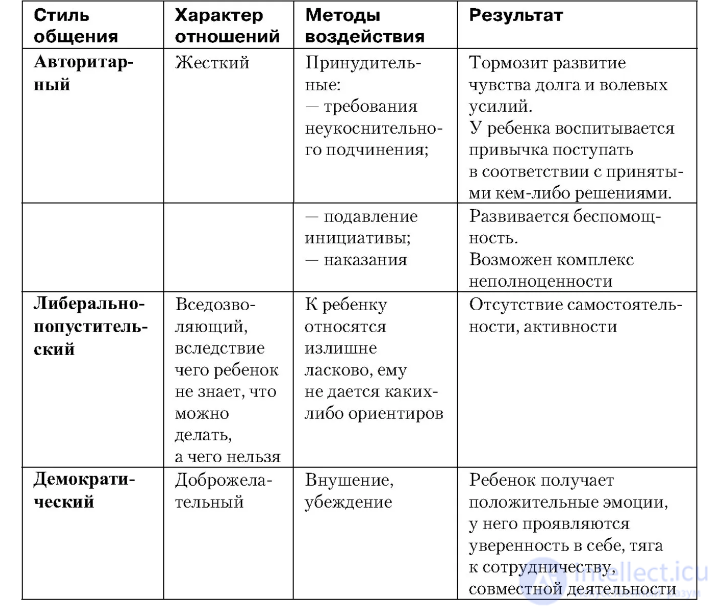
fig. communication styles
All people differ in their communication style – stable characteristics of communication
in various situations. Communication styles significantly determine a person's behavior when interacting with other people. The specific choice of a particular communication style is determined by a number of factors, among
which the following are important: the purpose of communication, the situation in which
it takes place, the status and personal characteristics of the interlocutor, their worldview and position in society, and the nature of the form of interaction itself.
The nature of the content of interaction, as already noted, depends
above all on the verbal means of communication, which form
an essential logical-semantic line in communication. The leading characteristic of the modern communication style is brevity and simplicity in the construction of phrases, speech
structures, the use of everyday or professional colloquial vocabulary, distinctive speech clichés, templates, and stock phrases.
In professional verbal communication, the following styles of communicative interaction are typically used: official-business, scientific, publicistic, and everyday (colloquial).
Official-business communication style. The official-business style of speech
is dictated by the practical requirements of life and professional activity. It serves the sphere of legal, administrative, and social relations and is realized both in written form (business correspondence, regulatory
acts, record-keeping, etc.) and in oral form (a report at a meeting,
a speech at a business meeting, an official dialogue, a conversation, negotiations).
The official-business style distinguishes three sub-styles:
– legislative,
– diplomatic,
– administrative-clerical.
Each of the listed sub-styles has its own specifics, communicative forms, and speech clichés. Thus, memoranda, notes, and communiqués are used in diplomatic communication; receipts, certificates, memos, powers of attorney, orders, directives, statements, references, and extracts
from the minutes – in the administrative-clerical style; laws, articles, paragraphs,
regulatory acts, prescriptions, agendas, decrees, codes, etc. – in the legislative style.
Business communication style requires extreme precision of speech, achieved above all through the use of terms, both widely used and highly specialized. Terms most often denote:
– the names of documents: resolution, notification, request, agreement,
contract, act, etc.;
– the designation of persons by profession, status, function performed,
social position: teacher, judge, sales manager, broker, company president, investigator, psychologist, commercial director, marketer,
accountant, etc.;
– procedural matters, for example: carrying out an examination, conducting
an interrogation, a seizure, a certification, making an assessment, or performing some professional action (informing, preparing a report, writing a memo, and
so on).
Business style requires objectivity of information. In documents, expression of the subjective opinion of the person composing the text, use of emotionally colored vocabulary, and vulgarisms are not permitted. This style is characterized by compactness of presentation, brevity, and economical use
of linguistic means (KIY – concise and clear). According to psychological
research data, half of adults are unable to grasp the meaning
of spoken phrases if the phrase contains more than 13 words. Moreover, if a phrase lasts more than 6 seconds without a pause, the thread of understanding is broken. A phrase of more than 30 words is not perceived by ear at all.
The official sphere of communication, recurring standard situations,
and the clearly limited thematic range of business speech determine its standardization, which manifests not only in the choice of linguistic means but also
in the forms of documents. These require generally accepted forms of presentation and
a specific arrangement of structural-compositional parts: an introductory
part, a descriptive part, a regulatory part, and a summarizing part.
In business speech, speech clichés and templates are widely used, for example: to express acknowledgment – we apologize for…; to express a request – we are counting on your help in…; to express
approval and agreement – I fully agree with your opinion…; to conclude
a conversation – I believe we have discussed all our questions today.
The business style is the most widespread in the everyday practice of formal communication. The more employees follow this style, the
more order, mutual understanding, and organizational culture there is in the organization.
Scientific communication style. The language of science is used in the business communication of people engaged in scientific, research, and pedagogical activity, who develop objective knowledge about objects and phenomena,
ideas and laws of reality, revealing their regularities. Scientific
style is characteristic of scientific treatises, articles, theses, reports, dissertation research, scholarly works, as well as of presentations at conferences and symposia, at seminars and lectures.
The basic form of thought in science is the concept, therefore the content of scientific interaction among participants in such communication requires the most precise, logical, and unambiguous expression of thoughts.
In the scientific style, individual compositional parts of a text are usually arranged in logical sequence. Various devices are used for this purpose, for example enumeration: firstly, secondly, thirdly; or
«first this was the case, then that…»; or «if this is so, then it follows that…» For
connective links within the text, the following speech constructions are also used: however; meanwhile; while; nevertheless; therefore; in accordance with...; consequently; moreover;
let us turn to…; let us consider; it is necessary to dwell on…; so; thus; in conclusion let us say; all that has been said allows us to draw the conclusion; as
we can see; summing up; it should be said.
Scientific communication style is more effective in the professional environment
of scientists and teachers, when participating in scientific-research or scientific-practical conferences and symposia, where people are united by a certain level of competence and there is a need to exchange scientific achievements. At the same time, the use of the scientific style, for example when conducting
a lesson or delivering an academic lecture, as practice shows, does not produce the necessary positive result; moreover, it is poorly received by listeners. We should also note that the scientific style allows for the possibility of reading written materials aloud (vocalizing), however the perception of such a text by ear is difficult. To increase the effectiveness of the perception of a scientific message, in
recent years poster presentations and the illustration of presentations using multimedia have become widespread.
Publicistic style of speech. Any public speech can
be classified as publicistic: oral – a speech, a report, a lecture, an address at
a meeting or a rally, a television or radio interview; or written – an article (note) in a newspaper, a review of a professional book. The publicistic style (from the Latin publicus – public), as a rule, serves
the sphere of social relations: political, ideological, economic, cultural. This speech style is widely used in the mass
media, in propaganda and campaign actions, and in elections.
The main characteristics of the publicistic communication style are the following:
– the informativeness of the message, its documentary-factual accuracy, its collective character, and the official nature of the materials used;
– real-life phenomena and facts (verified, documented
sources);
– the novelty of facts, based on real situations, events, reports from the field, eyewitness accounts;
– bookish-abstract means (for example, words such as: activity, discussion, research, understanding, dominates, correlate, process, concept, system, in demand, indicates, is assumed, is carried out, means, requires, affects, etc.);
– devices of address, i.e. the speaker's words must be directed
at some specific person (or group). This, in turn, presupposes
feedback – questions and answers («I am addressing you, students!», «You, sitting in this hall», «Guys!»);
– accessibility of information for the audience;
– expressiveness, heightened emotionality, artistry. The facts used in the text of a speech are, as a rule, evaluated, commented on, and interpreted by the speaker; statements by well-known
people, anecdotes, and historical curiosities (from the Latin casus – a complicated, tangled
case) are widely used, as well as proverbs, aphorisms, artistic images, repetition
of words, metaphors, comparisons, quotations, illustrations;
– conciseness of speech. To shorten the text, so-called distillation is used (from the Latin disillitio – distillation, separation) – careful editing and abridgment, the elimination of everything superfluous, the utmost stylistic
polishing of thoughts;
– humor, wit, irony. In a public speech they are, in principle,
acceptable, while at the same time merciless mockery, malicious sarcasm, and incorrect
remarks addressed at specific persons are not always appropriate, and sometimes even have a destructive effect (for example, the remark made by Bernard Shaw addressed to
a speaker: «I would very much like to take you seriously, but that would be
a grievous insult to your intelligence»).
In a public speech, caution must be exercised when using information that could be classified as slander and defamation (from
the Latin diffamare – to disclose, defame, deprive of a good name), in the form of hatred, ridicule, alienation, contempt, as well as when compromising the affairs, profession, or position held by a particular person (from the French compromettre –
to harm someone, undermine their reputation, their good name). Moreover, it is not recommended to speak negatively about the age, gender, territorial,
racial, sexual, or other affiliations or preferences of the people
sitting in the audience;
– speaking directly in front of an audience, vocalizing the text, and
eye contact, with various nonverbal means of communication usually being used:
facial expressions, gestures, postures, intonations of voice, changes in the rhythm
of speech, pauses, exclamations, smiles, etc.
Thus, all three styles are in demand and are practically used
in professional communication to achieve various goals.
Conversational-everyday style. Unlike business styles, conversational
speech serves the sphere of informal relations, which occur not only
in everyday life, in the family, among friends, but also in the professional environment. Conversational speech, as is known, performs the function of interpersonal communication, and therefore most often manifests in oral form, in dialogue, in which the speakers often participate spontaneously. Preliminary deliberation is not envisaged in such communication.
Since conversational speech promotes self-expression and the manifestation
of individual personality traits, it is emotionally colored.
Nonverbal means of communication and expressive body signals play a major role here. In addition, everyday colloquial vocabulary is widely used in informal communication: vernacular expressions, words of subjective evaluation, expressively-emotionally colored statements, as well as clipped forms (Piter [St. Petersburg], chitalka [reading room], obshchaga [dorm]), slang («e-blin» [darn it], «ya tashchus'» [I'm thrilled]), colloquial-everyday phraseology («gol kak sokol» [naked as a falcon, i.e. dirt poor], «bezhit kak ugorely» [runs like one poisoned by fumes, i.e. runs like mad], «kak sneg na golovu» [like snow on one's head, i.e. out of the blue],
«upryam kak osyol» [stubborn as a donkey], «gde tebya cherti nosili» [where the devil have you been], etc.), verbal interjections
(shmyak [smack], skok [hop], shmyg [scoot]), various particles (etot-to, day-ka, nu, vot, ved', etc.
), etc. Interrogative, imperative, and exclamatory
sentences are widely practiced. Such a style of speech can undoubtedly only be used in
certain situations. Thus, observing stylistic rules and norms
will allow every person to match the image of a business-like person and achieve the desired results based on the cooperation of joint efforts,
the convergence of goals and collaboration.
Each of these communication styles has its own advantages and disadvantages and can be effective in different situations. The choice of communication style depends on the goals of communication, the context, and the personalities involved. The best approach is to develop assertive skills, which allow one to express one's thoughts and feelings openly and respectfully, while taking into account the interests of others.

Comments