
Lecture
In contemporary Western social psychology, issues that can be grouped under the general heading of "personal representation of a person in
communication" are studied as the phenomenon of self-disclosure (primarily within humanistic psychology) and as the phenomenon of self-presentation (mainly within interactionism).
Self-disclosure — the process of communication in which a person reveals information about themselves to someone. This information may be descriptive or evaluative, and may include thoughts, feelings, goals, failures, successes, fears, and dreams, as well as one's likes, dislikes, and attachments.
Social penetration theory posits two dimensions of self-disclosure: breadth and depth. Both are crucial to the development of personal relationships. The range of topics in a dialogue is called the breadth of disclosure. The degree of intimacy of the information is called the depth of disclosure. At the beginning of communication, breadth of disclosure is achieved more easily thanks to more accessible topics; it consists of the outer layers of personality and everyday life, activities, and hobbies. Depth is harder to reach, since it includes painful memories and traits that we do not wish to reveal in front of others. We disclose ourselves fully and talk about major topics with spouses and loved ones.
Self-disclosure is an important part of intimate relationships that cannot be achieved without it. Mutual and appropriate self-disclosure is expected. Self-disclosure can be understood through a cost-benefit analysis, which can be further clarified by social exchange theory. A greater amount of self-disclosure occurs at the beginning of a relationship, while the most intimate disclosure appears later.
Self-disclosure and self-presentation of the personality are important aspects of the process of communication and interpersonal relationships. These concepts relate to how people reveal their personality and present themselves to others. Let us examine them in more detail:
Self-disclosure: Self-disclosure is the process of revealing personal thoughts, feelings, experiences, and information about oneself to other people. It involves disclosing emotions, experiences, wishes, concerns, and other aspects of one's inner world. Self-disclosure can be superficial (talking about a hobby) or deep (talking about personal traumas or feelings).
Examples of self-disclosure include talking about one's dreams, childhood experiences, personal values, views on life, and so on. Self-disclosure fosters close and open relationships, since it allows people to get to know one another on a deeper level. However, it is important to observe boundaries and take context into account in order to avoid unwanted intrusion into personal life.
Self-presentation: Self-presentation is the way in which we present ourselves to others. It involves efforts to create a particular image or impression of oneself. Self-presentation can be oriented toward how we want to be seen, and may include the choice of image, style of behavior, and manner of communication.
Examples of self-presentation may include grooming one's appearance, choosing particular clothing, and using specific facial expressions and gestures. People may use self-presentation to create a particular impression of themselves, for example, as professional, friendly, or authoritative.
Self-disclosure is understood as communicating personal information about oneself to another person (a partner); self-presentation (or
impression management) refers to the various strategies and tactics a person uses to create a particular impression on others.
Based on an analysis of foreign research on the personal representation of a person in communication, self-disclosure and self-presentation can be compared along two grounds (criteria): through the specifics of content and the specifics of the purpose (goal) of the information conveyed.
This comparison reveals the following: on the one hand, the content of self-disclosure is limited only to information about oneself, and on this
ground it is narrower than self-presentation; however, the purposes (goals) of self-disclosure are quite diverse, and by this criterion it is broader than self-presentation.
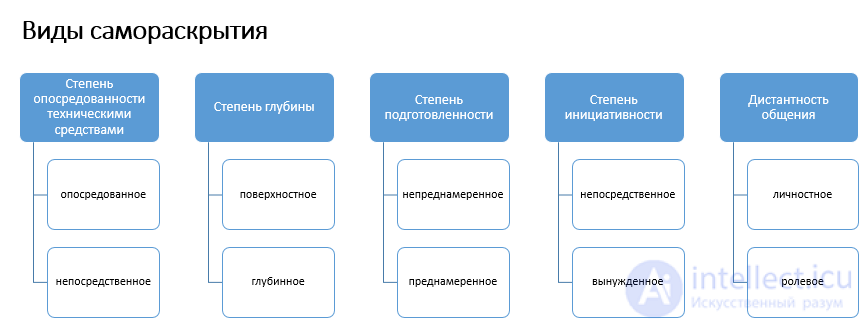
Fig. Types of self-disclosure
On the other hand, the content of self-presentation is not limited only
to information about oneself, and on this ground it is broader than self-disclosure; but
the purpose (goal) of self-presentation is mainly to manage the
impression made on the audience, and by this criterion it is narrower than self-disclosure.
Thus, it seems appropriate to view self-disclosure and self-presentation as two independent, though closely interrelated, phenomena. Most often these two phenomena relate to one another as follows: the more pronounced the self-disclosure, the less pronounced the self-presentation.
Consequently, superficial, shallow self-disclosure is more often associated with
pronounced self-presentation and may be better described as self-presentation rather than self-disclosure.
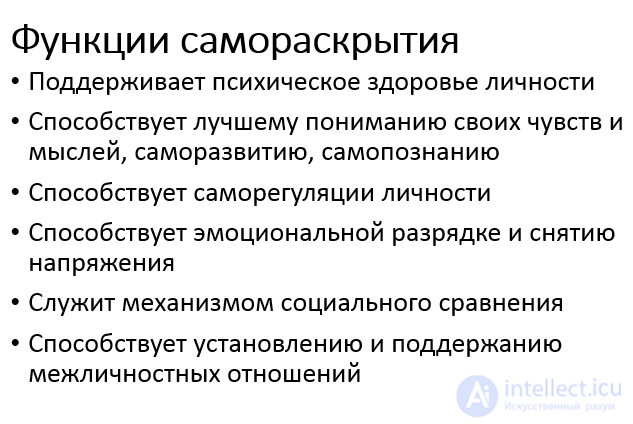
Fig. Functions of self-disclosure
Almost all authors emphasize that self-disclosure is a process associated with risk; one has to pay a price for it, and therefore it is not such a widespread phenomenon. The positive consequences of self-disclosure can, under certain conditions, turn into negative ones. This is probably why the literature contains a kind of register of the advantages of «closedness»:
a) secrecy is important for preserving the integrity of the personality; it allows one to maintain a sense of identity;
b) people have a need not only for contact with others but also a need for solitude, the frustration of which can lead to negative consequences; in solitude a person better comprehends their true «self»;
c) excessive openness is regarded as a deviation from social norms; a lack of selectivity in choosing the people one confides in
is also perceived negatively;
d) secrecy allows one to preserve freedom and avoid unwanted closeness and excessive control by others;
e) allusion and mystery have their own charm, while openness is sometimes prosaic;
f) if, in the process of self-disclosure, other people's secrets are let slip, this causes them pain;
g) self-disclosure often makes a person vulnerable: there may arise a fear of being left defenseless, a fear of rejection, a fear of provoking
aggression against oneself, a fear of losing control over oneself and behaving destructively and impulsively, a fear of losing one's sense of uniqueness;
h) self-disclosure is often associated with negative emotions caused by self-awareness;
i) the sense of «we», especially in intimate relationships, is partly based on the preservation of secrecy, among other things.
Self-presentation – is one of the mechanisms of personality self-regulation and the regulation of interpersonal relationships, which began to be studied intensively in the works of interactionists (C. Cooley, G. Mead). This problem has been developed most actively and purposefully since the 1980s. Self-presentation is described as a person's ability to be ready for «expression, as well as presentation of oneself to other people… and the use of this knowledge as a kind of guideline ensuring control over one's own behavior and its management» (Snyder, 1974, p. 528). Prior to the 1980s, the mechanisms of «impression management» were considered only in terms of their negative influence on people's interaction, since it was believed that the actualization of such mechanisms leads to systematic errors in empirical research on the problem of interpersonal communication. Later, thanks to a whole series of works (Schlenker, 1980; Buss, Briggs, 1984; Tetlock, Manstead, 1985; Arkin, Baumgardner, 1986; Baumeister, 1986; Schlenker, Weigold, 1992), this problem becomes just as topical as aggression, coping behavior, nonverbal communication, and many others.
The concept of self-presentation strategy is associated above all with the names of E. Jones and T. Pittman. They believe that self-presentation is based on
a striving to expand and maintain influence in interpersonal relationships, that is, a striving for power.
Based on this criterion they identify five strategies of self-presentation, each of which is aimed at obtaining a particular kind of power.
1. Trying to be liked, or gaining favor
(ingratiation). This strategy obliges those around to be courteous and well-disposed toward the subject, and in this way the power of charm is achieved.
The main goal of this strategy is to make a favorable impression on
the partner, to appear likeable to them, to charm them with one's charisma. For
this purpose, the most varied tactical devices may be used:
2. Self-advertising, or self-respectation, self-promotion (self-promotion) by a person of their competence. The use of this strategy achieves the power of the expert. This strategy is implemented with
the help of the following tactics:
3. Intimidation – a demonstration of strength that obliges those around to submit; in this way the power of fear is achieved.
A well-known Russian politician constantly displays examples
of self-presentation clearly based on intimidation and aggression. However, only
a very naive person could believe that this politician needs lessons in
communication, or that the cause of his aggressive outbursts lies in an inability to communicate. It is perfectly clear that in this case we are dealing with a person who commands communication techniques far better than, perhaps, many trainers who run communication workshops. This seeming lack of constructiveness turns out, in this case, to be a fully conscious strategy of self-presentation. Everything is determined by the goal he has set for himself. In these situations
the aim pursued is not to come to an agreement, not to solve a problem, but to focus the attention of those around on himself, to present himself as a person capable of standing out
from the circle of respectable politicians, and to win over new supporters who share his views. His goal is self-presentation. This person
perfectly understands that he can score extra points precisely through aggressive behavior and, perhaps, by humiliating others, and that his non-constructive communication turns out, paradoxically, to be constructive in relation to the tasks he has set himself.
Aggressive self-presentation is very often chosen as a behavioral strategy by people who feel a certain anxiety about the effectiveness of their self-presentation. The tactical devices used include
verbal signs (swearing, insults) and nonverbal means (everyone is familiar with the «fierce» look, aggressive gestures, and so on).
4. Exemplification – demonstrating one's superiority, convincing one's communication partner of one's high social (role) status and abilities – this strategy contributes to achieving the power of the mentor. Among the many tactics used to achieve this goal, the following appear to be the most effective:
The posture, gestures, and bearing of such people indicate their high role status.
5. Supplication – a demonstration of weakness that grants the power of compassion. This strategy is by no means always chosen by people who are genuinely weak
people. Most often this strategy is resorted to in cases when open
confrontation will not produce the desired effect due to the opponent's obvious advantage, whereas lulling his vigilance and making him lenient –
can bring far greater dividends.
As a tactic here, emphasizing physical infirmity may also be used. A significant proportion of people resort to emphasizing their own insignificance.
Both of these aspects, self-disclosure and self-presentation, are important for the formation of interpersonal relationships and influence how other people perceive us. They can be used to establish close, trusting connections or to achieve particular goals in communication and interaction. It is important to remember that the balance between self-disclosure and self-presentation can vary depending on the situation and the relationship with a specific person.

Comments